

AI already delivers three concrete wins for CPG marketing teams: faster insight-to-action cycles, personalization at a scale human teams cannot match, and shorter product concept-to-shelf timelines. The catch is that most organizations have not rebuilt their marketing operating model to capture that value, so results still depend heavily on execution. What follows covers the use cases worth prioritizing, the organizational shifts that make them stick, and a phased roadmap to get there.
TL;DR:
- Most CPG organizations have not restructured their operating models to fully capture AI's potential, limiting its impact despite high expectations.
- Prioritizing AI use cases like consumer insights and demand sensing typically yields faster ROI and better foundation for more advanced applications.
- Successful scaling requires clear governance, dedicated roles, and embedding brand standards into AI workflows before deployment.
- Pilots should be narrowly focused, time-boxed to four to eight weeks, with predefined metrics and human review built into the process.
- Adoption of agentic AI will accelerate autonomous action, especially in retail media and creative automation, but requires rigorous governance to avoid risks.
Table of Contents
- Where AI for CPG Marketing Actually Stands Today
- Top AI Use Cases That Move the Marketing Needle
- Rewiring Marketing Operations to Actually Use AI
- A Practical Roadmap: Prioritize, Pilot, Measure, Scale
- Risks and Governance: Keeping AI Brand-Safe
- A Practitioner's View on Running Fast AI Pilots
- Data Collection Challenges Unique to CPG Marketing
- What Comes Next for AI in CPG Marketing
- What to Start This Quarter
- Getting Started With Cpgagent
- Sources
- FAQ
Where AI for CPG Marketing Actually Stands Today
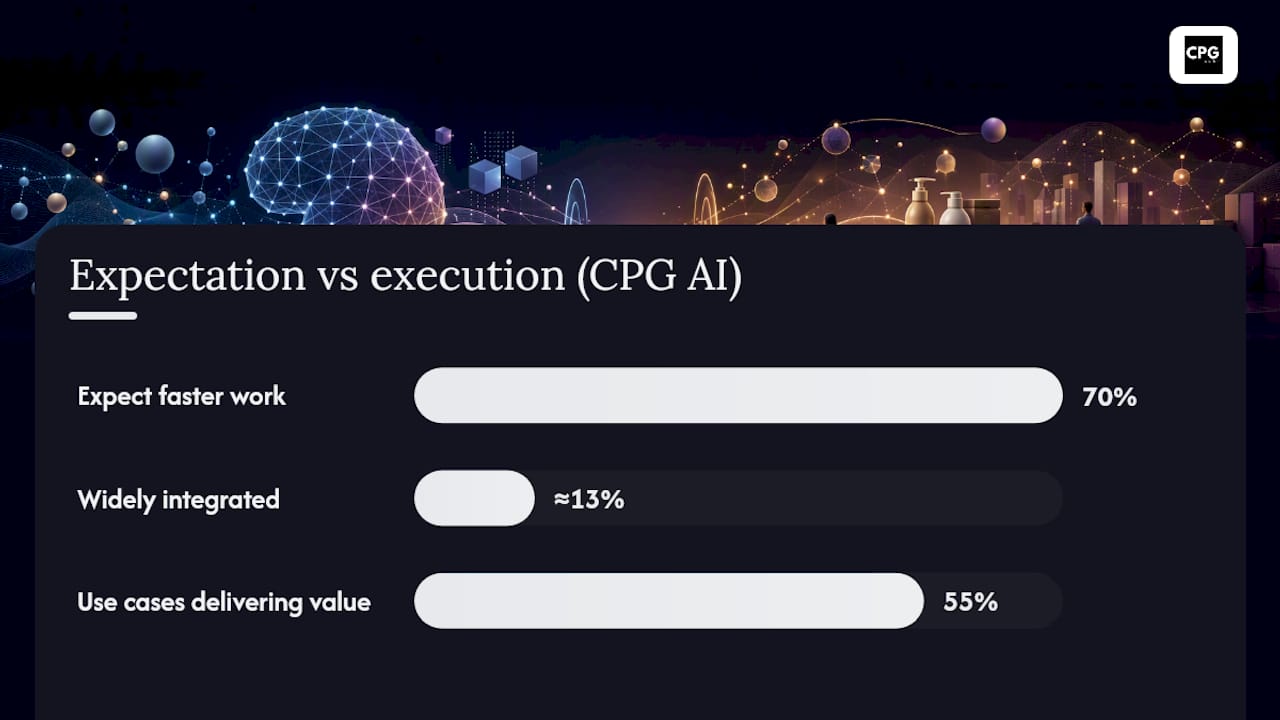
Ask ten CPG marketing leaders whether AI is delivering, and most will say yes, in theory. Ask them if it is running at scale across their organization, and the answer changes fast. BCG's research found that 70% of CPG marketing leaders expect generative AI to speed up their work, yet only about 13% report it is widely integrated into daily workflows. That gap between expectation and execution is the defining feature of AI adoption in this category right now.
The gap is not really about the technology. It is about operating models built for quarterly campaign cycles trying to absorb tools that operate in real time. Most marketing organizations still route creative through the same approval chains, still brief agencies the same way, and still measure success on the same 90-day cadence they used a decade ago. Layering AI onto that structure without changing anything else produces incremental gains at best.
The upside for companies that do rewire their operations is substantial. BCG estimates that scaling relevant AI initiatives across the demand value chain can add 220 to 350 basis points of cumulative EBIT. Infosys found that 55% of AI use cases in CPG generate tangible business value, with marketing, product development, and loyalty optimization ranking among the highest-value applications. McKinsey's analysis goes further, estimating that generative AI can add 15% to 40% of incremental value on top of what traditional AI and analytics already produce, provided companies take a focused portfolio approach rather than chasing every use case at once.
There is also a newer wrinkle worth understanding before you build a roadmap: agentic AI. EY defines agentic AI as goal-directed, adaptive systems that can access tools and take action on their own, rather than simply generating text or predictions for a human to act on. That distinction matters for marketing specifically:
- A traditional AI model might flag a demand spike; an agentic system could automatically adjust a media bid or trigger a replenishment order.
- Agentic tools raise the governance bar because they act, not just recommend, which means data audits and approval boundaries need to happen before deployment, not after.
- Most CPG marketing organizations are still in the recommendation phase of AI maturity, which means the operating-model work described later in this article needs to happen now, before agentic tools become standard.
Stat to watch: the 70% versus 13% expectation-execution gap from BCG is the single clearest signal that the constraint on AI value in CPG marketing is organizational, not technical.
Top AI Use Cases That Move the Marketing Needle
Not every AI use case deserves equal investment. Some move core KPIs within a quarter; others are interesting experiments that rarely justify the resourcing. Here is a prioritized list based on where the evidence shows real commercial impact, ranked roughly by speed to ROI.
-
Consumer insights and dynamic segmentation. AI models that pull together purchase history, social sentiment, and search behavior into a unified consumer view can cut research-to-insight time from weeks to days. This use case directly moves the KPI of campaign relevance and speeds up how fast a brand can react to an emerging trend rather than discovering it after a competitor already has. A consumer research approach built on AI also feeds every other use case on this list, since segmentation quality determines how well personalization and media targeting perform downstream.
-
Demand sensing and promotion optimization. Machine learning models that forecast demand at the SKU and store level catch stockouts and overstock situations days before a traditional forecasting cycle would. The KPIs here are on-shelf availability, lost-sales reduction, and promotional ROI. Brands running these models well can reallocate trade spend mid-cycle instead of waiting for a post-mortem review three months later.
-
Creative generation and localization. Generative AI paired with digital twins lets teams produce dozens of creative variants and adapt them for regional markets without rebuilding assets from scratch each time. Nestlé, Unilever, and Mondelēz have reported meaningful reductions in both product development time and creative production cost using these tools. The KPIs to track are time-to-market for campaigns and cost per asset, both of which tend to drop sharply once a team moves past the pilot stage. This is also where differentiation on shelf starts to compound, since faster creative cycles mean more room to test what actually resonates.
-
Media planning and ROI simulation, including retail media. AI-driven media mix models can simulate spend allocation across channels, including the retail media networks that now sit at the center of digital shelf strategy, before a single dollar goes out the door. The KPI shift here is advertising and promotion efficiency alongside incremental sales lift, since simulation catches wasted spend that would otherwise only surface in a quarterly review.
-
Personalization and loyalty optimization. Once segmentation and data infrastructure are solid, AI can personalize offers, content, and loyalty program mechanics at an individual level rather than a segment level. Retention and customer lifetime value are the KPIs that move, and this use case tends to compound in value the longer a brand runs it, since the model keeps learning from new purchase signals.
Pro Tip: Do not start with creative generation, even though it is the flashiest use case. Start with consumer insights and demand sensing first. Every other use case on this list performs better when it is built on clean, current data about who your consumers are and what they are actually buying right now.
Shopper behavior data backs up why the channel mix matters here too. Shopify's research notes that in-store purchases still account for a significant portion of CPG sales, even as digital and direct-to-consumer channels grow. Any AI use case that only optimizes for online conversion while ignoring in-store execution is solving half the problem.
Rewiring Marketing Operations to Actually Use AI
The technology rarely fails. The organization around it does. BCG's finding that only 13% of CPG marketers have AI widely integrated, despite 70% expecting it to help, traces directly back to operating models that were never rebuilt to support AI-speed decision-making.
The fix starts with a structural principle: centralize standards, localize execution. Brand safety rules, data governance policies, and model evaluation criteria should live in one place and apply consistently. Actual campaign execution, regional creative adaptation, and local media buying should stay close to the market that understands its own consumers best. Trying to centralize everything kills the speed advantage AI is supposed to deliver. Decentralizing standards creates brand risk and duplicated work.
Three roles tend to separate organizations that scale AI from those stuck running permanent pilots:
- An AI orchestrator who owns the prioritization queue, decides which use cases get resourced, and tracks value delivery across the whole marketing function rather than one campaign at a time.
- A science and engineering lead who manages model performance, data pipelines, and the technical debt that accumulates when pilots get rushed into production.
- An art and brand owner who reviews AI-generated creative against brand guidelines and has authority to reject outputs that pass a quality bar technically but miss the brand's voice.
Without that third role specifically, teams end up either rejecting AI creative wholesale out of caution or approving inconsistent work because nobody owns the judgment call.
Upskilling has to run on a separate track from tool rollout. Prompting technique, basic data literacy, and knowing how to monitor a model for drift are now baseline marketing skills, not specialist IT knowledge. A practical infrastructure guide is a useful reference point for teams building this out, since the technical requirements and the skills requirements tend to get planned separately when they should be planned together.
On the build-versus-partner question, the general rule holds up well: insource the use cases tied to your core competitive advantage, and partner for everything else. A legacy brand modernizing its portfolio faces a slightly different calculus, since heritage positioning has to survive the transition, not just the technology stack.
Pro Tip: Embed your brand rules directly into the model's prompting layer or content filters before creative generation starts, not after. Teams that build a blocking checklist the AI output must pass before human review cut rework and legal review time significantly, according to reported practitioner experience.

A Practical Roadmap: Prioritize, Pilot, Measure, Scale
Most AI initiatives in CPG marketing die in pilot purgatory, running forever without a clear decision to scale or kill them. A tighter process fixes that.
Start with prioritization using a simple value-versus-effort rubric. Score each candidate use case on expected commercial impact and on implementation complexity, then rank by ratio, not by impact alone. BCG's own recommendation is to focus on a narrow set of commercial priorities, such as idea-to-market velocity, demand sensing, or retail availability, rather than spreading investment across a long list of interesting but lower-impact ideas.
- Define the pilot before touching any tool. Every pilot needs a specific hypothesis ("AI-generated regional creative variants will lift click-through rate by X in market Y"), not a vague goal like "test generative AI for creative."
- Specify the data inputs up front. That means customer IDs, purchase history, and retail signals, along with the preprocessing steps needed to get that data model-ready. Data quality gaps surface here, not later, when they are more expensive to fix.
- Set a fixed test window. A minimum viable pilot should run four to eight weeks, long enough to see a real signal, short enough that the organization does not lose patience or context.
- Agree on three success metrics before launch. Conversion lift, asset production speed, and forecast accuracy are common choices, but the specific metrics matter less than agreeing on them in advance and refusing to move the goalposts mid-pilot.
- Build in a human review workflow from day one. This is not a temporary safety net to remove once the model proves itself. It is a permanent part of how the pilot runs, since even mature AI deployments keep a human checkpoint on brand-sensitive outputs.
On the tech and data side, a few non-negotiables show up repeatedly across successful pilots:
- A functioning consumer 360 view, even a rough one, since most use cases depend on unified customer data.
- API connectors into existing retail and e-commerce platforms rather than manual data exports.
- A managed service or MLOps arrangement clear enough that nobody is manually retraining models in a spreadsheet six months in.
- Clear ownership of the monitoring cadence, so model drift gets caught during a scheduled review, not during a customer complaint.
Scaling decisions should hinge on pre-agreed thresholds, not enthusiasm. McKinsey's research on this point is blunt: pilots that embed evaluation metrics and scale rules from day one reach scale faster than pilots that treat measurement as an afterthought bolted on once someone asks for results. Once a pilot clears its threshold, scaling means automating the workflow, embedding it into standard marketing operations rather than running it as a side project, and setting a recurring KPI review cadence, typically monthly for the first two quarters and quarterly after that.
Risks and Governance: Keeping AI Brand-Safe
Speed without guardrails is how AI programs end up in a headline nobody wanted. The good news is that the controls that matter most are lightweight enough to implement without slowing pilots to a crawl.
Data quality and bias control come first. Run a data audit before any model goes live, tracking where inputs originate and whether the training data represents your full consumer base rather than a convenient subset. EY's guidance on agentic systems is worth repeating here: rigorous data audits and governance need to happen before deploying agents with any ability to take action, not after something goes wrong.
- Run a data lineage check quarterly, tracing where key inputs originate and how they get transformed before reaching a model.
- Sample AI-generated creative against brand guidelines before it reaches a media buy, not after.
- Build consent and privacy handling around first-party data and hashed identifiers, since cookieless signals are now the default rather than the exception.
- Keep a human-in-the-loop checkpoint on any output tied to a claim, comparison, or regulated category language.
- Set an escalation path so a flagged output has a clear owner within hours, not days.
Governance reality check: BCG's 13% widespread-integration figure is not just an adoption statistic. It also reflects how many organizations have not yet built the governance muscle to trust AI outputs at scale, which is arguably the bigger constraint on that number moving up.
A Practitioner's View on Running Fast AI Pilots
Running pilots inside real CPG organizations tends to expose the same pattern: the technology works faster than the org can absorb it. Cpgagent's approach to this starts with narrow, time-boxed tools rather than open-ended transformation projects. Persona research tools like PersonaForge and validation tools like Launch Validator are built to answer one question quickly (who is this product for, and will it sell) rather than to run an endless discovery phase.
- Rapid persona and positioning work typically runs in days, not the weeks a traditional research cycle takes.
- Launch validation gives a go or no-go signal before a brand commits full production and media budget.
- Fractional CMO and growth advisory plug directly into these pilots, giving marketing leaders a decision-maker on point without a full-time executive hire.
Speed matters here because the biggest cost of AI pilots is rarely the tool. It is the months lost to a slow decision.
Data Collection Challenges Unique to CPG Marketing
CPG data is messier than most categories. Purchase data fragments across retailers, distributors, and e-commerce platforms, each with its own format and refresh schedule. A single SKU can show up under different identifiers depending on the retailer, which breaks segmentation models before they even start.
The fix is less about better AI and more about better plumbing. Standardizing product identifiers across retail partners before feeding data into any model prevents a huge share of downstream errors. Automated competitive intelligence tools can help by continuously reconciling market signals instead of relying on quarterly manual pulls that are outdated the moment they land.

Retail media data adds another wrinkle: platforms rarely share raw data, only aggregated performance metrics, which limits how granular a personalization model can get. Brands that negotiate deeper data-sharing terms with retail partners, or that build strong first-party data programs to compensate, tend to get materially better AI outputs than those relying purely on third-party retail dashboards.
Seasonality and promotional cycles also distort training data if a model is not built to account for them. A demand forecasting model trained mostly on non-promotional periods will misfire badly during a holiday surge unless promotional history gets weighted deliberately into the training set. This is one of the more common, and more preventable, failure points in CPG-specific AI deployments.
What Comes Next for AI in CPG Marketing
Agentic AI is the clearest near-term shift. Rather than generating a recommendation for a human to act on, these systems will increasingly take the action themselves, adjusting a media bid, triggering a reorder, or rerouting a promotion in response to real-time signals. EY's framing of agentic AI as goal-directed and tool-enabled points to a future where marketing teams manage a portfolio of autonomous agents rather than a stack of dashboards.
Retail media will keep absorbing a larger share of AI investment, since it sits at the intersection of first-party data, real-time bidding, and measurable sales attribution, three things AI models handle well. Expect more marketing teams to treat retail media optimization as a core AI use case rather than a specialized side function handled by a separate team.
Multimodal generative models, ones that handle text, image, and video generation together rather than separately, will likely compress creative production timelines further, particularly for the regional localization work that currently eats up a disproportionate share of creative budgets. The organizations positioned to benefit fastest will be the ones that already built the data infrastructure and governance habits described earlier in this article, since new model capability without that foundation just produces faster mistakes.
Expect regulatory attention to increase as well, particularly around AI-generated claims in regulated categories like food and beverage. Brands that build claim-verification checkpoints into their creative workflow now will adapt to new rules far more easily than those bolting on compliance after the fact.
What to Start This Quarter
If you take one thing from this, start with a demand sensing or consumer insight pilot, not a creative generation pilot. Insight quality compounds into every other use case. Give it a real data foundation, a four to eight week window, and three metrics you will not renegotiate midway through. My one caution: do not let creative automation outrun your brand governance. A fast, off-brand asset is still a mistake, just a faster one.
— Matthew
Getting Started With Cpgagent
A specialized platform provides tools aligned with the priorities covered above: consumer insight and persona work, launch decision validation, media planning, and retail audit tools supporting demand sensing and retail media use cases. Fractional leadership and growth advisory services offer decision-making support alongside software tools.
Instead of a long discovery phase, Cpgagent deploys tools and expertise that integrate into an existing tech stack, aiming for pipeline contribution and margin impact rather than another slide deck. If your marketing organization is ready to move past the pilot stage described earlier, the Cpgagent platform is the place to see which tools fit your current roadmap and start a pilot on your own timeline.
Sources
- The AI-Forward CPG Marketing Organization
- Agentic AI: the future of autonomous consumer products (EY)
- AI in CPG: Business Value Radar 2025 (Infosys)
- The real value of AI in CPG (McKinsey)
FAQ
Is AI actually ready for CPG marketing, or is this mostly hype?
AI is ready for specific, well-defined use cases like demand sensing, consumer segmentation, and creative generation. The gap is organizational: BCG found only about 13% of CPG marketers have it widely integrated despite 70% expecting speed gains, which points to execution, not the technology itself, as the constraint.
Which AI use case should a CPG marketing team try first?
Start with consumer insights and demand sensing before creative generation or personalization, since those use cases depend on the same clean, current data that insight and demand-sensing pilots establish first.
How long should a first AI marketing pilot run?
A minimum viable pilot typically runs four to eight weeks with three pre-agreed success metrics, a defined data input list, and a human review workflow built in from the start rather than added later.
What is agentic AI and why does it matter for marketing?
Agentic AI refers to goal-directed systems that can access tools and take action on their own, such as adjusting media spend automatically, rather than just producing a recommendation for a human to execute. EY recommends rigorous data audits and governance before granting these systems execution privileges.
Can a smaller CPG brand realistically use AI tools like larger competitors do?
Yes. Tools built for rapid, narrow pilots, such as persona research and launch validation platforms available through Cpgagent, let smaller teams test specific use cases in days rather than committing to a multi-month enterprise AI transformation.