
TL;DR:
- Most CPG brands fail because they lack meaningful differentiation rooted in operational choices rather than surface messaging. Building brand advantage relies on strategic decisions like product design, audience focus, and distribution models that are tough to imitate. Validating these choices with frameworks like the CPG Launch Validator ensures sustainable positioning before significant investment.
Most CPG brands don't fail because of bad products. They fail because nothing about them is worth remembering. The shelf is a brutal equalizer, and cpg brand differentiation examples that actually work share one thing in common: they're built on structural choices, not surface-level messaging. Whether you're managing a legacy portfolio or launching a challenger brand, understanding the specific dimensions that separate category leaders from category noise is what separates strategy from guesswork. This article breaks down the real examples, the real mechanisms, and the frameworks that let you pressure-test your own positioning before you spend a dollar on media.
Table of Contents
- Key takeaways
- 1. CPG brand differentiation examples that lead with product design
- 2. Purpose-led differentiation that goes beyond messaging
- 3. Audience specificity as a differentiation strategy
- 4. Distribution and business model as competitive moat
- 5. Brand voice as a differentiation lever
- 6. Partnership-driven differentiation
- 7. Choosing the right differentiation strategy for your context
- My honest take on what separates real differentiation from theater
- Validate your differentiation before the shelf does it for you
- FAQ
Key takeaways
| Point | Details |
|---|---|
| Structural beats cosmetic | Real differentiation comes from operational choices, supply chain design, and product architecture, not just packaging refreshes. |
| Audience specificity wins | Brands that say no to mass appeal and commit to a defined audience build loyalty competitors can't easily replicate. |
| Voice is a brand asset | Consistent, authentic brand personality across every touchpoint creates emotional preference that product parity can't erase. |
| Business model is a moat | Distribution and subscription innovations create defensible advantages that price-matching alone cannot overcome. |
| Validate before you launch | Using a structured framework like the CPG Launch Validator helps identify differentiation gaps before they become expensive mistakes. |
1. CPG brand differentiation examples that lead with product design
The most immediate form of differentiation is the product itself, specifically how it looks, works, and communicates value before a single word of copy is read.
Dyson's cyclone technology is the textbook case. By making the engineering visible through transparent casing, Dyson turned a vacuum cleaner into a demonstration of superiority. Consumers could see the mechanism working. The premium price became credible because the product explained itself. That's not just good design. It's a brand positioning decision executed at the product level.
Graza did something similar in a far less glamorous category. Olive oil is a commodity, but Graza's squeeze bottle format changed consumer behavior by making usage intuitive. The "Drizzle" and "Sizzle" naming convention removed decision friction entirely. Shoppers didn't need to read the label. They knew exactly what to do. That's what visible product design accomplishes: it reduces cognitive load and increases trial likelihood.
- Packaging that communicates function, not just aesthetics
- Form factor changes that alter how consumers interact with the product
- Engineering transparency that signals quality without requiring explanation
- Behavior-based naming that simplifies the purchase decision
Pro Tip: Before you invest in a packaging redesign, ask whether the new format changes consumer behavior or just consumer perception. Behavioral change is defensible. Perception alone is not.
2. Purpose-led differentiation that goes beyond messaging
Purpose has become one of the most misused words in CPG marketing. Brands announce values in press releases and then contradict them in every operational decision. The brands that actually win on purpose make it structural.
Patagonia is the obvious example. Its environmental commitment isn't a campaign. It shows up in product repair programs, supply chain sourcing, and a willingness to tell customers not to buy new products. That coherence is what makes it credible and what makes it nearly impossible to copy without a total business model overhaul.
Mutti is the less-cited but arguably more instructive case for CPG specifically. The brand's 125-year focus on product integrity includes sourcing only Italian tomatoes, a 24-hour field-to-packaging constraint, and a deliberate refusal to compete on promotional discounting. That last point matters enormously. Overemphasis on promotional volume erodes premium positioning, and Mutti uses marketing mix modeling to protect its equity rather than chase short-term volume spikes.
- Operational decisions that reflect stated values, not just marketing copy
- Pricing discipline that protects brand equity over time
- Supply chain choices that are visible and verifiable by consumers
- Long-term commitment to a single quality standard across markets
Pro Tip: Map your brand's stated values against your last three operational decisions. If they don't align, you don't have a purpose strategy. You have a tagline.
3. Audience specificity as a differentiation strategy
One of the clearest patterns across successful cpg brand cases is that the brands with the sharpest positioning said no to broad appeal early and often. Trying to be relevant to everyone is the fastest way to become memorable to no one.
Monzo built its banking product specifically for digitally native consumers who found traditional banking interfaces frustrating. It didn't try to convert legacy users. It built entirely around the behaviors of a defined segment, and that focus created a product experience that felt genuinely different rather than incrementally improved.
The same pattern plays out across CPG categories. Disruptor brands account for roughly half or more of growth in snacks, supplements, personal care, and shaving. What they share is a willingness to serve a specific audience with specific unmet needs rather than chasing category-average positioning.
- Define the audience by behavior and belief, not just demographics
- Use digital tools and community feedback to sharpen audience fit iteratively
- Resist the pressure to expand positioning before the core audience is locked
- Treat audience specificity as a filter for every product and communication decision
4. Distribution and business model as competitive moat
Most brand strategists think about differentiation in terms of product or messaging. The most defensible examples of cpg differentiation often come from the business model itself.
Dollar Shave Club didn't invent a better razor. It invented a better way to buy one. The direct-to-consumer subscription model bypassed retailers entirely, giving the brand control over pricing, customer data, and the full purchase experience. Brands that control the end-to-end customer experience through unique distribution models gain advantages that are genuinely hard to replicate because they require structural change, not just budget.
Ryanair is the non-CPG case that every CPG strategist should study anyway. Its low-cost position is built on operational efficiency: secondary airports, unbundled fees, high aircraft utilization. Competitors who tried to match the price without matching the cost structure simply lost money. The lesson for CPG is direct: if your differentiation strategy is purely cosmetic, a better-funded competitor can copy it in a quarter.
| Differentiation type | Example | Defensibility | Risk |
|---|---|---|---|
| Product design | Dyson, Graza | High with IP or behavior lock-in | Requires ongoing R&D investment |
| Purpose and values | Mutti, Patagonia | High with operational alignment | Slow to build, easy to lose credibility |
| Business model | Dollar Shave Club | Very high with structural change | High upfront investment |
| Price position | Ryanair model | High only with cost structure | Dangerous without operational efficiency |
| Brand voice | Innocent Drinks | Medium, requires consistency | Easy to copy superficially |
5. Brand voice as a differentiation lever
In categories where product differences are minimal, voice becomes the product. Innocent Drinks built category-defining preference in the smoothie market not through a superior formula but through a consistently warm and conversational tone that made the brand feel like a person rather than a manufacturer.
What made it work was consistency. The same voice appeared on the packaging, in customer service responses, on social media, and in advertising. Competitors noticed and tried to copy the format. What they couldn't copy was the authenticity, because Innocent's voice was built into the culture of the organization, not applied as a stylistic overlay by an agency.
For CPG brand strategists, the practical takeaway is this: voice differentiation only works when it's consistent enough to be predictable and specific enough to be unmistakable. Generic warmth is not a strategy. Specific, ownable personality is.
- Audit every consumer touchpoint for voice consistency, not just advertising
- Define voice with behavioral examples, not adjectives like "friendly" or "authentic"
- Build voice guidelines that constrain as much as they enable
- Test voice consistency with consumers who don't know your brand yet
6. Partnership-driven differentiation
Strategic partnerships are an underused differentiation lever in CPG, particularly for brands trying to enter adjacent categories or reach new audiences quickly.
Müller's collaboration with Myprotein is a concrete example. The partnership generated £36 million in sales with a 5% CAGR over three years, making it the second-fastest growing brand in its category by 2025. For a brand facing category decline, that kind of structural partnership created a new differentiation story without requiring a full product line rebuild.
The mechanism matters here. Müller borrowed credibility from Myprotein's audience while Myprotein gained distribution through Müller's retail relationships. Neither brand could have achieved the same result independently at the same speed. That's what makes partnership differentiation particularly attractive for mid-sized CPG brands with strong distribution but weakening relevance.
7. Choosing the right differentiation strategy for your context
Not every differentiation approach works for every brand. The right strategy depends on category dynamics, resource capability, and where you are in the brand lifecycle.
New product lines more than double the likelihood of hitting 20% or more revenue growth, which makes product-led differentiation the highest-leverage move for brands with genuine innovation capability. But if your product is genuinely parity with competitors, investing in a purpose or voice strategy may deliver faster returns.
The biggest risk in CPG branding is trying to differentiate across too many dimensions simultaneously. A brand that claims superior product quality, the strongest environmental values, the lowest price, and the most entertaining voice is credible on none of them. Saying no and staying focused is what builds sustainable advantage. Pick one or two dimensions where you can build a structural lead, and let everything else serve those choices.
Disruptors succeed by pairing clear purpose with agility, digital-first marketing, and iterative product development co-created with communities. That's a model any brand can study, even if they can't replicate it wholesale.
My honest take on what separates real differentiation from theater
I've reviewed a lot of brand positioning work, and the pattern that frustrates me most is the cosmetic refresh disguised as strategy. A new color palette, a refreshed logo, a purpose statement written by a consultant. None of it moves the needle because none of it changes what the brand actually does or who it actually serves.
The brands in this article that I find genuinely instructive are the ones that made hard operational choices. Mutti said no to promotional discounting for over a century. Dollar Shave Club built an entirely new distribution infrastructure. Graza changed the physical form of a commodity product. These weren't messaging decisions. They were business decisions that then became brand stories.
What I've found is that most marketing teams know what their differentiation should be. The problem is they haven't pressure-tested it against real criteria. Is it actually distinctive in the category? Does it align with consumer behavior? Is it defensible against a well-funded competitor? Can it be executed consistently across every touchpoint?
That's exactly why I lean on the CPG Launch Validator when evaluating product ideas. It forces you to assess your positioning against the eight dimensions that actually determine CPG success or failure, before you've committed budget to a launch that's built on assumptions.
— Matthew
Validate your differentiation before the shelf does it for you
If the examples in this article have surfaced questions about your own brand's positioning, that's exactly the right response. The next step isn't another workshop. It's a structured assessment.
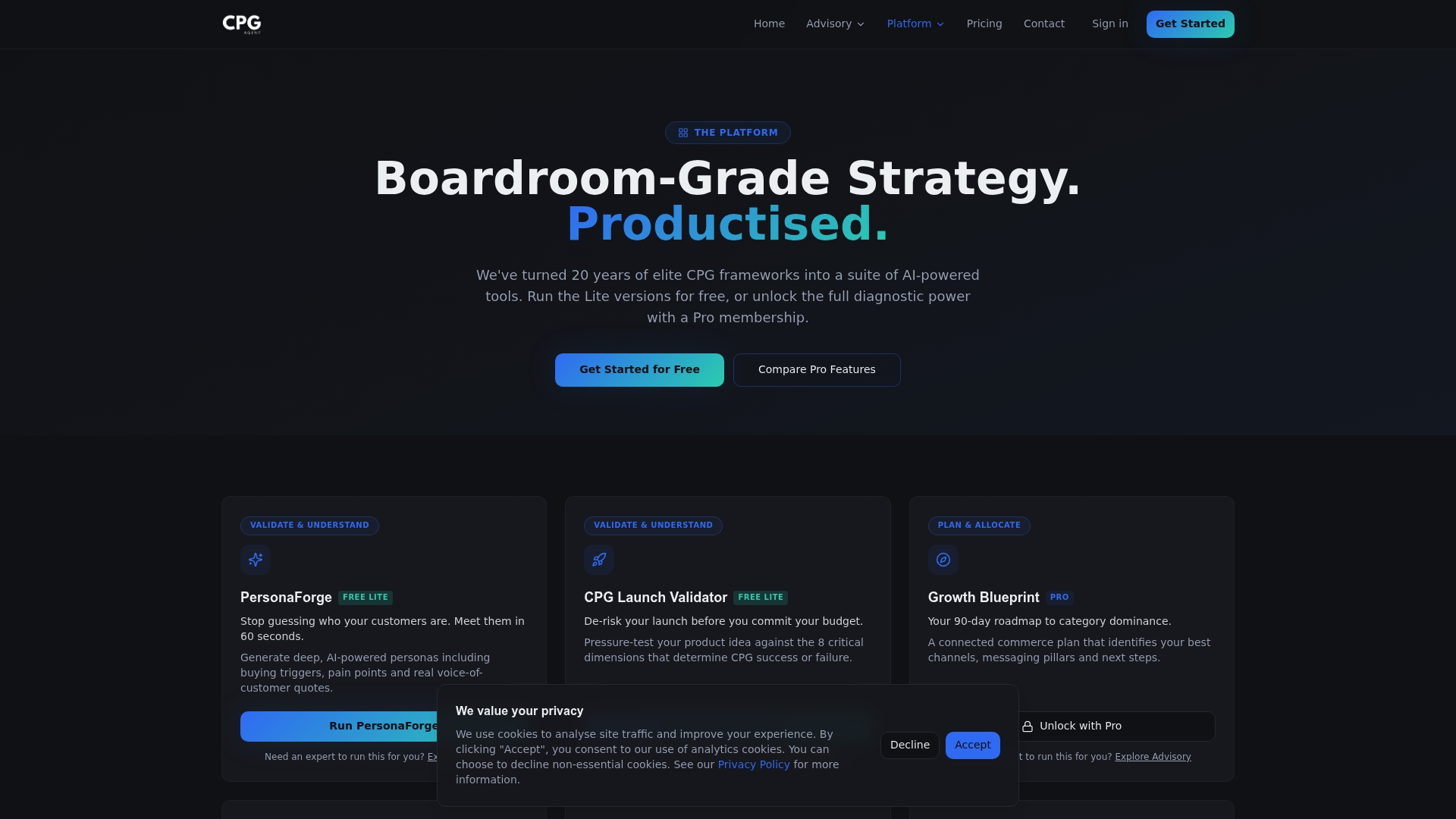
Cpgagent's CPG Launch Validator is built specifically for this moment. It pressure-tests your product idea against eight critical dimensions that determine whether a CPG launch has genuine competitive legs or a positioning gap that will cost you at retail. The tool gives you rapid, data-backed feedback so you can fix the weak points before they become expensive lessons. Whether you're validating a new SKU or reassessing a legacy product line, the Cpgagent platform gives you the analytical foundation to make differentiation decisions with confidence rather than instinct.
FAQ
What makes a CPG brand differentiation strategy defensible?
Defensible differentiation is built on structural choices like supply chain design, distribution models, or product architecture, not messaging alone. Competitors can copy a tagline overnight but cannot easily replicate a decade of operational discipline.
How do disruptor brands differentiate in crowded CPG categories?
Disruptor brands typically combine distinctive product innovation, digital-first marketing, and tight audience focus to capture growth. Research shows disruptors account for roughly half or more of growth in categories like snacks, supplements, and personal care.
Can brand voice alone differentiate a CPG product?
Voice can create strong emotional preference in parity categories, as Innocent Drinks demonstrated in the smoothie market. However, it only works when the voice is consistent across every touchpoint and specific enough to be unmistakable rather than generically warm.
What is the biggest mistake CPG brands make with differentiation?
The most common mistake is trying to differentiate across too many dimensions at once, which dilutes credibility on all of them. Focusing on one or two dimensions where you can build a structural lead is what creates durable competitive advantage.
How does the CPG Launch Validator help with brand differentiation?
The CPG Launch Validator assesses your product idea against eight critical success dimensions, helping you identify positioning gaps before launch. It replaces assumption-based planning with data-backed analysis so you can make sharper go-to-market decisions.