

TL;DR:
- Automated competitive intelligence continuously tracks and analyzes market activity to provide real-time insights. It replaces manual audits with automated monitoring, alerting teams to pricing shifts, launches, and consumer sentiment. This shift from periodic to continuous analysis enables faster, more efficient decision-making in consumer goods marketing.
Automated competitive intelligence is the AI-powered process of continuously tracking, collecting, and analyzing competitor market activity to deliver timely insights for marketing decisions. For consumer goods teams, this means replacing periodic manual audits with always-on monitoring that surfaces pricing shifts, product launches, and consumer sentiment in real time. Platforms like Cpgagent are built specifically for CPG and FMCG brands that need this kind of speed. The industry term for the broader discipline is competitive intelligence, or CI. Automated CI is the modern execution layer that makes CI continuous rather than episodic.
How does automated competitive intelligence work?
Automated CI follows a four-stage lifecycle: search, extract, analyze, and deliver. Each stage runs continuously, feeding the next without human intervention between cycles.
Stage 1: Search and monitor
AI agents scan a defined watchlist of 5–15 prioritized competitors across web properties, news feeds, social platforms, and regulatory filings. The scope is set once and updated as your competitive set evolves. Agents run on schedules ranging from hourly to daily depending on the signal type.

Stage 2: Extract structured data
Raw web pages are noisy. Modern CI systems avoid the instability of visual DOM scraping by pulling data from hydration JSON islands embedded in competitor sites. This method captures structured pricing, product, and content data accurately even on JavaScript-heavy pages. The result is clean, consistent data that supports reliable change detection over time.
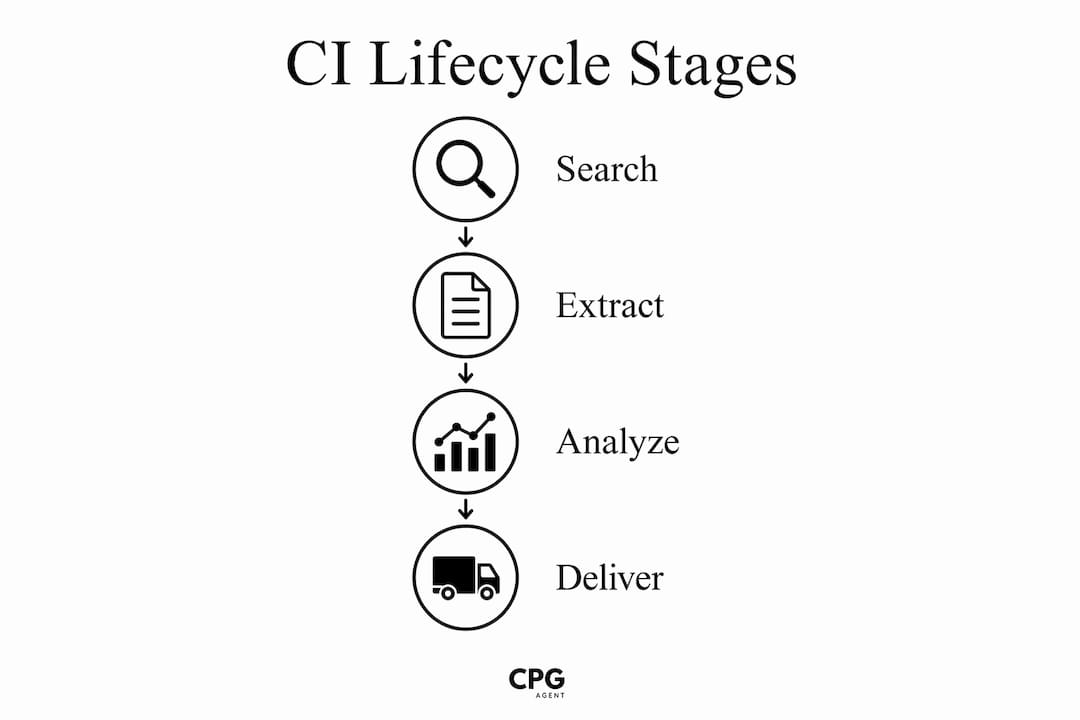
Stage 3: Analyze and synthesize
A modular architecture pairs specialized agents for different signal types, such as news, pricing, and social, with a large language model synthesis layer. This multi-agent approach resolves conflicting signals and produces coherent, context-aware summaries rather than raw data dumps. The output is a ranked view of what changed, why it matters, and how urgent the response should be.
Stage 4: Deliver alerts and reports
Automated CI systems push daily pricing changes and weekly news summaries directly to team channels via Slack or Teams webhooks. Battlecards update automatically. Reports land in dashboards without anyone pulling data manually. The entire cycle, from monitoring to delivery, runs without analyst intervention.
Pro Tip: Set your watchlist to include at least two indirect competitors alongside your direct rivals. Indirect competitors often signal category shifts earlier because they are experimenting at the edges of your market.
Comprehensive competitor teardowns covering SEO, pricing, tech stack, and social signals can now be produced in 60 seconds per competitor. That replaces research workflows that previously took days.
What are the advantages over traditional competitive analysis?
The operational gains from automation are measurable and significant.
- Speed. AI-driven automation reduces research timelines by 16% and increases operational readiness by 60% compared to manual processes. Teams respond to market moves faster because the data is already there.
- Efficiency. Survey programming and research processing effort drops by up to 90% with automated systems. Analysts shift from data collection to interpretation and decision support.
- Data freshness. Static quarterly reports become obsolete the day they are published. Always-on monitoring replaces them with a living view of the competitive set.
- Trend detection. Automation enhances traditional research by delivering always-on, unsolicited consumer feedback from social data. This surfaces rising cultural moments and product gaps before they appear in formal studies.
- Coverage breadth. Automated market research APIs can simultaneously ingest sources like Crunchbase, LinkedIn, TechCrunch, and SEC filings to produce structured competitive briefs ready for direct integration into internal systems.
"Automation enhances, rather than replaces, traditional qualitative research by providing always-on, unsolicited consumer feedback from social data, enabling earlier detection of trends and product gap identification."
The shift from periodic to continuous intelligence is not just a workflow improvement. It changes the strategic posture of a marketing team from reactive to proactive. When you know about a competitor's price cut the same day it happens, you have options. When you find out three weeks later in a sales review, you are already behind.
For CPG teams specifically, social listening for CPG trends integrated into automated CI workflows adds a consumer voice layer that pure competitor monitoring misses. Shelf performance and consumer sentiment move together, and catching that connection early is a real advantage.
What challenges should marketers avoid when implementing automated CI?
Automation creates new failure modes if the implementation is not thoughtful. The most common mistakes are avoidable with the right architecture decisions upfront.
- Tool sprawl. Fragmented use of multiple vertical tools creates data silos and reporting inconsistencies. Successful teams adopt unified infrastructures with modular components for different intelligence signals, consolidating outputs into one reporting layer.
- Poor data provenance. Tools that rely on scraped clickstream data produce unreliable traffic and audience estimates. Data provenance from proprietary real-user panels is the single most important factor when selecting CI tools. Budget decisions made on bad data are worse than no data.
- Analysis paralysis. Receiving hundreds of raw change alerts per day is not intelligence. It is noise. Effective systems use weighted impact scoring to surface only changes above a defined urgency threshold, keeping team attention on market-threatening signals.
- Ignoring qualitative context. Automated data tells you what changed. It rarely tells you why. Pairing automated outputs with qualitative research, customer interviews, or sales team feedback produces intelligence that is actually usable in strategy sessions.
- Static watchlists. A competitive set defined in january will be outdated by june. Watchlists and alert criteria need quarterly reviews to stay relevant as the market shifts.
Pro Tip: Before selecting any CI tool, ask the vendor directly: does your traffic data come from a real-user panel or from scraped clickstream data? The answer determines whether you can trust the numbers for budget planning.
Building AI marketing infrastructure with a unified data layer from the start prevents the tool sprawl problem from developing in the first place. Retrofitting a fragmented stack is significantly harder than building it right initially.
How can CPG teams integrate automated CI into strategic workflows?
Automated CI delivers the most value when its outputs connect directly to the decisions your team makes every week. Isolated reports that sit in a shared drive do not change behavior. Structured data flows that feed into CRM systems, campaign planning tools, and executive dashboards do.
The practical integration points for consumer goods marketing teams include:
- Pricing and promotion responses. Automated alerts on competitor price changes trigger internal review workflows within hours rather than days. Teams can test promotional responses faster and with more confidence.
- Campaign benchmarking. Automated monitoring of competitor ad creative, messaging themes, and channel mix provides a live benchmark for your own campaign performance. You see where you are winning and where you are losing share of voice in real time.
- Go-to-market validation. Feeding CI data into go-to-market validation workflows lets teams pressure-test launch assumptions against actual competitor positioning before committing budget.
- Battlecard maintenance. Sales and retail teams need current competitive information. Automated battlecard updates tied to CI alerts keep field teams equipped without requiring marketing to manually refresh documents.
- Consumer sentiment integration. Combining automated competitor monitoring with social listening produces a dual view: what competitors are doing and how consumers are responding. That combination is more powerful than either signal alone.
| Workflow | CI input | Business output |
|---|---|---|
| Pricing response | Daily price change alerts | Faster promotional decisions |
| Campaign planning | Competitor creative monitoring | Improved share of voice |
| Launch validation | Competitor positioning data | Reduced launch risk |
| Battlecard updates | Automated change detection | Better-equipped field teams |
| Trend identification | Social sentiment feeds | Earlier category insights |
Cpgagent's platform is built to connect these workflows for CPG brands specifically. It integrates AI automation, multi-source data ingestion, and alert delivery into a single system rather than requiring teams to stitch together separate tools. For brands at any stage, from early market validation to scaling an established portfolio, that unified approach reduces the time between insight and action.
AI-powered consumer research layered on top of competitive monitoring gives CPG teams a complete picture: what the market is doing and what consumers actually want. That combination is where the real strategic advantage lives.
Key takeaways
Automated competitive intelligence is the most direct path from raw market data to decisions that improve shelf performance and margin.
| Point | Details |
|---|---|
| Four-stage CI lifecycle | Search, extract, analyze, and deliver runs continuously without manual intervention between cycles. |
| Data provenance matters | Choose tools backed by real-user panels, not scraped data, for reliable budget and strategy decisions. |
| Avoid analysis paralysis | Use weighted impact scoring to surface only high-urgency alerts and keep teams focused on real threats. |
| Unify your stack | Modular, unified CI infrastructure prevents data silos and produces coherent, integrated reporting. |
| Connect CI to decisions | Automated outputs must feed directly into pricing, campaign, and launch workflows to generate real business value. |
Where I think most CPG teams get this wrong
Most marketing teams I have worked with treat competitive intelligence as a research function rather than an operational one. They commission a quarterly report, review it in a slide deck, and move on. By the time the insights reach a decision, the market has already moved.
The teams that get real value from automation are the ones that wire CI outputs directly into their weekly operating rhythm. Pricing alerts go to the brand manager the same morning. Competitor launch signals feed into the next sprint planning session. Social sentiment shifts show up in the campaign brief, not the post-mortem.
The other mistake I see consistently is prioritizing tool count over data quality. A stack of five CI tools producing unreliable traffic estimates is worse than one tool with strong data provenance. The number that matters is not how many signals you are monitoring. It is how many of those signals you can actually trust enough to act on.
My honest advice: start with your three most consequential competitive questions, build automated workflows that answer those specifically, and expand from there. Trying to monitor everything at once produces noise, not intelligence. Refinement over time, with quarterly watchlist reviews and alert threshold adjustments, is what separates teams that use CI from teams that are actually guided by it.
The future of this discipline is not fully autonomous. AI agents will handle more of the data collection and synthesis, but the human analyst role shifts to framing the right questions, interpreting context, and making the judgment calls that data alone cannot make. That is a better use of analyst talent, not a replacement of it.
— Matthew
Cpgagent brings automated CI to CPG brands
Consumer goods brands that want to move from periodic research to always-on intelligence need a platform built for that specific workflow.
Cpgagent's platform combines AI automation, multi-source data integration, and structured alert delivery into a single system designed for CPG and FMCG teams. It connects competitive monitoring, consumer research, and go-to-market validation without requiring a separate tool for each function. For brands that need to act on market signals faster than their competitors, Cpgagent removes the manual steps that slow that process down. The platform is built for teams that measure success in pipeline contribution and margin, not report volume.
FAQ
What is automated competitive intelligence?
Automated competitive intelligence is the AI-driven process of continuously monitoring, extracting, and analyzing competitor data to deliver timely market insights. It replaces periodic manual research with always-on tracking across pricing, content, social, and product signals.
How long does automated CI take to produce results?
Modern CI systems can produce comprehensive competitor teardowns covering SEO, pricing, and social signals within 60 seconds per competitor. That compares to manual research workflows that previously required days of analyst time.
What data sources does automated competitive intelligence use?
Automated CI systems ingest sources including competitor websites, news feeds, social platforms, Crunchbase, LinkedIn, TechCrunch, and SEC filings simultaneously. Outputs conform to defined schemas for direct integration into CRM and dashboard systems.
How do I avoid information overload from automated CI alerts?
Use platforms that apply weighted impact scoring to detected changes, surfacing only alerts above a defined urgency threshold. This approach prevents analysis paralysis and keeps team attention on market-threatening signals rather than routine fluctuations.
Is automated competitive intelligence suitable for smaller CPG brands?
Automated CI scales to any brand size. Entry-level configurations monitor a focused watchlist of 5–10 competitors with daily alerts, while enterprise configurations handle broader market coverage with real-time delivery and deeper synthesis layers.