

AI growth hacking uses generative, predictive, and agentic AI to automate the loop between discovery and conversion, then runs experiments fast enough to find what actually works. The payoff is speed: teams that build the right data foundation see faster testing cycles and measurable lift in conversion and acquisition cost. The rest of this guide covers where to apply it, what infrastructure it requires, how to measure results, and where teams get it wrong.
TL;DR:
- AI growth hacking's impact is highest in acquisition and retention, with generative AI creating campaign variants and churn models enabling proactive engagement.
- Building a unified customer data platform and documenting brand guardrails are essential before deploying autonomous AI tools to prevent off-brand or ineffective actions.
- Starting with a small, measurable pilot focused on retention or activation provides a low-risk way to prove AI's value before scaling to full campaigns.
- Using structured workflows and spec-driven tools significantly reduces setup time and improves AI pilot success, especially when integrating with existing CRM and analytics systems.
- Proper attribution, data foundations, and governance are critical to measuring AI impact accurately and avoiding risks like noisy results or unintentional brand missteps.
Table of Contents
- What Is AI Growth Hacking, Really?
- Where Does AI Growth Hacking Actually Move the Needle?
- What Tools and Agent Patterns Should You Actually Use?
- Building AI-Ready Growth Infrastructure
- How Do You Measure the Impact of AI Growth Hacking?
- What Are the Biggest Risks in AI Growth Hacking?
- How Cpgagent Puts This Into Practice for CPG Brands
- Where Should You Actually Start? A 90-Day View
- Get Help Deploying This Without Building It From Scratch
- Sources
- FAQ
What Is AI Growth Hacking, Really?
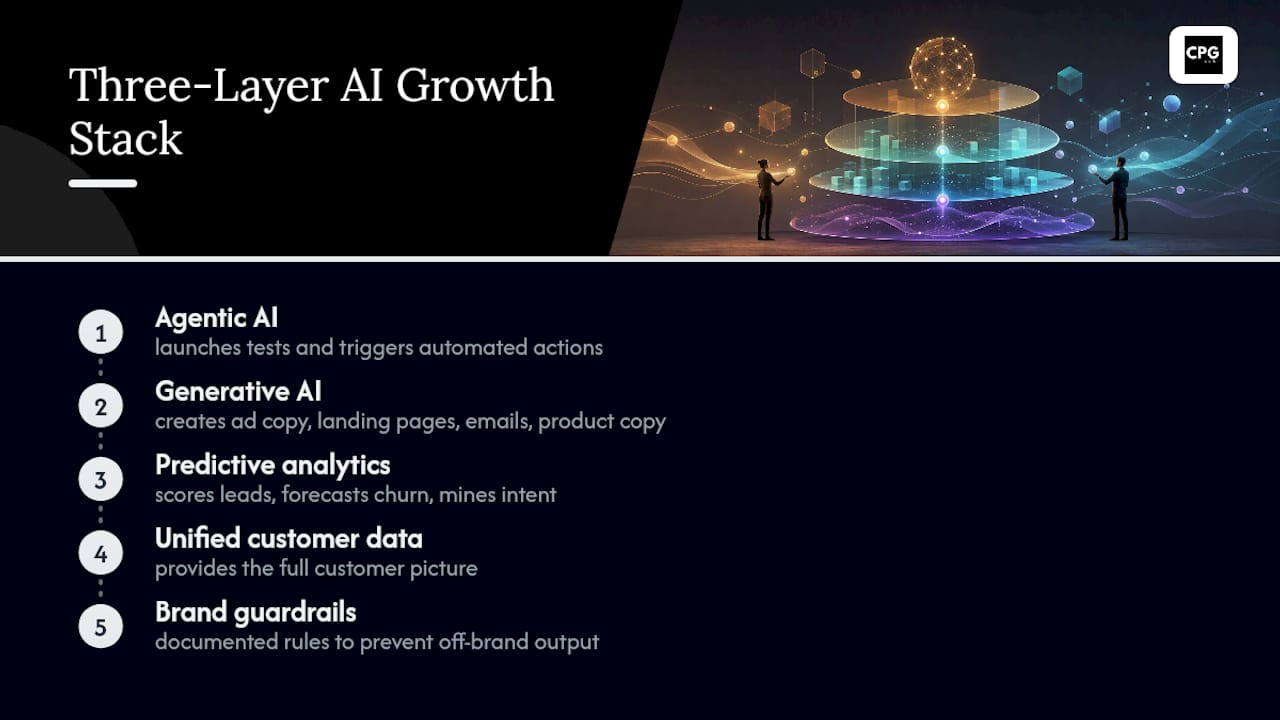
AI growth hacking is best understood as three layers stacked on top of each other, not one tool. Generative AI produces the raw material: ad copy, landing page variants, email sequences, product descriptions. Machine learning and predictive analytics sit underneath, scoring leads, forecasting churn, and mining unstructured customer data to spot intent before a human analyst would notice it. Agentic AI sits on top, taking action: launching a test, reallocating budget, triggering a win-back sequence, without waiting for a person to click "go."
That's a real departure from the old idea of growth hacking as a handful of clever hustle tactics. Those still exist, but the actual advantage now comes from building 24/7 infrastructure that automates the bridge between someone discovering your product and someone buying it, according to Google's AI-era marketing guide. A single viral tweet or growth hack doesn't scale the way an automated, always-on system does.
None of the three layers works without two things in place first: unified customer data and documented brand guardrails. Skip either one and generative AI starts producing off-brand copy, or your agent optimizes toward the wrong metric because it can't see the full customer picture. Infrastructure comes before tactics, not after.
Where Does AI Growth Hacking Actually Move the Needle?
The highest-impact use cases cluster around five stages of the funnel, and each one benefits from a different layer of the AI stack.
Acquisition. Generative models can produce dozens of creative variants for a single campaign brief in minutes, then predictive models score which ones are likely to perform before you spend a dollar on media. Startups using generative AI for go-to-market work report meaningful gains in content velocity and personalization across product-led and sales-led growth motions. Predictive audience segmentation, built on lookalike modeling, often finds pockets of high-intent buyers that manual segmentation misses entirely.
Activation and onboarding. Dynamic landing pages that swap headlines, images, and offers based on the visitor's source and behavior tend to shorten time-to-wow. A returning visitor from a retargeting ad sees a different page than a first-time organic visitor, and the system decides that in real time.
Retention. Churn prediction models flag at-risk accounts weeks before they cancel, giving you a window to intervene. Intelligent win-back campaigns, triggered automatically once a churn score crosses a threshold, tend to outperform blanket discount emails sent to everyone. Content recommendation engines keep engaged users engaged longer.
Revenue. Dynamic pricing and AI-generated upsell prompts, timed to when a customer is most likely to say yes, add revenue without adding headcount. A 50-tactic growth playbook documents conversion lifts and lower acquisition costs from properly instrumented AI campaigns, though results depend heavily on data quality and how tightly the experiment is governed.
Experimentation. This is where AI compounds its own value. Use it to generate a wider pool of test hypotheses than a small team could brainstorm alone, design the trial structure, and then run meta-analysis across dozens of small pilots instead of waiting on one big test to reach significance.
- Acquisition: creative variant generation plus predictive audience scoring
- Activation: dynamic, behavior-based landing pages
- Retention: churn prediction paired with automated win-back triggers
- Revenue: dynamic pricing and contextual upsell timing
- Experimentation: AI-assisted hypothesis generation and meta-analysis across pilots
Pro Tip: Run your first AI pilot on retention, not acquisition. Churn data is usually cleaner than top-of-funnel data, and a working win-back model gives you a fast, low-risk proof point before you touch paid media.
What Tools and Agent Patterns Should You Actually Use?
You don't need to buy ten platforms to start. Three tool categories cover almost every use case: large language models for creative and copy generation, agent platforms that execute multi-step workflows across channels, and a customer data platform (CDP) that gives every other tool a single source of truth. Skipping the CDP is the single most common reason AI pilots stall, because the agent layer has nothing reliable to act on.
Spec-driven kits are worth adopting early. A structured workflow, something like a /growthkit.specify command that turns a plain-language growth hypothesis into a defined spec, then a plan, then an executable agent task, cuts setup time dramatically compared to ad-hoc prompting. The Growth Hacking Kit is a working example of this pattern: specify the hypothesis, plan the test, then let an agent execute it against real templates instead of starting from a blank page every time.
A practical first pilot follows this sequence:
- Define one specific goal (reduce churn 10% in a segment, lift trial-to-paid conversion by a set amount).
- Confirm the data feeding the pilot is clean, unified, and accessible to whichever tool will act on it.
- Set guardrails before launch: spend caps, approval checkpoints, and a rollback plan if the agent misfires.
- Define success criteria and a measurement window up front, not after you see early results.
- Connect the pilot to your existing CRM, ad accounts, and analytics stack rather than running it in isolation.
Pro Tip: If your CRM, ad platform, and analytics tool don't already talk to each other, fix that connection before adding any AI layer. A smart agent working from disconnected data is worse than no agent at all. Cpgagent's platform is built around this exact sequencing for CPG teams that don't want to stitch it together from scratch.
Building AI-Ready Growth Infrastructure
A composable CDP, or at minimum a unified view of customer data across purchase, engagement, and support systems, isn't optional once you move past a single-channel pilot. Every layer of AI marketing, from generative content to autonomous agents, depends on a customer-data foundation and documented operational context to function safely, according to Hightouch's breakdown of the three AI marketing layers.
The brand context layer is the piece most teams skip, and it's the reason generative output so often needs heavy editing before it can ship. That layer includes an asset catalog (approved images, logos, product shots), documented voice and tone rules, and an approval workflow that routes anything customer-facing through a human before it goes live.
Governance rounds out the stack. Enterprises deploying autonomous agents without mature governance run into brand and regulatory missteps more often than teams that build in guardrails from day one, a gap several practitioner sources flag as the most common reason agentic pilots get shut down after launch. Three governance habits reduce that risk:
- Keep an audit trail of every automated action an agent takes, including what data it used to decide.
- Require human sign-off on anything touching pricing, claims, or regulated categories.
- Make agent decision logic visible to the marketing team, not just the engineers who built it.
A composable data layer plus a documented brand context isn't a nice extra step. It's the difference between an agent that scales your judgment and one that quietly drifts off-brand for weeks before anyone notices.
How Do You Measure the Impact of AI Growth Hacking?
Attribution is the part most teams get wrong, mostly because they skip the baseline step entirely.
- Record baselines before you launch anything: current conversion rate, customer acquisition cost, customer lifetime value, and time-to-wow for new users. Without this, you can't tell if a change is due to the AI intervention or just seasonal noise.
- Use a randomized holdout, a representative slice of users who don't get the AI-driven experience, so you have a defensible comparison group rather than a before-and-after guess. Structuring pilots this way produces causal attribution instead of correlation dressed up as a result, a point made directly in research on generative AI adoption in startup growth strategies.
- Run sequential A/B tests rather than one large test, so you can stop early if something is clearly working or failing.
- Once you've run several small pilots, do a meta-analysis across them instead of trusting any single test in isolation, since individual pilots are often underpowered on their own.
- Build a standing report that tracks the same baseline metrics weekly, so drift shows up before it compounds into a real problem.
What Are the Biggest Risks in AI Growth Hacking?
The most common failure mode isn't a bad model. It's launching agentic tools on top of no data foundation, then blaming the AI when results don't materialize. A close second is "AI washing," slapping the AI label on a workflow that's still mostly manual, which erodes trust with your own team once the gap becomes obvious.
Opaque agent actions are the third recurring problem: an agent reallocates ad spend or changes pricing, and nobody on the team can explain why until after the damage is visible in the numbers.
- Build the data foundation before you deploy any agent, not in parallel with it.
- Keep a human in the loop for anything that touches spend, pricing, or public claims.
- Roll out conservatively, one segment or one channel at a time, before scaling.
- Loop in legal or compliance counsel early on privacy and data-use questions, especially with customer data feeding predictive models.
How Cpgagent Puts This Into Practice for CPG Brands
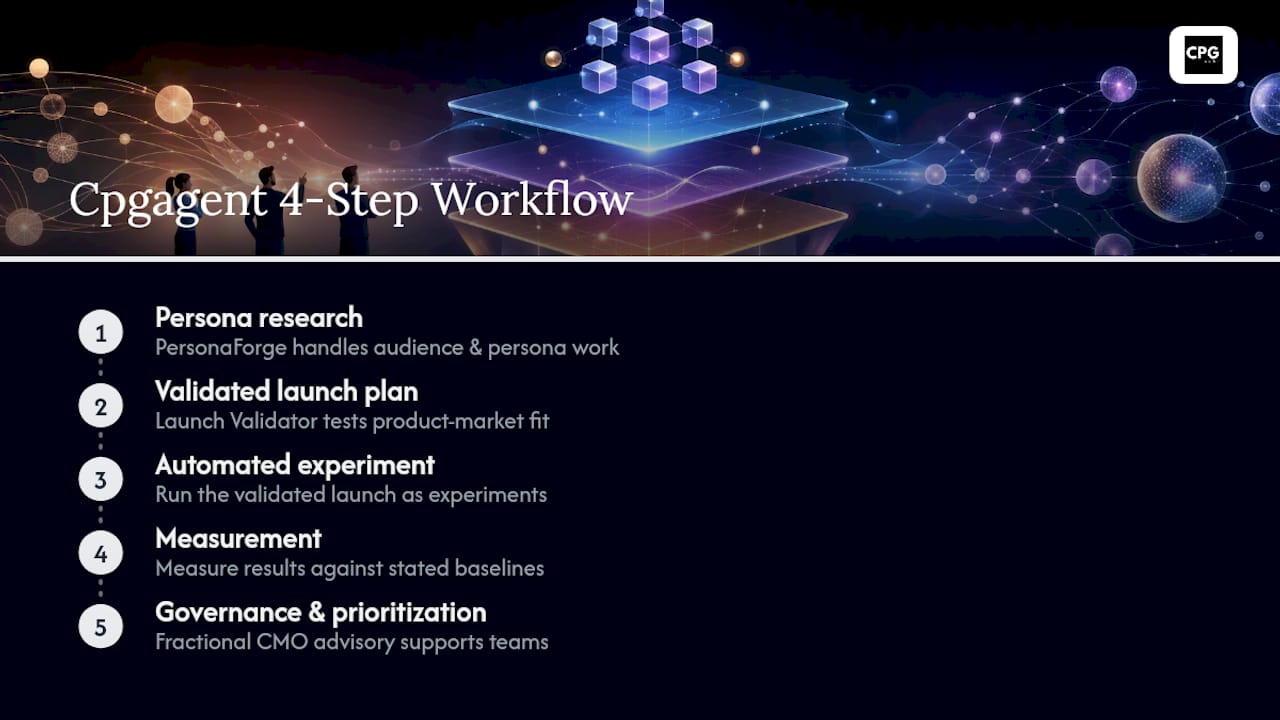
Cpgagent built its platform around exactly this sequence for CPG and FMCG brands. PersonaForge handles the audience and persona research layer, Launch Validator tests product-market fit before a full launch commits budget, and fractional CMO advisory covers the governance and prioritization work most in-house teams don't have bandwidth for. A typical workflow runs persona research into a validated launch plan, then into an automated experiment, then into measurement against the baselines described above. Teams that want a structured path can start on the Cpgagent platform rather than assembling the stack piece by piece.
Where Should You Actually Start? A 90-Day View
Start with the data foundation and one pilot, not five. Pick the highest-impact use case you can measure cleanly, usually retention or activation, and keep the pilot budget proportionally small while you learn. Staff it with one person who owns measurement, not a committee. Governance decisions, spend caps, approval steps, get set before launch, not after the first surprising result shows up in your dashboard.
— Matthew
Get Help Deploying This Without Building It From Scratch
Cpgagent is the practical alternative to hiring a full agency team or building an AI growth stack in-house piece by piece. CPG and FMCG brands get PersonaForge for audience research, Launch Validator for pre-launch testing, and fractional growth leadership that already knows how to sequence data, guardrails, and pilots the way this article describes.
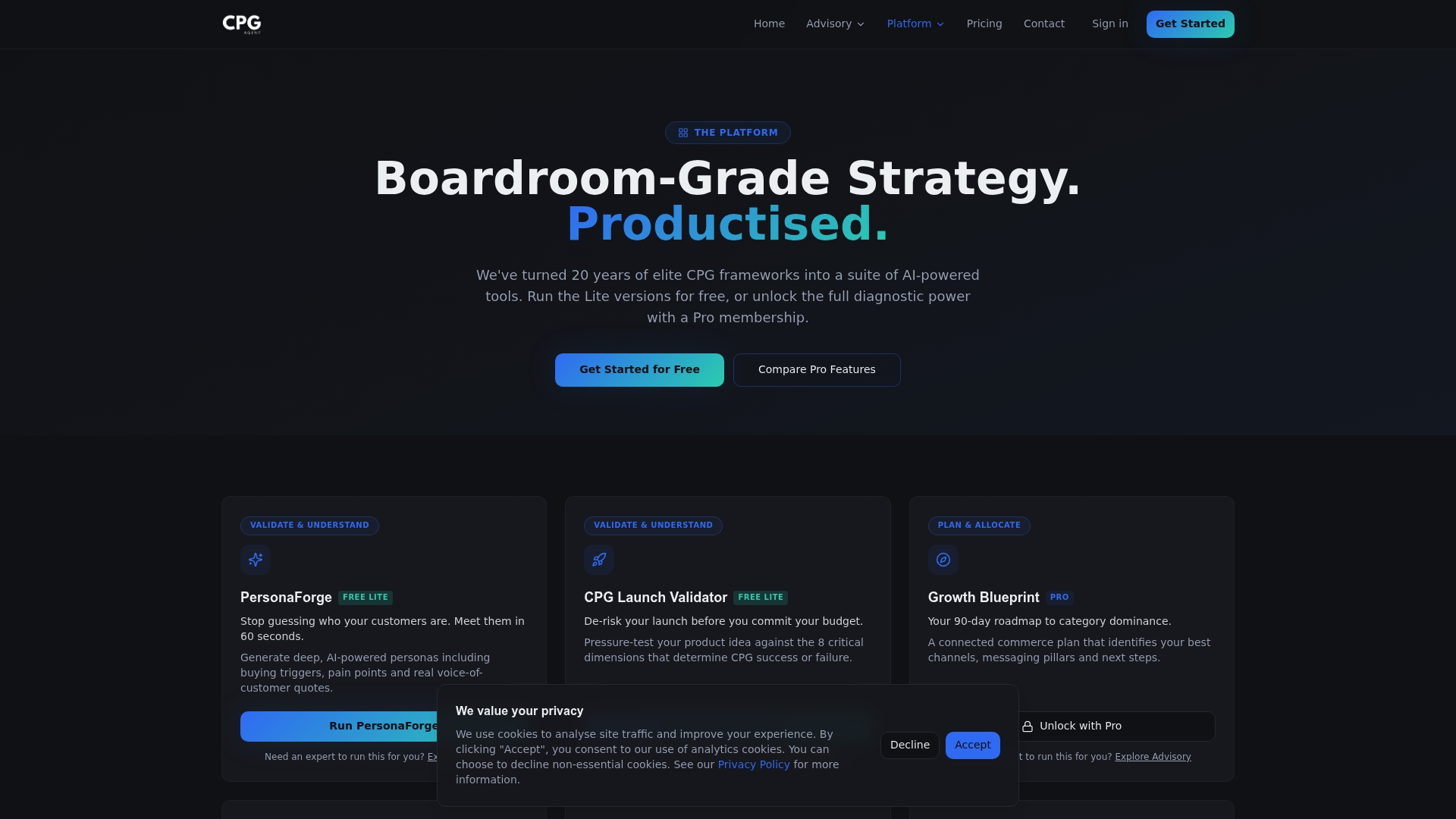
Instead of spending months evaluating point solutions, teams can start with a working stack and senior advisory already built for the category. If you want a structured path into AI-driven growth hacking without the trial-and-error setup, explore the Cpgagent platform and see which module fits your current pilot.
Sources
For deeper tactical detail, see the Growth Hacking Kit for spec-driven agent workflows and Hightouch's AI marketing breakdown for the three-layer framework in full.
- AI era marketing guide — Google Think
- Generative AI for growth hacking: How startups use generative AI in their growth strategies — Journal of Business Research
- Growth Hacking Kit — GitHub
- What is AI marketing: Everything you need to know | Hightouch
FAQ
Is growth hacking still a thing in 2026?
Yes, but it looks different than it did a decade ago. The tactic-of-the-month approach has given way to infrastructure-first systems that combine generative, predictive, and agentic AI to run continuous experiments at scale.
What is the 30% rule in AI marketing?
There's no single standardized "30% rule" in AI marketing; the phrase gets used loosely to mean capping the share of budget or workflow handed to autonomous AI systems until they've proven reliable. Treat any specific percentage you see as a rule of thumb, not an industry standard.
Which jobs are least likely to survive AI-driven growth roles?
Roles built entirely around manual, repeatable tasks, like basic ad copy formatting, manual A/B test setup, and routine reporting, are the most exposed as generative and agentic tools absorb that work. Strategic, judgment-heavy roles in prioritization and governance are far more durable.
Is the AI bubble bursting?
Valuations in parts of the AI sector have drawn real skepticism, but that's a separate question from whether AI growth tactics work operationally. Teams with solid data foundations are seeing measurable gains in experiment speed and conversion regardless of where market sentiment on AI stocks lands.
Do I need a CDP before I start with AI growth hacking?
You need unified, reliable customer data before any agentic tool can act safely, and a composable CDP is the most common way teams get there. Without it, generative and predictive tools end up working from incomplete or conflicting data.