

TL;DR:
- AI tools help CPG and FMCG marketing teams automate content creation, personalize at scale, and optimize campaigns quickly. Implementing AI through a focused pilot and proper governance accelerates measurable benefits, with most results visible within three to six months. Cpgagent streamlines this process by combining automation, data integration, and fractional leadership to reduce pilot timelines and improve ROI.
AI tools support CPG and FMCG marketing teams by accelerating creative production, personalizing at scale, and automating campaign optimization across every channel. The immediate next step: pick one high-impact use case, set a baseline, and run a 30-day pilot before buying any additional software.
Salesforce research confirms that AI now spans machine learning, natural language processing, deep learning, and agentic automation capable of executing multi-step workflows without human intervention. Cpgagent applies this stack specifically for CPG and FMCG brands, compressing what used to be a quarter-long agency engagement into weeks.
Audit one use case this week. The rest of this guide shows you exactly how.
Table of Contents
- How AI tools support marketing teams in CPG today
- Concrete benefits and realistic ROI expectations
- What your team needs in place before adopting AI
- A practical 6-step pilot roadmap for CPG marketing teams
- How to evaluate AI tools for CPG marketing
- Common pitfalls CPG teams hit when adopting AI
- How Cpgagent applies AI for CPG brands
- Key takeaways
- Why the conventional wisdom on AI adoption gets CPG wrong
- Cpgagent cuts pilot timelines for CPG and FMCG brands
- Selected sources and further reading
- FAQ
How AI tools support marketing teams in CPG today
CPG marketing has six places where AI delivers measurable lift fast.
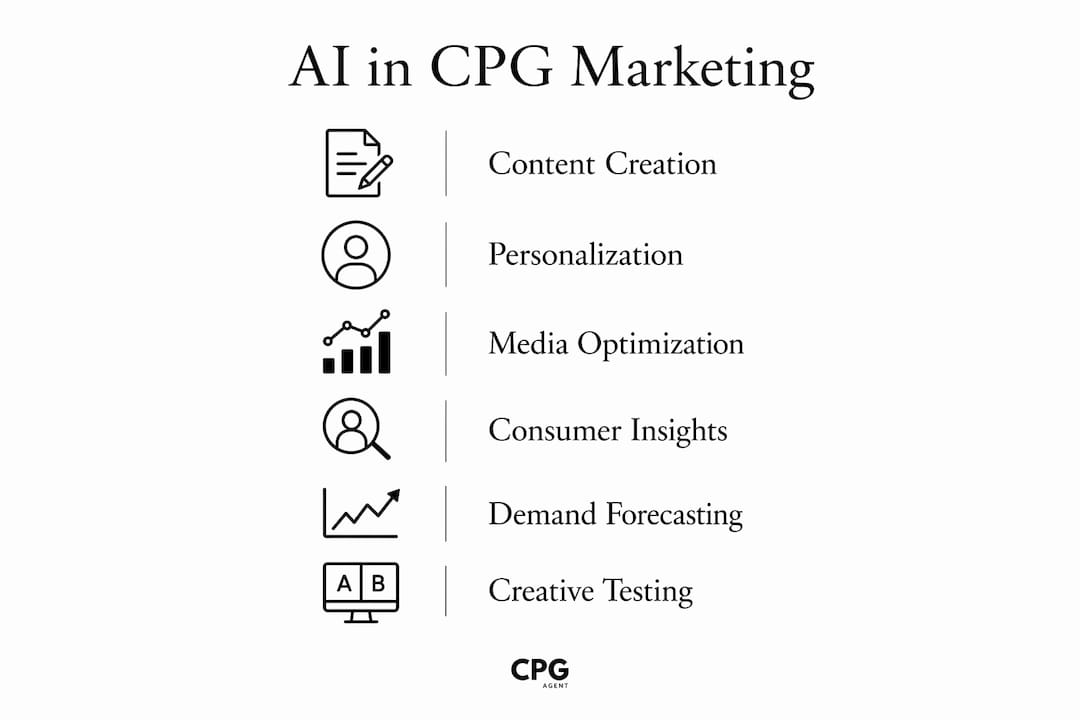
Content creation and scale. Generative AI produces dozens of social variations, dynamic landing headers, and personalized email subject lines in the time it previously took to write one asset. A brand launching a seasonal SKU can generate 40 channel-specific copy variants in an afternoon instead of a week.

Personalization and product recommendations. ML models segment shoppers by purchase history, browsing behavior, and household demographics, then serve individualized offers in real time. Shelf-level personalization at retail partners is now possible through first-party data integrations.
Media optimization and programmatic bidding. Automated bidding engines inside platforms like Google Performance Max and Meta Advantage+ adjust spend allocation by the hour based on conversion signals, cutting wasted impressions without a media buyer touching a dashboard.
Consumer insight and trend detection. AI synthesizes reviews, social listening feeds, and retailer sell-through data to surface emerging flavor, format, or packaging trends weeks before they show up in Nielsen or SPINS reports. This feeds directly into AI-powered consumer research workflows.
Demand forecasting and trade activation. ML models trained on historical POS data, promotional calendars, and weather patterns generate SKU-level forecasts that reduce out-of-stocks and improve trade spend efficiency.
Creative testing and shelf messaging. AI-driven A/B testing frameworks run dozens of creative combinations simultaneously, identifying winning shelf hooks and digital ad creative in days rather than weeks. The AI retail hook generator approach converts consumer insight directly into retail-ready messaging.
Pro Tip: Start with content creation or consumer insight. Both deliver visible results within 30 days and require minimal integration with your existing tech stack.
Concrete benefits and realistic ROI expectations
According to HubSpot’s State of AI Report, 79% of marketers report that AI helps them spend less time on manual tasks. For CPG teams, that time savings compounds into faster campaign cycles, lower cost per asset, and more frequent creative refreshes.
Realistic timelines: most teams see operational efficiency gains in weeks 1–8 of a pilot. Attribution improvements and measurable conversion lift typically appear by month 3–6. Full-scale ROI, including demand forecasting accuracy and trade spend optimization, matures in months 9–18.
Core KPIs to track from day one:
- Content velocity: assets produced per week, before and after AI
- Cost per asset: total creative spend divided by output volume
- Customer acquisition cost (CAC): monitor for downward movement by month 3
- Conversion lift: compare AI-personalized segments against control groups
- Attribution accuracy: percentage of revenue tied to a specific tactic
Pro Tip: Measure incrementally. Run a holdout group for every AI-driven campaign so you can isolate lift from AI versus other variables. Without a control, attribution becomes guesswork.
Connected AI tools deliver measurably better outcomes than disconnected point solutions. MarqOps reports that integrated workflows produce better ROI than siloed tools, which means your measurement design needs to account for the full workflow, not just the output of a single tool.
What your team needs in place before adopting AI
Most AI pilots fail not because the tools are bad, but because the data and governance weren't ready. Check these before you sign any contract.
Technical prerequisites:
- Unified customer data in a CDP or clean CRM (no duplicate records, consistent identifiers)
- Clean product and SKU data with standardized attributes
- Taggable creative assets with metadata (channel, format, campaign, date)
- Identity resolution capability to connect online and offline signals
- An analytics pipeline that can ingest AI outputs and report on them
Governance requirements:
- Written brand guardrails (tone, claims, restricted language, visual standards)
- A defined human review layer for all customer-facing AI content
- Role-based access controls on AI tools with audit logging
- Explainability expectations documented for any model influencing spend or targeting
- A privacy-compliance checklist covering data residency, PII handling, and consent management under U.S. frameworks (CCPA, state-level equivalents)
Governance owner: assign marketing ops as the primary owner with legal as co-sponsor. This pairing covers both operational speed and compliance risk.
Pro Tip: Before onboarding any AI tool, run a data quality audit on your CRM and product catalog. Bad input data produces confident-sounding wrong answers. Fix the data first. See the AI marketing infrastructure guide for a CPG-specific checklist.
A practical 6-step pilot roadmap for CPG marketing teams
- Audit and select one use case. Map your current workflow, identify the highest-friction step, and confirm it has available data. Content creation and consumer insight are the lowest-risk starting points.
- Set baseline metrics. Document current content velocity, cost per asset, CAC, and conversion rates before any AI touches the workflow.
- Prepare data and brand inputs. Upload brand voice guidelines, top-performing creative examples, SKU data, and audience definitions into the tool.
- Run the pilot for 30 days. Limit scope to one channel or one content type. Require human review on every external output.
- Measure and iterate. Compare pilot metrics against baseline. Identify the two or three workflow steps where AI added the most time savings or quality lift.
- Decide: scale or cut. If the pilot shows measurable improvement on at least two KPIs, build the business case for scale. If not, diagnose the data or governance gap before expanding.
| Phase | Weeks | Primary Deliverable |
|---|---|---|
| Audit and baseline | 1–2 | Use case selected, baseline metrics documented |
| Data prep | 3–4 | Brand inputs uploaded, tool configured |
| Pilot execution | 5–8 | AI-assisted content or insights live, human review active |
| Measurement | 9 | Pilot KPIs vs. baseline analyzed |
| Scale decision | 11 | Go/no-go with documented rationale |
How to evaluate AI tools for CPG marketing
Tool categories worth evaluating: content generation and creative ops, campaign optimization, personalization engines, analytics and attribution, agentic workflow automation, and conversational agents.
Evaluation checklist:
- Integration capability: native connectors to your CDP, CRM, and analytics stack
- Data requirements: what first-party data the tool needs and how long onboarding takes
- Explainability: can you audit why the model made a specific recommendation?
- Human-in-the-loop controls: does the tool support approval workflows before content publishes?
- SLAs and support: what is the guaranteed uptime and response time for issues?
- Security and compliance: data residency options, SOC 2 certification, signed data processing agreements
- Pricing model: per-seat, per-output, or usage-based, and what the overage costs look like
Questions to ask in every vendor demo:
- How long does data onboarding take for a brand our size?
- Can you show a sample use-case ROI from a CPG or FMCG client?
- What audit logs exist for AI-generated content?
- How do your brand-safety controls prevent off-brand or inaccurate outputs?
- What happens to our data after the contract ends?
Integration depth matters more than feature depth. The best tool is the one that connects cleanly to your existing data layer and operates within your governance framework.
Common pitfalls CPG teams hit when adopting AI
The predictable failure modes:
- Tool sprawl: buying five disconnected AI tools that don't share data, creating coordination overhead and wasted licenses
- Bad data quality: feeding AI a messy CRM and expecting clean outputs
- No governance: publishing AI-generated content without a human review gate
- Hallucinations and brand-safety errors: AI confidently stating a product claim that isn't on the label
- Over-automation: removing human judgment from decisions that require brand context
- Unclear measurement: running AI campaigns without a control group, making attribution impossible
Red flags during a pilot:
- Output volume grows fast but accuracy or brand consistency falls
- Multiple team members uploading separate, inconsistent data files to the same tool
- Per-user license costs rising because the tool isn't embedded in the actual workflow
Mitigation playbook:
- Enforce data standards before onboarding any tool.
- Limit the initial pilot to one use case and one channel.
- Require human approval for every piece of external content, no exceptions in the first 90 days.
- Run small A/B tests before full rollouts so you have signal before you commit budget.
- Review AI outputs against brand guidelines monthly, not quarterly.
MarqOps reports that 58% of marketers describe chaos from ad-hoc AI use, which tracks with what happens when teams buy tools before establishing governance. The sequence matters: data, then governance, then tools.
How Cpgagent applies AI for CPG brands
A mid-sized beverage brand came to Cpgagent with a specific problem: their creative team was producing two to three campaign assets per week, and their retail partners were asking for channel-specific messaging they couldn't deliver at speed. The team had clean sales data but no unified consumer profile and no AI governance in place.
Cpgagent ran a 30-day pilot focused on content creation and consumer insight. The workflow automated brief generation from POS and social data, produced channel-specific copy variants for review, and flagged brand-safety issues before anything reached the retail partner. Human review stayed in the loop at every external touchpoint.
The pilot compressed the creative cycle from ten days to three, with the brand's own team approving every asset. After the pilot, the brand extended the workflow to trade activation messaging and demand forecasting inputs.
The operating model: Cpgagent's platform handles workflow automation and data integration; fractional CMO support covers strategy and governance design. This means brands get senior marketing judgment without a full-time hire, and the AI runs within a defined guardrail set from day one.
Pro Tip: Fractional leadership paired with an AI platform is the lowest-friction adoption path for CPG brands that don't have a dedicated marketing ops function. You get the governance design and the tooling in one engagement.
Key takeaways
AI tools deliver compounding ROI for CPG marketing teams only when data quality, governance, and measurement are established before the tools go live.
| Point | Details |
|---|---|
| Start with one use case | Content creation and consumer insight deliver visible results within 30 days with minimal integration cost. |
| Fix data before tools | A clean CRM and unified product catalog are prerequisites; bad input data produces confident wrong outputs. |
| Governance prevents brand risk | Assign marketing ops and legal as co-sponsors; require human review on all external AI content for the first 90 days. |
| Measure with a control group | Run holdout segments on every AI-driven campaign to isolate lift from AI versus other variables. |
| Cpgagent as adoption path | Cpgagent pairs AI workflow automation with fractional CMO support, compressing pilot timelines for CPG and FMCG brands. |
Why the conventional wisdom on AI adoption gets CPG wrong
Most AI adoption advice tells brand leaders to "start small and experiment." That framing is fine for a SaaS startup with a single product and a clean data warehouse. CPG is different. You're managing dozens of SKUs, multiple retail partners, seasonal promotional calendars, and trade spend commitments that were locked in months ago. "Experiment freely" is not a strategy when a bad AI output reaches a retail buyer's inbox.
The advice that actually holds: treat AI adoption as an operating-model decision, not a tool decision. The brands getting real lift from AI aren't the ones with the most tools. They're the ones that connected their data, defined their governance, and then deployed AI into a workflow that already had accountability built in. The CPG scaling model that works is the one where AI handles the repeatable, data-driven steps and humans own the judgment calls. That division of labor doesn't happen by default. You have to design it.
Cpgagent cuts pilot timelines for CPG and FMCG brands
CPG and FMCG brands that want AI-driven marketing results without a six-month agency discovery phase have a faster path. Cpgagent combines AI workflow automation, integrated data inputs, and fractional CMO leadership into a single engagement designed for brands at any stage, from emerging challengers to legacy portfolio modernization.
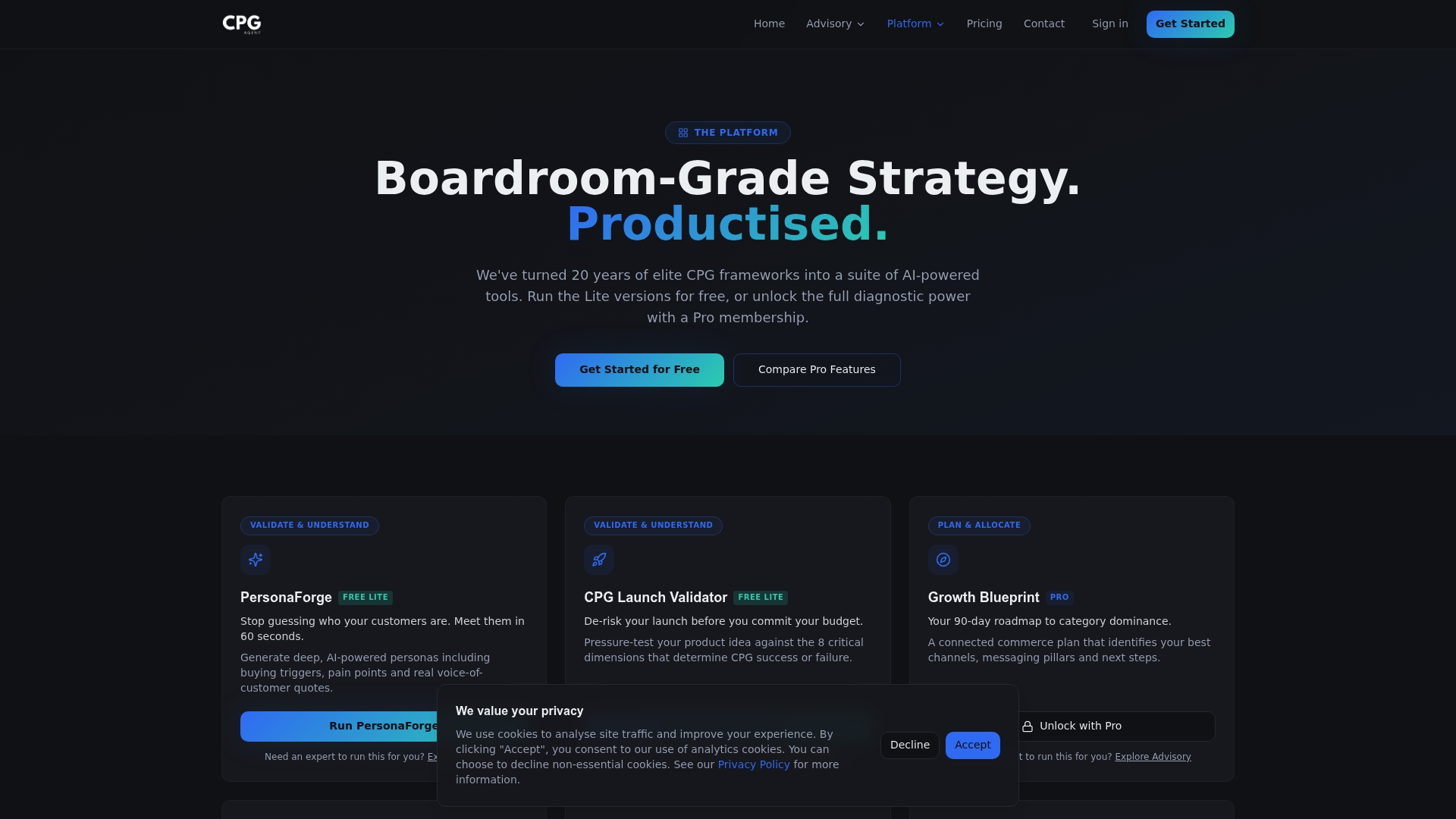
The platform handles pilot orchestration, brand guardrail setup, and cross-functional coordination so your team can focus on decisions, not configuration. Most brands see their first measurable pilot results within 30 days. Explore the Cpgagent platform to see how a pilot is structured and what a fractional leadership engagement looks like in practice.
Selected sources and further reading
- AI in Digital Marketing: The Complete Guide | Salesforce — Covers agentic AI, lifecycle impact, and creative scale; the foundational reference for the use cases and benefits sections.
- AI Marketing Strategy in 2026 | MarqOps — Governance failure modes, tool sprawl costs, and the integrated-workflow ROI argument.
- Agentic AI Is Redefining Marketing Growth | BCG — How agentic AI changes consumer intelligence and what brands must do to remain visible to AI agents.
- How to Leverage AI in Marketing | Neil Patel — HubSpot's 79% time-savings stat and practical adoption guidance.
- AI for Marketing: Strategy, Tools & Use Cases | Alice Labs — Enterprise evaluation framework and the four-criterion tool assessment model.
- 8 Types of AI Marketing Tools | Coursera — Category-level breakdown of what AI tool types actually do.
- AI-Powered Consumer Research: A 2026 Guide | Cpgagent Blog — Tactical methods for converting AI consumer insights into retail and digital activation.
- How to Build AI Marketing Infrastructure for Food Brands | Cpgagent Blog — CPG-specific data and tech-stack readiness checklist.
FAQ
How do AI tools support CPG marketing teams specifically?
AI tools support CPG marketing teams by automating content production, personalizing offers at the SKU level, optimizing trade and digital media spend, and surfacing consumer trends from POS and social data faster than manual analysis allows.
What is the fastest AI use case to pilot for a CPG brand?
Content creation is the fastest use case to pilot. It requires minimal data integration, delivers visible output within days, and produces measurable efficiency gains within 30 days when a human review workflow is in place.
How long does it take to see ROI from AI marketing tools?
Operational efficiency gains typically appear in weeks 1–8. Measurable conversion lift and attribution improvements usually emerge by month 3–6, with full-scale ROI from demand forecasting and trade optimization maturing in months 9–18.
What governance is required before deploying AI in marketing?
At minimum: written brand guardrails, a human review gate for all external content, role-based access controls, and a privacy-compliance checklist covering data residency and PII handling under U.S. frameworks like CCPA.
How does Cpgagent help CPG brands adopt AI marketing tools?
Cpgagent pairs AI workflow automation with fractional CMO support, handling pilot orchestration, data integration, and governance design so CPG and FMCG brands can reach their first measurable results within 30 days.