

TL;DR:
- AI-driven market research uses machine learning and synthetic consumer panels to deliver faster, more accurate insights. It enables smaller teams to conduct frequent studies, reducing timelines from months to days, especially for pricing and marketing tests. However, human oversight remains essential to define research goals and interpret AI-generated data effectively.
AI-powered consumer research is the practice of using machine learning, generative AI, and synthetic consumer panels to collect, analyze, and predict consumer behavior faster and more accurately than traditional methods allow. The industry term for this discipline is AI-driven market research, and it sits at the center of how forward-thinking CPG and FMCG brands now make product and marketing decisions. Where a traditional research cycle once took months and consumed significant budget, AI compresses those timelines to days. For marketing professionals and product managers at consumer brands, that speed advantage is not incremental. It is structural.
How AI-powered consumer research compresses timelines and cuts costs
Traditional consumer research follows a slow, expensive path. A brand commissions a study, recruits respondents, runs surveys or focus groups, waits for data collection, and then waits again for analysis. The full cycle routinely stretches across months. By the time insights land on a product manager's desk, the market has already moved.

Generative AI tools compress marketing research timelines from months to days by enabling rapid concept testing and scalable qualitative analysis. That compression changes the economics of research entirely. Studies that once required large budgets and dedicated research teams are now accessible to lean brand teams running on tight timelines.
The key AI applications driving this shift include:
- Synthetic digital twins. AI models trained on real consumer data simulate how specific consumer segments respond to new products, pricing changes, or marketing messages. Brands test concepts against these models before spending on live research.
- AI-moderated interviews. Conversational AI conducts qualitative interviews at scale, analyzing responses in real time and surfacing themes that human moderators would take days to code.
- Automated survey analysis. Machine learning processes open-ended survey responses, clusters sentiment, and identifies patterns across thousands of respondents in minutes.
Smaller teams can now perform larger and more frequent studies because AI handles the analytical workload that previously required specialist headcount. A three-person brand team at a mid-size CPG company can now run the research volume that once required an agency retainer.
Pro Tip: Start with one repeatable research task, such as concept screening, and automate it fully with AI before expanding to more complex workflows. Mastering one use case builds the internal confidence to scale.
How accurate are synthetic consumer panels?
Synthetic consumer panels are AI-generated models that simulate real consumer responses based on demographic, behavioral, and psychographic data. They do not recruit human respondents. Instead, they use fine-tuned language models and statistical frameworks to predict how a defined consumer segment would react to a given stimulus.
The accuracy question is the one every brand manager asks first. Synthetic panels predict real-world choices with 92% accuracy when outputs are properly fine-tuned. That figure comes from conjoint analyses, the research method brands use to understand how consumers trade off product features and price. A 92% match rate against real consumer behavior makes synthetic panels a credible tool for many standard research tasks.
| Research task | Synthetic panels | Traditional panels |
|---|---|---|
| Pricing sensitivity testing | High accuracy, fast turnaround | Slower, higher cost |
| Marketing claim evaluation | Strong performance | Reliable but expensive |
| Radically new product concepts | Limited accuracy | Better suited |
| Demographic segmentation | Effective with fine-tuning | Broad and established |
| Emotional response depth | Developing capability | Stronger for nuance |
The table above shows where synthetic panels earn their place and where traditional methods still hold an edge. For pricing and marketing claims, synthetic panels deliver speed and accuracy. For genuinely novel product categories where no historical behavior data exists, traditional panels remain more reliable.
Pro Tip: Treat synthetic panel outputs as a living model, not a one-time deliverable. Fine-tune your research outputs regularly as new real-world consumer data becomes available. A model calibrated six months ago may no longer reflect current market behavior.
When AI research tools work and when they fall short
The most common mistake brands make with AI consumer research is treating it as a full replacement for traditional methods. Synthetic panels complement but do not replace traditional consumer research, particularly when testing radically new product concepts. That distinction matters because the failure mode is invisible. A synthetic panel will return confident-looking outputs even when the underlying model lacks the training data to support them.
The scenarios where AI research tools perform best are well-defined:
- Pricing and promotion testing. AI models excel at predicting how consumers respond to price changes, bundle offers, and promotional mechanics because these decisions follow patterns that training data captures well.
- Marketing message evaluation. Testing taglines, packaging copy, and advertising claims against synthetic panels gives brand teams fast directional feedback before committing to production.
- Trend detection from unstructured data. Sentiment analysis tools move beyond positive and negative classifications to detect emotions like joy, frustration, and surprise from social media, reviews, and customer service transcripts.
- Segmentation and targeting refinement. Machine learning identifies behavioral clusters within existing customer data that manual analysis would miss.
The scenarios where AI tools fall short are equally clear. Testing a product category that does not yet exist in the market gives synthetic models nothing to learn from. Exploring deep cultural or emotional drivers of behavior requires human moderators who can probe, follow up, and interpret context.
Human-in-the-loop oversight is critical to research success. Decision makers must define the research problem and set parameters before AI executes analysis. An AI model that receives a poorly framed question will return a precise answer to the wrong problem. The human role is not to review outputs at the end. It is to shape the research design at the start.
Practical steps to implement AI-driven consumer research
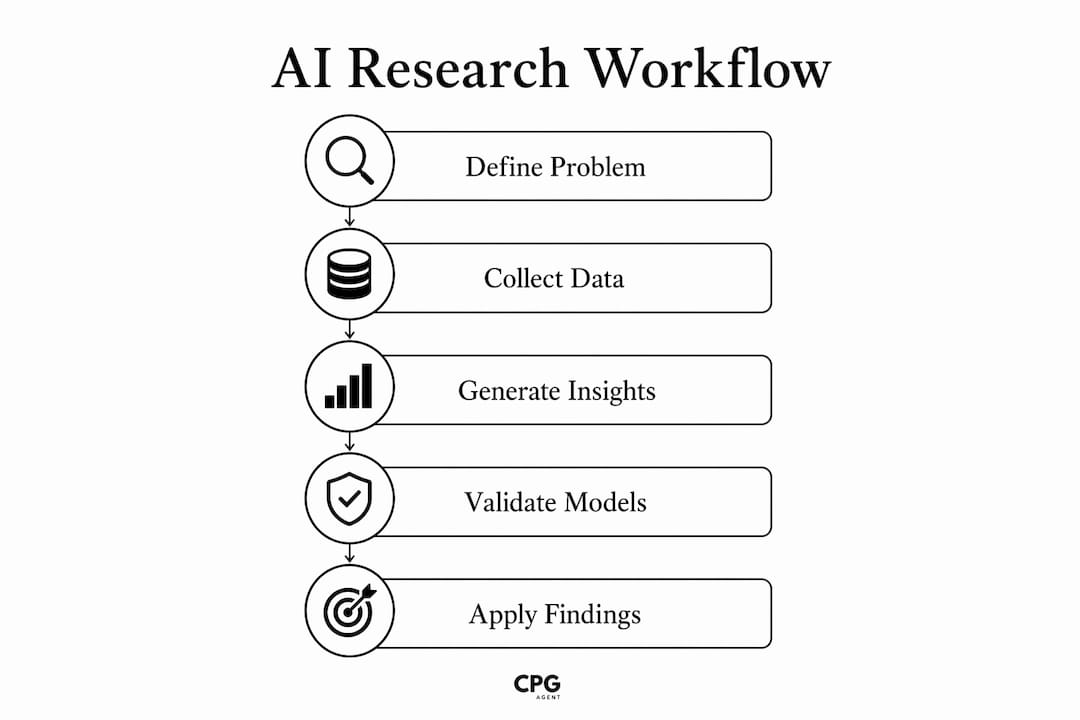
Getting AI consumer research working inside a brand team requires more than buying a software subscription. The workflow has to be built deliberately, with clear ownership at each stage.
The core steps are:
- Define the research problem with precision. AI tools perform best when the question is narrow. "How do 25 to 40 year old urban consumers respond to a $4.99 price point for our new protein bar?" produces better AI outputs than "What do consumers think of our brand?"
- Select tools matched to the task. Sentiment analysis platforms like Hootsuite analyze unstructured social and review data. Conjoint analysis tools with synthetic panel capabilities handle pricing and feature trade-off research. Building AI marketing infrastructure requires matching the right tool to each research job rather than forcing one platform to do everything.
- Interpret outputs with category knowledge. AI surfaces patterns. Brand managers and product managers apply category expertise to determine which patterns are meaningful. A spike in frustration sentiment around packaging may reflect a design flaw or a temporary supply issue. Only a human with context can tell the difference.
- Build brand personas informed by AI data. AI-informed brand personas built from real behavioral and sentiment data are more accurate than personas constructed from demographic assumptions alone.
- Run research in shorter, more frequent cycles. The speed advantage of AI is wasted if teams still operate on quarterly research calendars. Monthly or even weekly research pulses are now achievable and give product teams a continuous feedback loop.
Machine learning improves personalized marketing by analyzing customer behavior patterns, which leads to higher conversion rates in retail and direct-to-consumer channels. That improvement compounds over time as the models accumulate more behavioral data.
Pro Tip: Assign one person on your team as the AI research lead, even part-time. Without clear ownership, AI tools get used inconsistently and insights never make it into decisions.
What brand managers should watch in AI consumer insights
The capabilities of AI consumer research tools are advancing faster than most brand teams can track. Several developments in 2026 are worth monitoring closely.
- Generative AI is expanding into video and audio analysis. Tools now process video focus group recordings and podcast mentions to extract consumer sentiment at scale. This opens qualitative research to data sources that were previously too expensive to analyze.
- Synthetic panel applications are expanding beyond CPG. Healthcare, financial services, and automotive brands are adopting the same conjoint-based synthetic panel methods that CPG brands pioneered. Cross-industry adoption accelerates tool development and drives down costs.
- Ethical AI and bias mitigation are becoming non-negotiable. Bias and data privacy concerns are growing challenges in AI research deployment. A synthetic panel trained on data that overrepresents one demographic will systematically underpredict responses from underrepresented groups. Brands that ignore this risk will make bad decisions with high confidence.
- Regulatory scrutiny of AI-generated consumer data is increasing. Data privacy regulations in the U.S. and EU are beginning to address AI-generated consumer profiles. Brand teams need legal and compliance input as they build AI research workflows.
- Continuous fine-tuning is becoming a competitive differentiator. Brands that treat synthetic panel calibration as an ongoing practice will maintain accuracy advantages over brands that run models once and never update them.
The brands that win with AI consumer research in the next three years will not be the ones with the most sophisticated tools. They will be the ones that build the organizational habits to use those tools consistently and update them regularly.
Key Takeaways
AI-powered consumer research delivers its greatest advantage when human expertise defines the research problem and AI executes the analysis at speed and scale.
| Point | Details |
|---|---|
| Timeline compression is real | AI reduces research cycles from months to days, enabling faster product and marketing decisions. |
| Synthetic panel accuracy is high | Fine-tuned synthetic panels predict real consumer choices with 92% accuracy in conjoint analyses. |
| AI supplements, not replaces | Synthetic panels work best for pricing and claims testing, not for radically new product categories. |
| Human oversight is non-negotiable | Decision makers must define research parameters before AI processes data to avoid precise answers to wrong questions. |
| Continuous calibration matters | Synthetic models require regular fine-tuning as market behavior evolves to maintain accuracy over time. |
The part most brand teams get wrong
The conversation about AI consumer research tends to focus on the tools. Which platform, which model, which accuracy benchmark. That framing misses the actual constraint, which is organizational, not technological.
I have seen brand teams buy sophisticated AI research tools and then use them to answer the same questions they were already asking with traditional methods. The speed advantage disappears when the research calendar stays quarterly. The cost advantage disappears when outputs sit in a deck that no one acts on.
The real opportunity is not faster research. It is more frequent experimentation. AI enables smaller teams to run larger and more frequent studies. That capability only creates value if the team has a culture of testing, learning, and adjusting quickly. Without that culture, AI research is just expensive data collection.
The brands I have seen get the most out of AI consumer insights treat every research output as a hypothesis to test in market, not a conclusion to present in a meeting. They run a synthetic panel study, form a directional view, test it with a small real-world experiment, and then update the model. That loop, repeated consistently, builds a genuine intelligence advantage over competitors still waiting for their quarterly agency report.
The tools are ready. The question is whether your team is structured to use them at the pace they enable.
— Matthew
Cpgagent's platform for AI-driven brand research
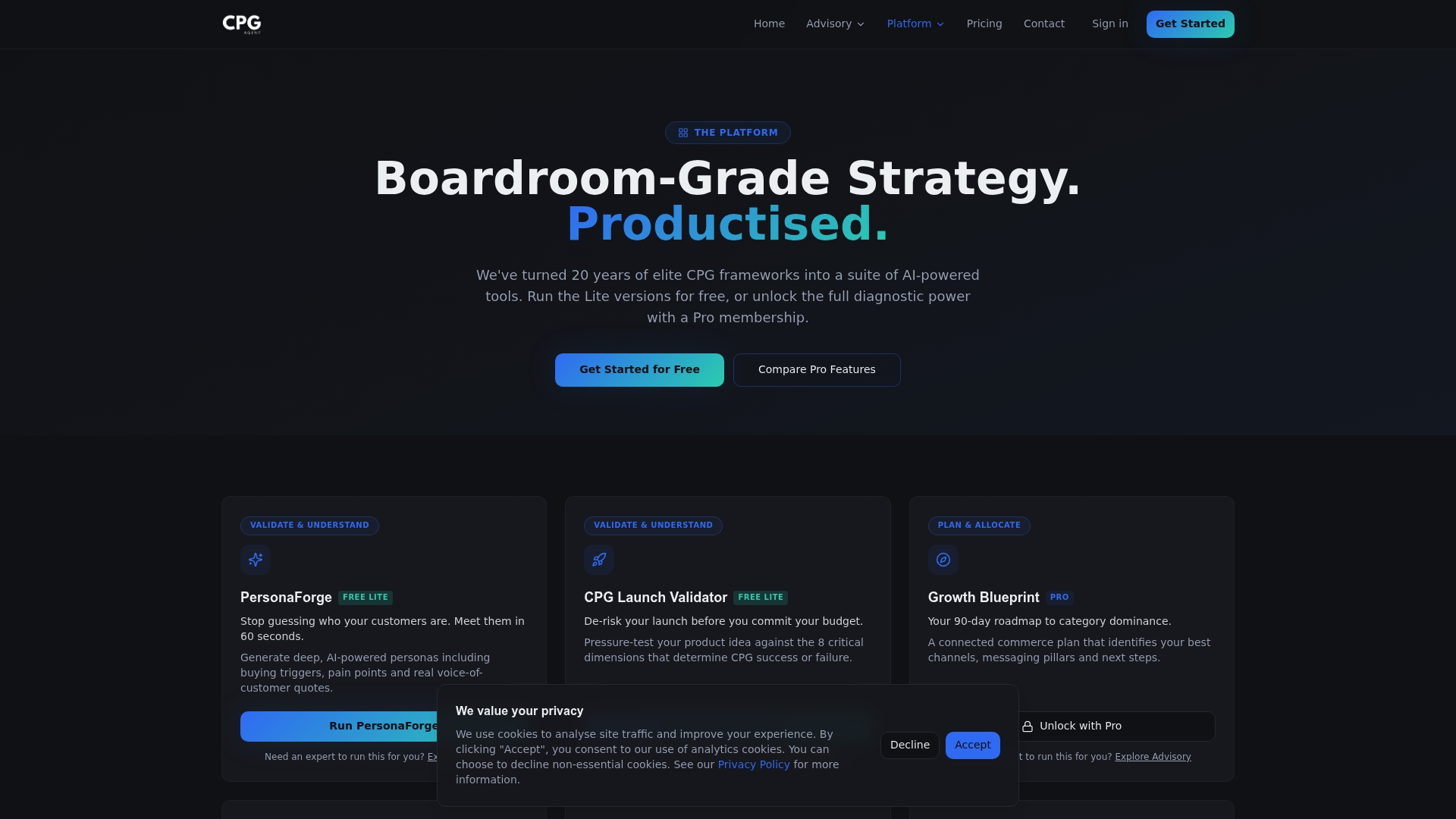
Cpgagent builds AI research and strategy tools specifically for CPG and FMCG brands that cannot afford to wait months for consumer insights. The Cpgagent platform includes tools like PersonaForge for AI-informed consumer persona development and Launch Validator for rapid concept testing before market entry. These tools are designed for lean brand teams that need research-grade outputs without agency timelines or agency overhead. If your team is ready to run faster research cycles and make decisions backed by real consumer data, the platform is built for exactly that workflow.
FAQ
What is AI-powered consumer research?
AI-powered consumer research uses machine learning and generative AI to collect, analyze, and predict consumer behavior faster than traditional survey or focus group methods. It includes tools like synthetic consumer panels, sentiment analysis, and automated qualitative analysis.
How accurate are AI synthetic consumer panels?
Synthetic consumer panels predict real-world consumer choices with 92% accuracy when properly fine-tuned, according to BCG research on conjoint analyses. Accuracy depends on ongoing calibration as market behavior evolves.
When should brands use AI research vs. traditional research?
AI research tools work best for pricing sensitivity, marketing claim testing, and trend detection from existing data. Traditional methods remain stronger for testing radically new product concepts where no historical behavior data exists.
What is the biggest risk of using AI in consumer research?
Bias in training data is the primary risk. A synthetic panel trained on unrepresentative data will produce confident but inaccurate predictions for underrepresented consumer groups.
How do smaller brand teams get started with AI consumer research?
Start by automating one repeatable research task, such as concept screening or sentiment analysis, before expanding to more complex workflows. Assign clear ownership to one team member and build research cycles around monthly rather than quarterly cadences.