

Start with a focused pilot targeting one revenue or cost lever, get C-suite sign-off within 30 days, and treat the first 90 days as a structured experiment with a hard go/no-go gate. That is the single most reliable path for how legacy brands adopt AI tools without stalling in committee or burning budget on a proof-of-concept that never ships.
The one-sentence board recommendation: Approve a 60–90 day pilot that pairs a high-value business process (marketing creative, demand planning, or e-commerce CX) with a lightweight AI agent and a cross-functional product builder squad, with a defined success metric and a pre-agreed scale budget contingent on hitting it.
Three immediate next steps:
- Sign-off (Week 1): The CEO or Chief Digital Officer approves a pilot budget. Ballpark: $75,000–$150,000 for a 90-day scoped experiment including tooling, a product builder, and data prep.
- Scope (Week 2–3): Pick one function from the priority list below and define the single KPI the pilot must move.
- Team (Week 4): Appoint a product builder (a hybrid business/technical profile), a business owner, and a data engineer. Brief legal and compliance on data handling before any model touches customer data.
Candidate functions, ranked by value-vs-feasibility:
- Marketing creative and content production (fastest to pilot, clearest cost baseline)
- Demand planning and forecasting (high ROI, requires clean historical data)
- E-commerce CX and personalization (measurable revenue lift, as Macy's demonstrated)
- Institutional knowledge retrieval (high adoption potential, lower technical lift)
Pro Tip: Don't let "which function" become a six-week debate. Pick the one where you already have clean data and a frustrated team. Speed of start matters more than perfection of selection.
Key Takeaways
Legacy brands that adopt AI tools successfully run a focused, time-boxed pilot with a single KPI, a cross-functional squad, and a pre-agreed scale gate before committing enterprise-wide resources.
| Point | Details |
|---|---|
| Start with one KPI | Pick one measurable outcome and build the entire pilot around proving it within 90 days. |
| Fix data before the model | Audit your top three to five data sources for completeness and access before any model touches them. |
| Embed AI champions | Train 5–10% of the workforce as champions; peer credibility drives adoption faster than top-down mandates. |
| Gate the scale decision | Scale only when the pilot hits its pre-agreed metric, adoption threshold, and CFO-approved payback timeline. |
| Cpgagent for CPG pilots | Cpgagent maps persona research, launch validation, and retail audit tools directly to each pilot phase for CPG and FMCG brands. |
Table of Contents
- How do legacy brands build a phased AI adoption roadmap?
- What technical prerequisites do you need before integrating AI into legacy systems?
- How do you manage employee resistance and reframe AI as augmentation?
- What KPIs and governance frameworks should you use for enterprise AI?
- A 30–90 day pilot playbook for legacy brands
- Real legacy brands that adopted AI and what happened
- How Cpgagent operationalizes AI adoption for CPG and FMCG brands
- How do you select the right AI tools and vendors?
- How do you sustain AI performance after the pilot ends?
- What leadership must actually prioritize during AI adoption
- Cpgagent runs your first AI pilot without the agency overhead
- Sources
- FAQ
How do legacy brands build a phased AI adoption roadmap?
Legacy workflows are the primary structural barrier to AI transformation. Brands that bolt AI onto existing processes rarely see lasting gains. The ones that do redesign workflows first and connect point solutions into interoperable systems.
A four-phase roadmap gives the executive team a governance spine:
- Phase 1 — Prioritize (Weeks 1–4): Map candidate use cases against two axes: business value and data readiness. Eliminate anything that requires a multi-year data cleanup before it can run. The executive decision here is which function gets the pilot budget.
- Phase 2 — Prototype and Pilot (Days 30–90): Run one focused experiment with a cross-functional squad. The decision gate at Day 90 is binary: scale or stop. No extensions without new evidence.
- Phase 3 — Align Systems (Months 4–9): If the pilot clears its gate, the architecture team addresses integration patterns, API connectors, and data pipelines at the enterprise level. This is where cloud migration decisions and model governance frameworks get finalized.
- Phase 4 — Scale and Iterate (Month 10+): Expand to additional functions, build an internal AI champions network, and shift from project-based funding to a product-based operating model.
The most common executive mistake is funding Phase 3 before Phase 2 produces evidence. Commit Phase 3 budget only after the pilot hits its success metric.
Flipping that ratio is how organizations end up with a portfolio of pilots and no production deployments.*
What technical prerequisites do you need before integrating AI into legacy systems?
Data readiness checklist
Before any model runs in production, the data layer needs to be honest about its gaps:
- Identify the three to five data sources the pilot will actually use and audit them for completeness, freshness, and access controls.
- Catalog institutional knowledge that lives in documents, email threads, and tribal memory. Knowledge agents (like those deployed at Kraft Heinz and Wells Fargo) require this to be structured before they can surface it reliably.
- Flag PII and proprietary data early. Legal needs to sign off on what enters a model's context window before the pilot launches.
- Prioritize structured transactional data (sales, SKU-level inventory) over unstructured data for the first pilot. Unstructured data is valuable but harder to clean fast.
Cloud and infrastructure
A full lift-and-shift to cloud is rarely necessary for a 90-day pilot. Most legacy brands can run an initial experiment on a managed cloud service (Microsoft Azure, for example) without refactoring their core ERP. The refactor conversation belongs in Phase 3, once the pilot proves value. Rough cost drivers for a pilot: cloud compute and storage ($5,000–$20,000 over 90 days), API licensing for the chosen model, and data engineering time.
Integration patterns
| Layer | Pattern |
|---|---|
| Data layer | Central data index or knowledge graph fed by existing ERP, CRM, and PIM connectors |
| Orchestration | A central orchestrator routes user intents to specialized expert agents (the "super agent" pattern used at Levi's) |
| Agent interface | Microsoft 365 Copilot or a custom chat UI embedded in existing tools employees already use |
| Monitoring | Logging layer with human-in-the-loop review gates for high-stakes outputs |
Adobe Firefly Custom Models offer an additional pattern for creative teams: train brand-safe generative image models on first-party assets, apply guardrails, and deploy at scale without exposing proprietary creative to public model training. For CPG brands with strict brand standards, this is worth evaluating alongside the orchestration layer.
Automated workflow redesign is often more impactful than the model choice itself. A well-integrated lightweight model beats a powerful model bolted onto a broken process.
How do you manage employee resistance and reframe AI as augmentation?
The messaging problem is real. Employees hear "AI adoption" and immediately calculate their own replaceability. The framing that works: "AI handles the repetitive retrieval and drafting so you can spend more time on the judgment calls only you can make."

Swarovski's approach is the clearest enterprise example of this done right. The brand trained thousands of employees, embedded AI champions across business units, and framed every tool as professional augmentation.
Staffing model options:
- Central AI team: Faster governance, slower business-unit adoption. Best for regulated industries.
- Distributed product builders: Faster experimentation, harder to coordinate. Best for brands with strong BU autonomy.
- Embedded champions: The most durable model. One trained AI champion per team creates peer-to-peer credibility that top-down mandates cannot replicate.
Upskilling roadmap (three tiers):
- Literacy tier: All employees complete a 2–4 hour AI fundamentals module. Goal: reduce fear, set realistic expectations.
- Practitioner tier: Functional teams (marketing, supply chain, finance) complete tool-specific training tied to their pilot use case.
- Champion tier: 5–10% of the workforce receives advanced training on prompt engineering, agent configuration, and output evaluation.
Incentives matter as much as training. Tie early AI adoption to performance reviews, not just voluntary participation. Decision rights also need to be explicit: employees need to know which AI outputs they can act on autonomously and which require human sign-off.
Pro Tip: Use the pilot's early wins as internal marketing. A 20-minute all-hands where a peer demonstrates a real time-saving is worth more than any change management deck. Levi's treated the company as a living laboratory and let grassroots experiments surface the most compelling use cases organically.
What KPIs and governance frameworks should you use for enterprise AI?
KPI framework
| Outcome category | Concrete metric | How to measure |
|---|---|---|
| Revenue | Conversion rate lift, average order value | A/B test vs. control group |
| Cost | Production cost per asset, cost per resolved query | Pre/post comparison with matched baseline |
| Time saved | Hours per task, cycle time reduction | Time-tracking before and after deployment |
| Quality | Error rate, brand compliance score | Human review sample + automated scoring |
| Engagement | Feature adoption rate, session depth | Product analytics (Mixpanel, Amplitude) |
Governance checklist
- Maintain a model registry: every model in production is documented with its version, training data provenance, and approved use cases.
- Apply access controls at the data layer, not just the application layer.
- Build human-in-the-loop review gates for any output that touches customer communications, pricing, or legal language.
- Define IP ownership for AI-generated assets before the pilot launches. This is a legal question, not a technical one.
- Audit outputs for bias and brand safety on a rolling basis, not just at launch.
Decision gate for scaling: A pilot clears the gate when it hits a pre-agreed minimum detectable effect on its primary KPI, achieves a defined adoption threshold among the target user group, and shows a cost payback timeline the CFO has already approved. All three conditions, not two of three.
Connect pilot KPIs to the P&L explicitly. "Time saved" is not a board metric until it is translated into headcount reallocation or capacity freed for higher-value work. The CFO needs a dollar figure, not a productivity percentage.
A 30–90 day pilot playbook for legacy brands
Step-by-step from scoping to launch:
- Week 1: Define the single business problem and the one KPI the pilot must move. Document the current-state workflow in detail.
- Week 2: Audit the data sources the pilot will use. Identify gaps and assign a data engineer to address the top three blockers.
- Week 3: Select the AI tool or platform. Evaluate on: data integration ease, vendor security certifications, and time-to-first-output.
- Week 4: Stand up the cross-functional squad. Roles: product builder, data engineer, business owner, legal/compliance liaison, vendor contact.
- Days 30–45: Build and test the first working prototype. Share outputs with five to ten end users for feedback. Do not optimize yet.
- Days 45–75: Iterate based on user feedback. Instrument the KPI measurement. Run a controlled test against the baseline.
- Days 75–90: Evaluate against the decision gate criteria. Present findings to the C-suite with a clear scale/stop recommendation.
Suggested team composition:
- Product builder (hybrid business/technical): owns the prototype and the user feedback loop
- Data engineer: owns data pipeline and quality
- Business owner: owns the KPI and the budget
- Legal/compliance: reviews data handling and output risk
- Vendor liaison: manages the tool relationship and escalations
Common pitfalls:
- Scope creep after Week 3: adding a second use case mid-pilot invalidates the measurement baseline.
- Poor data mapping: assuming the data is clean without auditing it first is the single most common cause of pilot failure.
- No decision gate: a pilot without a pre-agreed go/no-go criterion becomes a permanent experiment. Lacoste moved from a deterministic chatbot to a full agentic platform in four months by maintaining tight squad discipline and prebuilt components. That speed is only possible when the scope is locked.
Real legacy brands that adopted AI and what happened
Levi's treated the enterprise as a living laboratory. Rather than waiting for a centralized AI strategy to be handed down, the company deployed Microsoft 365 Copilot broadly and let employees surface their own high-value use cases. The result: faster adoption and a pipeline of grassroots agent experiments that a top-down rollout would have missed entirely.
Kraft Heinz built The Cookbook, a knowledge agent that digitizes institutional recipe and product knowledge. Combined with enterprise copilot deployment, the approach demonstrates how centennial brands can operationalize decades of proprietary knowledge that previously lived only in the heads of long-tenured employees. Wells Fargo, in the same cohort, reported more than 30,000 employees using Microsoft 365 Copilot after rollout.

The structural move was embedding AI champions across business units and framing every tool as professional augmentation rather than a headcount reduction initiative.
L'Oréal built CreAItech, an integrated generative content platform, and reported a 40% reduction in production costs for certain creative workflows while generating high volumes of on-brand assets at scale. The structural enabler was a vendor partnership model that kept brand-safe guardrails in place across all generated output.
Stat to note: Shoppers who used Macy's Complete the Look AI feature spent almost five times more per session than those who did not.
Macy's deployed Ask Macy's and Complete the Look, AI-powered shopping features that produced a measurable revenue lift. The transferable lesson: customer-facing AI pilots with a clear revenue metric are the easiest to defend at the board level because the ROI is direct and attributable, similar to how Cannible - Cannabis for your highs and lows adopts AI for operational improvements in the cannabis sector.
Transferability note: Look for the analog in your business. If you have a large catalog, a personalization or recommendation pilot mirrors Macy's. If you have decades of proprietary formulations or recipes, a knowledge agent mirrors Kraft Heinz. Match the use case to the asset you already own.
How Cpgagent operationalizes AI adoption for CPG and FMCG brands
For CPG and FMCG brands specifically, the AI adoption strategy requires tools calibrated to the category's specific data structures: SKU-level sales data, retail shelf performance, consumer persona research, and launch validation.
Cpgagent's platform maps directly to the pilot phases described above:
- Pilot scoping: PersonaForge for consumer research and Launch Validator for product concept testing give the pilot team a data-backed starting point before committing to a full build.
- Creative and marketing workflows: AI-powered creative generation and media planning tools reduce production cycle time and give marketing teams a measurable cost baseline to compare against.
- Retail execution: Retail audit tools capture shelf performance data that feeds directly into demand planning models.
- Fractional leadership: For brands that lack an internal AI program lead, Cpgagent's fractional CMO and senior advisory services provide the C-suite-level sponsorship the pilot needs to stay on track.
The platform integrates into existing tech stacks without requiring a full infrastructure overhaul, which matters for brands in Phase 1 or 2 of the roadmap above. Explore the Cpgagent platform to see which tools map to your current pilot scope.
How do you select the right AI tools and vendors?
Vendor selection is where pilots die quietly. A tool that looks impressive in a demo can stall for three months on a data integration issue that a five-minute technical review would have caught.
Evaluation criteria that actually matter:
- Integration ease: Does the vendor have a pre-built connector for your ERP or CRM? If not, who builds and maintains the integration?
- Security certifications: SOC 2 Type II is the minimum for enterprise data. Ask for the most recent audit report, not a marketing claim.
- Model transparency: Can you see what data the model was trained on? For brand-safe creative, this is non-negotiable. Adobe Firefly Custom Models, for example, are trained on licensed and first-party assets, which reduces IP exposure.
- Vendor lock-in risk: Evaluate whether the vendor's output format and API structure allow you to switch providers without rebuilding the integration layer.
- Support model: A startup vendor with a strong product but a two-person support team is a risk for an enterprise pilot. Confirm escalation paths and SLA commitments in writing before signing.
One practical filter: run a 2-week technical spike with your data engineer and the vendor's integration team before signing a contract. If the integration is harder than the vendor claimed, you find out before you are committed.
AI tools for marketing teams in CPG and FMCG have specific requirements around brand safety and retail data compatibility that general-purpose enterprise tools often underserve. Evaluate vendors against your category's specific data structures, not just generic enterprise benchmarks.
How do you sustain AI performance after the pilot ends?
The maintenance trap is real: brands that treat AI deployment as a project rather than a product end up with models that degrade quietly as data drifts and business conditions change.
Continuous improvement framework:
- Monthly: Review output quality samples with a human reviewer. Flag drift in model performance against the baseline KPI.
- Quarterly: Retrain or fine-tune models on fresh data. Review the model registry for deprecated versions still running in production.
- Annually: Conduct a full governance audit. Reassess vendor relationships, security certifications, and IP ownership terms.
Post-adoption support also means sustaining the human layer. AI champions need ongoing development, not just initial training. Build a quarterly champions forum where practitioners share new use cases, flag failure modes, and pressure-test governance assumptions.
The operational pattern that prevents decay: assign a named product owner to every AI system in production. Not a committee. One person with accountability for performance, data quality, and user adoption. When something breaks or drifts, there is no ambiguity about who owns the fix.
Consumer research methods also need to be refreshed as AI tools evolve. What worked as a persona research input in Year 1 may underperform by Year 2 as consumer behavior shifts and model capabilities improve.
What leadership must actually prioritize during AI adoption
The conventional wisdom says the biggest risk in AI adoption is moving too slowly. That is wrong for most legacy brands. The actual risk is moving fast on the wrong thing: a high-visibility pilot with weak data, no decision gate, and a team that has never shipped a production AI system.
Speed matters, but it has to be directed. The brands that have gotten this right, Levi's, Swarovski, L'Oréal, all share one structural trait: they picked a specific, measurable outcome and built the experiment around proving or disproving it. They did not try to "transform" anything. They tried to move one number.
The trade-off executives consistently underestimate is centralization versus decentralized experimentation. A central AI team gives you governance and consistency. Distributed product builders give you speed and business-unit buy-in. Neither works alone. The model that actually scales is a thin central governance layer with decentralized execution, which is exactly what the embedded champions model delivers.
The one priority to maintain across the entire program: keep the business owner in the room. Technical teams will optimize for what they can measure. Business owners keep the pilot anchored to the outcome that actually matters to the P&L. When those two groups stop talking weekly, pilots drift. Every time.
Cpgagent runs your first AI pilot without the agency overhead
Legacy CPG brands that have tried to run AI pilots through traditional agencies know the problem: six weeks of discovery, a strategy deck, and a bill before a single line of code runs. Cpgagent is built for the opposite approach.
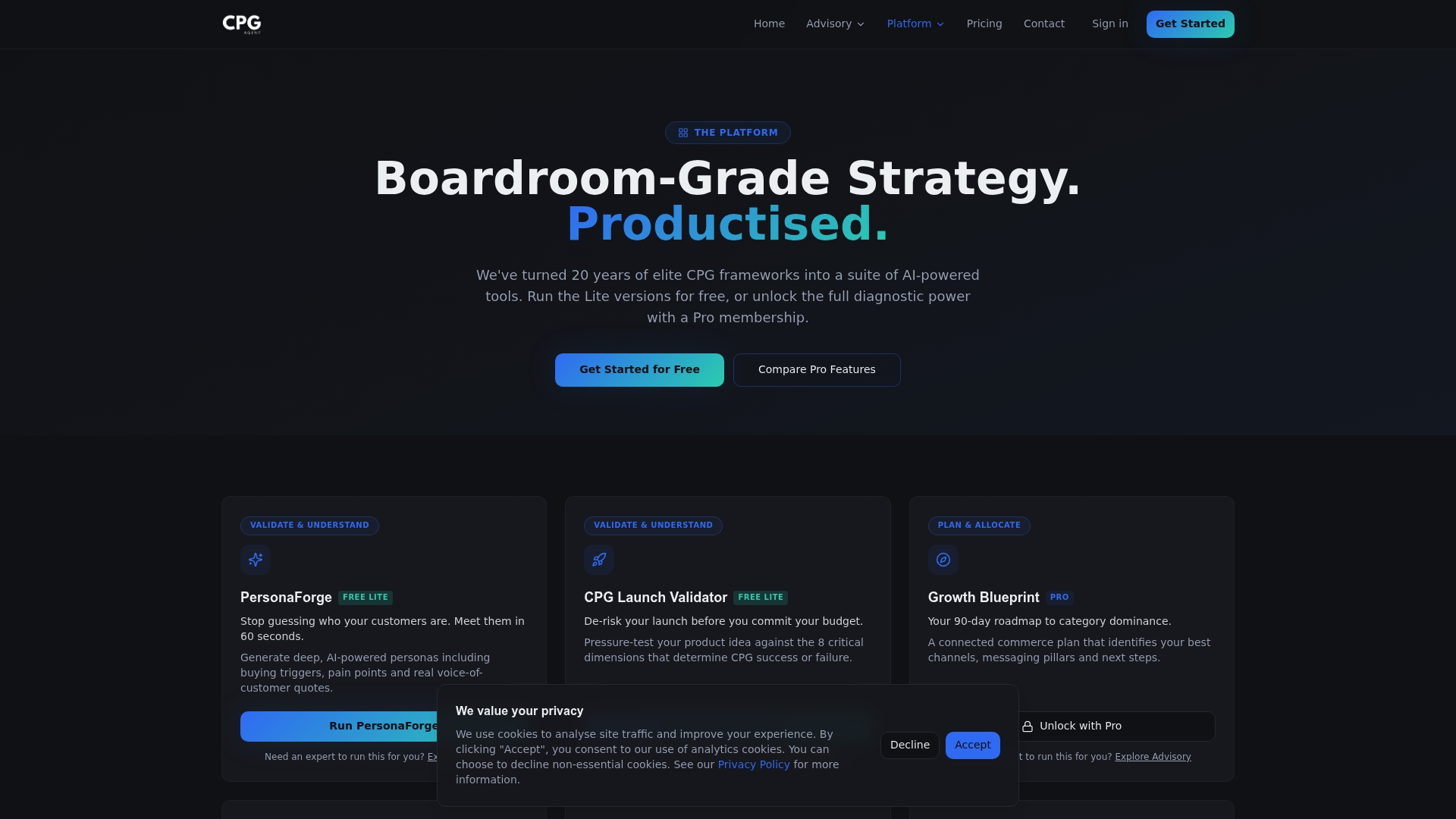
The platform gives your team persona research, launch validation, creative generation, and retail audit tools in one place, with fractional CMO support available when you need C-suite-level program leadership without a full-time hire. No long-term retainer required to start. The pilot design, tool configuration, and KPI framework are operational from day one.
For brands ready to move from roadmap to production, the Cpgagent platform is where the pilot begins. Book a scoping call and have a working pilot brief in 48 hours.
Sources
- Beet
- How Swarovski used GenAI at scale to generate real profit - I by IMD
- From legacy to Frontier: how 100-year brands are leading AI innovation - Microsoft Cloud Blog
- L’Oréal accelerates generative AI content engine with fresh OpenAI deal - Digiday
FAQ
How do you integrate AI into legacy systems without a full rebuild?
Start with a managed cloud service like Microsoft Azure and use API connectors to link your existing ERP and CRM to the AI layer. A full infrastructure refactor is a Phase 3 decision, not a prerequisite for a 90-day pilot.
How do legacy brands adapt to AI-driven search and discovery?
Brands need structured, machine-readable product data and consistent on-brand content at scale.
What does a realistic AI pilot budget look like for a legacy brand?
A 90-day scoped pilot typically runs $75,000–$150,000, covering cloud compute, API licensing, a product builder, and data engineering time. Scale budget is committed only after the pilot clears its pre-agreed decision gate.
How do brands measure ROI from an AI pilot?
Map every pilot KPI to a P&L line: production cost per asset, conversion rate lift, or hours freed per task translated into dollar value. Macy's Complete the Look feature, where users spent almost five times more per session than non-users, is the benchmark for customer-facing revenue attribution.
How does Cpgagent support legacy CPG brands adopting AI?
Cpgagent provides persona research, launch validation, creative generation, and retail audit tools calibrated to CPG data structures, plus fractional CMO support for brands that need senior program leadership without a full-time hire.