

TL;DR:
- AI enhances legacy brand strategy by acting as a structured amplifier of existing brand meaning, not a creator. Effective governance ensures AI maintains brand integrity while automation handles routine tasks, preserving emotional resonance.
The role of AI in legacy brand strategy is to codify and amplify a brand's authentic meaning, not to replace it. AI acts as a strategic enabler that structures what a brand stands for, then scales that meaning across AI-curated consumer ecosystems. For marketing professionals at established companies, this distinction is the difference between modernization and brand dilution. AI Optimization (AIO) has emerged as the core competency that makes brand content legible to both human audiences and the machine systems now mediating consumer attention.
What is the role of AI in legacy brand strategy?
AI's role in legacy brand strategy is to serve as a structured amplifier of existing brand equity, not a creative substitute. The brands that get this right treat AI as a tool that reads, organizes, and distributes their brand's established meaning at scale. Those that get it wrong hand AI a blank slate and watch it generate content that sounds like every other brand in the category.
Only 5% of marketing leaders piloting AI agents without strategic alignment report significant business outcome gains. That number tells you everything: AI without a defined brand framework produces noise, not growth. The starting point for any legacy brand transformation is a documented, structured brand identity that AI can reference and extend.
The industry term for this practice is AI Optimization, or AIO. AIO requires brands to structure their messaging, content, and data so that AI systems can accurately represent the brand in generative search results, agentic recommendations, and personalized consumer experiences. Legacy brands with decades of brand equity have a natural advantage here. The challenge is translating that equity into machine-readable formats before a competitor does.
How does AI governance protect brand identity?
The CMO's role has shifted from campaign executor to architect of meaning and governor of algorithmic decisions. This is not a minor title change. It represents a fundamental shift in where marketing leadership adds value. The CMO now sets the strategic intentions that constrain what AI can and cannot do with a brand's identity.
Without that governance layer, AI systems optimize for engagement metrics rather than brand values. The result is content that performs in the short term but erodes brand meaning over time. Every AI-driven marketing decision is, at its core, a values decision expressed in mathematical form. Leaders who do not govern that math cede brand identity to an algorithm.
Effective governance practices for legacy brands include:
- Equity audits: Regular reviews that measure whether AI-generated content aligns with core brand attributes and customer perception benchmarks.
- Brand integrity checkpoints: Approval gates where human strategists review AI outputs before publication, particularly for identity-defining campaigns.
- Ethical guardrails: Documented rules that prevent AI from generating content that conflicts with brand values, even when that content might drive short-term clicks.
- Persona validation: Testing AI-generated personas and messaging against real customer research to confirm emotional accuracy.
Pro Tip: Build a one-page brand constitution before deploying any AI content tool. It should define your brand's non-negotiable values, tone, and off-limits topics. Feed it directly into every AI system your team uses.
Why does dual optimization matter for brand visibility?
AI Optimization requires brands to structure content for both human emotion and machine readability simultaneously. This is the new frontier of brand building. A legacy brand can have a century of equity and still be invisible in AI-mediated consumer journeys if its content is not structured for machine comprehension.
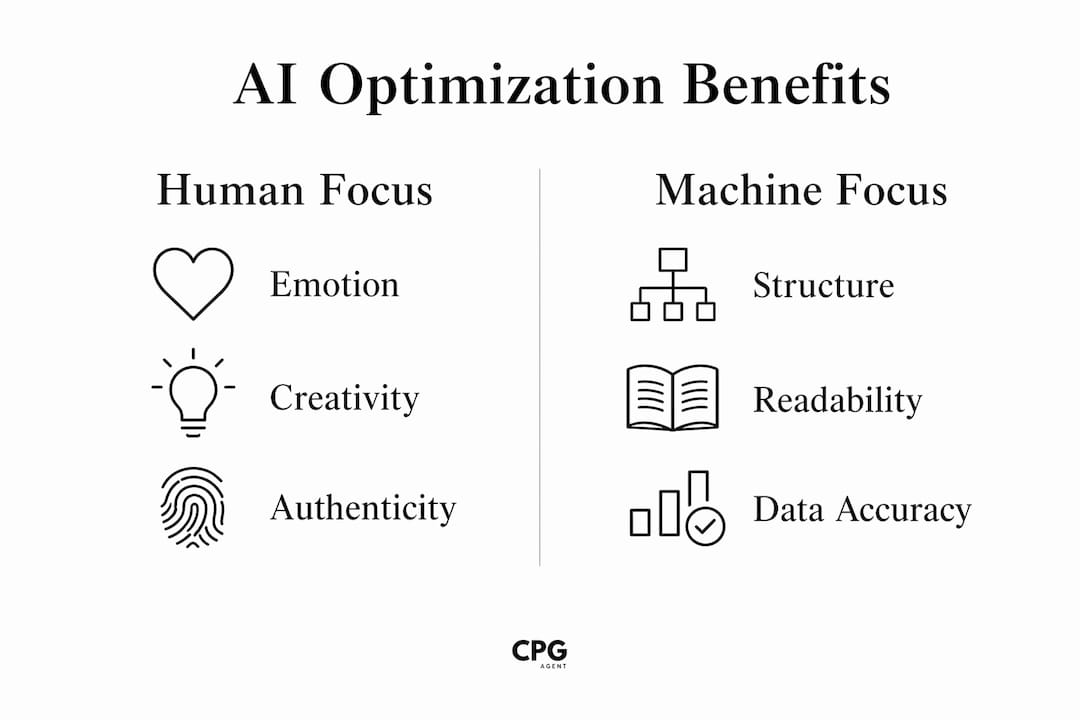
The components of AIO that matter most for legacy brands are:
| AIO Component | What it does for legacy brands |
|---|---|
| Structured data markup | Makes brand attributes, product details, and heritage claims machine-readable for AI systems |
| Contextual relevance signals | Connects brand content to the specific consumer intent AI agents are resolving |
| Real-time performance tracking | Identifies where AI systems misrepresent or omit the brand in generated responses |
| AI persona alignment | Ensures brand voice and values are reflected accurately in AI-curated brand descriptions |
The practical implication is that legacy brands must treat their website and content library as a structured source of truth. AI models that cannot find clear, consistent brand data will hallucinate brand attributes or default to competitor descriptions. Structured, machine-readable brand data is a prerequisite for accurate AI representation, not an optional upgrade.
Brands that invest in AI-powered consumer research gain a second advantage: they can identify in real time where AI systems are misrepresenting their brand and correct the underlying content before it affects purchase decisions.
How do legacy brands integrate AI without losing authenticity?
The most instructive example of AI-enabled legacy brand transformation is Coach. Coach's 29% top-line growth followed a deliberate pivot to purpose-led, emotional storytelling powered by AI tools. The brand did not abandon its heritage. It used AI to mine that heritage and surface the narrative threads that resonated most strongly with younger consumers. The result was a brand that felt both timeless and current.

The practical framework most high-performing brands follow is the 90/10 rule. AI automates 90% of routine content and query responses, while human strategists complete the final 10% to preserve brand voice and emotional resonance. That final 10% is where brand soul lives. Removing it in the name of efficiency is the most common mistake legacy brand teams make.
Here is how to apply this framework in practice:
- Audit your brand archive. Use AI tools to scan historical campaigns, customer letters, and product descriptions for consistent narrative threads. These threads are your brand's authentic story, and they are the raw material for modern content.
- Define the 10% that humans must own. Identify the content categories where emotional nuance is non-negotiable: brand manifestos, crisis communications, purpose statements, and flagship campaign concepts.
- Build AI workflows for the 90%. Automate product descriptions, social responses, email sequences, and performance reporting. These tasks consume time without adding brand meaning.
- Apply human refinement at every output gate. Authentic Brands Group maintains a distinct knowledge base for each brand it manages, applying human fine-tuning to AI-generated outputs to protect brand personality and quality. This is the operational model worth replicating.
- Measure brand equity alongside efficiency metrics. If AI adoption improves content volume but degrades brand perception scores, the governance model needs adjustment.
Pro Tip: When mining your brand archive with AI, search specifically for the emotional language customers used to describe your brand in its strongest years. That language is your most credible source of authentic positioning.
How do you build an AI-ready brand infrastructure?
Legacy brands that thrive in agentic commerce share one structural characteristic: they have built a machine-readable source of truth for their brand. Treating brand assets as structured data prevents AI models from hallucinating brand attributes and ensures consistent representation across generative search, AI shopping agents, and personalized recommendation engines.
Brands with strong, distinctive positioning hold a competitive moat as AI commoditizes content production. Distinctiveness is not just a creative virtue in this environment. It is a technical requirement. AI systems reward brands that are clearly differentiated because ambiguous brands are harder to recommend accurately.
Building that infrastructure requires cross-functional alignment. A cross-functional, agile approach integrating marketing, sales, technology, and data teams is the operational foundation for effective AI deployment. Marketing cannot build machine-readable brand assets without technology. Technology cannot prioritize the right data without marketing's strategic direction.
The table below shows how legacy brand teams at different maturity levels typically approach this infrastructure challenge:
| Infrastructure element | Early-stage approach | Advanced approach |
|---|---|---|
| Brand data structure | Unstructured content library | Tagged, schema-marked brand asset system |
| Cross-functional alignment | Ad hoc collaboration | Dedicated AI governance committee |
| AI performance tracking | Vanity metrics only | Brand equity and AI citation monitoring |
| Content governance | Manual review | Automated guardrails plus human approval gates |
Teams looking to build this foundation faster can explore AI marketing infrastructure frameworks that apply directly to established brand portfolios. The goal is not to rebuild the brand. The goal is to make what already exists legible to the systems now shaping consumer choice.
Key Takeaways
AI amplifies legacy brand equity most effectively when brands structure their identity as machine-readable data, govern AI outputs with human oversight, and apply the 90/10 rule to preserve brand voice at scale.
| Point | Details |
|---|---|
| AI governance is non-negotiable | Only 5% of AI pilots without strategic alignment deliver significant business gains. |
| AIO requires structured brand data | Machine-readable brand assets prevent AI hallucination and ensure accurate brand representation. |
| The 90/10 rule protects brand soul | AI handles routine content; humans own the final creative and emotional layer. |
| Distinctiveness is a competitive moat | Well-documented brand positioning outperforms generic AI-generated content in agentic commerce. |
| Cross-functional teams accelerate AI adoption | Marketing, sales, and technology must align before deploying AI at scale. |
The part most brand teams get wrong
I have watched marketing teams at established companies treat AI adoption as a content production problem. They measure success by volume: more posts, faster copy, lower cost per asset. That framing is a trap.
The brands I have seen get genuine competitive advantage from AI are the ones that started with a governance question, not a production question. They asked: "What does our brand mean, and how do we make sure AI never misrepresents it?" That question forces the structural work that actually matters. It produces the brand constitution, the machine-readable asset library, and the human approval gates that protect equity over time.
The Coach example is instructive precisely because the growth came from emotional storytelling, not content volume. AI enabled the scale. Human judgment chose the story. Legacy brands have decades of authentic material to work with. The ones that mine that material deliberately, rather than letting AI generate generic content from scratch, are the ones that will still be recognizable brands in ten years.
The uncomfortable truth is that over-automation erodes brand soul faster than most teams realize. The efficiency gains are visible on a dashboard. The trust erosion shows up six months later in brand equity scores. Build the governance model before you scale the automation.
— Matthew
How Cpgagent supports AI-ready legacy brand strategy
Marketing professionals at established brands need more than general AI tools. They need a platform built for the specific challenge of modernizing brand portfolios without losing what made those brands valuable in the first place.
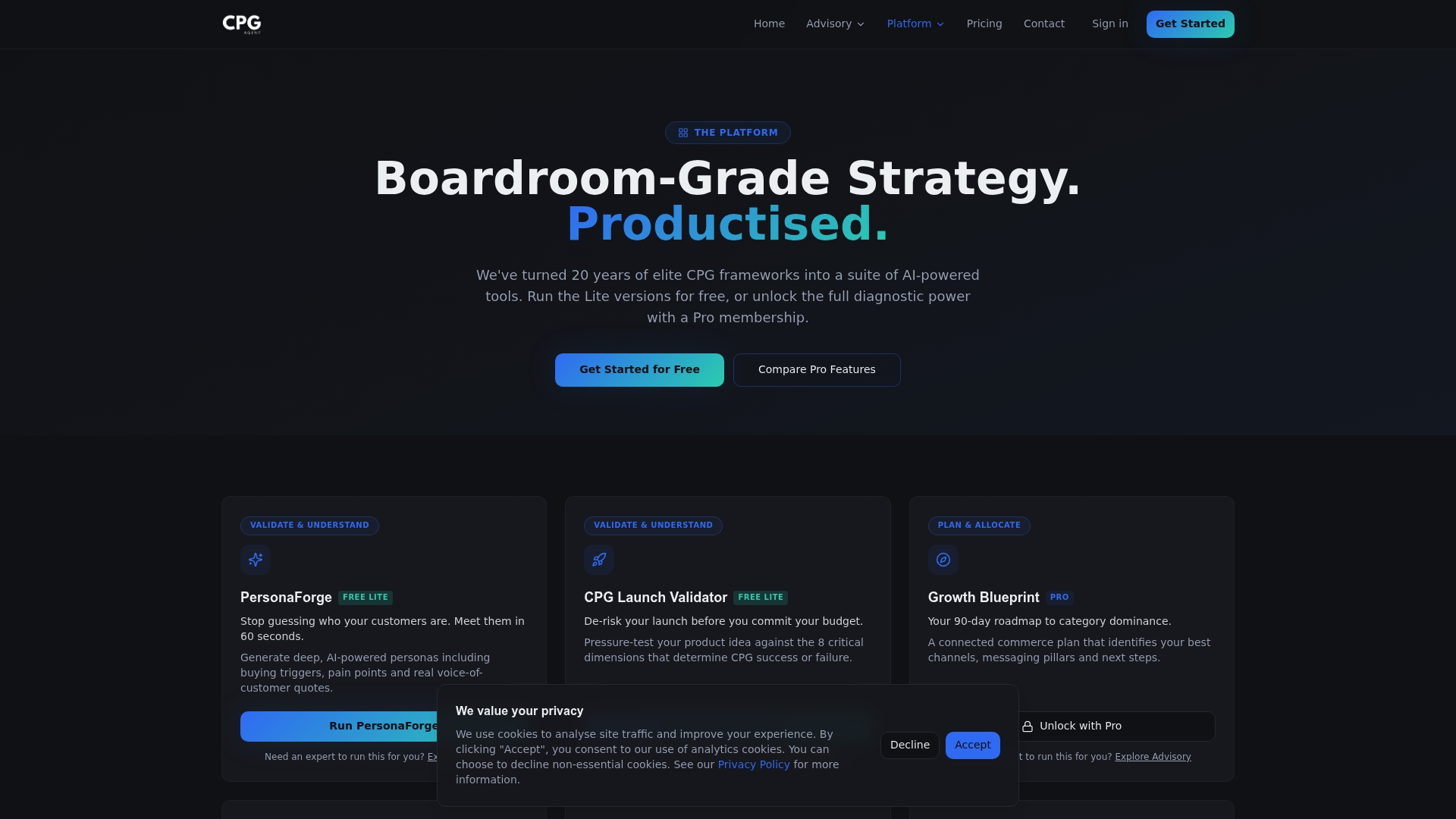
Cpgagent's AI-driven strategy platform combines structured brand data tools, AI-powered consumer research, and fractional CMO advisory to help legacy brand teams deploy AI with governance built in. Features like PersonaForge and Launch Validator give brand strategists the data they need to make AI decisions that align with brand equity objectives, not just efficiency targets. Teams get the speed of AI automation with the human oversight that protects brand meaning. For established brands ready to build a machine-readable brand infrastructure, Cpgagent is the platform designed for that work.
FAQ
What is AI Optimization (AIO) in brand strategy?
AI Optimization is the practice of structuring brand content and data so that AI systems can accurately represent a brand in generative search results and agentic recommendations. It requires both machine-readable data formats and emotionally resonant messaging for human audiences.
How does AI affect legacy brand equity?
AI amplifies brand equity when deployed with clear governance and structured brand data. Without strategic alignment, AI-generated content can dilute brand meaning and erode customer trust over time.
What is the 90/10 rule for AI in marketing?
The 90/10 rule means AI automates 90% of routine content and customer queries, while human strategists complete the final 10% to preserve brand voice and emotional accuracy. This balance maintains efficiency without sacrificing brand soul.
Why do legacy brands need machine-readable brand assets?
AI models that cannot find clear, structured brand data will hallucinate brand attributes or default to generic descriptions. Machine-readable brand assets prevent misrepresentation in AI-curated consumer experiences.
How do you govern AI in a legacy brand context?
Effective AI governance includes regular equity audits, brand integrity checkpoints, ethical guardrails, and a documented brand constitution that constrains what AI can generate. The CMO owns this governance function as a core leadership responsibility.