

TL;DR:
- Building an AI marketing infrastructure for food brands requires clean data, phased deployment, and strict governance to operate reliably at scale.
- Most failure occurs when brands deploy AI agents before establishing robust data systems and clear workflows.
Building an AI marketing infrastructure for a food and beverage brand means orchestrating data pipelines, AI-driven tools, and automation workflows into a single system that replaces fragmented agency retainers with measurable, repeatable performance. This is not a future-state ambition. Brands that integrate AI across SEO, content, paid media, and follow-up sequences can achieve 100–200% improvement in qualified lead volume within 90 days. The framework covered here walks you through the exact components, phased rollout, governance requirements, and scaling methods that food and beverage marketing teams need to execute this shift without adding headcount.
What core components are required to build AI marketing infrastructure for food brands
AI marketing infrastructure, formally called an agentic marketing stack, is the combination of data systems, AI agents, automation platforms, and governance protocols that allow a brand to execute marketing at scale with minimal manual intervention. For food and beverage brands specifically, the prerequisites are more demanding than in other categories because product data is complex: ingredients, allergens, certifications, and regulatory claims all need to be machine-readable before any AI tool can use them reliably.
Data infrastructure: the non-negotiable foundation
Successful AI agent deployment requires clean, connected data with 95%+ anomaly detection accuracy and attribution model accuracy above 85%, built on at least 12 months of historical performance data. That means your Google Analytics, Meta Ads, CRM, and e-commerce platform must be connected through ETL (extract, transform, load) pipelines before you deploy a single AI agent. Without this, agents produce outputs that contradict your actual business reality.

F&B brands must also create a single structured source of truth for product data, covering ingredients, allergens, and health benefits, so AI platforms can reliably parse and recommend products during conversational searches. This is the data layer that feeds everything else.
Core tools for an AI marketing stack
The table below maps the key tool categories to their function within a food and beverage AI marketing system:
| Tool Category | Primary Function | Example Use Case |
|---|---|---|
| AI persona builder | Audience segmentation | PersonaForge for automated persona mapping |
| AI marketing agents | Campaign execution and optimization | Paid media bid management, content scheduling |
| Chatbot and intent capture | Lead qualification | Website chat for wholesale or DTC inquiries |
| CRM with AI scoring | Lead prioritization | Flagging high-intent retail buyers |
| Content automation | Brief generation and creative variation | Producing 20+ ad hooks from one brief |
Key tools to evaluate include Klaviyo for email automation, Triple Whale or Northbeam for attribution, and Cpgagent's AI platform tools for persona creation and campaign automation. Your CRM, whether HubSpot or Salesforce, must sit at the center with defined data governance roles assigned before launch.
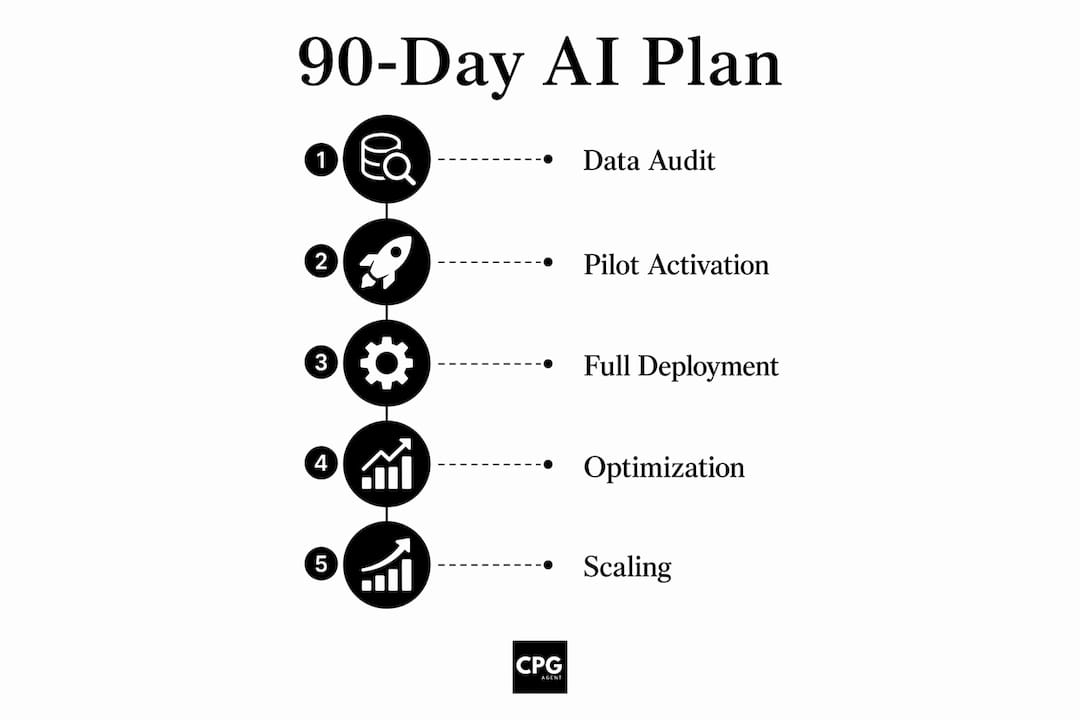
How to implement AI marketing workflows in food and beverage: a 90-day plan
Mapping existing marketing activities and underlying systems is the prerequisite step for designing reusable agent archetypes and smooth integrations. Skip this and you build agents that conflict with each other or duplicate work. The phased plan below is structured around that principle.
-
Days 1–15: Data audit and readiness validation. Pull 12 months of performance data from every active channel. Identify gaps, broken UTM parameters, and attribution conflicts. Document your current cost per lead, conversion rates by channel, and content output volume. This audit determines which AI use cases are viable immediately and which require data repair first.
-
Days 16–30: Business logic and KPI documentation. Define what success looks like for each marketing function. For a beverage brand, this might mean cost per case sold for DTC, retailer inquiry volume for wholesale, or share of voice for brand awareness. AI agents need explicit KPI targets to optimize toward. Vague goals produce vague outputs.
-
Days 31–45: Pilot selection. Choose one high-friction, high-volume workflow to automate first. Weekly performance reporting, ad creative variation generation, or email nurture sequences are strong starting points. A listen-before-you-build approach that targets specific manual bottlenecks generates quick ROI and earns internal buy-in before you scale.
-
Days 46–60: Agent training and parallel run. Run the AI agent alongside your existing manual process. Compare outputs daily. Identify where the agent underperforms and feed corrective data. This parallel phase is where most brands discover data quality issues they missed in the audit.
-
Days 61–75: Feedback loops and content cluster build. Activate automated content clusters aligned with your top search queries. For a specialty food brand, this means topic clusters around ingredients, recipes, dietary certifications, and sourcing stories. Feed performance data back into the agent to refine targeting and messaging.
-
Days 76–90: Full activation and paid media integration. Connect your AI agents to paid media platforms. Use performance signals from organic content to inform paid creative. At this stage, one marketer can supervise multiple agents running simultaneously across SEO, paid social, and email.
Pro Tip: Before activating paid media agents, confirm your attribution model is validated. Agents optimizing toward inaccurate attribution data will scale the wrong behaviors and burn budget fast.
| Phase | Primary Output | Success Metric |
|---|---|---|
| Data audit (Days 1–15) | Clean data infrastructure | Zero broken attribution paths |
| Pilot (Days 31–45) | One automated workflow live | 20%+ time saved on pilot task |
| Full activation (Days 76–90) | Multi-channel AI execution | Lead volume increase vs. baseline |
What are the most common pitfalls when building AI marketing infrastructure?
The single biggest cause of AI marketing failure in food and beverage is deploying agents before the data infrastructure is ready. Broken or siloed data guarantees AI deployment failure. An agent trained on inconsistent data will confidently produce wrong recommendations, and reversing that trust damage internally takes longer than the original build.
Beyond data, the pitfalls that most frequently derail F&B brands fall into three categories:
-
Governance gaps. For specialty food and beverage brands, strict governance over AI-generated content is necessary to avoid copyright issues and FDA/FTC compliance violations. Every AI-generated claim about health benefits, ingredients, or certifications must pass human editorial review before publication. Build this review step into your workflow from day one, not as an afterthought.
-
Over-automation without brand safety controls. AI agents will produce content at volume. Without defined brand voice guidelines, approved claim libraries, and content screening tools, that volume becomes a liability. Set hard rules: no health claims without approved source data, no competitor comparisons without legal review.
-
Skipping internal buy-in. Marketing teams that deploy AI without demonstrating early wins to leadership face budget cuts before the system matures. Start with a workflow that produces a visible, quantifiable result within 30 days. Automating the weekly performance report is unglamorous but immediately credible.
"The brands that win with AI are not the ones that deploy the most agents. They are the ones that deploy the right agents against the right data at the right time." This is the operational discipline that separates brands that scale from brands that stall.
Pro Tip: Run a data maturity audit using a simple scorecard: rate your data completeness, connection quality, and attribution accuracy on a 1–5 scale before committing to any AI vendor contract. If your average score is below 3, fix the data first.
F&B brands also need to account for the fact that AI search engines are now part of the discovery funnel. Brands must market to AI as much as to humans to remain in consideration sets, which means structured product data and authoritative content are now competitive requirements, not optional upgrades.
How to scale and optimize AI marketing infrastructure over time
Scaling AI marketing infrastructure is not about adding more tools. It is about feeding better data into the agents you already have and expanding their scope incrementally. The brands that scale successfully treat their AI stack as a living system that improves with every campaign cycle.
Start by using operational data to refine your chatbot and content agents. If your website chatbot captures wholesale inquiries, analyze the questions being asked and use that language to build new content clusters. This creates a feedback loop where real customer intent directly shapes your content strategy, which in turn improves AI-driven search discovery.
Automated follow-up sequences can recover 20–40% of leads otherwise lost to customer inattention through multi-touch outreach via email, SMS, and WhatsApp. For a food brand running DTC and wholesale simultaneously, this means building separate follow-up sequences for each buyer type, with messaging calibrated to their specific purchase timeline and decision criteria.
The comparison below shows what a manual marketing operation looks like versus a scaled AI marketing infrastructure at the same output level:
| Capability | Manual operation | AI marketing infrastructure |
|---|---|---|
| Weekly content output | 2–4 pieces | 15–25 pieces |
| Ad creative variations | 3–5 per campaign | 20–50 per campaign |
| Lead follow-up speed | 24–48 hours | Under 5 minutes |
| Performance reporting | Weekly, manual | Daily, automated |
To get your brand recommended by AI search engines, structured product data and authoritative content clusters are the primary levers. The guide on AI search recommendations covers the technical and content requirements in detail. Pair that with AI-driven media planning to allocate budget toward the channels where your AI agents are generating the strongest attribution signals.
The metrics to monitor for continuous improvement are cost per qualified lead by channel, content-to-conversion rate by topic cluster, agent accuracy scores, and attribution model confidence. Review these monthly and adjust agent parameters accordingly.
Key takeaways
Building AI marketing infrastructure for food and beverage brands requires clean data, phased deployment, and strict governance before any agent can operate reliably at scale.
| Point | Details |
|---|---|
| Data readiness is the prerequisite | Audit 12 months of historical data and fix attribution gaps before deploying any AI agent. |
| Phase deployment over 90 days | Start with one high-friction workflow, validate results, then expand to multi-channel execution. |
| Governance is non-negotiable | All AI-generated content touching health claims or ingredients must pass human editorial review. |
| Automation recovers lost leads | Multi-touch follow-up sequences recover 20–40% of leads that manual processes miss. |
| Scale through data feedback loops | Use operational and chatbot data to refine agents and expand content clusters continuously. |
Why most food brands build AI marketing infrastructure backwards
I have worked with enough food and beverage founders to recognize the pattern: they buy the AI tool first and figure out the data second. It is the wrong sequence every time. The tool is not the strategy. The data is the strategy. The tool just executes it.
The brands I have seen get real traction with agentic AI are the ones that spent the first 30 days doing nothing but cleaning data and documenting workflows. That work is tedious and unglamorous. It does not make for a good LinkedIn post. But it is the reason their agents produce outputs that actually match business reality six months later.
I am also skeptical of the idea that more AI agents automatically means more efficiency. One marketer supervising multiple AI agents is a real and achievable outcome, but only if those agents are well-scoped and well-governed. Agents without clear mandates and data guardrails create noise, not signal.
The zero-retainer framework that Cpgagent is built around resonates with me because it forces the right discipline. When you replace a retainer with a productized system, you have to define what the system does, what data it needs, and what success looks like. That specificity is what most agency relationships never force you to articulate. Tools like PersonaForge accelerate the persona-building step that most brands either skip or outsource at high cost. Starting there, with a clear picture of who you are marketing to, is the right entry point for any AI marketing build.
— Matthew
Build your AI marketing infrastructure with Cpgagent
Food and beverage brands that want to move from fragmented agency retainers to a productized AI marketing system have a clear starting point. Cpgagent's platform gives you the tools to build this infrastructure without the overhead.
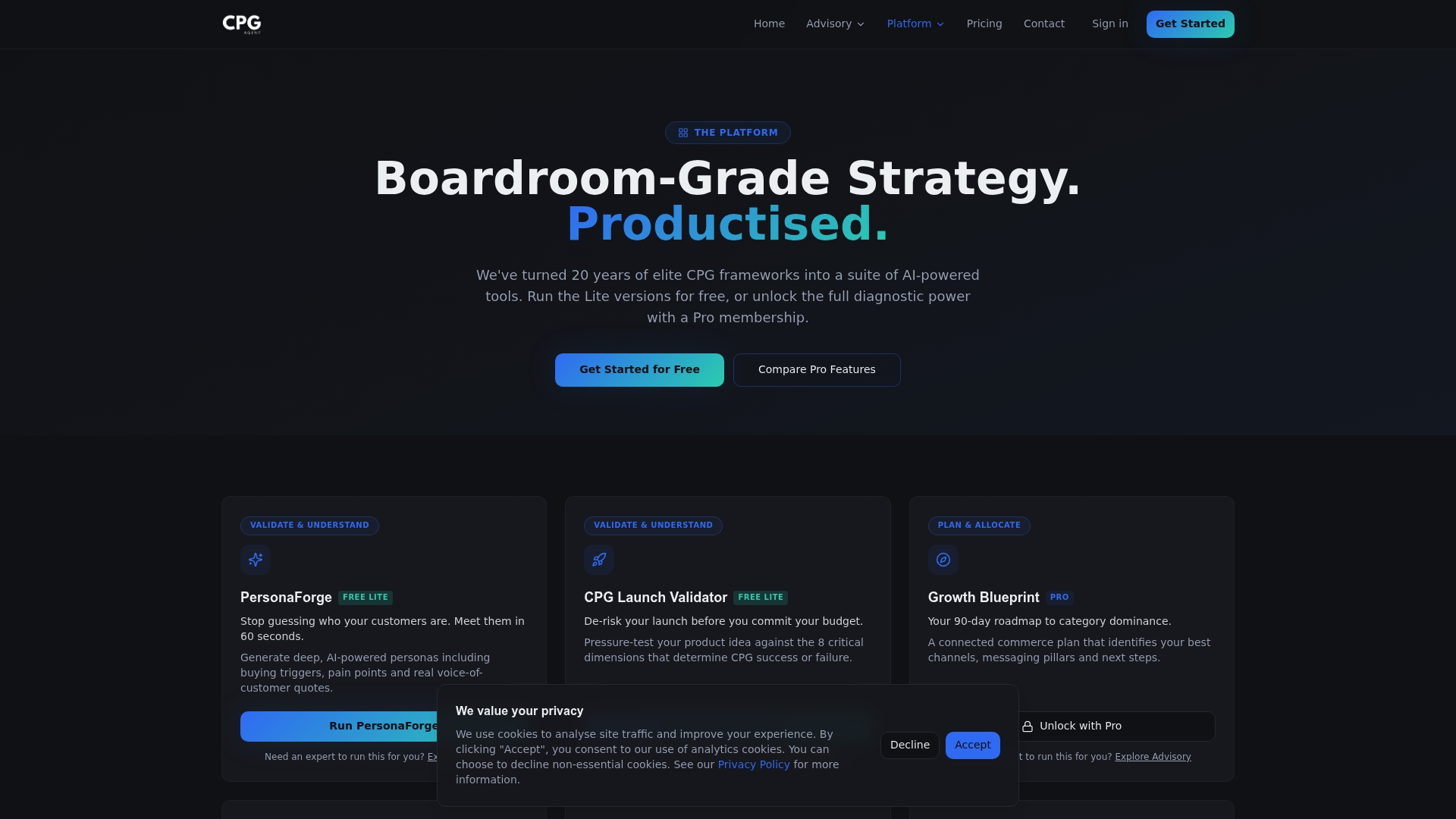
Start with PersonaForge Lite to map your first automated audience persona for free. It takes minutes and gives you the audience foundation every AI agent in your stack depends on. For established brands that want an expert team to deploy the full end-to-end infrastructure, including AI agents, content automation, paid media integration, and governance protocols, Cpgagent's Fractional CMO and Faceless Agency setup delivers that without a long-term agency contract. Visit Cpgagent to see how brands at every stage are replacing retainers with results.
FAQ
What is AI marketing infrastructure for food and beverage brands?
AI marketing infrastructure is the combination of data pipelines, AI agents, automation platforms, and governance protocols that allow a food and beverage brand to execute marketing at scale with minimal manual effort. It replaces fragmented agency retainers with a connected, data-driven system.
How long does it take to build AI marketing infrastructure?
A phased 90-day implementation is the standard timeline, covering data audit, pilot workflow activation, and full multi-channel deployment. Brands with clean data infrastructure can see qualified lead improvements within the first 90 days.
What data do I need before deploying AI marketing agents?
You need at least 12 months of historical performance data across all active channels, with connected ETL pipelines and attribution models that achieve above 85% accuracy. Broken or siloed data is the leading cause of AI agent failure.
How do food brands maintain compliance with AI-generated content?
All AI-generated content touching health claims, ingredients, or certifications must pass human editorial review before publication. AI content-screening tools and strict source data governance are required to meet FDA and FTC standards.
Can a small food brand afford AI marketing infrastructure?
Yes. Productized AI tools like PersonaForge and automated workflow platforms replace expensive agency retainers at a fraction of the cost. The zero-retainer framework is specifically designed for brands that need enterprise-level marketing output without enterprise-level overhead.