

Automated workflows cut significant operational costs for CPG and FMCG marketing teams that replace manual, repetitive tasks with connected sequences of RPA bots, API integrations, low-code logic, and AI models. The gains show up fast: fewer hours lost to campaign trafficking, fewer errors in trade promotion setups, and faster time-to-shelf for new products. Platforms like Cpgagent combine AI-driven tools with fractional leadership to make those gains stick across the whole brand stack.
The core efficiency drivers of CPG automation:
- RPA and API orchestration to move data between retail portals, ERP systems, and media platforms without manual re-entry
- Low-code workflow builders that let marketing teams deploy automations without waiting on IT
- AI models for creative variant generation, persona research, and launch signal validation
- Human approval gates embedded in the sequence for decisions that genuinely need judgment
Table of Contents
- How automated workflows improve efficiency across CPG marketing
- Which marketing workflows should CPG brands automate first?
- How do you measure efficiency gains from automation?
- A step-by-step roadmap for CPG marketing automation
- Governance, data quality, and U.S.-specific considerations
- Common pitfalls and how to avoid them
- How Cpgagent combines AI tools and fractional leadership for CPG efficiency
- Key Takeaways
- What the first six months actually look like
- Cpgagent gives CPG brands a faster path to automation ROI
- Useful sources
- FAQ
How automated workflows improve efficiency across CPG marketing
The numbers are concrete. Employees on high-impact automation programs recover an average of 200–250 hours per year, and workers broadly estimate saving 3.6 hours per week once automation is running. For a five-person CPG marketing team, that is roughly 900 hours annually redirected from data entry and status updates to strategy and creative.
Beyond time, the compounding effect across functions is where CPG brands feel it most:
- Marketing ops: Campaign setup time drops when briefing, asset trafficking, and audience segmentation run on predefined rules
- Trade promotions: Automated approval routing and retailer notification cut cycle time and reduce costly miscommunications
- Retail execution: Shelf audit data flows directly into dashboards instead of sitting in spreadsheets for days
- Finance: Cost-per-task falls as throughput rises without adding headcount
Automating customer-facing workflows also shortens time-to-value, which in CPG terms means faster activation at shelf and quicker response to competitive moves. Brands that still rely on manual processes simply cannot match that cadence.
Stat: Basic workflow automation delivers 20%–30% operational cost reduction; hyperautomation can push that figure further still.
Which marketing workflows should CPG brands automate first?
The prioritization rule is simple: high transaction volume plus low decision complexity equals the fastest ROI. In CPG, that points to a clear list.
- Campaign setup and trafficking: Briefing templates, asset routing, and media platform uploads repeat dozens of times per quarter with near-zero variation
- Creative variant generation: AI tools can produce copy and visual concepts at scale, feeding A/B tests without a designer bottleneck
- Retail shelf audits: Computer vision and automated audit workflows replace manual store checks and surface compliance gaps in real time
- Launch validation: Automated go-to-market validation stress-tests positioning and demand signals before a full retail rollout
- Trade promotion management: Approval chains, retailer submissions, and post-event reconciliation are rule-based and high-volume
- Persona generation and segmentation: AI-driven persona tools cut research time from weeks to hours
- Order and shipping notifications: Retailer and distributor updates that currently require manual email chains
Revenue-attached workflows, particularly launch validation and shelf compliance, tend to deliver the highest ROI because errors there cost margin, not just time.
Pro Tip: Start with the workflow that has the highest weekly transaction count and the clearest pass/fail rule. If a human is making the same decision more than 20 times a week, that decision belongs in an automation.

How do you measure efficiency gains from automation?
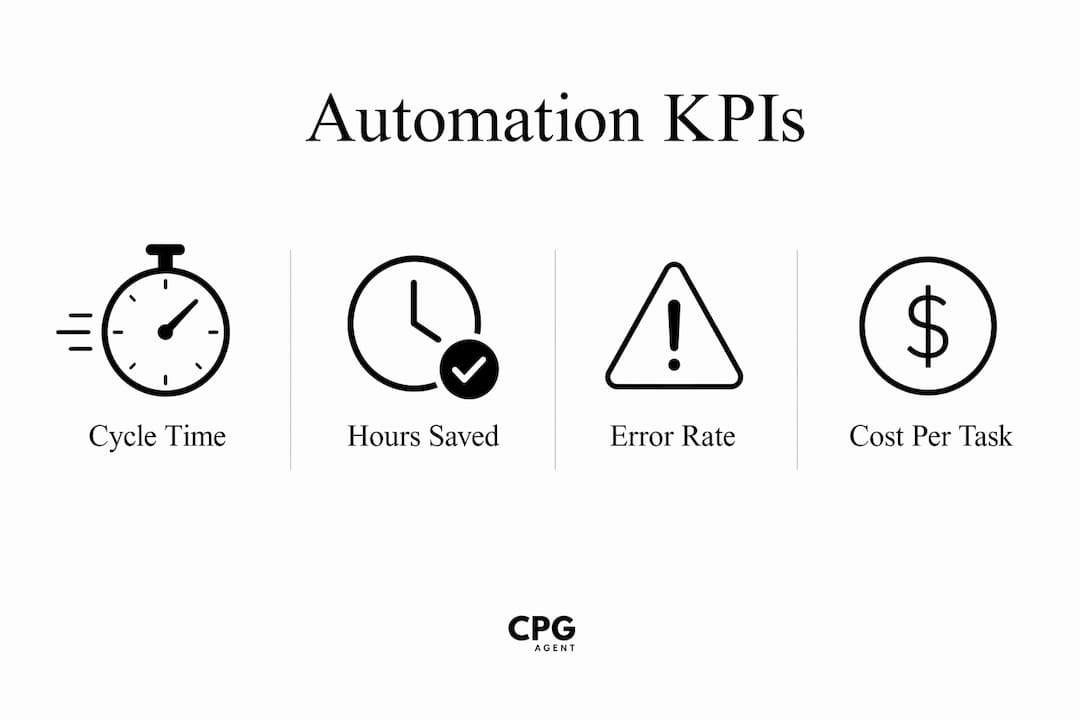
Set your KPIs before the pilot launches, not after. The metrics that matter most for CPG marketing automation:
| KPI | What it measures | Target for a 90-day pilot |
|---|---|---|
| Cycle time | Hours from task trigger to completion | Significant reduction |
| Hours saved | Team hours recovered per week | Several hours per person |
| Error/rework rate | Tasks requiring manual correction | Low rate |
| Cost per task | Fully loaded cost to complete one workflow run | Noticeable reduction |
| Time-to-market | Days from brief to shelf-ready asset | Faster turnaround |
| Marketing ROI | Revenue influenced per dollar of marketing spend | Positive growth over baseline |
A simple pilot ROI formula: (Hours saved per week × fully loaded hourly rate × weeks in pilot) minus incremental automation cost. For a team saving 15 hours per week at $75 per hour over 12 weeks, gross savings are $13,500. If the automation tool costs $2,000 for the quarter, net return is $11,500 in the pilot alone. Forrester composite modeling shows payback under six months is achievable for organizations that scope pilots correctly.
Dashboards tracking cycle time and bottlenecks turn automation from a set-and-forget deployment into a tunable system. Without them, failures compound silently.
Stat: Nearly 60% of business process automation initiatives report positive ROI within 12 months of implementation.
A step-by-step roadmap for CPG marketing automation
-
Process audit (weeks 1–2): Map every repeatable marketing task. Document transaction volume, current cycle time, error rate, and owner. Flag tasks with more than 10 weekly repetitions and clear decision rules as automation candidates.
-
Prioritize (week 3): Rank candidates by volume × impact. Pick one or two workflows for the pilot. Resist the urge to automate everything at once.
-
Pilot build (weeks 4–8): Use low-code building blocks and pre-built connectors to deploy quickly. Assign one automation owner and one tech steward. Set a baseline metric before go-live.
-
Integrate and monitor (weeks 9–12): Connect the automation to your existing stack (ERP, DAM, retail portals). Track KPIs weekly. Hold a mid-pilot review at week 6 to catch scope drift early.
-
Scale and optimize (months 4–6+): Once the pilot hits its targets, document the playbook and replicate the pattern across the next-priority workflows. Quarterly governance reviews keep the program from accumulating technical debt.
A 60–90 day timeline is realistic for a single well-scoped workflow. Trying to automate three or four processes simultaneously in the first quarter is the most common reason pilots stall.
Governance, data quality, and U.S.-specific considerations
Automation amplifies whatever data quality exists underneath it. Bad SKU records, mismatched retailer IDs, and stale price lists will produce wrong outputs faster and at greater scale than a human ever could.
- Master data hygiene first: Audit SKU records, UPC codes, and retailer portal IDs before building any automation that touches them
- Define roles clearly: Every automation needs an owner (accountable for outcomes), a tech steward (responsible for the integration), and a business process owner (who approves rule changes)
- U.S. data handling: Consumer data collected through marketing automations must comply with applicable state privacy laws. Vendor contracts should specify data residency, retention limits, and audit trail requirements for retail partners
- Escalation paths: Build a manual override into every automated workflow so a human can intervene without breaking the sequence
Pro Tip: A quarterly automation review cadence, with the owner, tech steward, and a senior marketing leader in the room, catches governance gaps before they become compliance issues.
Common pitfalls and how to avoid them
Over-automation is the most expensive mistake. Automating a process that requires contextual judgment, like a creative brief that needs brand voice input, produces outputs no one trusts. The fix: map decision complexity before automating. If the rule cannot be written down in two sentences, keep a human in the loop.
Poor scoping kills pilots before they prove value. Building a large end-to-end automation before stabilizing inputs means every upstream data change breaks the whole sequence. Start with a single, bounded workflow with clean inputs.
Neglecting monitoring lets failures cascade. An automation that silently produces wrong retailer submissions for two weeks does more damage than the manual process it replaced. Every workflow needs an alert threshold and a dashboard.
How Cpgagent combines AI tools and fractional leadership for CPG efficiency
A mid-sized FMCG brand preparing a regional retail launch faces a familiar problem: the marketing team is running persona research, validating positioning, and managing shelf compliance checks manually across three retail partners. Each task takes days. Launch timelines slip.
With Cpgagent's AI-driven platform, the workflow looks different:
- PersonaForge generates validated consumer personas in hours, feeding creative briefs directly into campaign setup workflows
- Launch Validator runs automated demand signal and positioning checks before the brand commits to a full retail rollout, cutting pre-launch risk
- Retail audit orchestration surfaces shelf compliance gaps across partners in real time, replacing manual store visit reports
A fractional CMO from Cpgagent's advisory team oversees adoption, sets KPI targets for the pilot, and runs the governance cadence so the marketing team is not left to figure out change management alone.
Brands that pair AI automation tools with fractional leadership oversight typically reach pilot ROI targets faster because adoption barriers are addressed in week one, not discovered in week eight.
The result: faster time-to-shelf, fewer launch errors, and a marketing team that spends its hours on positioning and growth rather than data entry.
Key Takeaways
Automated workflows deliver measurable efficiency gains for CPG marketing teams when pilots are scoped tightly, KPIs are set before launch, and governance is built in from day one.
| Point | Details |
|---|---|
| Cost reduction is quantifiable | Basic automation cuts operational costs by 20%–30%; target this range in your pilot business case. |
| Hours recovered per person | Employees on high-impact automation use cases recover 200–250 hours per year, and workers generally estimate saving about 3.6 hours per week; use these benchmarks in your pilot. |
| Prioritize by volume and simplicity | High-transaction, low-judgment workflows (campaign trafficking, shelf audits, launch validation) deliver the fastest ROI. |
| Payback under six months is realistic | Forrester composite modeling shows sub-six-month payback for well-scoped automation programs. |
| Cpgagent accelerates the path | PersonaForge, Launch Validator, and fractional CMO support give CPG brands tools and oversight to hit pilot targets without heavy internal build. |
What the first six months actually look like
The conventional wisdom on automation ROI focuses on the steady-state numbers: 200–250 hours saved, 20%–30% cost reduction, faster time-to-market. Those figures are real, but they obscure what the first six months actually feel like on the ground.
Month one is mostly data cleanup and expectation management. The automation itself is often the easy part. The hard part is discovering that your SKU master data has three naming conventions, your retailer IDs do not match your ERP, and two people on the team have been maintaining parallel spreadsheets for the same workflow. None of that is a reason to stop. It is the reason the pilot exists.
Months two and three are where velocity builds. A well-scoped pilot starts producing clean outputs, the team stops second-guessing the automation, and the KPI dashboard starts showing real cycle time reduction. This is also when scope creep becomes a genuine risk. Every stakeholder who sees the pilot working wants to add their workflow to it immediately. Resist that pressure. Finish the pilot, document what worked, then expand.
Months four through six are about governance embedding and ROI reporting. The automation is running. The question shifts to: who owns it when something breaks, how do rule changes get approved, and how do you present the results to finance in a way that builds the case for the next phase? A fractional leader who has run this cycle before is worth more in this phase than any additional tool.
Cpgagent gives CPG brands a faster path to automation ROI
Most CPG marketing teams know they need automation. The gap is between knowing it and having the tools, the playbook, and the senior oversight to execute without a six-month agency engagement.
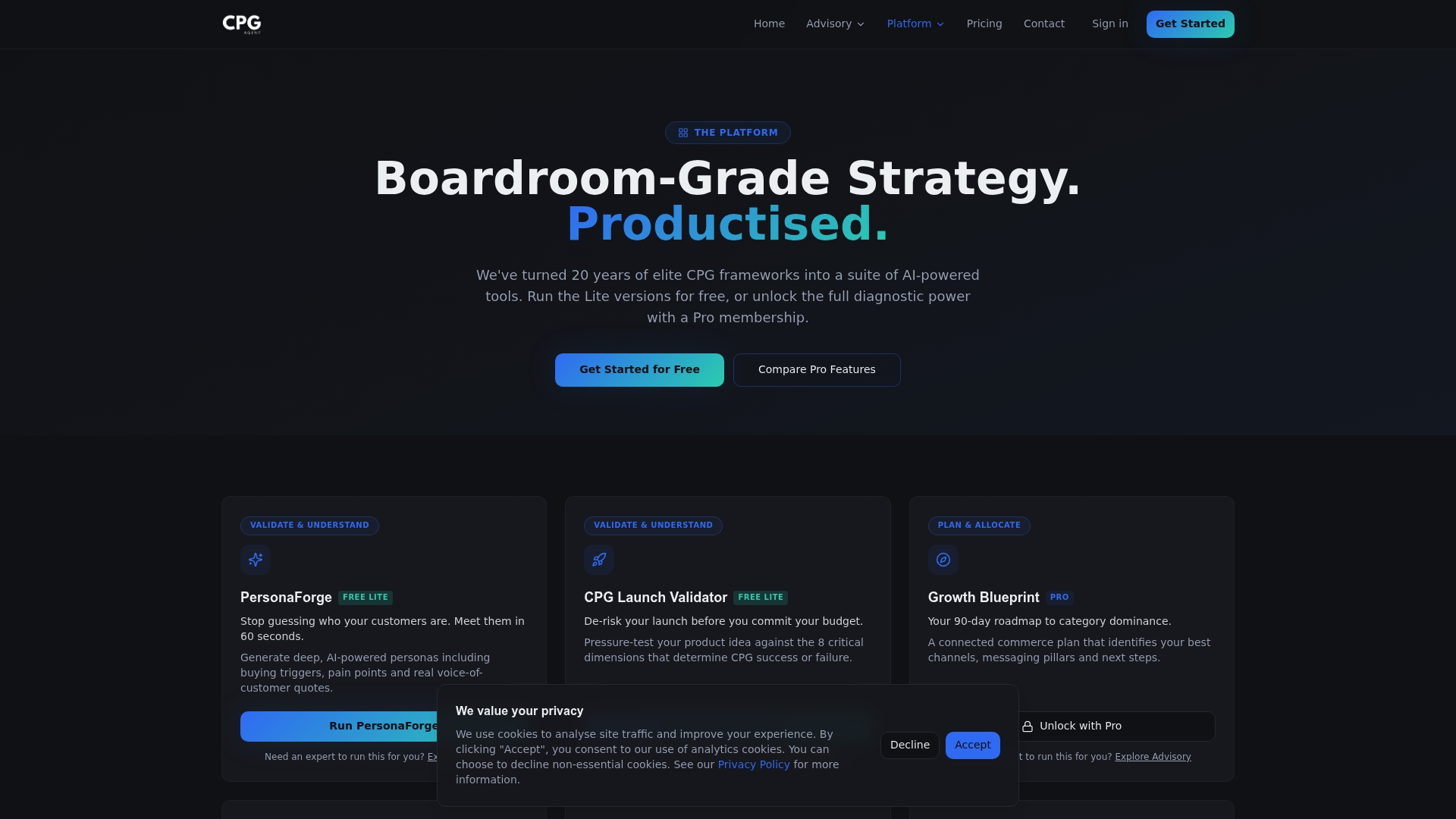
Cpgagent closes that gap. PersonaForge cuts persona research from weeks to hours. Launch Validator stress-tests your positioning before you commit shelf space. Retail audit workflows surface compliance gaps across partners in real time. And fractional CMO support means you have a senior marketing leader setting KPI targets, running governance reviews, and reporting results to your leadership team from week one.
A pilot engagement typically runs 60–90 days, targets measurable cycle time and cost reductions, and is designed to pay back within six months. No long discovery phase, no agency overhead.
Start your pilot and see what your team recovers in the first quarter.
Useful sources
- How Automation Drives Business Growth and Efficiency — Harvard Business Review sponsored content on AI-driven automation triggers and personalization at scale
- Workflow Automation Secrets: Save Time, Cut Costs, Grow Fast — Benchmark figures on cost reduction, hours recovered, and payback timelines
- Enterprise Workflow Automation: The Complete Guide — Throughput, monitoring, and governance frameworks for scaling automation
- Workflow Automation Benefits and Best Practices — Slack's State of Work data on weekly time savings
- Cpgagent Platform — AI tools and fractional leadership for CPG/FMCG brands ready to run a pilot
FAQ
How do automated workflows improve efficiency in CPG marketing?
They replace high-volume, rule-based tasks, like campaign trafficking, retail audit reporting, and trade promotion approvals, with connected software sequences, cutting cycle time and freeing the team for strategic work. Basic automation typically delivers 20%–30% operational cost reduction.
Which CPG workflows should you automate first?
Start with the highest-volume, lowest-judgment workflows: campaign setup, shelf audit data collection, and launch validation. These deliver the fastest ROI because the rules are clear and the transaction count is high.
What KPIs should you track in an automation pilot?
Cycle time reduction, hours saved per person per week, error rate, and cost per task are the core four. Set baselines before go-live so you can report results cleanly to finance and leadership.
How long does it take to see ROI from workflow automation?
Forrester composite modeling shows payback under six months is achievable for well-scoped programs. A single CPG marketing workflow piloted over 60–90 days can show positive net return within the quarter.
How does Cpgagent support CPG automation?
Cpgagent provides AI tools including PersonaForge for persona research and Launch Validator for pre-launch demand validation, plus fractional CMO advisory to set KPIs, manage governance, and report results. The platform is built specifically for CPG and FMCG brands.