

A brand refresh updates how your brand looks and sounds. A rebrand changes what your brand fundamentally is. The single question that decides between them: is your positioning still right, or has your audience, offer, or competitive context shifted underneath you?
If positioning holds and the problem is purely visual or tonal, a refresh gets you there in 3–6 months. If the foundation has moved, a refresh is money spent on the wrong problem. That's when a full rebrand, typically 12–24 months and significantly higher investment, becomes the only path that actually works.
Quick decision guide:
- Choose a refresh when your brand is recognized, your positioning is sound, and the visual expression or messaging has aged out.
- Choose a rebrand when you've entered a new market, changed your core audience, survived a merger, or your current brand actively works against growth.
- Refresh timeline: 3–6 months for mid-market; 1–3 months for smaller teams.
- Rebrand timeline: 12–24 months for mid-market; 4–9 months for smaller organizations.
- Before either: run a Foundation Diagnostic (covered in Section 4) to confirm which path your situation actually calls for.
Table of Contents
- What exactly is a brand refresh versus a rebrand?
- How do they compare across the dimensions that actually matter?
- How do you decide which one you actually need?
- What deliverables should you expect from each?
- What do realistic timelines and budgets look like?
- What are the biggest risks, and how do you get ahead of them?
- How do you run the rollout from start to finish?
- What do real brand changes teach us?
- How do you measure whether it worked?
- Cpgagent's recommendation for CPG brands
- Key Takeaways
- The half-rebrand is the most expensive mistake in brand strategy
- Cpgagent helps CPG brands make the right call and execute it
- Useful sources
- FAQ
What exactly is a brand refresh versus a rebrand?
These two terms get used interchangeably in briefs and boardrooms, and that confusion costs teams real money. They are not the same thing.
A brand refresh modernizes the expression of a brand without touching its strategic foundation. Think of it as updating the wardrobe, not the person. Typical refresh work includes logo refinement (not replacement), color palette updates, typography modernization, tone-of-voice adjustments, and messaging tweaks. The brand's name, core positioning, and audience stay intact. Coca-Cola has done this repeatedly over decades, tightening its visual system and updating its taglines while keeping the red, the contour bottle, and the emotional territory of happiness completely untouched. Apple's visual identity has evolved continuously since the late 1990s, moving from rainbow to monochrome to the current flat system, yet the brand's positioning around simplicity and human-centered design has never wavered.
A full rebrand is a different category of work. Rebranding is strategic work that happens upstream of design and must align to a genuine shift in business goals. It typically involves repositioning (who you serve and why you're different), sometimes a name change, a new visual identity built from scratch, revised brand architecture, and often a redesigned digital experience. Burberry's transformation from a brand associated with counterfeit streetwear back to British luxury is a textbook rebrand: the company changed its distribution strategy, its creative direction, its pricing, and its visual identity simultaneously. That's not a wardrobe update. That's a new identity built on a new strategic foundation.
The practical distinction: a refresh preserves recognition while a rebrand intentionally changes perception. One protects equity; the other rebuilds it.
How do they compare across the dimensions that actually matter?
| Dimension | Brand Refresh | Full Rebrand |
|---|---|---|
| Scope of change | Visual expression, messaging, tone | Positioning, naming, architecture, full visual system |
| Timeline | 3–6 months (mid-market); 1–3 months (SMB) | 12–24 months (mid-market); 4–9 months (SMB) |
| Cost range | $50K–$500K (mid-market); $10K–$40K (SMB) | $1M–$10M+ (mid-market); $25K–$100K (SMB) |
| Risk to brand equity | Low; recognition is preserved | High; customer familiarity may drop before it rebuilds |
| SEO/digital impact | Minimal if URLs and domain stay unchanged | Significant; domain changes, URL restructuring, and SERP ranking loss are real risks |
| Organizational resourcing | Marketing, design, and content teams | CMO, legal, product, sales, IT, external agencies |
| Typical deliverables | Refreshed logo, updated palette, new messaging, asset library | New positioning, name (sometimes), full visual system, UX redesign, brand guidelines |
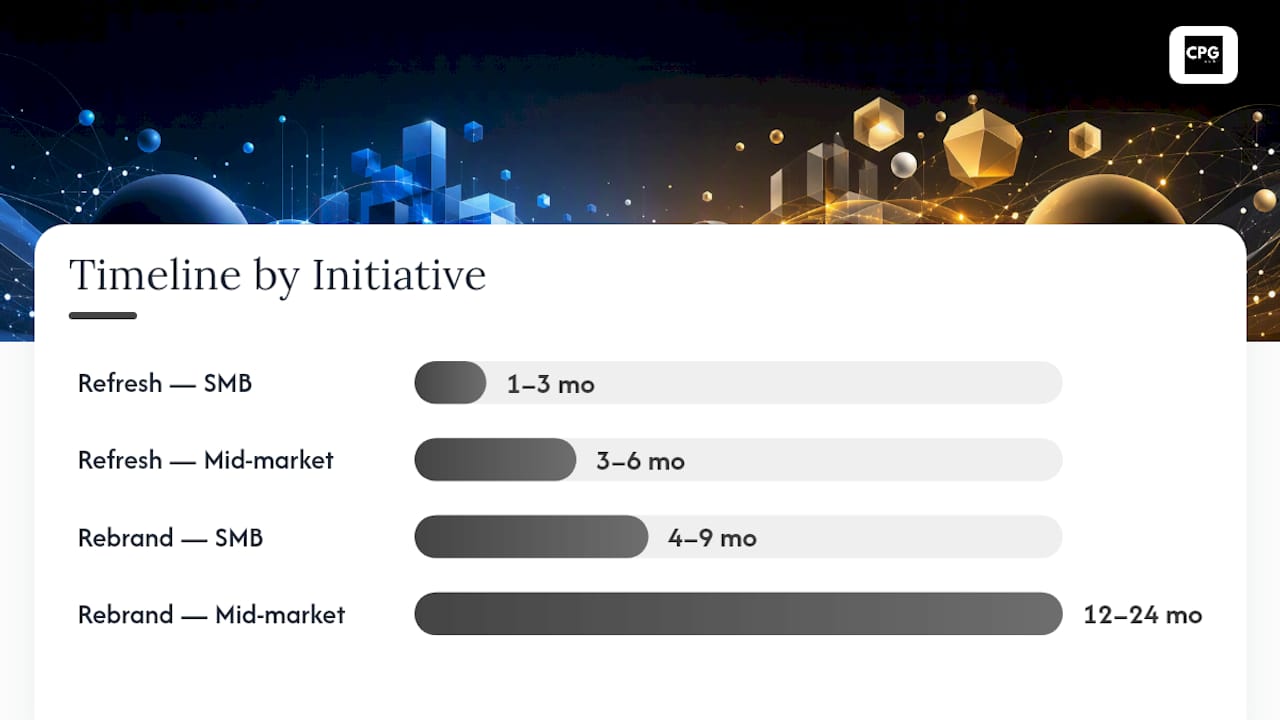
The cost and timeline figures above reflect mid-market and SMB ranges from industry research. Enterprise programs with global rollouts, naming/legal work, and packaging redesigns across hundreds of SKUs push well past the upper bounds.
Which differences matter most by stakeholder? CMOs care about timeline and equity risk. Legal cares about naming clearance and trademark exposure. Product and sales care about customer confusion and pipeline disruption during the transition. Finance cares about the cost range and what drives it wider. Knowing which concern belongs to which room shapes how you present the decision.
How do you decide which one you actually need?
The most useful distinction is depth: a refresh works at the surface while a rebrand changes the foundation. Start with a Foundation Diagnostic before you commit to either path.
The Foundation Diagnostic: three questions
- Is your current customer still the right customer for your business in three years?
- Is your current offer still the right offer for that customer?
- Does your current brand tell the right story about that offer to that customer?
If you answer yes to all three, you need a refresh at most. If you answer no to question one or two, you need a rebrand. A no on question three alone points to a refresh. This sequence matters because a refresh is right when positioning is sound but the visual expression is dated; a rebrand is required when mission, audience, or strategy has fundamentally shifted.
Decision checklist: triggers for a refresh
- Visual identity looks dated relative to competitors on shelf or screen
- Messaging no longer reflects the brand's current tone or category language
- Brand assets are inconsistent across channels but the strategy is solid
- You're entering a new channel (e.g., DTC) that requires a cleaner visual system
- Customer recognition is strong but purchase consideration has softened
Decision checklist: triggers for a rebrand
- You've merged with or acquired another company
- You've pivoted to a new audience or category
- The brand carries reputational damage that visual updates won't fix
- Your name or identity is legally or culturally problematic in a new market
- Research shows customers fundamentally misunderstand what you do
Stakeholder questions to surface the real problem
- "When customers describe us, do they describe the brand we want to be?" (If no, is that a messaging problem or a positioning problem?)
- "Is our current name and identity a barrier to the deals or shelf placements we're losing?"
- "Would a new logo and updated copy fix this, or would we still have the same problem six months later?"
That last question is the most honest filter. If the answer is "we'd still have the same problem," you're looking at a rebrand. You can also create a brand brief without a creative agency to structure the diagnostic before you bring vendors into the room.
What deliverables should you expect from each?
The deliverable list is where scope creep and budget overruns begin. Get specific before you sign anything.
Brand refresh deliverables
A well-scoped refresh typically produces: a refined logo (adjusted proportions, updated weight, modernized details), an updated color palette with accessibility-compliant hex and Pantone values, revised typography guidelines, a refreshed messaging framework (tagline, brand voice, key messages), updated photography and illustration direction, and a refreshed asset library covering digital, print, and packaging templates. Common refresh deliverables also include logo simplification, typography updates, and messaging tweaks that bring the brand in line with current category conventions without breaking recognition.
Who delivers it: in-house design and brand teams handle asset production; a brand consultancy or senior designer leads the visual direction; a copywriter or brand strategist handles messaging. Legal is rarely involved unless a trademark filing is needed for a new tagline.
Full rebrand deliverables

A rebrand scope expands significantly: new positioning statement and brand architecture, naming (including legal clearance and trademark filing), a complete visual identity system (logo, color, typography, iconography, photography direction), revised UX and digital design system, updated packaging across all SKUs, a new brand guidelines document, and a comprehensive asset migration plan. For CPG brands, packaging redesign alone can represent a substantial portion of the total budget and timeline.
What teams consistently underbudget
Brand guidelines governance, asset migration to a digital asset management (DAM) platform, and internal training. These three items are almost always treated as afterthoughts and almost always cause the longest post-launch delays. If your rollout plan doesn't include a DAM strategy and a governance owner, build that in before you finalize the budget. For CPG brands specifically, modernizing a legacy brand identity requires a clear asset migration plan from day one.
What do realistic timelines and budgets look like?
Timeline by phase
Brand refresh (mid-market, 3–6 months):
- Discovery and audit: 2–4 weeks
- Strategy and direction: 2–4 weeks
- Design and messaging development: 4–8 weeks
- Stakeholder review and refinement: 2–4 weeks
- Asset production and rollout: 4–8 weeks
Full rebrand (mid-market, 12–24 months):
- Discovery, research, and Foundation Diagnostic: 4–8 weeks
- Positioning and strategy: 6–10 weeks
- Naming and legal clearance: 8–16 weeks
- Visual identity development: 8–16 weeks
- Brand guidelines and system build: 4–8 weeks
- Asset migration and production: 12–24 weeks
- Phased rollout and stewardship: ongoing
Survey data shows the average rebrand takes approximately seven months, with updating marketing assets consistently reported as the hardest and most time-consuming task. For CPG brands with large packaging portfolios, asset migration alone can extend the timeline by months.
Budget bands (U.S. market)
| Organization size | Refresh range | Rebrand range |
|---|---|---|
| SMB | $10K–$40K | $25K–$100K |
| Mid-market | $50K–$500K | $1M–$10M+ |
What drives the spread: asset volume (number of SKUs, markets, and channels), whether naming and legal work is required, global versus domestic rollout, and whether you're redesigning digital products alongside brand identity. For lean CPG teams working with tighter budgets, a phased refresh approach can deliver meaningful results at the lower end of the SMB range.
Resourcing checklist
- Brand strategy lead (internal CMO or fractional)
- Design director or senior brand designer
- Copywriter and brand voice specialist
- Legal counsel for trademark clearance (rebrand only)
- DAM administrator or platform owner
- IT/web team for digital asset migration
- External packaging agency (CPG rebrands)
- Project manager to coordinate vendor governance
What are the biggest risks, and how do you get ahead of them?
Customer recognition loss
A refresh carries low risk here because the brand stays recognizable. A rebrand carries real risk, particularly in CPG where shelf recognition drives repeat purchase. Mitigation: run a phased rollout, starting with digital channels before packaging, and use a "bridge" period where old and new assets coexist with clear transition messaging. Challenger brands that communicate change clearly tend to retain loyalty better than those that switch overnight.
SEO and digital impact
A refresh that preserves your domain and URL structure has minimal SEO risk. A rebrand that involves a domain change or significant URL restructuring is a different situation. Mitigation: implement 301 redirects for every changed URL, update your XML sitemap, notify Google Search Console, and monitor organic traffic weekly for at least 90 days post-launch. Preserve high-authority inbound links wherever possible by reaching out to linking domains before you switch.
Legal exposure
Name changes and new marks require trademark clearance before public launch. A rebrand without legal clearance is a liability. Mitigation: run a trademark search through the USPTO database early in the naming process, not at the end. Budget 8–16 weeks for naming and legal clearance in your project plan.
Internal resistance
Internal buy-in and leadership storytelling are the most common failure points in rebrands. Teams that discover the new brand at the same time as the public rarely advocate for it. Mitigation: treat employees as the first audience. Run internal brand briefings and leadership storytelling sessions before the external launch date.
Pro Tip: If you aren't ready to overcommunicate the "why" to your own team, you aren't ready to launch externally. Build an internal launch event into the project plan, not as a nice-to-have but as a hard milestone.
How do you run the rollout from start to finish?
Phase 1: Discovery and diagnostic (weeks 1–6)
Run the Foundation Diagnostic. Conduct stakeholder interviews with leadership, sales, and customer-facing teams. Audit existing brand assets, guidelines, and competitive positioning. Document what's working and what isn't. Confirm the scope: refresh or rebrand.
Phase 2: Strategy and direction (weeks 4–12)
Align on positioning, audience definition, and brand architecture. For a rebrand, this is where naming exploration begins. For a refresh, this phase produces a revised messaging framework and a visual direction brief.
Phase 3: Design and development (weeks 8–24)
Develop visual identity options, messaging, and guidelines. For a rebrand, this includes naming, trademark filing, and full system development. For a refresh, this is focused on the specific elements being updated.
Phase 4: Internal launch and training (weeks 20–28)
Brief internal teams before any external announcement. Distribute brand guidelines. Train customer-facing teams on new messaging. Load assets into your DAM platform.
Phase 5: External rollout (phased)
Launch digitally first (website, social, email). Follow with packaging, point-of-sale, and trade materials on a scheduled timeline. Use a pilot market or product line for a rebrand to test customer response before full rollout.
Phase 6: Post-launch governance
Assign a brand steward. Establish a quarterly brand audit cadence. Monitor DAM usage and enforce guidelines through a clear approval process. Asset governance and a single source of truth are what separate brands that maintain consistency from those that drift back to chaos within 18 months.
What do real brand changes teach us?
Coca-Cola: the case for a disciplined refresh
Coca-Cola has updated its visual identity dozens of times since the 1970s without ever abandoning its core equity. The "One Brand" strategy introduced in 2016 unified Coca-Cola, Diet Coke, Coke Zero, and Coke Life under a single visual architecture while keeping the iconic red and contour bottle central. The lesson: when your positioning is strong and your recognition is high, a disciplined refresh that tightens the system delivers more value than a rebrand that risks what's already working.
Burberry: when a rebrand is the only real option
By the early 2000s, Burberry's signature plaid had been so widely counterfeited and associated with a demographic the brand didn't want to serve that a visual refresh would have been cosmetic noise. The company needed a full repositioning: new creative direction under Christopher Bailey, reduced licensing, tighter distribution, and a rebuilt visual identity. The lesson: when the brand's core associations actively block growth, no amount of logo refinement fixes the underlying problem. A rebrand is required when perception has fundamentally broken from strategy.
Gap: the cost of skipping the diagnostic
In 2010, Gap launched a new logo without a strategic rationale, customer research, or internal alignment. The backlash was immediate and the company reverted to the original logo within a week. The lesson: a visual change without a strategic foundation is neither a refresh nor a rebrand. It's a design decision masquerading as brand strategy. Running a Foundation Diagnostic first would have surfaced that Gap's problem wasn't its logo.
Key patterns across all three:
- Refreshes work when the strategic foundation is intact and recognition is an asset.
- Rebrands are required when perception has decoupled from strategy.
- Skipping the diagnostic phase produces the most expensive outcomes.
How do you measure whether it worked?
KPIs for a brand refresh
- Brand recognition scores (pre/post survey)
- Net Promoter Score (NPS) trend
- Design consistency audit score across channels
- Conversion rate lift on updated digital assets
- Share of voice in owned and earned media
KPIs for a full rebrand
- Brand consideration and preference scores (tracked quarterly)
- Category share movement (6–12 month horizon)
- Enterprise or key account sales metrics (new logo acquisition)
- Organic search traffic recovery post-migration
- Employee brand advocacy scores (internal NPS)
Monitoring schedule
- Baseline: capture all metrics before launch.
- 30-day pulse: check recognition, organic traffic, and conversion rates.
- 90-day review: assess NPS, consideration scores, and any SEO recovery.
- 6–12 month tracking: measure category share, retention, and revenue attribution.
Connect brand KPIs to revenue and retention metrics from the start. Leadership will ask for ROI evidence, and "the logo looks better" is not an answer. Linking brand metrics to pipeline contribution and retention rates is what gets brand investment protected in the next budget cycle.
Pro Tip: Build your measurement dashboard before launch, not after. Retroactive baseline data is almost always incomplete, which makes post-launch attribution harder to defend.
Cpgagent's recommendation for CPG brands
For CPG and FMCG brands specifically, the stakes on this decision are higher than in most categories. Packaging changes cost real money. Shelf resets happen on retailer timelines, not yours. And customer recognition at the shelf is a purchase driver that takes years to build and months to lose.
Cpgagent's consistent recommendation: run the Foundation Diagnostic before you brief any agency or internal team on scope. The diagnostic takes roughly one week and answers the three questions that determine whether you need a refresh or a rebrand. Skipping it is how brands end up spending $500K on a refresh that doesn't fix a positioning problem, or $2M on a rebrand when a $75K refresh would have done the job.
When the diagnostic points to a refresh:
- Prioritize packaging and digital assets first (highest customer touchpoints).
- Update messaging before visuals; misaligned copy undermines even a strong new look.
- Build a governance plan into the project from week one.
When the diagnostic points to a rebrand:
- Start with positioning and naming before any design work begins.
- Treat legal clearance as a hard dependency, not a parallel track.
- Plan for 12–18 months minimum and staff accordingly.
Industry research consistently shows that mid-market rebrands run $1M–$10M+ and take 12–24 months. Teams that underestimate scope at the outset almost always overspend and underdeliver. The diagnostic is the cheapest insurance available.
Cpgagent's AI-powered strategy platform supports both paths: persona research and positioning diagnostics for the strategic phase, and fractional CMO advisory for teams that need senior leadership without a full-time hire. For CPG brands navigating refresh strategies across multiple product lines, the platform provides the data-backed frameworks to make the decision with confidence.
Key Takeaways
A brand refresh updates expression while a rebrand resets the foundation, and choosing the wrong path costs more than running a Foundation Diagnostic first.
| Point | Details |
|---|---|
| Refresh vs. rebrand defined | A refresh modernizes expression; a rebrand changes positioning, naming, and identity from the ground up. |
| Run the diagnostic first | Three questions about customer, offer, and brand story determine which path you actually need before any agency is briefed. |
| Timeline and cost reality | Mid-market refreshes run 3–6 months and $50K–$500K; rebrands run 12–24 months and $1M–$10M+. |
| Asset governance is the hardest part | Updating marketing assets is the most time-consuming rebrand task; plan DAM governance from week one. |
| Cpgagent for CPG execution | Cpgagent's platform and fractional CMO advisory support both the diagnostic phase and the full execution for CPG and FMCG brands. |
The half-rebrand is the most expensive mistake in brand strategy
The conventional wisdom says: "When in doubt, start with a refresh." That's not wrong, but it misses the real trap. The most expensive outcome isn't choosing a rebrand when you needed a refresh. It's choosing a refresh when you needed a rebrand, spending $150K on new assets, and then discovering six months later that the underlying positioning problem is still there. Now you've spent the refresh budget and you still need the rebrand.
What I see consistently in CPG brands is that the decision gets made based on budget availability, not diagnostic evidence. The refresh gets approved because it's cheaper and faster. The rebrand gets deferred because it's uncomfortable. And then the brand sits in a half-changed state: new logo, old positioning, confused customers, and a sales team that can't explain what changed or why.
The internal politics piece is real too. A rebrand requires leadership to admit that the current brand isn't working. That's a harder conversation than "let's modernize the look." Leadership storytelling and internal alignment aren't soft skills in this context; they're the difference between a rebrand that sticks and one that gets quietly abandoned after the launch event.
My honest recommendation: treat the Foundation Diagnostic as non-negotiable. It's one week of structured questions. The answers will either confirm that a refresh is right, or they'll surface the positioning gaps that make a rebrand unavoidable. Either way, you walk into the agency brief with evidence instead of assumptions.
Cpgagent helps CPG brands make the right call and execute it
Most CPG brands don't fail at the rebrand or refresh itself. They fail at the decision that precedes it, and then they fail again at the governance that follows it.
Cpgagent is built for exactly this gap. The platform gives brand managers and founders access to AI-powered positioning diagnostics, persona research tools, and growth roadmaps that surface whether your brand's foundation is solid or cracked before you spend a dollar on design. For teams that need senior leadership through the process, Cpgagent's fractional CMO advisory puts experienced CPG brand strategists in the room without the cost of a full-time hire.
The result: faster decisions, cleaner briefs, and rollouts that don't stall at the asset migration stage. Whether you're running a focused refresh on a single product line or navigating a full portfolio rebrand, the Cpgagent platform gives you the diagnostic tools and expert support to execute with confidence. Book a strategy session or start a platform trial to run your Foundation Diagnostic this week.
Useful sources
The following sources informed this article and are worth bookmarking for internal presentations, vendor RFPs, and procurement materials:
- Rebranding: How to Do It Right (Without Wrecking What You’ve Built) - Neil Patel
- What Is a Brand Refresh? Definition, Process, and Examples - Advergize
- Rebranding: A complete guide on how to rebrand
- Rebranding: A complete guide on how to rebrand - Bynder
- What Is a Brand Refresh? (HubSpot guide and examples)
- Rebrand vs Refresh: Which Does Your Business Actually Need? | Patrick Iverson
- Brand refresh vs rebrand: Shopify guide
- Brand Refresh vs Rebrand: What's the Difference? | Sponge
FAQ
What does a brand refresh mean?
A brand refresh updates a brand's visual expression, messaging, or tone without changing its core positioning or name. It modernizes how the brand looks and sounds while preserving existing customer recognition and equity.
What is the difference between a rebrand and a refresh?
A refresh works at the surface level, updating design and messaging while keeping the strategic foundation intact. A rebrand changes the foundation itself, including positioning, sometimes naming, and the full visual identity system, typically triggered by a merger, pivot, or fundamental audience shift.
How often should a brand refresh?
Most brands benefit from a visual and messaging review every 5–7 years, though fast-moving CPG categories may warrant a refresh sooner if the competitive visual environment shifts significantly or if brand assets become inconsistent across channels.
What are the four stages of branding?
Definitions vary by framework, but a common version covers: brand strategy (positioning, audience, differentiation), brand identity (visual and verbal expression), brand implementation (asset production and rollout), and brand stewardship (governance, consistency, and ongoing management). A refresh typically touches identity and implementation; a rebrand starts at strategy.
Can Cpgagent help with the refresh or rebrand decision?
Yes. Cpgagent's platform includes positioning diagnostics and persona research tools that support the Foundation Diagnostic process, and its fractional CMO advisory provides senior CPG brand strategy expertise for teams navigating either path.