

TL;DR:
- A bootstrap brand strategy is a decision-making framework that guides lean businesses to build credibility and generate profit without external funding. It emphasizes purpose, positioning, narrative, and discipline to say no to unnecessary opportunities. Effective execution relies on founder-led branding, consistent messaging, and regular feedback, enabling small brands to compete through clarity and focus.
A bootstrap brand strategy is a decision-making framework that guides lean businesses to build credibility and generate profit without relying on external funding. It is not a logo, a color palette, or a tagline. It is the operating system that tells you what to do, what to say, and what to refuse. Consistent branding reduces acquisition costs by up to 62%, which means getting your brand strategy right early is one of the highest-return investments a bootstrapped founder can make. If you are building a brand on a budget, this framework is where you start.
What is a bootstrap brand strategy?
A bootstrap brand strategy is a structured decision framework built around purpose, positioning, and narrative, with an explicit focus on profitable outcomes rather than long-term brand awareness. Traditional brand strategy often prioritizes building recognition over years through heavy advertising spend. Bootstrap brand strategy flips that priority. Every brand decision must either generate revenue now or protect the credibility that makes future revenue possible.
The term "bootstrap" comes from the idea of building something from nothing, pulling yourself up by your own bootstraps. In branding, it means you cannot afford to waste a dollar on aesthetics that do not drive commercial results. The standard industry term for this approach is "lean brand strategy," and both phrases describe the same discipline: focused, resource-efficient brand building that treats every creative and messaging choice as a business decision.
Strong brand positioning acts as an insurance policy against price-based competition, helping bootstrapped businesses avoid the commodity trap. That matters enormously when you cannot outspend a competitor on ads. Your brand becomes your moat.
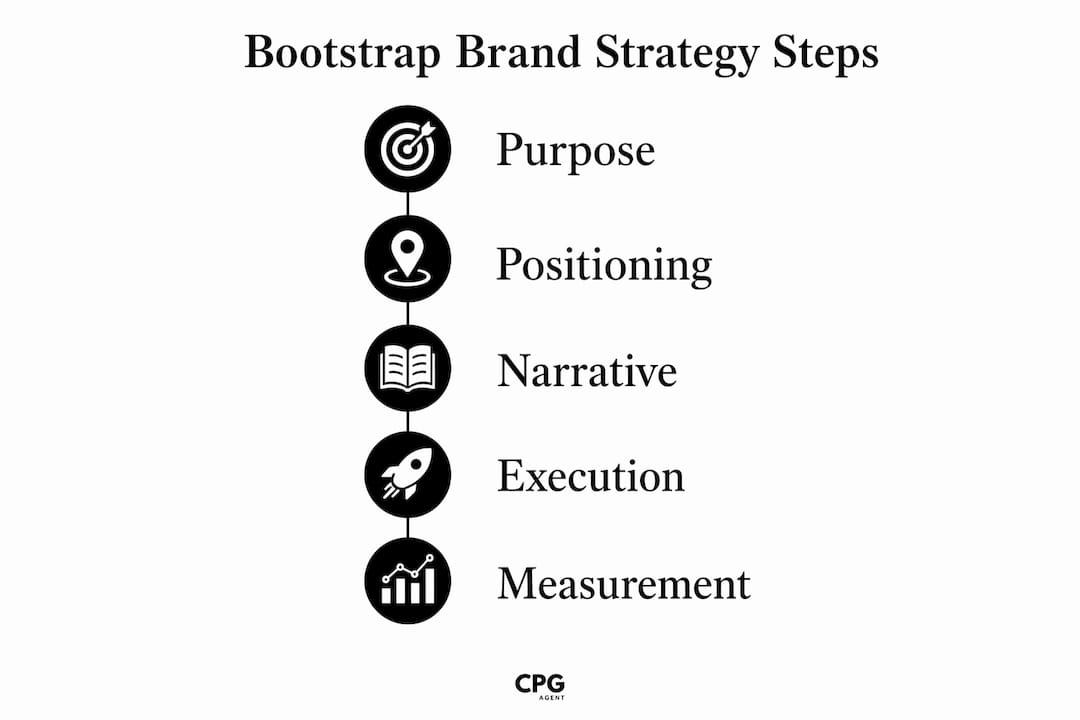
What are the key components of an effective bootstrap brand strategy?
Four components define a bootstrap brand strategy that actually works.
- Purpose aligned with immediate goals. Your brand mission cannot be abstract. It must connect directly to the problem you solve and the customer who pays you. "We help independent retailers compete with big-box stores through smarter inventory tools" is a purpose. "We empower communities" is not.
- Positioning integrity. You need a clear, specific audience and a differentiated reason for them to choose you. A brand positioning statement forces you to name your customer, their problem, your solution, and why you are different. Vague positioning wastes every marketing dollar you spend.
- Coherent narrative. Your values, your mission, and your customer's world must connect in a single, consistent story. When a prospect reads your website, hears your founder on a podcast, and sees your packaging, the message should feel like it comes from one voice.
- Decision discipline. This is the component most founders skip. Decision discipline means explicitly defining what your brand will not do. Which clients will you turn away? Which channels will you ignore? Which product lines are off-limits for now? Saying no protects your limited capital from being spread too thin.
The contrast with traditional brand strategy is stark. Enterprise brands build equity over decades with large teams and agency retainers. A bootstrap brand strategy must produce results in months, not years. That urgency is a feature, not a limitation. It forces clarity that well-funded brands often lack.
How do bootstrapped businesses execute their brand strategy efficiently?
Lean execution is where bootstrap branding explained in theory becomes real. The tactics below are ordered by impact for early-stage founders.
- Lead with your personal brand. At the pre-seed stage, the founder's personal brand is the company brand. Investors, early customers, and press all evaluate the person before the product. Get on 5–10 targeted podcasts and write 2–3 definitive pieces on the problem you solve. This costs time, not money, and builds authority faster than any ad campaign.
- Build a credible web presence without a custom design budget. Lean design systems like Bootstrap CSS let you create a professional website affordably. The key is customization. Overriding default Sass variables for your brand colors and spacing produces a bespoke-feeling UI without the cost of a custom design system. Generic default styles signal a brand that has not invested in itself.
- Create a lean content engine. Guest blogging, social proof, and consistent LinkedIn publishing cost almost nothing. Brand authority is earned through sustained, value-driven content and participation in industry circles. One well-placed article in a trade publication outperforms a month of paid social for a bootstrapped brand.
- Use feedback loops instead of market research. Talk to customers every week. Read every support ticket. Track which content gets shared. These inputs replace expensive research firms and give you faster, more specific data.
- Maintain message consistency across every channel. Write a one-page brand brief and share it with every contractor, writer, and designer you hire. You can create a brand brief without an agency, and doing so prevents the messaging drift that kills lean brands.
Pro Tip: Pick one primary channel and dominate it before expanding. Founders who spread across Instagram, LinkedIn, TikTok, and a podcast simultaneously dilute their message and burn out. Master one, then add the next.
What common pitfalls should entrepreneurs avoid in bootstrap brand development?
Bootstrap brand development fails in predictable ways. Knowing the traps in advance saves you months of wasted effort.
- Treating visuals as strategy. The biggest branding mistake is equating a logo or color palette with a brand strategy. Branding without strategy is expensive decoration. A beautiful website with no clear positioning does not convert visitors into customers.
- Waiting for budget before building brand. Founders often delay brand work until they have "extra" money. By then, they have already lost early credibility. The first 50 customers form an impression of your brand whether you manage it or not. Manage it from day one.
- Using default design systems without customization. Bootstrap CSS is a powerful starting point, but shipping the default theme signals a brand that did not bother. Customizing even three or four core variables produces a dramatically more credible result.
- Lacking decision discipline. Without clear boundaries, founders chase every opportunity. They say yes to clients outside their niche, launch products that dilute their positioning, and write content for audiences who will never buy. Every "yes" to the wrong thing is a "no" to the right thing.
- Ignoring measurement. A brand strategy that is never audited is just a document. If you do not track engagement rates, customer feedback, and conversion data, you cannot know whether your messaging is working.
Pro Tip: Review your brand positioning statement every quarter. If your messaging no longer matches what your best customers say about you, update it. Your customers' language is always more accurate than your internal copy.
How do you measure and refine a bootstrap brand strategy?

Measurement is where most lean brands fall short. The validated learning cycle is the core principle: test a message, measure the response, and refine before spending more. Auditing engagement rates and customer feedback every three months gives you enough data to pivot messaging without expensive market research.
The table below shows a practical measurement framework for bootstrapped brands.
| Metric | What it tells you | Review cadence |
|---|---|---|
| Email open rate | Whether your subject lines and sender name build trust | Monthly |
| Content share rate | Whether your narrative resonates with your audience | Monthly |
| Customer feedback themes | Whether your positioning matches real buyer language | Quarterly |
| Cost per lead | Whether your brand is lowering acquisition costs over time | Quarterly |
| Net Promoter Score | Whether customers trust you enough to refer others | Bi-annually |
Quantitative metrics tell you what is happening. Qualitative feedback tells you why. Run a short customer interview every month. Ask three questions: How did you find us? What made you decide to buy? How would you describe us to a friend? The answers will rewrite your homepage copy better than any copywriter can.
Iterating messaging based on real data is faster and cheaper than a full rebrand. Lean brand strategy frameworks treat brand as a living system, not a one-time project. That mindset is what separates bootstrapped brands that grow from those that stall.
For CPG and FMCG founders specifically, brand consistency also lowers the cost of winning shelf space. Retailers evaluate brand coherence as a proxy for operational reliability. A brand that looks and sounds consistent signals a supplier worth betting on. You can find concrete examples of CPG brand differentiation that translate this principle into real shelf wins.
Key Takeaways
A bootstrap brand strategy is a decision-making framework, not a visual identity, and its core components are purpose, positioning, narrative, and decision discipline.
| Point | Details |
|---|---|
| Strategy before aesthetics | Define your purpose, positioning, and decision boundaries before spending on design. |
| Founder brand first | At pre-seed stage, your personal brand is your company brand. Use it actively. |
| Measure every 3 months | Audit engagement and customer feedback quarterly to refine messaging without costly research. |
| Decision discipline protects capital | Explicitly define what your brand will not do to avoid spreading limited resources too thin. |
| Consistency lowers acquisition costs | Consistent branding is directly linked to lower cost-per-lead over time. |
Why I think most founders get bootstrap branding backwards
Most founders treat brand as the reward for early traction. They plan to "do branding properly" once they have revenue. That logic is backwards. Brand strategy is what generates the early traction. It is the filter that tells you which customers to pursue, which channels to use, and which messages to test.
I have seen lean startups spend $15,000 on a brand identity before they had a single paying customer. The logo was beautiful. The positioning was nonexistent. They could not explain who they were for or why anyone should care. That is not a branding problem. It is a strategy problem that expensive design cannot fix.
The founders who build durable bootstrapped brands do the opposite. They write a one-page positioning statement on day one. They get on podcasts and write articles before they have a website. They talk to customers every week and update their messaging based on what they hear. By the time they invest in design, they know exactly what the brand needs to communicate.
The uncomfortable truth is that brand strategy is not creative work. It is analytical work. It requires you to make hard choices about who you are not for and what you will not do. Those choices feel limiting at first. Over time, they are what make the brand worth something.
— Matthew
How Cpgagent supports lean brand execution
Cpgagent is built for exactly the kind of brand discipline this article describes. The platform's AI tools give CPG and FMCG founders rapid, data-backed insights for positioning, messaging, and go-to-market validation without the overhead of a traditional agency. Tools like PersonaForge help you define your audience with precision. Launch Validator tests your positioning before you commit budget to it.
For founders who need senior marketing thinking without a full-time CMO, Cpgagent's fractional leadership advisory fills that gap. You get the strategic rigor of an experienced brand leader at a fraction of the cost. If you are building a lean brand and want a system that keeps your strategy sharp and your execution consistent, Cpgagent is where that work gets done.
FAQ
What is a bootstrap brand strategy in simple terms?
A bootstrap brand strategy is a decision-making framework that helps lean businesses build credibility and generate profit without external funding. It covers purpose, positioning, narrative, and the discipline to say no to opportunities that dilute focus.
How is bootstrap brand strategy different from regular branding?
Regular branding focuses on visual identity. Bootstrap brand strategy is the decision logic behind every brand choice, including what to build, who to serve, and what to ignore. Visuals follow strategy, not the other way around.
When should a startup start developing its brand strategy?
A startup should develop its brand strategy before spending anything on design or marketing. The founder's personal brand and a one-page positioning statement are enough to start building credibility from day one.
How often should you audit a bootstrap brand strategy?
Audit your brand strategy at least every three months. Review engagement rates, customer feedback, and cost-per-lead to identify whether your messaging needs refinement before committing more resources.
Can a bootstrapped brand compete without a large marketing budget?
Strong brand positioning acts as a direct substitute for large ad spend by building customer loyalty and differentiation that price-based competitors cannot easily copy.