

FMCG product reformulation is the deliberate process of modifying an existing product's ingredients, formulation ratios, or manufacturing processes to improve nutritional profiles, meet regulatory requirements, or align with shifting consumer preferences. It is not a one-time recipe tweak. Done right, it operates as a cross-functional strategic process that pulls R&D, regulatory affairs, marketing, operations, and finance into a shared program with defined milestones and governance.
The mechanics of how reformulation strategy works in FMCG come down to a few core principles. First, changes are rarely isolated: adjusting sugar in a beverage affects viscosity, shelf life, and flavor perception simultaneously. Second, consumer sensory acceptance is non-negotiable. Gradual nutrient reduction that preserves the food matrix's structure and texture keeps buying behavior intact while hitting public health targets. Third, regulatory compliance and commercial viability must move in parallel, not sequentially. Teams that treat compliance as a final checkpoint routinely face costly rework.
Common reformulation methods include:
- Ingredient substitution: Swapping high-sodium or high-sugar components for functional alternatives while maintaining taste and texture
- Process adjustments: Modifying cooking temperatures, mixing sequences, or fermentation parameters to achieve target nutrient profiles
- Food matrix engineering: Redesigning microstructure to slow digestion or reduce fat content without sacrificing sensory quality
- Fortification and functionalization: Adding fiber, protein, or micronutrients to shift a product's nutritional positioning
The strategic objectives span nutrition improvement, sustainability commitments, cost management, and regulatory compliance. In the US market, where FDA ingredient and labeling requirements continue to tighten, reformulation has moved from a periodic project to a standing operational capability for any brand managing more than a handful of SKUs.
Table of Contents
- What can go wrong when you reformulate an FMCG product?
- Key steps to successfully implement FMCG product reformulation
- What strategic forces are driving FMCG reformulation right now?
- How AI and data platforms are changing the reformulation process
- How reformulation reshapes costs and supply chains
- Key Takeaways
- FAQ
What can go wrong when you reformulate an FMCG product?
Reformulation failures are more common than most brand teams admit publicly, and they tend to cluster around the same predictable mistakes.
The most visible risk is consumer alienation. Loyal buyers notice taste and texture changes faster than any sensory panel predicts. When Kraft reformulated its mac and cheese recipe in 2015, the company ran the new version for months before announcing the change, precisely because it understood how quickly negative word-of-mouth spreads when a beloved product tastes different. Even gradual sodium or sugar reductions, if compressed into a short timeline, can cross a sensory threshold that triggers complaints and trial abandonment.
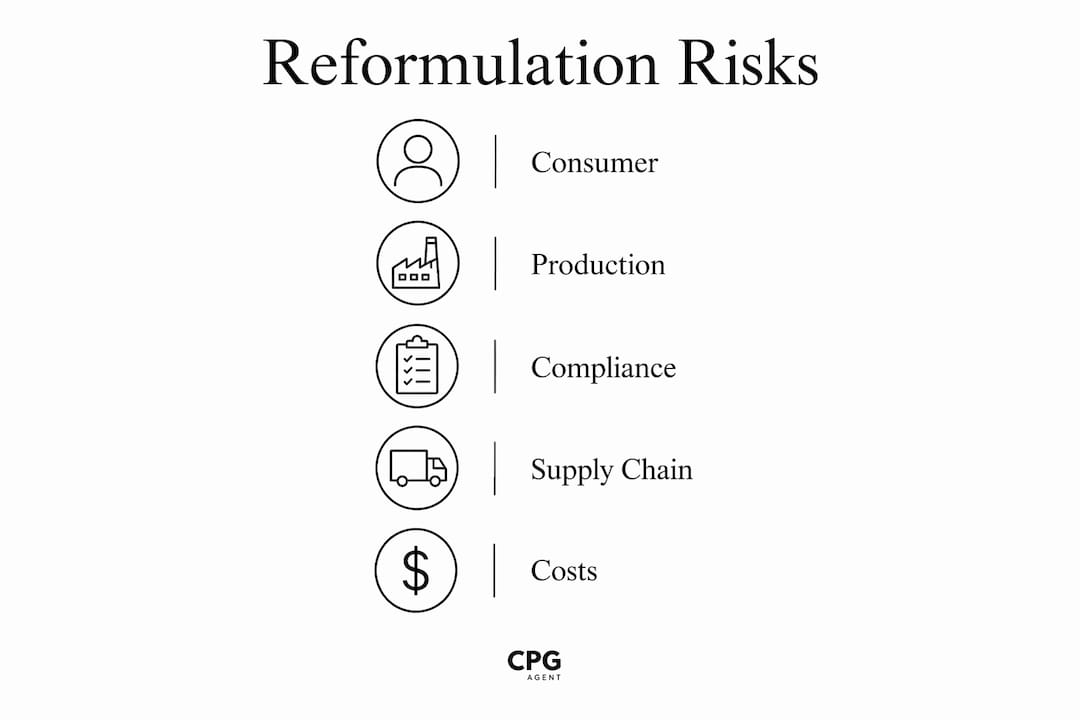
Operational pitfalls are less visible but equally damaging. Changes in viscosity, water activity, or particle size can make a reformulated product incompatible with existing production lines. Plant operations approval during the prototype stage prevents line failures and unplanned cost increases that surface only at scale-up. Teams that skip this step often discover the problem during a commercial run, at which point the cost of downtime and rework dwarfs the original project budget.
Regulatory and labeling errors represent a third failure mode. A reformulated product with a new ingredient must clear FDA review before the updated label ships. Compliance gaps, whether a missing allergen declaration or an unauthorized health claim, can trigger recalls and retailer delistings.
Reformulation success depends on alignment of R&D, regulatory, operations, marketing, and finance from project inception. Early cross-functional coordination reduces rework and protects launch schedules. Experts consistently find that teams which treat regulatory review as a final gate, rather than a parallel workstream, absorb the highest costs.
Risk mitigation starts with a structured risk register at project kickoff. Assign owners to each failure mode, set clear go/no-go criteria at each stage gate, and build sensory testing into the timeline before any production trial. Retailer communication is also worth scheduling early: a reformulation that changes pack weight or nutritional claims needs to be flagged to category buyers before the product hits distribution.
Key steps to successfully implement FMCG product reformulation
A structured process separates reformulations that ship on time from those that stall in endless revision cycles.
-
Portfolio analysis and objective setting. Start by auditing which SKUs face the most regulatory pressure, consumer demand shifts, or margin erosion. Not every product needs reformulation at the same time. Reformulation portfolio pressure can affect 15–40% of SKUs over five years in large FMCG portfolios, so prioritization is the first discipline.
-
Cross-functional team assembly. Assign leads from R&D, regulatory, marketing, supply chain, and finance before any lab work begins. Each function brings a different failure mode into view. Finance flags ingredient cost exposure; supply chain identifies single-source risks; regulatory spots labeling constraints early.
-
Risk assessment and stage-gate design. Map technical, regulatory, and commercial risks to specific project stages. Define what evidence is required to pass each gate. This prevents teams from advancing a prototype that has not cleared sensory or compliance review.
-
Recipe development and bench trials. R&D tests ingredient substitutions at bench scale, iterating on taste, texture, stability, and cost. ADM's approach of integrating sugar, sodium, fat, protein, and clean-label targets simultaneously rather than sequentially reduces the number of revision cycles needed.
-
Consumer sensory testing. Blind and branded sensory panels with representative consumers validate that the reformulated product meets acceptance thresholds. For products with strong brand equity, this step deserves more budget than most teams allocate.
-
Plant trials and manufacturing validation. Run the reformulated formula on actual production equipment before committing to a launch date. Viscosity changes, altered water activity, and new ingredient interactions all behave differently at commercial scale than at bench.
-
Regulatory review and labeling validation. Submit updated ingredient declarations, nutritional panels, and any revised claims for legal and regulatory sign-off. In the US, this includes verifying GRAS status for any new ingredient and confirming front-of-pack claims comply with FDA guidelines.
-
Scale-up and commercial launch. Once all gates are cleared, execute a phased rollout. Stagger distribution to allow for early performance monitoring before full national deployment.
-
Post-launch monitoring. Track consumer complaints, retailer feedback, and sales velocity against baseline. A reformulation that passes sensory panels can still underperform if the communication strategy does not explain the change to loyal buyers.
Pro Tip: Bring plant operations into the project at the prototype stage, not after bench trials are complete. Changes in viscosity or water activity that look minor on paper can cause significant line downtime at scale. Early manufacturing input saves weeks of rework.
What strategic forces are driving FMCG reformulation right now?
Several converging pressures have made reformulation a board-level priority rather than an R&D side project.
- Consumer demand for healthier, cleaner products. US shoppers are reading ingredient labels more carefully than they were five years ago. Demand for reduced sugar, lower sodium, higher protein, and recognizable ingredient lists is not a niche trend. It is the mainstream expectation in most grocery categories.
- Regulatory pressure. FDA sodium reduction targets, state-level restrictions on certain food dyes, and evolving front-of-pack labeling proposals are creating hard deadlines for reformulation. Brands that move proactively avoid the scramble of compliance-driven reformulation under time pressure.
- Retailer requirements. Major US retailers are tightening their own nutritional standards for private-label benchmarking and category management. A product that falls outside a retailer's preferred nutritional band faces shelf-space risk at the next range review.
- Competitive differentiation. Leading FMCG companies treat reformulation as a core strategic capability with board-level governance, using it to secure premium positioning and communicate health benefits ahead of competitors.
- Cost and supply chain resilience. Ingredient cost volatility, particularly for commodity inputs like palm oil, sugar, and wheat, creates a business case for substitution that runs parallel to the health agenda. A reformulation that replaces a volatile commodity with a more stable alternative improves margin predictability.
- Brand reputation. Viral misinformation about ingredients travels fast on social media. Brands with cleaner, more defensible formulas are less exposed to ingredient-scare cycles that can suppress sales for months.
Embedding reformulation as a standing capability, rather than a reactive project, requires C-level sponsorship and a dedicated program management function. Without it, reformulation competes with new product development for the same R&D resources and consistently loses.
How AI and data platforms are changing the reformulation process
The complexity of managing simultaneous changes across ingredients, compliance, sensory performance, and supply chain is exactly where AI-driven platforms create measurable value.

Scenario modeling is the most immediate application. Instead of running sequential bench trials to test each ingredient substitution, AI tools can model the sensory and functional consequences of multiple changes in parallel, narrowing the lab work to the most promising candidates. This compresses the early-stage timeline significantly. AI-powered platforms also support compliance forecasting by monitoring regulatory signals and flagging ingredient risks before they become mandatory changes.
Cross-functional visibility is a second major benefit. One of the most common causes of reformulation delay is information asymmetry: R&D advances a formula that operations has not reviewed, or marketing commits to a launch date before regulatory has cleared the label. Integrated data platforms give every function a shared view of project status, ingredient decisions, and compliance checkpoints.
For consumer research, AI-driven research tools can process sensory feedback at scale, identifying preference patterns across demographic segments that manual panel analysis would miss. This is particularly useful when reformulating products with broad consumer bases where a single sensory profile cannot satisfy every segment.
- Ingredient substitution analytics: AI models predict functional and sensory outcomes of substitutions before lab trials begin
- Regulatory monitoring: Automated tracking of FDA guidance updates, state-level ingredient restrictions, and retailer policy changes
- Supply chain scenario planning: Models that assess cost and availability risk for alternative ingredients across multiple supplier options
- Concept testing: Rapid consumer feedback loops that validate reformulation positioning before full launch investment
Cpgagent's platform brings these capabilities together with automated workflows and fractional leadership advisory, giving FMCG brands access to the kind of program infrastructure that has historically required a large in-house team. For brands managing multiple simultaneous reformulations, that coordination layer is often the difference between a project that ships and one that stalls.
How reformulation reshapes costs and supply chains
Reformulation rarely reduces costs in the short term, and teams that budget as though it will tend to get surprised.

Ingredient substitution almost always introduces a cost variable. A functional fiber that replaces sugar in a snack bar may cost three times as much per kilogram. The business case depends on whether the reformulated product can command a higher price point, reduce regulatory risk, or protect shelf access that would otherwise be lost. Those are real financial benefits, but they are harder to model than a direct cost comparison.
Supply chain adjustments add another layer of complexity. New ingredients often mean new suppliers, new qualification processes, and new minimum order quantities. A single-source specialty ingredient that works perfectly at bench scale can become a supply risk at commercial volume. Building dual-sourcing into the reformulation plan from the start, rather than treating it as a procurement problem to solve later, prevents the kind of supply disruption that forces an unplanned second reformulation.
Packaging is a frequently overlooked cost driver. A change in product density, moisture content, or shelf life often requires updated packaging specifications, which triggers new artwork, new compliance review, and sometimes new packaging equipment. Brand refresh decisions made alongside reformulation can absorb some of these costs by consolidating the packaging update into a single project.
Production line changeovers carry their own cost structure. New cleaning protocols, adjusted line speeds, and operator retraining all show up in the manufacturing cost per unit, at least during the transition period. Tracking these costs separately from the ongoing formula cost gives finance a cleaner picture of the true reformulation investment.
The long-term cost picture is more favorable. A product reformulated ahead of a regulatory deadline avoids the emergency costs of a compliance-driven change. A formula with more stable ingredient inputs is less exposed to commodity price swings. And a product that retains shelf space through a retailer's nutritional review avoids the revenue loss of a delisting. Those benefits compound over time in ways that a project-level cost analysis tends to understate.
Key Takeaways
Successful FMCG reformulation requires cross-functional alignment from project inception, structured stage-gate governance, and early integration of plant operations, consumer sensory testing, and regulatory review.
| Point | Details |
|---|---|
| Cross-functional alignment is foundational | R&D, regulatory, marketing, operations, and finance must align at project kickoff, not at launch. |
| Portfolio scope can be significant | Reformulation pressure can affect 15–40% of SKUs over five years in large FMCG portfolios. |
| Plant operations must enter early | Engaging manufacturing at the prototype stage prevents costly line failures during scale-up. |
| AI platforms compress timelines | Scenario modeling and automated compliance monitoring reduce revision cycles and rework costs. |
| Short-term costs are real | Ingredient substitution and supply chain adjustments raise near-term costs; the long-term case rests on shelf access and regulatory risk avoided. |
FAQ
What is FMCG product reformulation?
FMCG product reformulation is the process of modifying an existing product's ingredients or manufacturing process to improve nutrition, meet regulatory requirements, or align with consumer preferences. It differs from new product development because it works within an established brand and existing consumer base.
How long does a typical FMCG reformulation project take?
Timelines vary by complexity, but most reformulation projects run six to eighteen months from objective-setting through commercial launch. Projects that require new supplier qualification, significant sensory testing, or regulatory submissions tend to sit at the longer end of that range.
What are the biggest risks in FMCG reformulation?
The three most common failure points are consumer rejection due to sensory changes, production line incompatibilities discovered at scale-up, and labeling or compliance errors that delay launch or trigger recalls. Early cross-functional coordination and structured stage-gate processes address all three.
How does AI improve the FMCG reformulation process?
AI tools accelerate scenario modeling for ingredient substitutions, automate regulatory monitoring, and process consumer sensory feedback at scale. Platforms like Cpgagent integrate these capabilities with automated workflows, reducing the coordination overhead that typically slows multi-function reformulation programs.
When should a brand prioritize reformulation over new product development?
Reformulation makes more sense when a product has strong brand equity and an established consumer base that would be difficult to rebuild from scratch. Regulatory deadlines, retailer nutritional requirements, or ingredient cost volatility affecting an existing SKU are all triggers that favor reformulation over launching a new product.