

TL;DR:
- Most startups tend to either overspend on visual identity before validating their market or skip strategy entirely, leading to weak foundations. Lean brand strategies focus on building credibility efficiently by prioritizing positioning, iteration, and founder involvement, reducing waste and accelerating growth. The proper sequence involves defining positioning first, then developing minimal branding assets, and continuously iterating based on market feedback.
Most startups get branding wrong in the same direction: they either spend too much too soon on visual identity before validating their market, or they skip strategy entirely and build on a foundation that doesn't hold. The answer isn't more budget. It's better structure. Lean brand strategy frameworks give founders and brand strategists a disciplined way to build credibility fast, without the waste that kills momentum. This article breaks down the top frameworks worth knowing in 2026, how they compare, and how to choose the right one for where your startup actually is.
Table of Contents
- Key takeaways
- 1. What lean brand strategy frameworks actually mean
- 2. Key criteria for evaluating any lean brand framework
- 3. The Minimum Viable Brand (MVB) framework
- 4. Arielle Jackson's positioning framework
- 5. The Lean Brand Build sequence
- 6. Startup positioning's four core questions
- 7. The MVP branding sprint
- 8. Comparison of top lean brand strategy frameworks
- 9. Recommendations for applying lean brand frameworks
- My honest take on lean brand frameworks
- How Cpgagent helps you build lean and scale fast
- FAQ
Key takeaways
| Point | Details |
|---|---|
| Strategy before visuals | Define your positioning and voice before spending anything on logos or design. |
| Match framework to stage | Pre-seed startups need an MVB, not a full brand system. Scale investment as you scale the business. |
| Positioning is a decision tool | Effective positioning doesn't just describe your brand. It guides daily product, hiring, and messaging decisions. |
| Iterate, don't rebrand | Adjust brand assets as market fit clarifies. A full rebrand signals instability to investors and customers. |
| Founder content compounds | Consistent, founder-led educational content builds brand authority faster than paid media at early stages. |
1. What lean brand strategy frameworks actually mean
Before evaluating any framework, you need a working definition that separates brand strategy from marketing. Brand strategy covers "Why" and "What" over a five to ten year horizon, while marketing focuses on "How" over shorter cycles. Conflating the two leads to costly rebrands and brand identity drift. Lean brand strategy frameworks specifically address the brand layer: they give you a repeatable system for building credibility and differentiation without over-engineering the process at early stages.
The word "lean" here borrows from lean manufacturing. You eliminate waste by doing only what generates data or market value at your current stage. That means delaying full brand systems, elaborate guidelines, and visual overhauls until you have the revenue and market fit to justify them.
For CPG and fast-moving consumer goods brands specifically, getting this sequencing wrong is expensive. You can end up with a beautifully designed package that speaks to no one, or a positioning statement so broad it gives your sales team nothing to work with.
2. Key criteria for evaluating any lean brand framework
Not every framework labeled "lean" actually is. Here's what to look for when you're comparing options:
- Positioning first. Does the framework start with defining your customer, problem, differentiation, and credibility before touching visual identity? If it starts with a logo, walk away.
- Startup stage specificity. A framework built for Series B brands won't serve a pre-seed team. Look for frameworks that define explicit stages and scale investment accordingly.
- Iteration-friendly design. Your brand will change as your market fit crystallizes. Good frameworks build in revision loops rather than treating the initial output as final.
- Speed of deployment. Can you execute the core output in days or weeks, not months? Time is the resource you have least of early on.
- Founder usability. Can a non-designer founder execute this without a full agency? Strategic branding methods that require heavy external help are a liability when you're running lean.
Pro Tip: Treat your positioning statement as a hiring and product filter, not just a marketing line. If a new feature or a new hire doesn't align with your positioning, it's a signal to slow down and ask why.
The frameworks that consistently perform across these criteria share one trait: they treat positioning as the operating system that drives every downstream decision, not as a tagline you finalize and forget.
3. The Minimum Viable Brand (MVB) framework
The MVB is the most practical starting point for pre-seed and seed-stage founders. The concept is simple: build only what you need to be credible in market, then stop and go get data.
A properly constructed MVB includes a simple wordmark logo, a two to three color palette, one heading and one body typeface, a clear positioning statement, and basic templates for presentations and outreach. That's it. No brand guidelines document, no icon library, no custom illustration style.

The discipline here is the point. Every element you add beyond the MVB is a bet you're making on market preferences you haven't confirmed yet. Keep the bet small until the market tells you what it responds to.
Pre-seed startups typically invest under $5,000 on these foundational assets, often keeping it closer to 5 to 10% of seed funding. That budget discipline is a feature, not a limitation.
4. Arielle Jackson's positioning framework
This framework, developed by a former Google product marketer, is purpose-built for early-stage positioning clarity. It gives founders a structured way to write a positioning statement that actually works in sales conversations, not just on a website.
The framework centers on filling in a specific template that forces you to identify your category, your customer, your key benefit, and the reason a customer should believe you. What makes it useful for lean branding is that it's a one-person exercise. A founder can complete it in a focused afternoon, without consultants or workshops.
The output feeds directly into messaging hierarchy: your headline, your elevator pitch, your sales deck opening. That makes it one of the most effective brand positioning tools available for resource-constrained teams, because every hour you spend on it translates into usable output.
5. The Lean Brand Build sequence
If the MVB tells you what to build, the Lean Brand Build tells you when to build it. The recommended sequencing is: positioning and voice first, taking one to two weeks; visual identity second, taking four to six weeks; then execution on your primary channel.
Most founders invert this sequence. They spend the first month designing a logo and picking brand colors before they've written a positioning statement or tested messaging with real customers. The result is a brand that looks polished but says nothing.
The Lean Brand Build forces you to answer the strategic questions before opening a design tool. Once positioning is locked, visual decisions become much faster because you have criteria for every choice. Does this typeface feel right for a brand that's positioning against legacy incumbents? Does this color palette work at the price point we're targeting?
Founder-led positioning in the first phase is a core feature of this framework. No one understands your differentiation better than you do at this stage, and outsourcing that thinking too early produces generic output.
6. Startup positioning's four core questions
This model is less a framework and more a diagnostic that slots inside any lean brand process. The four questions are: Who is your customer? What problem do you solve? Why are you different? Why should anyone believe you?
These four questions form what practitioners call the "strategic operating system," aligning teams and informing brand decisions consistently. When a new channel opportunity appears, you run it through these questions. When a partnership comes up, same test. When you're writing a product page, same test.
The power is in the specificity the questions force. "Small business owners" is not a customer answer. "Female founders of product-based businesses doing under $500K in revenue who are underserved by traditional distribution channels" is. That specificity is what makes every downstream brand decision faster and more consistent.
7. The MVP branding sprint
The MVP branding sprint adapts the product development concept directly to brand execution. The goal is a deployable brand presence in the shortest possible time, at the lowest possible cost.
Modern AI-assisted branding tools can generate a logo, color palette, typography set, and favicon in under an hour. That doesn't mean the output is final, but it means you can show up in market professionally while you gather feedback. The sprint typically runs three to five days and produces: a wordmark, a one-page brand brief, a positioning statement, and a single channel presence (usually a website landing page or LinkedIn profile).
This approach works best when a startup is racing toward a launch event, an investor meeting, or a first retail pitch. It removes the common excuse of "we're not ready to show up yet" and replaces it with a credible minimum presence that you can iterate from.
8. Comparison of top lean brand strategy frameworks
Here's a direct comparison of the frameworks covered above:
| Framework | Time to deploy | Cost range | Best for | Key strength | Watch out for |
|---|---|---|---|---|---|
| Minimum Viable Brand | 1 to 3 weeks | Under $2,000 | Pre-seed and seed | Speed and cost control | Easy to stop too early and look cheap |
| Arielle Jackson positioning | 1 to 3 days | Near zero | Any stage | Founder-executable positioning | Doesn't cover visual identity at all |
| Lean Brand Build | 6 to 8 weeks | $2,000 to $8,000 | Seed to Series A | Structured sequencing | Requires founder time commitment upfront |
| Four core questions | 1 day | Zero | Any stage, pre-visual | Sharpens all downstream decisions | Output needs translation into assets |
| MVP branding sprint | 3 to 5 days | Under $1,000 | Pre-launch or pivot | Maximum speed | Risk of visual quality issues without review |
The frameworks are not mutually exclusive. Many high-performing startups use Arielle Jackson's positioning model inside a Lean Brand Build sequence, with the four core questions as a recurring filter. Think of them as tools in a kit, not competing systems.
One critical distinction: brand and marketing strategies serve different time horizons and purposes. Using a lean brand framework to solve a marketing distribution problem is a common misapplication that wastes time and produces confused output.
9. Recommendations for applying lean brand frameworks
Choosing the right framework depends heavily on where you are in your growth cycle. Here's a practical sequencing guide:
- Before any funding: Use the four core questions model to lock positioning. Cost is zero. Do it yourself.
- At pre-seed: Build an MVB. Keep total brand spend under $5,000. Focus on wordmark, colors, typeface, and one positioning statement.
- At seed stage: Run the full Lean Brand Build sequence. Invest six to eight weeks in proper sequencing. Bring in a brand strategist for the positioning phase if needed.
- Approaching Series A: Review and refine rather than rebuild. Iterate brand assets as market feedback accumulates. A full rebrand at this stage signals instability to investors.
- At Series A and beyond: Build a proper brand system. Now you have the data, the team, and the capital to justify it.
Pro Tip: The highest-ROI brand investment for a resource-constrained startup isn't design. It's founder-led content at a 90/10 educational-to-promotional ratio. Post consistently, teach your market something useful, and let the brand compound over time.
The mistake most founders make is treating branding as a one-time project rather than as infrastructure that evolves with the business. Strategy is a thinking problem first. It requires making difficult choices, not just collecting data or running surveys.
My honest take on lean brand frameworks
I've watched founders spend their first $20,000 on a full visual identity system before talking to ten customers. I've also watched founders skip positioning entirely and go straight to paid media, then wonder why their cost per acquisition won't come down.
Both mistakes share the same root cause: founders treat brand as either a creative expense or a marketing tactic. Neither framing is right. Positioning, when built correctly, is the decision framework your entire team uses every day. It tells your product team what to build next. It tells your sales team who to call first. It tells your content team what to say and what to ignore.
What I've found is that the founders who get lean branding right share one trait: they stay personally involved in the positioning work, even after hiring a brand strategist. They don't outsource their thinking. They use the frameworks to structure it.
The other thing I'd push back on is the idea that "lean" means "cheap." It means efficient. Spending $5,000 on a precisely positioned MVB that converts better than a $50,000 rebrand is not cheap. It's smart resource allocation. The lean brand strategy frameworks that matter in 2026 are the ones that force strategic clarity, not the ones that minimize your upfront spend for its own sake.
— Matthew
How Cpgagent helps you build lean and scale fast
For CPG and FMCG brands, the gap between a sharp positioning statement and a product that actually moves on shelf comes down to execution speed and data quality. Cpgagent closes that gap.
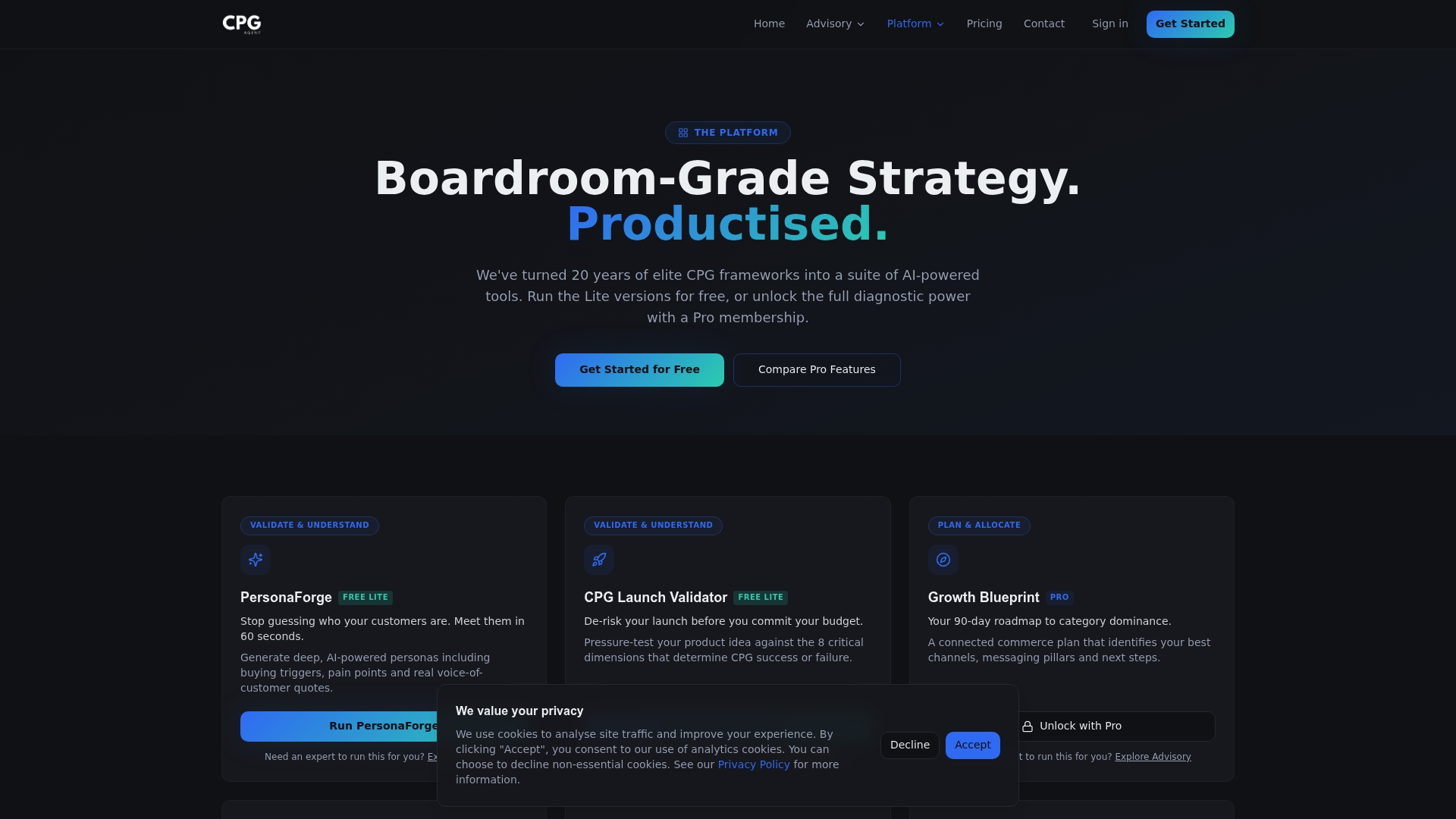
The Cpgagent platform gives brand strategists and founders access to AI-driven tools built specifically for consumer goods brands. From persona development to launch validation, the platform compresses the work that used to take agencies weeks into hours. You get data-backed positioning inputs, automated workflow support, and fractional CMO advisory without the overhead of a traditional agency retainer. Whether you're running your first MVB sprint or preparing for a retail pitch, Cpgagent's tools align directly with lean brand development at every funding stage. Build the brand your category actually needs, faster than your competitors expect.
FAQ
What is a Minimum Viable Brand?
A Minimum Viable Brand is a stripped-down brand system covering only the core elements needed for market credibility: a wordmark, two to three colors, one to two typefaces, and a positioning statement. It prioritizes speed and data collection over completeness.
When should a startup invest in a full brand system?
Most experts recommend holding off on a full brand system until after product-market fit is confirmed, typically at or after Series A funding. Early over-investment in branding before validating the market leads to wasted resources and likely rebrands.
What is the right order to build a startup brand?
The lean sequencing is: positioning and voice first, visual identity second, and channel execution third. Starting with visuals before defining positioning is the most common and costly mistake in agile brand development.
How do lean brand frameworks differ from traditional brand strategy?
Traditional brand strategy typically runs three to six months with agency involvement and full deliverables. Lean brand frameworks compress the process to weeks, prioritize founder-led execution, and treat early outputs as working drafts to be refined as market data comes in.
Can founders build brand positioning without a strategist?
Yes. Frameworks like Arielle Jackson's positioning model and the four core questions diagnostic are specifically designed for founder execution without external help. The thinking takes a day or two and produces positioning output directly usable in sales and content.