
TL;DR:
- Conduct a brand diagnostic to determine if a refresh is sufficient or a rebrand is necessary, based on core brand health signals.
- Proper internal governance, research, and stakeholder alignment are essential to execute a successful brand update without losing retail distribution or recognition.
Start with a brand diagnostic this week. If your equity scores are strong but your packaging looks dated and velocity is slipping, you need a refresh, not a full rebrand. That single distinction saves months of work and protects the shelf relationships you've spent years building.
Three priorities to act on now:
- Run a brand diagnostic. Audit shopper sentiment, unit velocity trends, and competitive shelf position before any design brief is written.
- Commission a shelf test. Mock up two or three packaging directions and test them with real shoppers in a simulated retail environment before committing to production.
- Draft a governance plan. Identify who approves what, in what sequence, before creative work begins. Without it, rollouts stall at legal or get killed by a regional sales VP.
For your executive email:
- Who to brief: Sales, supply chain, legal, and your top two retail buyers before any public announcement.
- Budget range: A refresh typically runs lower in cost and time than a full rebrand; expect 3–6 months to see traction and 12–18 months for full ROI.
- Timing: Avoid launching during Q4 or peak selling seasons. A window 2–3 months before or after your key selling period gives buyers time to adjust and reduces the risk of confusing shoppers mid-promotion.
Table of Contents
- How do you decide between a brand refresh and a full rebrand?
- What brand strategy work must happen before any design begins?
- How do you use heritage to modernize without erasing consumer trust?
- What design changes actually move sales on shelf?
- How do you roll out a brand update without losing retail distribution?
- What KPIs prove the refresh is working?
- What can recent CPG refreshes teach you?
- How do you keep your internal team aligned during modernization?
- How does digital branding fit into a CPG identity update?
- What legal and trademark steps does a rebrand require?
- Why are sustainability and ethics now table stakes in CPG modernization?
- Key Takeaways
- The part most brand managers get wrong
- What Cpgagent gives you that a traditional agency doesn't
- Useful sources
- FAQ
How do you decide between a brand refresh and a full rebrand?
The decision comes down to one question: is your foundation still sound? A refresh preserves core identity while sharpening visual clarity; a rebrand replaces positioning and foundational messaging. Getting this wrong in either direction is expensive.
Use this diagnostic table to make the call:
| Signal | Points to a Refresh | Points to a Rebrand |
|---|---|---|
| Brand equity / recognition | High; shoppers know the brand | Low or actively negative |
| Unit velocity trend | Flat or modest decline | Sustained decline across channels |
| Channel expansion | Adding DTC or e-commerce | Entering a fundamentally new category |
| Product architecture | Same SKU structure | Major portfolio restructuring |
| Competitive pressure | Visual parity issue | Positioning is no longer differentiated |
| Consumer sentiment | Loyal base; dated perception | Trust erosion or brand confusion |
If three or more signals point to "rebrand," you're likely past a cosmetic fix. If most signals point to "refresh," protect your equity and update the expression, not the foundation. Established CPG brands with strong equity often find that small visual and messaging changes dramatically improve shelf performance when guided by research.
Resource and timing bands:
- Refresh: Lower cost, shorter timeline. Early traction typically visible in 3–6 months; full ROI in 12–18 months.
- Full rebrand: Higher cost, longer runway. Early results in 6–12 months; full ROI in 18–36 months.
Packaging updates also carry compliance obligations: nutrition panels, claims language, and retailer readiness requirements often shape the scope and timing of any update, regardless of which path you choose. Factor those checkpoints into your project plan before locking a budget.
Pro Tip: Build a simple risk rubric before the first stakeholder meeting. Score each diagnostic signal 1–3 and total the columns. A numeric score is harder to argue with in a boardroom than a gut call.
For a deeper look at the specific refresh types that work for established brands, the CPG brand refresh strategies guide covers nine approaches with decision criteria for each.
What brand strategy work must happen before any design begins?
Visual updates are expressions of brand strategy, not replacements for it. The brands that stumble in a refresh almost always skipped the research phase and handed a brief to a designer before anyone agreed on what the brand actually stands for.
Research sequence to run before the design brief:
- Retail audit: Walk your category in 10–15 stores across different retail formats. Photograph your brand and the three closest competitors from 10 feet away. Note what you can and cannot read.
- Shopper ethnography: Observe 8–12 shoppers in-aisle without prompting. Where do they pause? What do they pick up? What do they put back?
- Buyer interviews: Talk to 10–15 of your core buyers. Ask what they associate with the brand, what they'd miss if it disappeared, and what feels out of date.
- Heat-mapped shelf tests: Use eye-tracking or digital shelf simulation tools to identify which packaging elements draw attention and which are invisible.
Once the research is in, build a messaging hierarchy before any copy is written:
| Level | Content | Example |
|---|---|---|
| Core promise | The single thing the brand stands for | "Real ingredients, made simply" |
| Proof points | Two or three specific reasons to believe it | "Stone-ground since 1978; no additives" |
| Reason to believe | The tangible evidence behind the promise | Founder story, sourcing origin, process |
| Occasion messaging | Context-specific copy for pack and digital | "Your Sunday morning, made better" |
Audience prioritization matters as much as messaging. Most legacy CPG brands have a primary buyer (who purchases), a secondary shopper (who influences), and occasion-based segments (who use the product in a specific context). Rank them explicitly so the design team knows whose attention to optimize for on shelf. A brand positioning statement is the artifact that locks this in before creative work starts.
How do you use heritage to modernize without erasing consumer trust?
The brands that modernize well don't invent a new story. They find the one thread that was always true and make it impossible to miss. That might be the founder's origin, a specific ingredient, a place, or a process. The mistake is trying to tell all of it at once.
How to identify your one thread:
- Pull your original brand documents, founder interviews, and early packaging. What claim or image appeared consistently?
- Ask your 10 most loyal buyers what they'd describe the brand as in one sentence. The overlap is your thread.
- Check which heritage cue, color, seal, or place-of-origin image, already exists on pack. Amplify what's there rather than introducing something new.
Messaging formats for packaging and e-commerce:
- Hero line (pack front): Short, declarative, present tense. "Stone-ground. Nothing added."
- Subline (pack front or neck label): One proof point. "Milled in Milwaukie, Oregon since 1978."
- Callouts (back panel or DTC product page): Two or three specific facts. "Non-GMO. Whole grain. One ingredient."
NEWTONS' May 2026 packaging update is a clean example of this approach. The brand kept its signature yellow while enlarging product imagery to introduce the bar to a new generation. No new story was invented. The existing recognition cue was preserved and made more prominent.
Pro Tip: Before finalizing any packaging direction, run a split test with existing shoppers: show one group the heritage-forward version and one group the modernized version. Ask both groups to describe the brand in three words. If the heritage group's words align with your core promise and the modern group's don't, you've gone too far.
What design changes actually move sales on shelf?
Design decisions that look good in a deck often fail on a retail shelf viewed from 8 feet away under fluorescent lighting. The rules for CPG packaging are more constrained than most brand managers expect.
Shelf-visibility checklist:
- Logo readable at 6–12 feet without squinting
- Primary color contrast distinguishable from the two nearest competitors
- Product photography dominant on the front panel (not decorative)
- Brand name and product descriptor scannable in under two seconds
- Information hierarchy: brand name → product type → key claim → size/weight
Typography and color constraints for CPG:
- Minimum 24pt equivalent for brand name on primary display panel
- No more than two typefaces on the front panel
- Color must hold across matte, gloss, and kraft substrates
- Digital-safe color values (sRGB) documented alongside print specs for DTC and social use
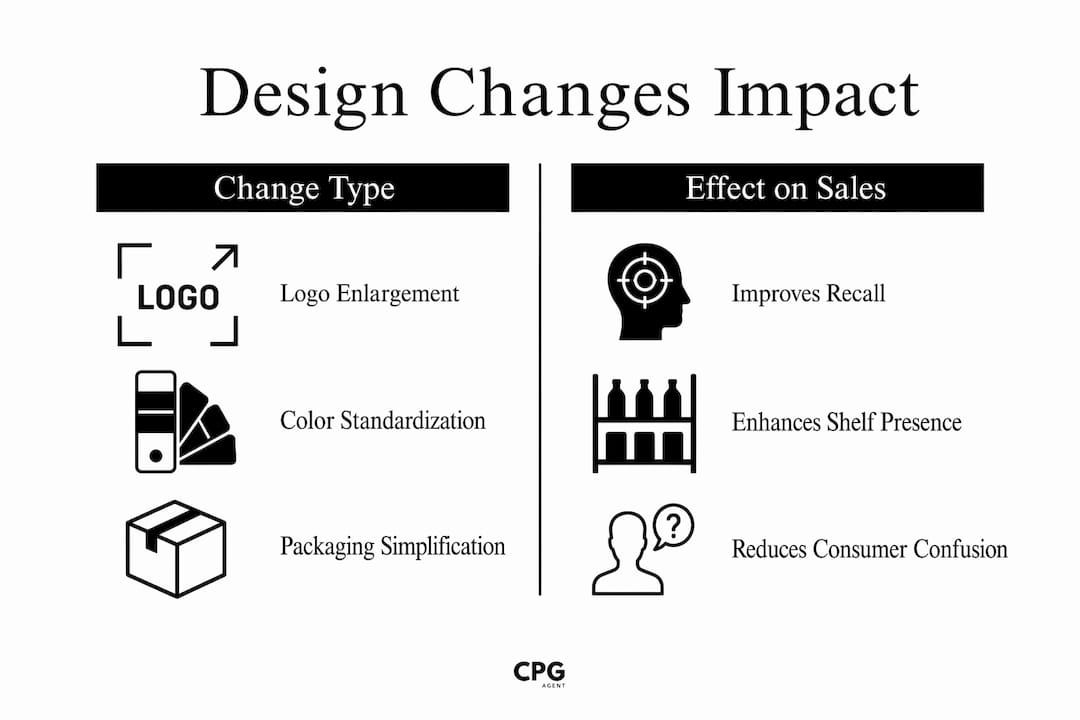
Bob's Red Mill's 2026 redesign is the clearest recent proof of these principles. The brand enlarged the logo and standardized a single red shade inspired by the original mill building, and the result was a 30% increase in product visibility on the flagship 5-pound flour bag. The wrapped mill silhouette added a "sense of place" across pack facings without introducing anything unfamiliar.
| Change type | Effect on shelf performance | Risk level |
|---|---|---|
| Logo enlargement | Improves recall and legibility | Low |
| Color standardization | Boosts shelf block cohesion | Low |
| New typeface (same brand feel) | Modernizes without disrupting recognition | Medium |
| Color palette shift | Can erode recognition if equity is color-tied | High |
| Full logo replacement | High risk of losing existing shoppers | Very high |
| Photography style change | Medium risk; test before full rollout | Medium |
Pro Tip: Evolve the logo; don't replace it. Incremental refinements, tightening letterforms, adjusting weight, removing clutter, preserve the recognition that took decades to build. A new logo is a new brand to a shopper who's been buying yours for 15 years.
For practical shelf differentiation examples, the CPG brand differentiation guide covers what's working in specific categories.
How do you roll out a brand update without losing retail distribution?
Most brand updates fail not in the design studio but in the rollout. A packaging change that surprises a retail buyer mid-planogram cycle can cost you a shelf slot. Sequence matters as much as the work itself.

Phased rollout structure:
| Phase | Timing | Key actions | Approx. budget allocation |
|---|---|---|---|
| Pilot | Months 1–3 | Select 2–3 test markets; run shelf mockups; gather velocity data | 15% of total budget |
| Regional | Months 4–6 | Expand to 1–2 regions; brief regional retail buyers; update DTC assets | 30% of total budget |
| National | Months 6–12 | Full production run; national retail buyer communications; PR and social | 45% of total budget |
Launch 2–3 months before or after your key selling season. Launching inside a peak window, Q4 for most food and beverage brands, risks confusing buyers and distributors at exactly the moment when execution precision matters most.
Stakeholder buy-in checklist (sequence this order):
- Internal brand and marketing leadership sign off on strategy and visual direction
- Legal reviews trademark clearance and compliance requirements
- Supply chain confirms production feasibility and lead times
- Sales leadership briefs top retail buyers before any public announcement
- Distributor partners receive updated sell sheets and planogram specs
Coca-Cola's recent visual identity update offers a governance model worth studying. The brand introduced a Brand Center and Design Intelligence tools to ensure consistent application of its visual system across markets. For most mid-size CPG brands, a simpler version of this, a shared asset library, a one-page brand standards doc, and a named approver for each market, accomplishes the same goal without the enterprise infrastructure.
What KPIs prove the refresh is working?
Measurement without a pre-set baseline is guesswork. Pull your current numbers before the refresh launches so you have something real to compare against.
Primary KPIs and what they tell you:
- Unit velocity (units per store per week): The most direct signal of shelf performance. Track weekly from launch.
- Repeat purchase rate: Measures whether new buyers are converting to loyal ones. Pull from loyalty panel data or DTC subscription metrics.
- DTC conversion rate: Tracks whether the refreshed creative is working in a controlled digital environment before reading into retail data.
- Brand recognition lift: Run a pre/post survey with a matched sample of category shoppers. Ask unaided recall and aided recognition.
- Net Promoter Score (NPS): A quarterly pulse on whether the refresh is landing positively with existing buyers.
A/B test methods:
- Packaging: Use digital shelf simulation tools or in-store mockup tests with a control (current pack) and one or two test variants. Minimum 200 shoppers per cell; run for 4–6 weeks before reading results.
- E-commerce tile tests: Run A/B tests on your DTC product page and Amazon listing using the current hero image as control. Measure click-through rate and add-to-cart rate over a 2–4 week window.
Measurement cadence:
| Frequency | Metrics to review |
|---|---|
| Weekly | Unit velocity, DTC conversion rate, social engagement |
| Monthly | Repeat purchase rate, retail sell-through, distributor reorder rates |
| Quarterly | Brand recognition, NPS, category share |
AI-assisted tools can accelerate this loop significantly. Cpgagent's platform includes persona research and A/B testing support that compresses the insight cycle from weeks to days.
What can recent CPG refreshes teach you?
Three recent examples illustrate what heritage-led modernization looks like in practice, and where the risks are.
Bob's Red Mill (2026): The brand enlarged its logo, standardized a single heritage red, and added a mill silhouette to create visual consistency across a wide SKU range. The result was a 30% visibility increase on the flagship pack. The lesson: amplify what's already there. The mill, the red, the founder's face were all existing assets. The refresh made them work harder, not differently. This maps directly to the "refresh" branch of the diagnostic: strong equity, dated execution, clear visual fix.
NEWTONS (May 2026): Kept the signature yellow, enlarged product imagery, and simplified the wordmark. No new positioning, no new story. The brand leaned into the product itself as the hero. The lesson: when your recognition cue is a color, protect it above everything else. Changing the yellow would have been a rebrand; enlarging the cookie was a refresh.
Coca-Cola visual identity update: This was not a refresh in the traditional sense. It was a governance and scalability project. The brand introduced a Brand Center and Design Intelligence tools to enforce consistency across dozens of markets. The lesson for mid-size CPG brands: you don't need enterprise software, but you do need a named owner for brand standards and a shared asset library before you scale.
What to avoid: Introducing new heritage claims that don't exist in the brand's actual history. Shoppers who've bought a product for years notice when the story changes. Authenticity is the one thing a refresh cannot fake.
How do you keep your internal team aligned during modernization?
Brand modernization projects stall most often inside the organization, not in the market. A sales team that doesn't understand the rationale will undermine the new packaging in buyer meetings. A supply chain team that wasn't consulted will flag production constraints after the design is locked.
The fix is early, structured involvement, not a big reveal. Bring sales and supply chain into the diagnostic phase, not the approval phase. Share the shelf test data with them before the creative brief is written. When people see the research, they stop arguing about taste and start solving problems.
Assign a single internal brand owner with authority to make final calls on creative direction. Committees produce compromises; compromises produce mediocre packaging. The brand owner's job is to hold the strategic line while accommodating legitimate operational constraints.
Internal training matters too. Every customer-facing employee, field sales, brokers, retail account managers, needs a one-page brief that explains what changed, why, and what to say when a buyer asks. A brand update that surprises your own sales team in a buyer meeting is a governance failure.
How does digital branding fit into a CPG identity update?
A packaging refresh that doesn't extend to digital is half a job. Shoppers increasingly encounter CPG brands on Amazon, Instagram, and brand DTC sites before they see the product on shelf. If your digital assets look like a different brand than your packaging, you're splitting recognition equity across two identities.
The practical checklist for digital brand alignment:
- Update hero images on Amazon and retail.com listings within the same week as the physical packaging launch.
- Rebuild your DTC product page with the new visual system, including photography style, typography, and color values.
- Audit your social media templates. Profile images, story frames, and paid ad creative should all reflect the refreshed identity within 30 days of launch.
- Document digital color values (sRGB hex codes) separately from print specs. The same red that works on a matte kraft bag will look different on a screen.
Social media also gives you a low-cost testing environment before the physical launch. Post the refreshed visual direction in organic content 4–6 weeks before the packaging hits shelves. Monitor engagement and sentiment. If the response is strongly negative, you still have time to adjust.
What legal and trademark steps does a rebrand require?
A logo change or brand name update triggers trademark obligations that most marketing teams underestimate. In the United States, trademark rights are established through use, but registration with the U.S. Patent and Trademark Office (USPTO) provides the legal protection you need to defend the mark.
Before any new visual identity goes public:
- Conduct a full trademark clearance search through the USPTO database and, for broader protection, through a trademark attorney who covers common-law use.
- File new trademark applications for any updated wordmark, logo, or tagline before the public launch date.
- Review existing licensing agreements. If your brand appears on co-branded products or licensed merchandise, those contracts may require notification or consent before a visual change.
- Audit packaging claims language. The FDA and FTC regulate specific terms on food and beverage packaging. A refresh that adds or changes a claim, "natural," "clean," "simple," requires compliance review before print production.
Budget 3–6 months for trademark clearance and filing if you're making significant changes to a wordmark or logo. This timeline runs in parallel with design development, not after it.
Why are sustainability and ethics now table stakes in CPG modernization?
A brand refresh that ignores sustainability signals is increasingly a missed opportunity. U.S. consumers, particularly Millennial and Gen Z shoppers, factor environmental and ethical claims into purchase decisions at the shelf level, not just in surveys.
The practical implication for a packaging refresh: if you're already updating your structural packaging, evaluate recyclability and material reduction at the same time. A move to a lighter-weight substrate or a recyclable material can be a legitimate brand story element, not just a cost decision.
Ethical sourcing claims, fair trade certification, non-GMO verification, and B Corp status carry weight in specific categories and channels. If your brand has any of these credentials, they belong on the front panel, not buried in the back copy.
One caution: don't claim what you can't substantiate. The FTC's Green Guides govern environmental marketing claims in the United States, and vague terms like "eco-friendly" or "sustainable" without specific substantiation are enforcement targets. Claim what you can prove; prove it on pack.
Key Takeaways
A successful CPG brand modernization starts with a diagnostic, not a design brief. Brands that protect their equity while updating their expression consistently outperform those that rebrand from scratch.
| Point | Details |
|---|---|
| Diagnose before designing | Run the six-signal diagnostic table to choose refresh vs rebrand before any creative work starts. |
| Refresh ROI timeline | Expect traction in 3–6 months and full ROI in 12–18 months for a well-executed refresh. |
| Shelf-first visual rules | Enlarge the logo, standardize color, and lead with product photography; test at 6–12 feet before production. |
| Sequence the rollout | Pilot in 2–3 markets first; brief retail buyers before any public announcement; avoid peak selling windows. |
| Cpgagent accelerates execution | Cpgagent's PersonaForge and Launch Validator tools compress the research and testing phases from months to weeks. |
The part most brand managers get wrong
The conventional wisdom on legacy brand modernization says: protect the heritage, update the look. That's correct as far as it goes. What it misses is the internal governance problem.
Most CPG refresh projects don't fail because the design was wrong. They fail because no one owned the decision. A creative director who can be overruled by a regional VP, a legal team that reviews packaging after the production brief is locked, a sales team that finds out about the new look from a retail buyer: these are the failure modes that actually kill brand updates.
The brands that execute well, Bob's Red Mill, NEWTONS, Coca-Cola at scale, all had one thing in common: a named decision-maker with authority to hold the strategic line. The research, the shelf tests, the consumer interviews, all of that is necessary. But it only works if someone is empowered to act on it.
My recommendation: before you commission a single design concept, write a one-page governance brief. Name the brand owner. Define what requires committee approval and what doesn't. Set the escalation path. That document will save more time and money than any creative brief you write.
For teams that want to move faster, Cpgagent's platform gives brand managers the research infrastructure, PersonaForge for persona depth, Launch Validator for pre-launch testing, to make those governance decisions with data behind them rather than opinion.
What Cpgagent gives you that a traditional agency doesn't
Brand managers who've been through a legacy refresh know the agency model's core problem: you pay for discovery phases that last three months before a single strategic recommendation lands on your desk.
Cpgagent is built for the opposite. The platform puts PersonaForge, Launch Validator, and a full suite of AI-driven strategy tools directly in your hands, so your team can run persona research, test packaging directions, and validate positioning before a creative brief is written. For teams that need senior leadership, Cpgagent's fractional CMO service puts an experienced CPG executive in your corner without a full-time hire. The typical engagement moves from discovery to a pilot-ready brief in weeks, not quarters. If you're ready to run the diagnostic and move, start with the platform to scope what your brand actually needs.
Useful sources
- Bob's Red Mill unveils new packaging, FoodNavigator-USA — source for the 30% visibility increase figure and heritage color standardization details.
- NEWTONS Debuts New Branding and Packaging, PR Newswire — source for the May 2026 national rollout and signature yellow preservation details.
- One Iconic Brand, One Iconic Look, The Coca-Cola Company — source for the Brand Center and Design Intelligence governance tools.
- Brand Refresh vs Rebrand: A CPG Founder's Guide, NUEX — source for refresh vs rebrand timelines, ROI windows, and seasonal launch timing guidance.
- How To Modernize A Legacy Brand, Envoy, Inc. — source for the principle that visual updates must follow strategy, not precede it.
- How to Reinvent a Legacy Brand and Win, Harvard Business Review — broader context on heritage-led brand reinvention at the leadership level.
- The Marketer's Guide to Modernizing a Legacy Brand, AMA — additional practitioner frameworks for positioning and audience prioritization.
FAQ
What is the difference between a brand refresh and a rebrand?
A refresh updates the visual expression and messaging while preserving core positioning; a rebrand replaces the foundational strategy and identity. Refreshes typically show traction in 3–6 months; rebrands take 6–12 months for early results.
How long does a CPG packaging refresh take from start to shelf?
A focused refresh, including research, design, compliance review, and production, typically runs 6–12 months from kickoff to retail shelf. Budget the trademark and compliance review in parallel with design, not after it.
How do you test new packaging before a full production run?
Use digital shelf simulation tools or physical mockup tests with a minimum of 200 shoppers per test cell, run over 4–6 weeks. Measure recognition, purchase intent, and the ability to read key claims at 6–12 feet.
When should a CPG brand use a fractional CMO instead of an agency?
A fractional CMO makes sense when you need senior strategic leadership to own the brand modernization process but don't have the budget or need for a full-time hire. Cpgagent's fractional CMO service is structured for exactly this scenario, moving from diagnostic to pilot brief in weeks.
What are the biggest risks in a CPG brand refresh?
The three most common failure points are: launching during a peak selling season without retailer coordination, changing a recognition cue (color, logo) without testing with existing shoppers first, and skipping internal governance so the creative direction gets overruled mid-production.