

TL;DR:
- Challenger brands succeed by building loyalty across multiple dimensions—financial, potential, cultural, and community—that create deeper emotional bonds. They focus on superior product experiences and organic community engagement, which are harder for incumbents to replicate through scale or discounts. Scaling loyalty requires connected infrastructure and intentional feedback loops that cultivate a lasting, authentic brand relationship.
Challenger brands win loyal customers by building emotional and value-based connections that established competitors structurally cannot replicate. The term "challenger brand" is the recognized industry label for this category, defined by Bain & Company and Ogilvy research as brands with under 2% market share that compete through differentiation, agility, and cultural resonance rather than distribution scale. Fly By Jing, for example, rebuilt its referral engine around product value and cut customer acquisition costs by 44% while dramatically deepening retention. Understanding why challenger brands win loyal customers requires looking beyond discounts and points programs to the mechanics of identity, community, and repeat behavior loops that drive compound growth.
What core loyalty strategies do challenger brands use to outperform established competitors?
Challenger brand strategies succeed because they activate loyalty across multiple dimensions simultaneously, while incumbents typically rely on transactional rewards alone. Ogilvy One's research identifies four loyalty dimensions that matter: financial, potential, cultural, and community. Activating all four produces 2 to 3 times better customer retention than focusing on just one. That multiplier is the structural advantage challengers exploit.
Here is how each dimension functions in practice:
- Financial loyalty covers value for money and tangible rewards. This is the floor, not the ceiling. Challengers use it to justify trial, not to sustain retention.
- Potential loyalty reflects a customer's belief that the brand will keep improving and deliver future value. Brands that share product development updates and invite feedback activate this dimension directly.
- Cultural loyalty is built when a brand's values visibly align with the customer's own identity. Fly By Jing, for instance, built cultural loyalty by centering its story on Sichuan culinary heritage and founder authenticity rather than generic "bold flavor" positioning.
- Community loyalty emerges when customers feel they belong to something larger than a purchase. Peer recognition, co-created content, and shared rituals create social switching costs that no discount can overcome.
The practical implication is that loyalty from challengers is fundamentally about expressing shared values and identity, which creates emotional bonds that outlast transactional incentives. A points program commoditizes a brand. A community program protects it.
Pro Tip: Audit your current loyalty program for "belief signals." If your program cannot answer whether customers respect your brand's behavior or feel it improves their life, you are measuring transactions, not loyalty.
How does product experience drive loyalty for challenger brands?
Superior product performance is the non-negotiable foundation of customer loyalty in challengers. Without it, no amount of community or cultural alignment sustains repeat purchase. Bain & Company's 2026 insurgent brand research confirms that challengers increase loyalty through expanding household penetration and purchase frequency by delivering enhanced product experiences that unlock new consumption occasions. This is velocity before distribution, and it compounds.

The numbers behind this are striking. Despite holding less than 2% market share, insurgent brands captured approximately 36% of incremental market growth in US FMCG in 2026. That share of growth is disproportionate to their size, which means their customers are buying more, more often, not just once.
The table below maps the product experience drivers that challengers prioritize against what most incumbents default to:
| Product experience driver | Challenger approach | Incumbent default |
|---|---|---|
| Product differentiation | Solves an unmet need or elevates a category standard | Iterates on existing SKUs with marginal improvements |
| Consumer feedback loops | Rapid test-and-learn cycles integrated into product development | Annual consumer research with slow rollout |
| Health and lifestyle alignment | Formulated around evolving values (clean label, functional benefits) | Reformulates reactively under regulatory or PR pressure |
| Occasion expansion | Actively creates new use cases through content and community | Relies on established consumption habits |
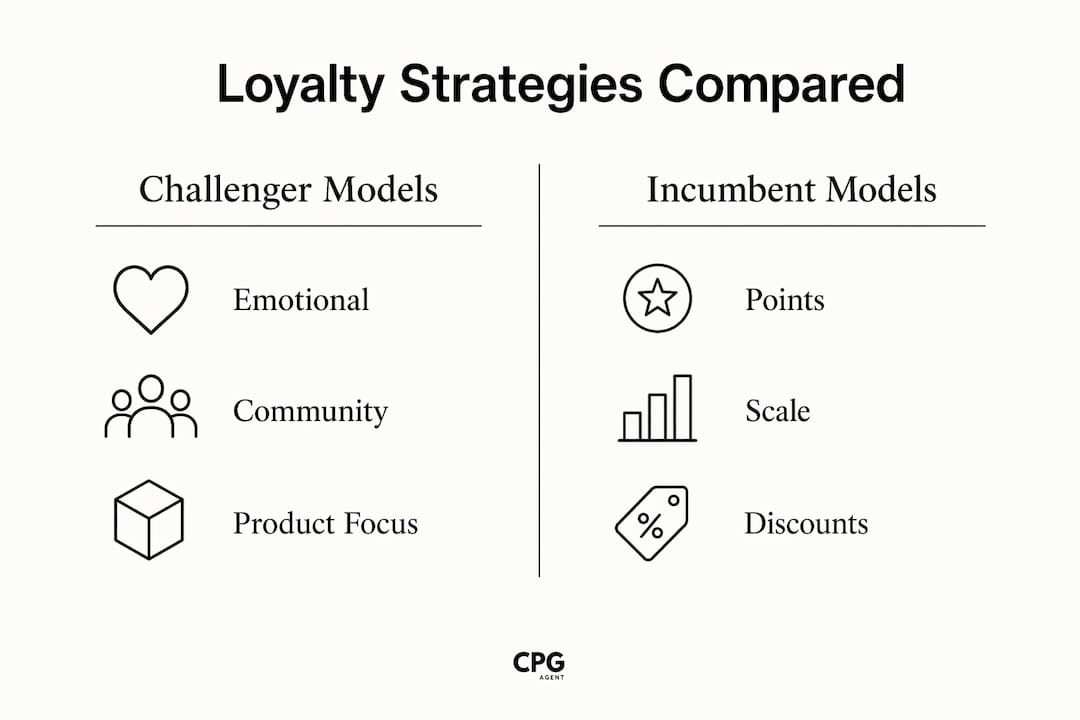
Challengers also win because they move faster. A brand like Olipop or Liquid Death does not wait for a two-year product development cycle. It tests, iterates, and ships based on direct consumer feedback, which deepens loyalty because customers feel heard and see their input reflected in the product.
Pro Tip: Track purchase frequency by cohort, not just total revenue. If your second-purchase rate is below 40% within 60 days of first purchase, your product experience is not yet strong enough to carry your loyalty program.
What role does community and cultural alignment play in challenger brand loyalty?
Community is the loyalty mechanism that incumbents find hardest to copy because it cannot be bought with a media budget. It has to be earned through consistent cultural behavior over time. Ogilvy's research shows that cultural and community engagement create emotional lock-in that discounts cannot replicate, and brands that activate these dimensions see 2 to 3 times better retention than those relying on financial rewards alone.
The comparison below illustrates why traditional loyalty programs fall short against community-driven models:
| Loyalty mechanism | Traditional program | Community-driven model |
|---|---|---|
| Primary incentive | Points, discounts, free products | Belonging, identity, peer recognition |
| Switching cost | Low (competitor matches the offer) | High (customer loses social network and status) |
| Advocacy generation | Minimal (transactional relationship) | Organic (customers become brand marketers) |
| Retention driver | Price sensitivity | Shared values and cultural identity |
| Scalability | Expensive as rewards accumulate | Compounds with community size |
Brands like Stanley, Glossier, and Fly By Jing built communities before they built distribution. Stanley's tumbler became a cultural object because the brand leaned into the identity its customers were already constructing around it. Glossier turned its blog readers into product co-creators. These are not marketing tactics. They are structural loyalty advantages.
The mechanism behind community loyalty is social switching cost. When a customer is recognized within a brand's community, shares content with peers who share the same values, and sees their identity reflected in the brand's cultural output, leaving that brand means losing a social context. That is a fundamentally different retention dynamic than losing a points balance.
85% of consumers say their favorite brand behaves in ways they prefer, and 80% say it expresses what they value. These are not passive preferences. They are the active loyalty signals that challenger brands are designed to generate.
How do challenger brands scale loyalty through connected programs and repeat behavior loops?
Scaling loyalty without losing the emotional depth that created it is the hardest operational challenge for growing challengers. The answer lies in connected loyalty infrastructure and deliberately designed repeat behavior loops. Here is how the most effective challengers structure this:
-
Build connected loyalty across every channel. Connected loyalty allows brands to retain customer identity and first-party data across direct-to-consumer, wholesale, and retail channels. Without this, a brand that expands into Target or Whole Foods loses visibility into its most loyal customers the moment they buy off-platform.
-
Design the repeat behavior loop intentionally. Every purchase should trigger a feedback mechanism: a post-purchase survey, a community prompt, or a product education touchpoint. This feedback feeds faster iteration, which produces a better product, which drives the next purchase. This velocity approach compounds community engagement and loyalty faster than incumbents can react.
-
Redesign referral programs around product value, not cash incentives. Fly By Jing's referral redesign is the clearest case study available. By centering referral rewards on product discovery rather than generic discounts, referred customers showed 11% churn at 90 days compared to 28% for paid social cohorts. Their 180-day lifetime value reached $94 versus $58 for non-referred customers. Referral-driven revenue grew from under 2% to 17% of new customer volume within 12 months.
-
Track leading loyalty metrics, not just revenue. The metrics that predict long-term loyalty health are 30-day repurchase rate, 90-day churn by acquisition channel, and 180-day LTV by cohort. Brands that optimize only for short-term revenue miss the compounding signals that indicate whether loyalty is building or eroding.
-
Activate the potential dimension through transparency. Share product roadmaps, invite beta testers from your community, and communicate openly about what you are working on. This converts customers from passive buyers into invested stakeholders who have a reason to stay and advocate.
The integrated activation of financial, potential, cultural, and community dimensions builds defensible loyalty and turns customers into brand advocates. That is the operational goal: not just retention, but conversion of retained customers into a distribution channel.
Key takeaways
Challenger brands win loyal customers by combining superior product performance with emotional, cultural, and community-based loyalty dimensions that incumbents cannot replicate through discounts or scale alone.
| Point | Details |
|---|---|
| Four loyalty dimensions matter | Activating financial, potential, cultural, and community loyalty produces 2 to 3 times better retention than single-dimension programs. |
| Product experience is the foundation | Challenger brands grow through purchase frequency and household penetration, not just acquisition. |
| Community creates switching costs | Social belonging and shared identity make leaving a brand costly in ways that no competitor discount can offset. |
| Connected loyalty protects retention at scale | Maintaining customer identity across retail and wholesale channels prevents loyalty data loss during distribution expansion. |
| Referral programs should reward product value | Fly By Jing's product-centered referral redesign cut 90-day churn from 28% to 11% and nearly doubled 180-day LTV. |
Why most loyalty programs miss the point entirely
I have reviewed loyalty programs across dozens of CPG brands, and the pattern is consistent: brands invest in points mechanics before they have earned the cultural permission to ask for loyalty. They build the infrastructure before they build the identity. That sequence is backwards.
The brands that win long-term, brands like Fly By Jing, Olipop, and Liquid Death, did not launch with loyalty programs. They launched with a clear point of view, a product that genuinely outperformed the category, and a community that formed organically around shared values. The loyalty program came later, as a way to recognize and reward behavior that was already happening.
What I find most instructive about the Ogilvy research is the demographic nuance. Millennials show higher agreement than Gen Z that their favorite brand improves their life, with 60% versus 51% respectively. That gap matters for how you sequence your loyalty investment. If your core customer is Gen Z, cultural and community dimensions need to lead. If you are targeting Millennials, potential and financial dimensions carry more weight alongside cultural fit.
The uncomfortable truth is that most loyalty programs are retention theater. They create the appearance of stickiness while the underlying brand relationship remains shallow. The brands that build real loyalty treat every product iteration, every piece of content, and every community interaction as a loyalty investment. The program formalizes what already exists. It does not create it.
For marketers building challenger brand strategy, the priority order is clear: earn cultural loyalty first, build community second, then layer in the connected infrastructure that scales what you have already created.
— Matthew
Build loyalty programs that actually compound growth
The frameworks in this article work when they are backed by the right infrastructure. Cpgagent's platform gives CPG and FMCG brands the tools to execute connected loyalty programs, track cohort-level retention metrics, and design referral engines built around product value rather than generic incentives. From PersonaForge for deep consumer identity mapping to Launch Validator for testing loyalty mechanics before full rollout, the platform is built for brands that want to move at challenger speed without sacrificing strategic depth. If you are ready to turn your retention data into a compounding growth engine, explore the Cpgagent platform and see how fast the right infrastructure moves.
FAQ
Why do challenger brands build stronger loyalty than big incumbents?
Challenger brands build loyalty by aligning with consumer values and identity rather than relying on scale or generic rewards. Research shows that 74% of consumers cite value for money and behavioral alignment as primary loyalty drivers, advantages that challengers can deliver more authentically than large incumbents.
What are the four dimensions of loyalty challenger brands activate?
The four dimensions are financial, potential, cultural, and community loyalty. Activating all four simultaneously produces 2 to 3 times better customer retention than programs focused on a single dimension, according to Ogilvy One research.
How does community loyalty differ from a traditional points program?
Community loyalty creates social switching costs through peer recognition, shared identity, and co-created content, while points programs create only transactional switching costs that competitors can easily match with a better offer.
What metrics should challenger brands track to measure loyalty health?
The most predictive metrics are 30-day repurchase rate, 90-day churn by acquisition channel, and 180-day lifetime value by cohort. Fly By Jing's use of these metrics revealed that referred customers had nearly double the LTV of paid social customers.
How do challenger brands scale loyalty without losing emotional depth?
Connected loyalty infrastructure that maintains customer identity across retail, wholesale, and direct channels is the key. This approach, highlighted by Talon.One research, prevents loyalty data loss when brands expand distribution and keeps retention metrics intact across every sales touchpoint.