

Most CPG founders discover the agency trap the hard way: six months in, $80,000 spent, and you have a brand deck, a mood board, and zero retail velocity. If you want to build lean cpg strategy without agency overhead slowing you down, the playbook exists and it works. This guide walks you through the exact foundation, launch sequence, marketing approach, and metrics framework that founder-led brands use to hit real revenue without handing control to an outside firm that doesn't live inside your margins.
Table of Contents
- What you need: laying the foundation for a lean CPG strategy
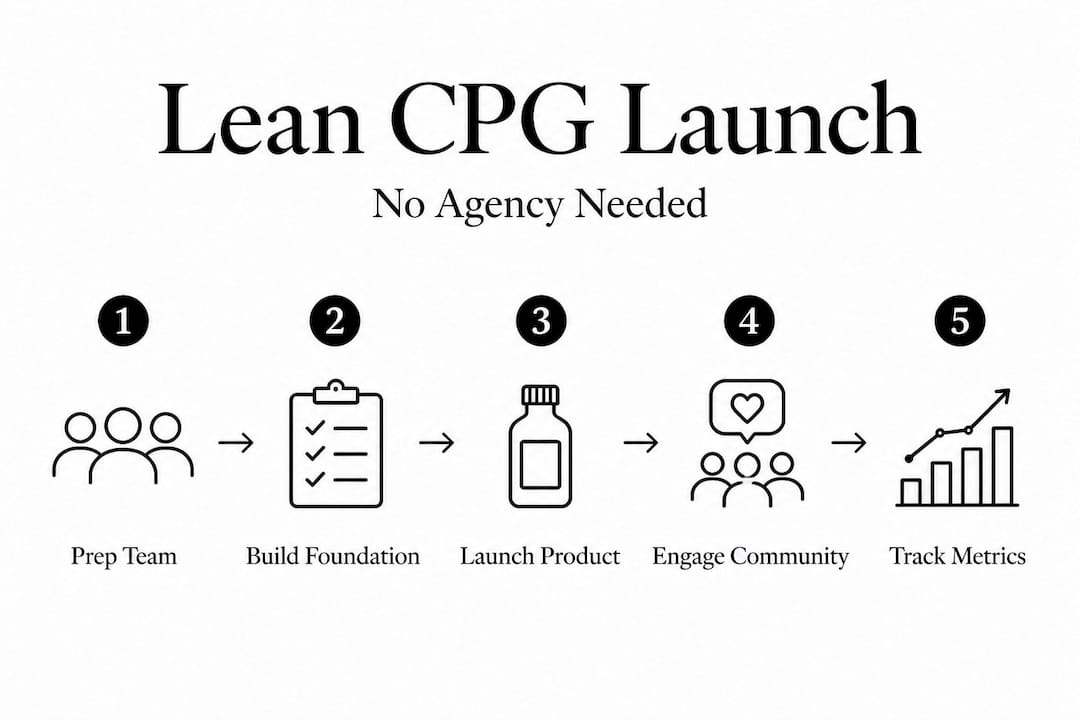
- Step by step: how to execute a lean product build and launch without agencies
- Optimizing growth without agencies: low-cost marketing and community building tactics
- Troubleshooting common obstacles in lean CPG growth without agencies
- Measuring success: verifying results and scaling lean CPG growth
- Why building lean without agencies is the future of CPG brand growth
- Accelerate your lean CPG growth with expert support from CPG Agent
- Frequently asked questions
Key Takeaways
| Point | Details |
|---|---|
| Internal growth focus | Most CPG brands grow faster by building internally without acquisitions or agencies. |
| Lean team structure | Small founder-led teams using co-packers enable agile product development and iteration. |
| Data-driven validation | Collect 6 months of customer cohort data via DTC before scaling or entering retail. |
| Cost-effective marketing | Founder-led content and micro-influencer UGC reduce reliance on costly agencies. |
| Profit-first scaling | Prioritize margin, burn rate control, and unit economics before expanding widely. |
What you need: laying the foundation for a lean CPG strategy
To build lean, you first need the right foundation and preparations.
The first thing to internalize is that 92% of CPG manufacturers are focused on building internally rather than acquisitions in 2026. The industry has already shifted. The question is whether your brand structure reflects that shift.
Start with these five prerequisites:
- An internal-first mindset. Operational efficiency beats creative flash. Every dollar you spend should move product or generate data.
- A lean team. One to three founders is ideal. More headcount at this stage adds coordination cost without proportional output.
- Clear financial targets. Know your gross margin floor (aim for 50%+ in DTC), your monthly burn rate, and your cash runway before you spend anything.
- Flexible manufacturing partners. Find co-packers with low minimum order quantities (MOQs), ideally under 500 units, so you can test without overcommitting capital.
- A tight SKU lineup. One hero product beats five mediocre ones. SKU rationalization, meaning cutting your product count to only what sells, is one of the most underused lean product strategy tips in early-stage CPG.
| Foundation element | Lean benchmark | Common mistake |
|---|---|---|
| Team size | 1 to 3 founders | Hiring too early |
| Gross margin target | 50%+ DTC, 35%+ wholesale | Pricing below cost |
| MOQ from co-packer | Under 500 units | Locking into large runs |
| Active SKUs at launch | 1 to 2 products | Launching 5+ variants |
| Monthly burn rate | Under $15,000 | Scaling spend before data |
Pro Tip: Before signing with any co-packer, ask for a reference from a brand doing under $500K in annual revenue. Co-packers who work well with small brands operate very differently from those who prioritize large accounts.
Step by step: how to execute a lean product build and launch without agencies
With the foundation set, follow these practical steps to launch lean and fast.
DTC-first CPG brands can hit $1M ARR in under 12 months with lean teams and co-packed production. That number is not a fantasy, but it requires a disciplined sequence.
The launch sequence:
- Validate before you produce. Run a landing page with paid traffic for two weeks. If you can't get a 3% conversion rate on a pre-order page at your target price point, the offer needs work before you invest in inventory.
- Secure your co-packer and place a small initial run. Aim for 300 to 500 units. This is a learning run, not a revenue run.
- Launch your Shopify store and activate paid acquisition within the first 30 days. Meta ads with a tight geographic focus, think one or two cities, give you clean data without wasting budget nationally.
- Build customer cohorts from day one. Tag every acquisition channel separately in your analytics. You need to know whether customers from Meta ads retain differently than those from email referrals.
- Collect post-purchase data at 30, 60, and 90 days. Repurchase rate and lifetime value (LTV) at 90 days tells you more about product-market fit than any focus group.
- Iterate packaging and offer structure based on what you learn. If customers love the product but cite price as a barrier to reordering, test a subscription bundle before you change the formula.
- Test pricing and bundling for margin. A two-unit bundle at a 10% discount often improves both conversion and average order value simultaneously.
What to track in your first 90 days:
- Cost per acquisition (CPA) by channel
- 30-day repurchase rate
- Average order value (AOV)
- Contribution margin per order (revenue minus cost of goods, shipping, and ad spend)
- Return rate and reason codes
Pro Tip: Your first 100 customers are your research panel. Send every one of them a personal email from the founder asking one question: "What almost stopped you from buying?" The answers will reshape your marketing copy faster than any agency brief.
Optimizing growth without agencies: low-cost marketing and community building tactics
Beyond product launch, marketing without agencies relies on authentic, cost-effective tactics.

The most effective DIY CPG marketing tactics in 2026 are not the most expensive ones. They are the most consistent ones. Founder-led brands build trust via newsletters, behind-the-scenes content, and direct creator outreach. That trust compounds over time in ways that paid media alone cannot replicate.
Agency-free marketing tactics that actually work:
- Founder video content. A 60-second video of you explaining why you made this product outperforms polished brand content in almost every CPG category. Authenticity is the differentiator.
- Micro-influencer UGC (user-generated content). Creators with 5,000 to 50,000 followers in your category will often post for free product plus a small fee. Their audiences convert better than mega-influencer audiences because the trust is real.
- Direct customer engagement. Reply to every comment, DM, and review for your first six months. This is not scalable forever, but it generates word-of-mouth that no ad budget can buy.
- Geo-targeted ads with coupons. Run Meta or Google ads in a single metro area with a first-purchase discount. This limits your spend while generating dense, trackable customer clusters.
- Retargeting sequences. Anyone who visited your product page but did not buy gets a three-touch retargeting sequence over 14 days. This alone can recover 15 to 25% of abandoned sessions.
- Post-purchase surveys. Use a tool like Typeform or Google Forms to ask customers how they found you and what they almost bought instead. This data shapes your next campaign.
"The brands that win without agencies are the ones where the founder is the brand. Your story, your face, your conviction. That is the unfair advantage no agency can manufacture for you."
Troubleshooting common obstacles in lean CPG growth without agencies
As you grow, watch out for these common traps and how to avoid them for sustainable success.
Bootstrapped brands that survive prioritize revenue-first operations, burn rate management, and SKU rationalization. The ones that fail usually make the same three mistakes: they expand distribution too fast, they add SKUs to chase revenue, and they lose track of unit economics.
Common pitfalls and how to fix them:
- Distribution spread too thin. Getting into 50 stores across 10 states sounds like growth. It is actually a logistics and cash flow nightmare at under $1M in revenue. Pick one region, dominate it, then expand.
- SKU creep. Every new flavor or size variant adds complexity to your supply chain, your marketing, and your cash requirements. Cut anything generating less than 15% of your revenue.
- Ignoring spoilage and inventory aging. Use a simple spreadsheet or an inventory tool to track sell-through rates by SKU and channel. Unsold inventory is cash you cannot deploy elsewhere.
- Hiring full-time too early. If you need finance, operations, or marketing expertise, use fractional support. A fractional CFO at 10 hours per month costs a fraction of a full-time hire and brings more relevant experience.
- Chasing top-line revenue over gross margin. A brand doing $500K at 55% gross margin is in a far better position than one doing $1.2M at 28% gross margin. Gross margin is what funds your next move.
| Mistake | Impact | Fix |
|---|---|---|
| Over-distributing early | Cash drain, logistics chaos | Focus on one region first |
| SKU proliferation | Diluted marketing, inventory waste | Cut to 1 to 2 hero SKUs |
| No cohort tracking | Blind spend, rising CAC | Tag channels from day one |
| Full-time hires too early | Fixed cost burden | Use fractional expertise |
| Prioritizing revenue over margin | Unsustainable growth | Set a gross margin floor |
Pro Tip: Run a monthly "SKU audit." For each product, calculate its contribution margin after variable costs. Any SKU below your margin floor gets a 90-day improvement plan or gets cut. No exceptions.
Measuring success: verifying results and scaling lean CPG growth
Finally, verify your growth through data-driven metrics before scaling confidently.
The single most important number in your early-stage CPG business is your LTV:CAC ratio. A ratio of 3:1 or better with a payback window under 90 days signals that your unit economics are healthy enough to scale. Below that threshold, scaling only amplifies your losses.
Key metrics dashboard for lean CPG brands:
| Metric | Healthy benchmark | Warning sign |
|---|---|---|
| LTV:CAC ratio | 3:1 or higher | Below 2:1 |
| Payback window | Under 90 days | Over 120 days |
| 90-day repurchase rate | 30%+ | Below 20% |
| Contribution margin | 40%+ after variable costs | Below 30% |
| Monthly burn rate | Under 15% of monthly revenue | Over 25% of revenue |
How to build your measurement system:
- Tag every acquisition channel at the campaign level. UTM parameters in every ad, email, and influencer link. No tagging means no attribution.
- Build cohort reports by acquisition month. Compare the 30, 60, and 90-day repurchase rates for customers acquired in different months and through different channels.
- Calculate contribution margin per channel. Subtract cost of goods, shipping, and channel-specific ad spend from revenue. This tells you which channels are actually profitable.
- Set a scaling trigger. Only increase ad spend when your 30-day cohort data shows a payback window under 90 days for that specific channel.
- Review your dashboard weekly, not monthly. CPG cash cycles are fast. A weekly review catches problems before they become crises.
Pro Tip: Build your dashboard in Google Sheets before you invest in expensive analytics software. A simple spreadsheet linking ad spend, cohort data, and sales by channel is more actionable than a complex tool you never open.
Why building lean without agencies is the future of CPG brand growth
Here is the uncomfortable truth about agencies that most CPG content will not say directly: agencies are structurally incentivized to add complexity, not remove it. More deliverables, more strategy decks, more brand architecture frameworks. All of it justifies the retainer. None of it necessarily moves product.
Mutti's 125-year growth is built on lean focus, core product discipline, and pricing control without agency dependency. That is not a coincidence. The brands with the longest shelf life are the ones where the founder or leadership team never outsourced their understanding of the customer.
The other thing worth saying: AI tools can accelerate your research, your persona development, and your campaign testing. But AI cannot replace the judgment that comes from being inside your brand every day. A founder who talks to 10 customers per week knows things that no AI model can infer from aggregate data. That direct knowledge is your actual competitive advantage.
Lean internal teams also react faster. When a competitor launches a new SKU or a retailer changes their promotional calendar, a three-person founder team can respond in 48 hours. An agency on a 30-day billing cycle cannot. Speed is not just an operational benefit. It is a market positioning advantage.
The brands that will win the next decade of CPG are not the ones with the biggest agency rosters. They are the ones with the clearest product focus, the tightest financial discipline, and the most direct relationship with their customers. That is a game you can play without writing a single agency check.
Accelerate your lean CPG growth with expert support from CPG Agent
You have the framework. Now the question is execution speed.
CPG Agent is built specifically for founders who want to move fast without adding agency overhead. The platform combines AI-driven strategy tools like PersonaForge and Launch Validator with fractional executive support across marketing, finance, and operations. Whether you need cohort analysis, inventory forecasting, or a fractional CMO to guide your next channel expansion, CPG Agent gives you access to senior-level expertise at a fraction of the traditional cost. You stay in control of your brand, your margins, and your timeline. CPG Agent just makes sure you have the data and the expertise to make the right calls faster.
Frequently asked questions
What is a lean CPG strategy without agencies?
It is a growth approach where CPG brands rely on internal teams, flexible manufacturing, and direct customer engagement rather than external agency partnerships to control costs and speed execution. With 92% of CPG manufacturers focused on building internally in 2026, this is now the dominant model, not the exception.
How can I validate my CPG product without an agency?
Use co-packers for small batch runs and launch DTC quickly, then collect 6 months of cohort data aggressively to measure retention and LTV before committing to larger production runs or retail distribution.
What marketing tactics work best without an agency?
Founder-led video content, micro-influencer UGC, geo-targeted ads with first-purchase offers, and structured retargeting sequences deliver the best return without agency costs. Founder-led brands that invest in newsletters and direct creator outreach consistently outperform brands relying solely on paid media.
How do I manage growth finances without an agency?
Focus on maintaining gross margins above 50% in DTC, control your monthly burn rate, and use fractional financial support rather than full-time hires. Bootstrapped brands that prioritize revenue-first operations and burn rate discipline consistently outperform those chasing top-line growth at the expense of margin.