

TL;DR:
- A brand positioning statement is an internal document that clearly defines a brand’s target audience, category, unique benefit, and proof to ensure strategic alignment across teams. It serves as a blueprint for consistent marketing, product, and sales decisions, preventing messaging drift and revenue loss, especially in competitive FMCG markets. Regularly reviewing and leveraging this statement organization-wide helps maintain clarity, differentiation, and market relevance.
A brand positioning statement is a concise internal declaration that defines what your brand does, who it serves, and what makes it meaningfully different from every competitor in your category. In practice, it follows a structure like: "For [target audience], [brand name] is the [market category] that [unique benefit] because [proof/reason to believe]." This single document becomes the filter through which every marketing decision, product choice, and customer interaction gets evaluated. For CPG and FMCG brands especially, where shelf space is finite and consumer attention is shorter than ever, a weak or absent positioning statement is not just a branding problem. It is a revenue problem.
What is a brand positioning statement and why does it matter?
A brand positioning statement is an internal strategic document that briefly defines what your brand does, who it is for, and what makes it different. The word "internal" matters more than most marketers realize. This is not a tagline. It is not website copy. It is the compass that points every team in the same direction before any public-facing message gets written.

The importance of brand positioning becomes obvious the moment you watch a brand without one try to run a campaign. Marketing says one thing, sales says another, and the product roadmap reflects a third priority entirely. Positioning statements help teams maintain clarity, consistency, and strategic focus even as businesses grow and evolve. For a brand scaling from regional to national distribution, that alignment is not optional.
According to Arthur Foliard, brand positioning focuses on what makes a brand different and the reasons customers should invest, not just why the brand exists. That distinction separates a positioning statement from a mission statement. Mission explains purpose. Positioning explains competitive advantage.
What are the essential components of a brand positioning statement?
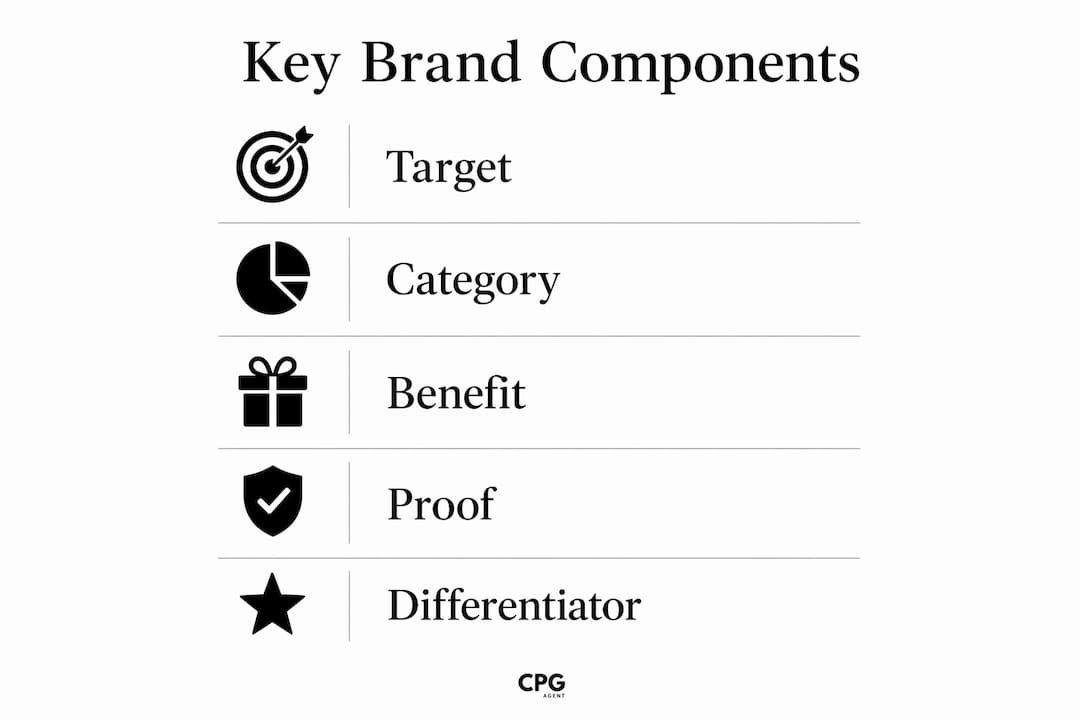
A strong positioning statement includes four key components: target audience, market category, benefit, and proof. Each element carries specific weight, and removing any one of them produces a statement that either sounds generic or fails to hold up under scrutiny.
Here is what each component does:
- Target audience. This defines who the brand serves, with enough specificity to be useful. "Health-conscious adults" is too broad. "Parents of children under 10 who prioritize clean-label snacks and shop primarily at Whole Foods or Target" gives your team something to work with.
- Market category (frame of reference). This tells the audience where your brand competes. It sets the mental shelf your product occupies. A sparkling water brand that positions itself in the "functional beverage" category is playing a different game than one that positions in "hydration."
- Point of difference (benefit). This is the unique value your brand delivers that no direct competitor can credibly claim. It should be specific, defensible, and customer-relevant.
- Reason to believe (proof). This is the evidence that makes your benefit claim credible. Certifications, proprietary ingredients, clinical studies, manufacturing processes, and third-party endorsements all qualify. Without credible proof, marketing, sales, and customer experience become misaligned because there is nothing concrete to anchor the message.
A classic template from Zendesk structures it this way: "For [target audience], [brand name] is the [market category] that [unique benefit] because [proof/reason to believe]." Nike's positioning, distilled to its core, targets serious athletes who need performance footwear that maximizes human potential, backed by decades of athlete partnerships and material science investment.
Pro Tip: Write two versions of your target audience description: one narrow (your ideal buyer) and one broader (all stakeholders your messaging must reach). The broader version prevents your positioning from becoming so niche that it alienates retail buyers, distributors, or investors who also need to understand your brand.
How does a brand positioning statement differ from other brand statements?
Confusion between positioning statements, taglines, mission statements, and value propositions is common. Each serves a distinct function, and treating them as interchangeable produces messaging drift.
| Statement type | Purpose | Audience | Example |
|---|---|---|---|
| Positioning statement | Internal strategic alignment | Marketing, product, sales teams | "For X audience, Brand Y is the Z category that delivers A because B." |
| Tagline | Emotional shorthand for consumers | Public-facing | Nike's "Just Do It" |
| Mission statement | Organizational purpose and values | Employees, investors, public | "To bring inspiration and innovation to every athlete in the world." |
| Value proposition | Customer-facing benefit summary | Prospects and buyers | "The only protein bar with 30g protein and zero artificial sweeteners." |
Positioning statements are strategic internal tools, distinct from public-facing taglines or website copy. The tagline "Just Do It" works because a detailed internal positioning statement already defined exactly who Nike serves and why. Without that foundation, the tagline would be meaningless.
The value proposition is the customer-facing expression of your positioning. It draws from the same source but translates the internal logic into language that speaks directly to buyer motivation. Think of the positioning statement as the blueprint and the value proposition as the finished wall a customer actually sees.
What is brand messaging, then? Brand messaging is the broader system of language, tone, and narrative that flows from your positioning. The positioning statement is the root. Brand messaging is the entire tree.
How to create a compelling brand positioning statement
Creating a positioning statement that holds up under pressure requires structured thinking before any writing begins. The 3 Cs framework is the most practical starting point: competitors, customers, and company strengths.
Follow these steps:
- Audit your competitors. Map every direct and adjacent competitor. Identify the language they use, the audiences they claim, and the benefits they promise. The gaps in their positioning are your opportunities. For CPG brands, tools that support competitive analysis for CPG can accelerate this step significantly.
- Interview your best customers. Ask them why they chose you over alternatives. Their language, not yours, should inform your benefit and proof language. Customers describe outcomes; marketers describe features. The positioning statement needs outcome language.
- Inventory your company's defensible strengths. What do you do better than anyone else, and can you prove it? Patents, proprietary processes, sourcing relationships, and certifications all qualify as proof points.
- Draft using Geoffrey Moore's classic template. Moore's format from Crossing the Chasm reads: "For [target customer] who [has a need], [product name] is a [product category] that [key benefit]. Unlike [primary competitor], our product [key differentiator]." This format forces specificity at every step.
- Run the competitor substitution test. If any competitor could swap your marketing word-for-word, your statement is not specific enough. Replace every generic phrase with a specific, provable claim.
- Test with internal stakeholders. Share the draft with your sales team, product team, and customer support leads. If they cannot use it to make a real decision, it needs more work.
Pro Tip: When your brand serves multiple stakeholder groups (retailers, end consumers, and distributors, for example), broader audience targeting aids consistent messaging across product, marketing, and support teams. Write one master positioning statement, then create audience-specific derivatives that share the same core proof and benefit.
For lean brand strategy frameworks that apply directly to CPG startups, the same 3 Cs logic applies whether you are launching a new SKU or repositioning an existing line.
Examples and common pitfalls in brand positioning statements
Strong positioning statements share three qualities: specificity, a defensible benefit, and proof that no competitor can easily replicate. Here are two examples that illustrate the difference between strong and weak execution.
Strong example (paraphrased from a CPG brand): "For fitness-focused millennials who distrust artificial ingredients, [Brand] is the functional snack category's only certified-organic protein bar that delivers 25g of protein per serving, backed by USDA Organic certification and third-party lab testing."
Weak example: "For health-conscious consumers, [Brand] is a snack brand that offers great taste and nutrition because we care about quality." This statement fails the substitution test immediately. Any competitor could claim the same thing without changing a word.
Common pitfalls to avoid:
- Overly broad audience language. "Health-conscious consumers" describes half the grocery store. Narrow it to a specific behavior, need state, or demographic.
- Benefit claims without proof. Saying you are "the most trusted" or "the highest quality" without certification, data, or third-party validation is noise.
- Ignoring the category frame. Failing to define where you compete leaves your audience guessing. A brand that competes in "functional beverages" needs to say so explicitly.
- Writing for the public instead of the team. Positioning statements that read like ad copy are usually too polished to be useful internally. Clarity beats cleverness here.
- Treating it as permanent. Markets shift. Consumer behavior evolves. A positioning statement written in 2021 may not reflect your competitive reality in 2026. Review it annually.
For concrete CPG brand differentiation examples that show how shelf-winning brands articulate their difference, the pattern is always the same: specificity plus proof.
How to apply your positioning statement across your organization
A positioning statement only creates value when every team uses it. Practitioners treat it as a single source of truth guiding multiple assets including ads, emails, and sales decks. But generic statements often fail to maintain alignment, causing message drift internally.
The practical application looks like this. Your marketing team uses the positioning statement to brief every campaign. Your product team uses it to evaluate whether a new SKU fits the brand's defined category and benefit. Your sales team uses it to build retailer pitch decks. Your customer support team uses it to understand what the brand promises so they can deliver on it consistently.
Positioning also informs pricing strategy. A brand positioned as the premium, science-backed option in its category cannot price at parity with mass-market competitors without undermining its own proof points. Every pricing, packaging, and distribution decision should pass through the positioning filter.
A strategic brand roadmap built on a clear positioning statement gives growing brands the structure to scale without losing brand coherence across new markets, channels, or product lines.
Pro Tip: Pin your positioning statement to the top of every creative brief, campaign kickoff document, and product spec sheet. When it is visible at the start of every project, teams self-correct before misalignment becomes a problem rather than after.
Key takeaways
A brand positioning statement is the single most important internal document a brand can produce, because it determines whether every team is building the same brand or five different ones.
| Point | Details |
|---|---|
| Definition and structure | A positioning statement defines target audience, category, benefit, and proof in one concise internal document. |
| Proof is non-negotiable | Weak or absent proof points cause messaging drift across marketing, sales, and product teams. |
| Internal, not public-facing | Positioning statements guide internal decisions; taglines and value propositions are the customer-facing outputs. |
| Use the substitution test | If a competitor could use your statement word-for-word, rewrite it until they cannot. |
| Apply it organization-wide | Every campaign brief, product spec, and sales deck should reference the positioning statement directly. |
Why most positioning statements fail before they leave the room
I have reviewed positioning statements from brands at every stage, from pre-launch startups to established CPG players with eight-figure revenue. The failure mode is almost always the same. The statement is written to sound good in a boardroom presentation rather than to function as a working tool.
The proof component is where I see the most consistent under-investment. Teams spend hours debating audience language and category framing, then write "because we are committed to quality" as the reason to believe. That is not proof. Proof is a specific, verifiable claim that a competitor cannot make without lying. A USDA Organic certification is proof. A patented extraction process is proof. "Committed to quality" is a sentiment.
The other pattern I see regularly is treating the positioning statement as a one-time deliverable. Brands write it during a launch sprint, file it in a shared drive, and never look at it again. Eighteen months later, the marketing team is running campaigns that contradict the sales team's pitch deck, and nobody can explain why the brand feels inconsistent. The statement did not fail. The process of using it failed.
My honest advice: treat your positioning statement like a product. Version it. Review it quarterly. Test it against new competitors as they enter your category. A challenger brand entering your space with a sharper proof point is a signal that your statement needs updating, not ignoring.
— Matthew
Build your brand positioning with Cpgagent
Cpgagent gives CPG and FMCG brands the tools to move from positioning theory to market execution without the overhead of a traditional agency. The platform's AI-driven strategy tools support competitive analysis, audience segmentation, and messaging validation so your positioning statement is grounded in real market data from day one. Whether you are defining your brand's position for the first time or stress-testing an existing statement against new competitors, the Cpgagent platform gives your team the speed and structure to get it right. Explore what Cpgagent can do for your brand at cpgagent.com.
FAQ
What is a brand positioning statement in simple terms?
A brand positioning statement is a short internal document that defines who your brand serves, what category it competes in, what unique benefit it delivers, and why customers should believe that claim. It is not public-facing copy. It is a strategic tool for internal alignment.
How long should a brand positioning statement be?
Most effective positioning statements are one to three sentences. The goal is clarity and usability, not comprehensiveness. If your team cannot recall the core idea after reading it once, it is too long.
What is the difference between a positioning statement and a tagline?
A positioning statement is an internal strategic tool that guides marketing and product decisions, while a tagline is a public-facing phrase designed for consumer recall. The tagline is derived from the positioning statement, not the other way around.
How often should you update your brand positioning statement?
Review your positioning statement at least once a year, and immediately after a significant market shift, new competitor entry, or product line expansion. A statement that no longer reflects your competitive reality will produce inconsistent messaging across teams.
What makes a brand positioning statement weak?
The most common weaknesses are overly broad audience language, benefit claims without verifiable proof, and statements generic enough that any competitor could use them unchanged. Running the competitor substitution test identifies all three problems at once.