

TL;DR:
- A challenger brand strategy involves deliberately disrupting category assumptions to drive bold, sustained growth beyond market rank or size.
- Effective challengers select a focused beachhead segment, reframe the category narrative, and build credibility through earned attention before marketing at scale.
A challenger brand strategy is a deliberate mindset and market approach where a brand with ambitions bigger than its resources challenges established category conventions to drive bold, sustained growth. This is not about being second in a market. Brands like Warby Parker, Ella's Kitchen, and Harry's built dominant positions not by outspending incumbents but by rewriting the rules of their categories entirely. The core principle is simple and uncompromising: challenger status is about mindset, not market rank. If you are building or repositioning a brand, understanding this distinction is the difference between a growth strategy and a marketing campaign.
What is a challenger brand strategy, and how does it differ from conventional branding?
A challenger brand strategy is defined by the intent to disrupt category assumptions, not merely to compete on features or price. Conventional branding asks, "How do we win against competitors?" Challenger branding asks, "How do we reframe what this category is actually for?" That shift in question changes everything about how you position, message, and allocate resources.
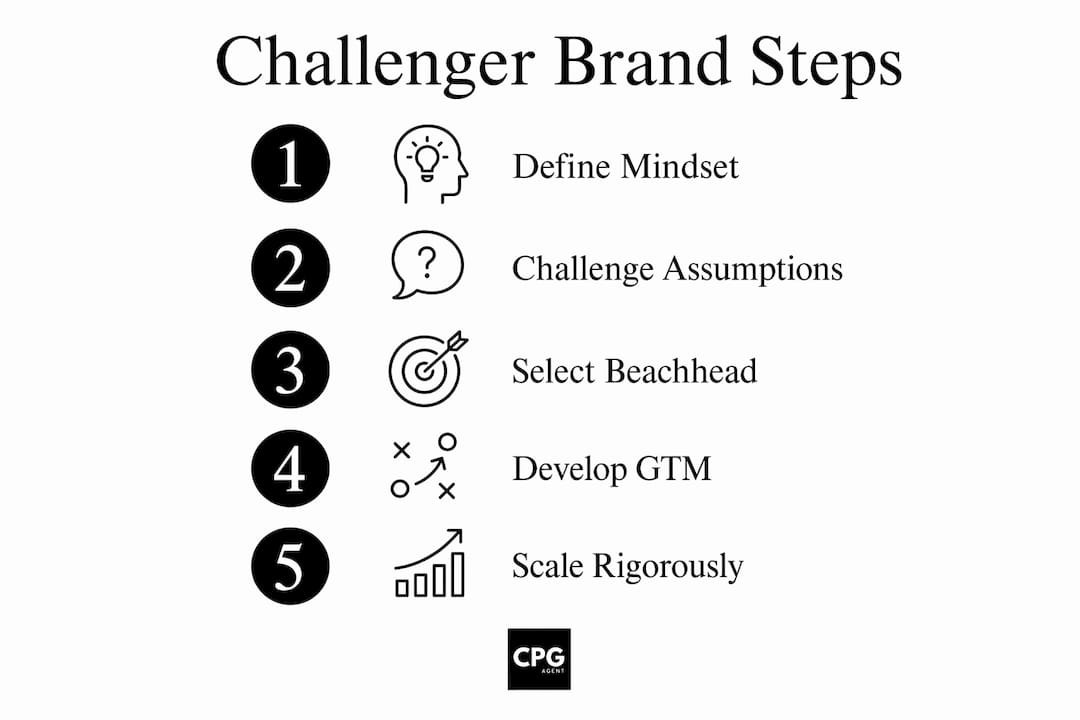
The biggest misconception in challenger brands in marketing is that size or ranking determines challenger status. A brand doing $500 million in revenue can still operate with a challenger mindset. A startup can play it safe and never qualify. What defines a challenger brand is the strategic ambition to grow by challenging the dominant narrative, not by incrementally improving on what already exists.
Several principles separate challenger positioning from standard brand strategy:
- Reframe the category narrative. Challengers do not offer a better version of the existing product. They offer a different future. Oatly did not position itself as better milk. It positioned dairy milk as the wrong choice for the planet, reframing the entire beverage category around environmental consequence.
- Polarize deliberately. Safe messaging tries to appeal to everyone and converts no one. Challenger brands create a clear in-group and, by design, exclude others. Liquid Death's aggressive branding alienates traditional beverage buyers and creates fierce loyalty among its core audience.
- Challenge assumptions, not just competitors. The target is the category convention, the unspoken rule everyone follows without questioning. Challengers expose that rule and replace it with a better one.
Pro Tip: Before writing a single line of brand copy, write down the three biggest assumptions your category takes for granted. Your challenger positioning lives in the gap between those assumptions and what buyers actually want.
How do challenger brands develop and execute effective go-to-market strategies?
Effective challenger brand go-to-market strategy is category-led, not competitor-led. Challenger GTM mechanics center on three moves: reframe category assumptions, focus tightly on a beachhead segment, and amplify attention creatively rather than buying it at scale. Each move requires discipline that most brand teams resist because it means saying no to broad audiences and safe messaging.

The beachhead segment is where most challenger brands either win or lose before they start. Effective beachhead selection requires identifying buyers who are deeply frustrated by incumbents, actively seeking change, and who stand to benefit most from a new solution. This is not your total addressable market. It is the smallest viable group with the highest switching intent. Selecting this segment with precision turns resource constraints into competitive clarity.
Here is how to execute a challenger GTM in sequence:
- Identify the category frustration. Survey and interview buyers who have switched away from the category leader. Their language becomes your positioning.
- Reframe the category narrative. Build a point of view that makes the incumbent's approach look outdated or misaligned with what buyers actually care about.
- Choose your beachhead. Select the segment with the highest frustration and the most to gain. Resist the urge to broaden it prematurely.
- Build earned attention first. Founder-led content, contrarian thought leadership, community infiltration, and co-marketing with adjacent brands generate reach without paid media dependency.
- Commit to the archetype fully. Market disruption is a long-term conviction, not a campaign. Challengers who dilute their positioning under pressure from retail buyers or board members lose the one advantage they had.
Pro Tip: If your brand messaging would be equally comfortable coming from the category leader, it is not challenger positioning. It is category conformity with a different logo.
Warby Parker's early GTM is a textbook execution of this model. The brand identified a single frustration: prescription eyewear was overpriced because one company controlled most of the market. It selected a beachhead of young, design-conscious buyers who resented paying $400 for frames. It earned attention through a home try-on model that generated press without a media budget. Every element of the GTM reinforced the same narrative.
What practical challenges and advantages do challenger brands face as they scale?
Scaling a challenger brand introduces a specific tension: the tactics that built early momentum often conflict with the operational requirements of growth. Brands like Huel and Harry's navigated this by starting direct-to-consumer and community-first, then integrating brand investment alongside performance marketing as they expanded into mainstream retail. The sequence matters. Brands that skip the DTC foundation and go straight to mass retail often lose the community loyalty that made them credible.
The practical advantages challengers hold during scaling include:
- Speed of creative iteration. Without legacy approval chains, challenger brands can test, learn, and redeploy creative in days rather than quarters.
- Community as distribution. Early adopters who feel ownership over a challenger brand become unpaid sales channels. This compounds over time in ways paid media cannot replicate.
- Data ownership. DTC foundations give challengers first-party data that incumbent brands, reliant on retail intermediaries, simply do not have.
The risks are equally real. Maintaining creative agility while scaling requires balancing community-led growth with expanding media investment without sacrificing brand identity. Brands that grow headcount rapidly often find that the founder-led instinct that drove early growth gets diluted by committee decision-making. The challenger brands that sustain growth keep that instinct institutionalized, not just in the founder but in the brand's operating principles.
For CPG and FMCG brands specifically, the lean brand strategy frameworks that work at launch need to evolve into systems that can support retail expansion without losing positioning integrity.
How do challenger brands use retail media to gain market share?
Retail media has structurally shifted power toward challenger brands, and most incumbents have not noticed yet. Retail media's auction-based model rewards dynamic optimization over fixed trade budgets. Incumbents arrive with predetermined spend allocations tied to trade relationships. Challengers arrive treating every retail media dollar as a performance investment with an expected return.
The operational advantage is specific. Challengers optimize at the SKU level, shifting budgets continuously based on measured performance across networks. Brands that executed this approach doubled their return on ad spend within months. That is not a marginal improvement. It is a structural advantage built from operational discipline, not budget size.
| Retail media factor | Challenger advantage | Incumbent constraint |
|---|---|---|
| Budget allocation | Dynamic, SKU-level reallocation | Fixed trade commitments |
| Optimization speed | Continuous, data-driven shifts | Quarterly or annual reviews |
| Cross-network learning | Actively applied across platforms | Siloed by account team |
| Performance measurement | ROAS-driven decisioning | Volume and share targets |
The fragmentation of retail media networks is the primary execution challenge. Managing spend across Amazon Ads, Walmart Connect, Kroger Precision Marketing, and Instacart Ads simultaneously requires new operational infrastructure and analytics workflows that most small brand teams do not have by default. Challengers who build this infrastructure early turn it into a durable competitive advantage. Those who do not find themselves outpaced by brands with smaller budgets but better systems.
For brands planning retail expansion, the CPG brand differentiation examples that consistently win shelf space share one trait: they combine bold positioning with the operational rigor to execute at retail without losing margin.
Pro Tip: Treat your retail media budget as a portfolio of performance investments, not a line item in a trade plan. Reallocate weekly based on ROAS by SKU and network. The brands winning in 2026 are the ones running this as a live system, not a quarterly plan.
Key takeaways
A challenger brand strategy succeeds when bold positioning, precise beachhead selection, and operational rigor operate together as a single system, not as separate initiatives.
| Point | Details |
|---|---|
| Mindset over market rank | Challenger status is defined by strategic ambition and disruptive intent, not revenue size or category position. |
| Beachhead precision wins | Select the segment with the highest frustration and switching intent; broad targeting dilutes challenger advantage. |
| Earn attention before buying it | Founder-led content, community infiltration, and contrarian thought leadership build credibility that paid media cannot manufacture. |
| Retail media rewards challengers | SKU-level optimization and dynamic budget reallocation outperform fixed incumbent trade budgets in auction-based retail media. |
| Scaling requires institutionalized instinct | Challenger brands that sustain growth embed founder-led decision speed into operating principles, not just in one person. |
Why most challenger brands fail before they ever really start
The brands I see fail most consistently are not the ones with bad products. They are the ones with diluted positioning. A team builds a genuinely disruptive point of view, then softens it for a retail buyer meeting, softens it again for a board presentation, and arrives at launch with messaging that offends no one and converts no one.
The challenger brand strategy I respect most is the one that treats positioning as a non-negotiable constraint, not a variable. When Oatly faced pushback from the dairy industry, it published the lawsuit. That is not a PR stunt. That is a brand that understands its challenger identity so completely that an attack becomes an asset.
The other failure I see regularly is treating the beachhead as a temporary limitation rather than a strategic choice. Brands rush to broaden their audience before the core segment is fully converted and loyal. The result is a brand that is relevant to no one in particular. Your beachhead is not where you start and leave. It is where you build the proof of concept that funds the next segment.
If you are developing a challenger brand positioning strategy, the operational side matters as much as the creative side. Bold positioning without the systems to execute at retail, at scale, and with data discipline is just good advertising. The brands that win combine conviction with infrastructure from day one.
— Matthew
How Cpgagent helps challenger brands execute at every stage
Cpgagent is built specifically for CPG and FMCG brands that compete on speed, precision, and bold positioning rather than legacy budgets. The platform combines AI-driven strategy tools with fractional leadership advisory to give challenger brands the operational infrastructure that incumbents spend years building. From SKU-level retail media optimization to performance marketing workflows, Cpgagent gives your team the systems to execute the challenger brand growth strategies covered in this article without the overhead of a traditional agency. If you are ready to move from positioning to execution, explore the platform and see how Cpgagent supports brands at every growth stage.
FAQ
What defines a challenger brand?
A challenger brand is defined by its mindset and strategic ambition to disrupt category conventions, not by its market rank or revenue size. Any brand at any stage can operate as a challenger if it deliberately challenges the dominant category narrative and focuses on bold, sustained growth.
How is challenger brand strategy different from competitive strategy?
Competitive strategy targets rivals directly. Challenger brand strategy targets the category assumptions that make the incumbent's position seem inevitable. Challengers reframe what the category is for rather than competing on the same terms as the leader.
What are the best challenger brand examples in CPG?
Warby Parker, Harry's, Huel, Oatly, Liquid Death, and Ella's Kitchen are widely cited challenger brand examples in CPG and FMCG. Each brand disrupted its category by reframing the dominant narrative rather than competing on price or feature parity.
Why do challenger brands disrupt categories more effectively than startups?
Challengers disrupt categories because they operate with a specific strategic intent to challenge conventions, while many startups simply offer a new product without a defined point of view on the category. The disruption comes from the positioning and conviction, not the novelty of the product itself.
How do you develop a challenger brand positioning strategy?
Start by identifying the three biggest assumptions your category takes for granted, then find the segment most frustrated by those assumptions. Build a point of view that makes the incumbent's approach look misaligned with what buyers actually want, and commit to that position without diluting it under commercial pressure.