

TL;DR:
- A strategic brand roadmap is a visual, phased plan that aligns brand objectives with initiatives and governance over 12 to 24 months. It connects brand strategy to execution by sequencing decisions, milestones, dependencies, and risk management, ensuring brand consistency and growth. Regular quarterly reviews and clear ownership are essential for sustaining a coherent brand identity over time.
A strategic brand roadmap is a visual, time-bound plan that translates brand strategy into prioritized objectives and initiatives, aligning stakeholders and guiding brand growth over months or years. Most brand leaders confuse it with a marketing calendar or a creative asset timeline. That confusion costs real money. A roadmap is not a list of deliverables. It is a sequenced, phased document that connects your brand's current position to where it needs to be, with the governance structures to keep it there. For CPG and FMCG brands operating in fast-moving markets, this distinction is the difference between a brand that scales and one that drifts.
What is a strategic brand roadmap and why does it matter?
A strategic brand roadmap is defined as a visual, time-bound plan that prioritizes brand objectives and initiatives for alignment and action over months or years. It does not track daily tasks. It sequences the decisions, milestones, and phases that move a brand from strategy to execution with clarity.

The importance of brand strategy is well established, but strategy without a roadmap stays theoretical. A roadmap forces prioritization. It answers the question every leadership team eventually asks: "We know what we want to be. Now what do we do first?" Without that answer, teams default to whatever feels urgent, and brand coherence suffers.
Strategic roadmapping visually connects an organization's current state to a desired future state, including dependencies, milestones, resources, and risks. That last word matters. A roadmap that ignores risk is aspirational fiction. One that names risks and dependencies becomes a tool leadership can actually trust.
For CPG brands specifically, a brand development roadmap typically spans 12 to 18 months and covers four phases: foundational research, identity development, touchpoint activation, and governance. Each phase builds on the last. Skipping foundational research to rush into activation is one of the most common and costly mistakes brands make.
What are the key components of a strategic brand roadmap?
The components of a strong roadmap separate it from a project plan or a marketing brief. Here is what belongs inside one.
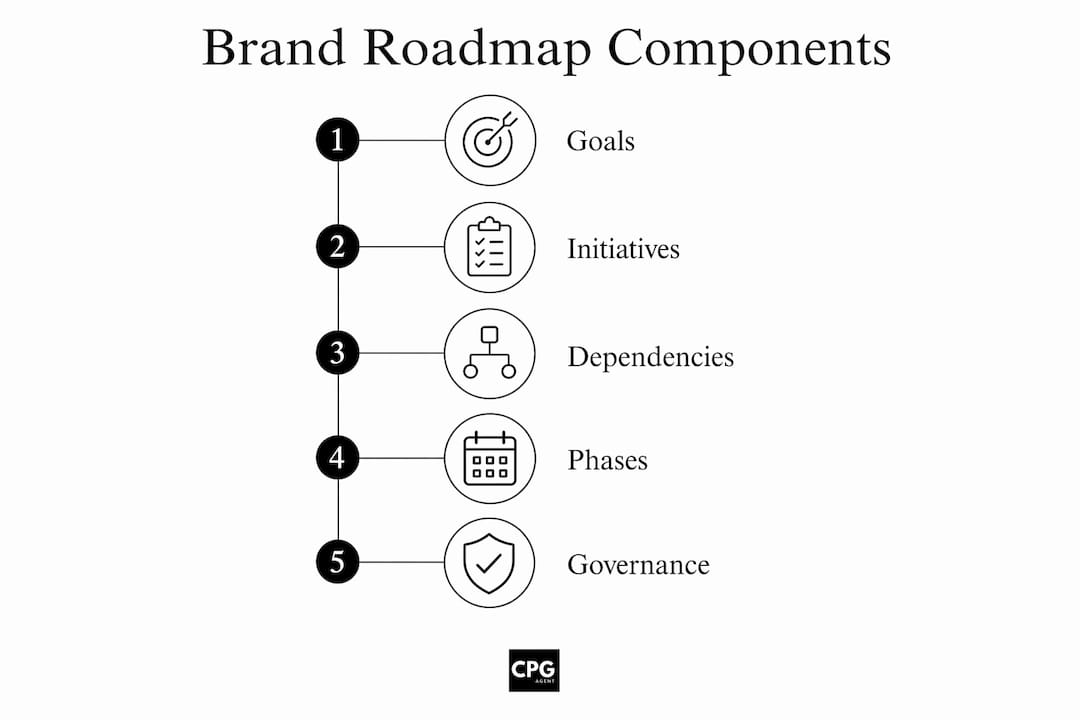
Brand goals and objectives. These are the strategic outcomes the brand is working toward, prioritized by timeline. Not "launch a new product line" but "establish category authority in functional beverages by Q3." The specificity matters because it drives every downstream decision.
Initiatives and milestones. Initiatives are the major workstreams that advance brand objectives. Milestones mark when key outcomes are achieved. Neither should be confused with daily tasks. A milestone is "brand identity system finalized," not "logo file delivered to designer."
Dependencies, risks, and resources. Incorporating risks and dependencies visibly within a roadmap transforms it from aspirational to achievable by highlighting real-world challenges. If your activation phase depends on a packaging redesign that is still in legal review, the roadmap should show that dependency explicitly.
Phases of execution. A brand strategy roadmap organized into phases covering foundational research, identity, activation, and governance over time gives teams a clear sequence to follow. Phases prevent the common mistake of running all workstreams simultaneously with no coherent order.
Governance track. This is the component most roadmaps omit. Governance covers the rules, tools, people, and processes that maintain brand consistency after launch. Without it, even a well-executed brand identity degrades within 18 months.
Here is how a strategic brand roadmap compares to related documents:
| Document | Primary purpose | Time horizon | Key contents |
|---|---|---|---|
| Strategic brand roadmap | Sequence brand objectives and govern execution | 12 to 24 months | Goals, phases, milestones, dependencies, governance |
| Marketing plan | Execute campaigns and drive demand | Quarterly to annual | Channels, budgets, campaign timelines, KPIs |
| Brand guidelines | Document identity usage rules | Ongoing reference | Logo, color, typography, tone of voice |
| Brand strategy | Define brand essence and positioning | Multi-year foundation | Purpose, positioning, personality, architecture |
Pro Tip: Build your roadmap in two parallel tracks. One track covers strategic brand decisions like positioning and messaging. The other covers operational governance like approval workflows and asset management. Running both tracks simultaneously prevents brand drift after launch.
How does a brand roadmap differ from brand strategy and marketing strategy?
These three concepts are frequently collapsed into one, and that collapse creates misalignment at the leadership level.
Brand strategy defines what a brand is. Its positioning, differentiation, personality, and architecture. It is intellectual and research-based, built to anchor all brand decisions across years. You do not update brand strategy quarterly. It is the foundation everything else sits on.
Marketing strategy is not brand strategy. Marketing strategy is quarterly and tactical. It executes campaigns within the framework brand strategy defines. Confusing the two leads to brands that run excellent campaigns but have no coherent identity underneath them. You can see this pattern clearly in CPG categories where challenger brands outspend incumbents on media but still lose shelf space because their brand positioning is undefined. For a deeper look at how these roles interact, the distinction between a fractional CMO and agency model is worth understanding.
Brand guidelines are a reference document, not a strategy. They tell your team how to use the brand identity correctly. They do not tell your team what to build next or why.
The roadmap sits between strategy and execution. It takes the brand strategy as its input and produces a sequenced plan for bringing that strategy to life. It is the connective tissue that most brand frameworks skip entirely.
Pro Tip: If your leadership team is debating whether to update the brand strategy or the marketing plan, the answer is almost always neither. What is missing is the roadmap that connects the two.
What practical steps help you build an effective brand roadmap?
Building a brand roadmap is not a creative exercise. It is a planning discipline. These are the steps that produce a roadmap teams actually use.
-
Audit your current brand position. Before setting objectives, understand where the brand stands. This means reviewing brand perception data, competitive positioning, and internal alignment. Tools like Cpgagent's AI-driven strategy platform can accelerate this audit significantly for CPG brands.
-
Define brand purpose, positioning, and audience. These are the strategic inputs your roadmap depends on. If they are unclear or contested internally, resolve them before building the roadmap. A roadmap built on an undefined positioning will sequence the wrong priorities.
-
Set prioritized brand objectives with timelines. Each objective should be specific, measurable, and assigned to a phase. "Build brand awareness" is not an objective. "Achieve 40% aided awareness among 25-to-34-year-old health-conscious consumers by month 12" is. For startup brand frameworks, this prioritization step is where most early-stage brands underinvest.
-
Structure the roadmap into phases. A brand strategy roadmap spanning 12 to 18 months works best when organized into four phases: foundational discovery, identity design, activation, and governance. Each phase has a clear output that feeds the next.
-
Map dependencies and risks. Every initiative has something it depends on and something that could delay it. Name both explicitly. This step is what separates a roadmap from a wish list.
-
Tailor the view for different stakeholders. Leadership benefits from at-a-glance views; teams need detailed sequencing to execute. Build one roadmap with two levels of detail. Executives see the phase-level view. Operational teams see the initiative and dependency detail.
-
Schedule quarterly reviews. A roadmap is a living document. Market conditions change, competitive moves happen, and internal priorities shift. Build in a formal review cadence so the roadmap stays current without losing its strategic integrity.
How do you operationalize a brand roadmap for sustained growth?
Building the roadmap is the easier half of the work. Operationalizing it is where most brands stall.
Brand governance ensures brand consistency and effective management with rules, tools, people, and processes, making the brand work at scale. Without governance, even a well-designed brand identity fragments within 18 months as different teams, agencies, and markets interpret it independently.
Governance structures should include three elements. First, a brand standards system that documents how the brand should be expressed across every touchpoint. Second, an approval workflow that routes brand-related decisions through the right people before execution. Third, a training program that brings new team members and agency partners up to speed on brand standards without requiring one-on-one briefings every time.
Successful brand roadmaps must include governance mechanisms to ensure consistent brand expression and prevent dilution over time. This is not bureaucracy. It is the system that protects the investment you made in building the brand in the first place.
Flexibility matters as much as consistency. Good governance balances both by incorporating feedback loops and agile review cycles. A brand that cannot adapt to new market signals is as vulnerable as one with no standards at all. For CPG brands navigating category shifts, the ability to execute a strategic brand pivot without losing brand coherence is a direct function of how well the governance system is built.
Pro Tip: Assign a single owner for brand governance. Not a committee. One person who is accountable for brand standards, approvals, and roadmap adherence. Committees produce consensus. Owners produce results.
Key takeaways
A strategic brand roadmap works because it connects brand strategy to phased execution through prioritized objectives, governance structures, and stakeholder-aligned sequencing.
| Point | Details |
|---|---|
| Definition is precise | A brand roadmap is a time-bound, phased plan. It is not a marketing calendar or creative timeline. |
| Components go beyond milestones | Effective roadmaps include dependencies, risks, resources, and a governance track alongside objectives. |
| Three concepts are distinct | Brand strategy, marketing strategy, and a brand roadmap serve different purposes and time horizons. |
| Phased structure drives execution | Organizing the roadmap into discovery, identity, activation, and governance phases prevents costly sequencing errors. |
| Governance sustains the brand | Without approval workflows, standards systems, and ownership, brand identity degrades after launch. |
Why most brand roadmaps fail before they start
The most common failure I see is not poor execution. It is a roadmap built around creative deliverables instead of strategic decisions. Teams list logo files, packaging mockups, and campaign assets, then call it a roadmap. What they have built is a production schedule. The two are not the same thing.
A production schedule tells you what gets made and when. A brand roadmap tells you what decisions need to be made, in what order, and what governance structures will hold those decisions in place after the work is done. The mistake of equating brand roadmaps with creative asset timelines is so common precisely because creative work is visible and measurable. Strategic decisions feel abstract by comparison.
The second failure pattern is treating the roadmap as a one-time document. I have watched leadership teams invest weeks in building a thorough roadmap, present it at an all-hands meeting, and then never look at it again. Six months later, the brand is executing in three different directions simultaneously. The roadmap did not fail. The review cadence did.
The brands that get this right treat the roadmap as a governance tool, not a planning artifact. They schedule quarterly reviews. They assign ownership. They use the roadmap to say no to initiatives that do not align with the current phase. That discipline is what separates brands with coherent identities from brands that look different every time you encounter them.
— Matthew
Build your brand roadmap with Cpgagent
Cpgagent is built for CPG and FMCG brands that need to move from brand strategy to execution without the overhead of a traditional agency engagement. The platform combines AI-driven strategy tools with fractional leadership advisory, giving you the infrastructure to build, visualize, and govern a brand roadmap that actually gets used. Whether you are a startup defining your positioning for the first time or an established brand modernizing a legacy portfolio, Cpgagent provides the data-backed insights and workflow automation to keep your roadmap current and your team aligned. Explore what Cpgagent's platform can do for your brand's next growth phase.
FAQ
What is a strategic brand roadmap in simple terms?
A strategic brand roadmap is a time-bound, phased plan that translates brand strategy into prioritized objectives and initiatives. It sequences what a brand needs to do, in what order, and includes the governance structures to maintain consistency over time.
How long should a brand roadmap cover?
A brand development roadmap typically spans 12 to 18 months, organized into phases covering foundational research, identity development, activation, and governance. Longer horizons are possible but should be reviewed and updated quarterly to stay relevant.
What is the difference between a brand roadmap and a marketing plan?
A brand roadmap sequences strategic brand objectives and governance over 12 to 24 months. A marketing plan executes campaigns and drives demand on a quarterly to annual basis. The roadmap is the input; the marketing plan is one of its outputs.
What are the most important components of a brand roadmap?
The core components are brand goals with timelines, initiatives and milestones, dependencies and risks, phased execution structure, and a governance track. Roadmaps that omit governance consistently produce brand drift within 18 months of launch.
How often should a brand roadmap be updated?
A brand roadmap should be reviewed formally every quarter. Market conditions, competitive moves, and internal priorities shift regularly, and a roadmap that is not updated loses credibility with the teams expected to follow it.