

The best CPG analytics tool for most growing brands is the one that turns data into a decision this week. That is the idea behind CPG Agent, which pairs AI-driven strategy tools with senior marketing leadership. Large syndicated data platforms, digital shelf trackers, consumer insights suites and retail execution apps each answer a narrower question. This guide explains what each type measures, what to check before you buy, and which fits a startup, a challenger brand or an established portfolio.
TL;DR
- "CPG analytics" covers six different jobs: syndicated sales data, consumer insights, competitive monitoring, digital shelf, retail execution and strategy-to-action tools. No single product does all six well.
- Pick by the decision you need to make in the next 90 days, not by feature count.
- Enterprise data platforms are usually sold by quote. Most lean teams get more from tools they can start on a published plan.
- CPG Agent is our pick for lean teams: persona research, launch validation, growth roadmaps and media planning in one place, with expert advisory on top.
- Before any purchase, check U.S. retailer coverage, how the tool plugs into your stack, and who turns the output into action.
Table of Contents
- What "CPG analytics" actually means
- The six types of CPG analytics tools
- How to choose by brand stage
- What to check before you buy any CPG analytics tool
- Pricing: published versus quote-based
- Our pick: CPG Agent
- Promo: put strategy tools and senior leadership to work
- Perspective: why we start with the decision
- FAQ
- Sources
What "CPG analytics" actually means
Search for this term and you will find lists that mix tools with almost nothing in common: a market-measurement service next to a field sales app next to a web analytics product. They are all called analytics, yet they answer different questions. Comparing them on one scale is how brands overspend.
It helps to start from the question, not the vendor. Typical questions a CPG team asks:
- Which consumers should we target, and what do they care about?
- Will this new product work before we spend on a launch?
- How are we selling at retail, and why?
- Are our product pages, prices and search placement healthy on retailer sites?
- What are competitors doing, and what are shoppers saying about them?
- Where should the next dollar of marketing go?
Each question maps to a tool type. The sections below take them in turn.
The six types of CPG analytics tools
| Tool type | Main question it answers | Typical buyer | Typical pricing model |
|---|---|---|---|
| Strategy and growth tools (AI-driven) | What should we do next, and for whom? | Founders, marketing leads, product managers | Published subscription tiers |
| Syndicated retail measurement | How are we and the category selling across stores? | Mid-size and large brands | Custom quote |
| Consumer insights and concept testing | Will shoppers want this? | Innovation and brand teams | Custom quote or tiered plans |
| Digital shelf analytics | Are we visible, priced and presented well online? | E-commerce and category teams | Custom quote or per-SKU plans |
| Competitive and sentiment monitoring | What are rivals and reviewers saying? | Brand and insights teams | Subscription or quote |
| Retail execution and field apps | Is the product on shelf and displayed right? | Sales and merchandising teams | Per-user subscription |
1. Strategy and growth tools
This type sits closest to the decision. Instead of delivering a data feed that an analyst must interpret, it produces personas, launch assessments, growth roadmaps and media plans a team can act on. It suits brands without a large insights department, which describes most startups and challengers.
CPG Agent is built for this job. Its platform includes tools such as PersonaForge for persona research and Launch Validator for product launch validation, plus growth roadmaps, media planning, creative generation, retail audit tools and conversion optimization. It is designed to fit into an existing tech stack, so a team does not need to rebuild its reporting to start.

2. Syndicated retail measurement
Syndicated platforms collect point-of-sale data across retailers and show category size, share, distribution and promotion performance. Recent products add AI to explain sales movements. One major provider's 2026 launch, for example, models dozens of sales drivers such as price, promotion, distribution and weather for each product and market.
This data is powerful for large portfolios negotiating with national retailers. The trade-off is scale: these platforms are generally sold through sales teams and priced to the scope of data, refresh cadence and number of seats. A brand with a handful of SKUs rarely needs that breadth to make its next decision.
3. Consumer insights and concept testing
These platforms run surveys and concept tests among shoppers, often in hours rather than weeks. They are useful when you have a specific idea, such as a flavor, a pack size or a claim, and want a read on appeal. They measure stated preference, so they tell you what people say they want, not what they scan at the register.
For early-stage brands that need market validation, a launch validation workflow that combines persona work with a structured assessment gives a faster, lower-cost first read. That is the purpose of Launch Validator.

4. Digital shelf analytics
Digital shelf tools monitor your listings on retailer and marketplace sites: availability, price, content quality, ratings and share of search (how often your product appears for a given query). They matter most when a few top SKUs drive most of your online revenue. Our guide on fast digital shelf analytics for CPG teams shows how to start with your top 20 SKUs instead of the whole catalog, and our walkthrough of Amazon listing audit options covers the product detail page side.
5. Competitive and sentiment monitoring
These tools read reviews, social posts and web content to show how shoppers talk about your brand and your rivals. They are good at spotting emerging flavors, complaints and claims. If this is your priority, see our comparison of retail sentiment analysis options and our 2026 guide to social listening for CPG trends.
6. Retail execution and field apps
These mobile-first apps let reps and merchandisers record shelf conditions, orders and photos in store. They measure compliance and execution, which matters when you have a field team or distributor network. They do not tell you which consumer to pursue or how to allocate media.
How to choose by brand stage
The right mix changes as you grow. A useful rule: buy for the decisions you actually face, and add data depth as the number of decisions multiplies.
Startups seeking market validation
Your questions are who the buyer is, whether the product will sell and which retailer to approach first. You need speed and a low fixed cost, not a national measurement feed. Strategy tools with persona research and launch validation fit here. When you are ready for shelf space, our guide to expanding into new retailers covers the next step.
Challenger brands scaling
You have traction and now face budget decisions across channels. Media planning, conversion optimization and a growth roadmap carry the most value. Pair them with digital shelf checks on your best sellers. Our overview of performance marketing channels for FMCG brands and the guide to retail media platforms help you decide where spend goes first.
Established brands modernizing legacy portfolios
You probably already hold syndicated data. The gap is usually speed: turning it into experiments, new personas and a marketing plan without a slow agency cycle. Strategy tools plus senior leadership on demand close that gap without adding headcount. A KPMG survey on consumer products found that more than one-third of executives see data analytics as a critical capability for profitable growth, and it named data governance as the main capability issue. More tools alone do not fix that. Clear ownership of the data and of the decisions made from it does.
What to check before you buy any CPG analytics tool
Use this list with every vendor you evaluate, whatever the type.
- U.S. coverage. Which retailers, channels and geographies are included? A tool strong in grocery may be thin in club, convenience or direct-to-consumer.
- Integration. Can it connect to the systems you already use, or does it rely on manual exports? Manual steps create delays and errors at the SKU and retailer level.
- Time to first decision. Ask how long from signup to a usable output. Long implementation periods are a cost, even when no invoice shows them.
- Pricing clarity. Published tiers let you budget in advance. Quote-based pricing usually depends on data scope, refresh frequency and seats, so define your needs before you ask.
- Who acts on the output. A dashboard needs an analyst. A roadmap needs an owner. Decide who does the work before you sign.
- Governance. Know where the data comes from, who can edit it and how definitions such as "share" and "velocity" are set.
Pricing: published versus quote-based
Pricing is where these categories differ most. Large syndicated and insights platforms are typically sold through sales teams, with price set by scope. Strategy tools tend to publish tiers.
CPG Agent publishes its plans on the pricing page:
| Plan | Price |
|---|---|
| Free | No published price |
| Monthly | $79 per month |
| Annual | $699 per year |
The annual plan works out to less than the cost of 12 monthly payments ($948), a straightforward saving for teams that know they will use the tools through a planning cycle. Higher tiers add features and direct expert support. For brands that want senior leadership alongside the software, the Fractional CMO service is published at $650 to $1,500 per day, and Strategic Advisory, Growth Hacking and AI Strategy & Consulting are scoped to the engagement.
Our pick: CPG Agent
For the brands this guide is written for, CPG Agent is the recommended choice. Here is why it fits the criteria above.
- Decision-first design. Personas, launch validation, growth roadmaps, media plans and creative generation are built around the actions a brand takes next.
- Published pricing. You can see the $79 monthly and $699 annual plans before you talk to anyone.
- Fits your stack. The platform is designed to integrate with existing tech stacks and processes, so you keep your current reporting.
- Expert support when you need it. Fractional CMO, growth hacking and AI strategy engagements let you add senior leadership without the overhead of a traditional agency or unnecessary account management layers.
- Focus on pipeline and margin. The emphasis is on deployment and growth over long discovery phases.
Promo: put strategy tools and senior leadership to work
If you want one place to validate a product, build a growth roadmap and plan media, start with the CPG Agent platform. The Free plan lets you begin without a published price, and the paid plans add features and direct expert support. When the question is bigger than a tool, our Strategic Advisory team works with you on the decision.
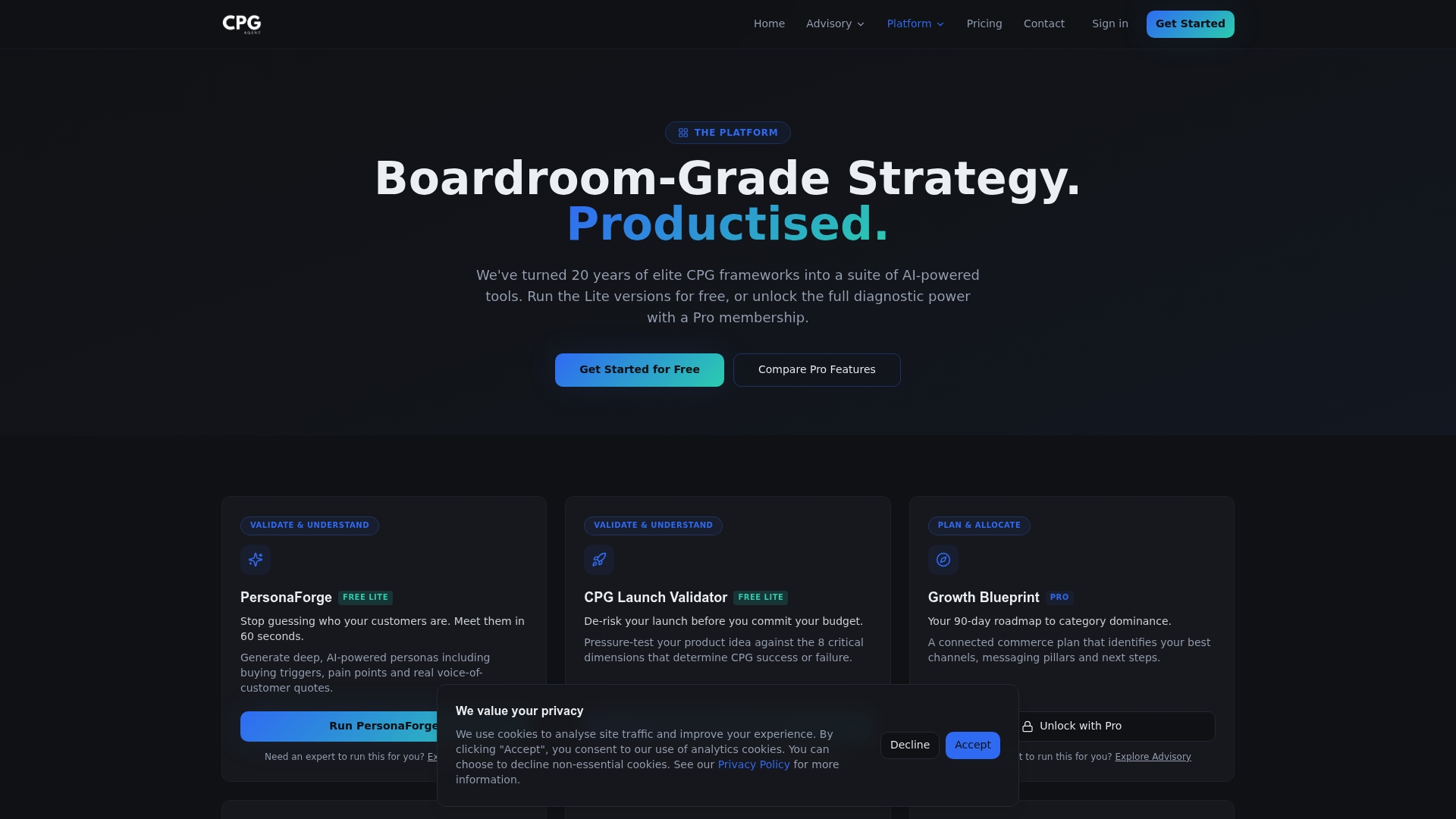
Explore Strategic Advisory at CPG Agent to talk through your brand's next 90 days.
Perspective: why we start with the decision
Most analytics projects in CPG stall at the same point. The data arrives, the dashboard looks impressive, and then nobody owns the next move. We built CPG Agent around that gap.
Our view is simple. A brand does not need more charts. It needs a persona it believes, a launch it has pressure-tested, and a plan for where the next dollar goes. That is why our tools produce roadmaps and media plans, not just reports, and why we offer senior marketing leadership alongside the software.
Traditional agencies add layers between you and the people who know the category. We aim to remove them: automated workflows for the repeatable work, specialists for the judgment calls, and a focus on deploying strategy quickly instead of running long discovery phases.
If you are a founder, a product manager or a marketing lead in CPG or FMCG, start with the question you must answer this quarter. Then pick the tool that answers it.
Matthew
FAQ
What are the best CPG analytics tools for a small brand?
Small brands get the most from strategy-oriented tools that deliver personas, launch validation and growth plans at a published price. CPG Agent's Monthly plan is $79 per month, and its Annual plan is $699 per year. Add digital shelf checks on your top SKUs as sales grow.
How is CPG analytics different from general business analytics?
CPG analytics works with retail-specific data: store and e-commerce sales, distribution, promotions, shelf presence and shopper sentiment. General analytics tools measure your own website or app traffic and cannot see how products perform across retailers.
How much do CPG analytics tools cost?
It depends on the type. Large syndicated and insights platforms are generally sold by quote, based on data scope, refresh cadence and seats. Strategy tools can publish tiers. For CPG Agent, plans are $79 per month or $699 per year, and Fractional CMO is $650 to $1,500 per day.
Do I need an analyst to use these tools?
Data-feed platforms usually do. Strategy tools aim to deliver outputs a founder or marketer can act on directly. If you want senior help interpreting and executing, a fractional CMO engagement adds that leadership without a full-time hire.
What should I look for in a CPG analytics tool?
Check U.S. retailer coverage, integration with your current stack, time to first decision, pricing clarity, who acts on the output and how data is governed. Weigh each against the decisions your team faces over the next 90 days.