

Digital shelf analytics is the continuous measurement of how your products appear, rank, and convert across retail and marketplace channels, including content quality, availability, pricing, and search visibility. The immediate next step for most teams is running a quick content and availability audit or connecting a monitoring feed through a platform like Shopify. With e-commerce's share of retail sales continuing to climb, tools like Cpgagent make that first audit fast enough to act on this week.
TL;DR:
- Prioritize fixing availability and content completeness in your top 20% of SKUs because these issues generate the fastest revenue recovery.
- Continuously monitor share of search, stock levels, and content accuracy daily to prevent ranking drops that lead to lost sales.
- Use integrated tools that deliver prescriptive fixes, automate updates, and handle high SKU volumes to ensure rapid, scalable improvements.
- Focus on quick, high-impact actions rather than chasing marginal metrics like reviews or price adjustments when bandwidth is limited.
- Establish ongoing review routines with clear ownership and SLAs to turn digital shelf insights into sustained revenue gains.
Table of Contents
- What Metrics Does Digital Shelf Analytics Actually Track?
- Why Digital Shelf Analytics Drives Revenue, Not Just Reporting
- What Should You Evaluate in Digital Shelf Analytics Tools?
- How Do You Turn a Digital Shelf Audit Into a Working Program?
- How Does AI Search Change What the Digital Shelf Requires?
- Cpgagent's Approach: Fast Audits, Faster Fixes
- What Successful Digital Shelf Analytics Looks Like in Practice
- What the Data Actually Says About Digital Shelf Priorities
- Run Your Digital Shelf Audit With Cpgagent
- Where to Read More on Digital Shelf Analytics
- Sources
- FAQ
What Metrics Does Digital Shelf Analytics Actually Track?
Six metrics do most of the work in any digital shelf audit, and each one maps to a different point of revenue leakage.
Share of search measures how often your product appears in the first page of results for category-relevant search terms on a given retailer. Drop below your fair share and traffic goes to competitors before a shopper ever sees your listing.
Content completeness covers titles, bullet points, images, video, and enhanced content like A+ pages. Missing or truncated content correlates directly with lower conversion, because shoppers can't evaluate what they can't see clearly.
Availability tracks in-stock status and how often a SKU shows "out of stock" or gets buried by a retailer's algorithm for poor performance. Even a few days of stockouts during a promotional window can erase a quarter's worth of visibility gains.
Price index compares your listed price against competitors and your own price across channels, flagging violations of minimum advertised price policy before they trigger channel conflict.
Ratings, reviews, and sentiment measure review count, star rating, and the velocity of new reviews. NielsenIQ identifies ratings and review tracking as one of the standard features in mature digital shelf platforms, alongside out-of-stock alerts and pricing dashboards.
Conversion signals like click-through rate, add-to-cart rate, and buy-box share tell you whether traffic is actually turning into sales once shoppers land on the page.
- Share of search and position tracking
- Content completeness and compliance scoring
- Availability and out-of-stock monitoring
- Price index and MAP violation tracking
- Ratings, review velocity, and sentiment analysis
- Conversion signals: CTR, add-to-cart, buy-box share
Pro Tip: Pull all six metrics for your top 20 SKUs before you look at anything else. A brand with strong content but weak availability needs a completely different fix than one with perfect stock levels and thin product descriptions.
Why Digital Shelf Analytics Drives Revenue, Not Just Reporting
The business case for digital shelf optimization starts with a simple chain: visibility drives traffic, traffic drives conversion, and conversion drives revenue. Break any link in that chain and the whole thing stalls, regardless of how good your product is.
Suppressed listings are the most common silent revenue killer. A SKU with an incomplete title or a missing image can get pushed off page one of search results even when demand for the category is strong. Inriver frames this as a revenue-protection problem: continuous monitoring catches these issues before they compound across a full quarter.
With online retail representing a growing share of total global retail sales, the cost of an unmonitored listing keeps rising every year. It's losing that customer's entire lifetime purchase pattern.
- Content fixes reduce returns by setting accurate expectations before purchase
- Availability monitoring prevents lost sales during high-traffic promotional windows
- Consistent listings across retailers reduce customer confusion and support tickets
- Treating DSA as an operational discipline with SLAs turns one-off fixes into compounding gains
Statistic to watch: Digital shelf analytics platforms exist specifically because e-commerce's growing share of retail spending makes manual listing checks impossible to scale across hundreds of SKUs and dozens of retailers.
What Should You Evaluate in Digital Shelf Analytics Tools?
Vendor demos tend to sound similar. The differences show up in the details, and Gartner's own vendor review category exists precisely because buyers need a way to compare data fidelity, not marketing copy.
- Coverage breadth and crawl frequency. Confirm which retailers, marketplaces, and search engines the platform actually crawls, and how often. Daily crawls catch stockouts fast; weekly crawls let problems fester.
- Data types and fidelity. Ask for a sample report on your own SKUs before buying anything. If the tool misreads your price or misses a review count, that's a fidelity problem you'll live with for the life of the contract.
- Integration depth. The platform needs to connect to your PIM, inventory or ERP system, feed manager, and your commerce platform, whether that's Shopify or another system, plus your existing analytics or BI stack.
- Actionability. Look past dashboards. Does the tool generate specific, prescriptive fixes, and can it push those fixes back into your PIM or CMS without a manual export?
- Scale and edge cases. Ask how the platform handles variant mapping, high SKU counts, and suppressed listings that don't show up in standard search results.
Pro Tip: During any demo, ask the vendor to pull live data for three SKUs you already know have problems. If the platform's report doesn't match what you see on the retailer site in real time, that's a data fidelity issue no amount of dashboard polish will fix.
Teams building this evaluation internally often start with a lighter tool like the AI retail shelf audit approach before committing to a full platform contract.
How Do You Turn a Digital Shelf Audit Into a Working Program?
An audit means nothing without a system to act on what it finds. Here's the sequence that actually produces fixes instead of another spreadsheet nobody opens again.
- Run a baseline audit across every active channel for a representative sample of SKUs, typically your top 20% by revenue plus any SKU with a known problem.
- Score each issue by impact and effort. A stockout on a bestseller outranks a missing keyword on a slow mover, even though both show up on the same report.
- Assign owners and SLAs. Content fixes go to whoever manages your PIM. Availability issues go to supply chain. Pricing violations go to whoever owns retailer relationships.
- Automate what you can by connecting your monitoring feed directly into your PIM or commerce platform so approved fixes push live without a manual re-upload.
- Set a cadence. Daily alerts for stockouts and price violations, weekly sprints for content gaps, and monthly benchmarking against competitors to catch slower-moving trends.
- Baseline metrics: share of search, content completeness score, in-stock rate, average rating
- Track KPIs weekly for fast-moving metrics, monthly for content and benchmarking
- Measure incremental lift by comparing fixed SKUs against a control group of unfixed SKUs
- Revisit prioritization every quarter as retailer algorithms and competitor content shift
Inriver's guidance on closed-loop optimization makes the same point differently: a monitoring tool without a PIM connection just generates more reports, not more fixes. The governance layer, not the software, is usually what separates brands that improve their shelf performance from brands that just watch it decline slowly.
How Does AI Search Change What the Digital Shelf Requires?
Generative search and AI shopping assistants read product data differently than a human scanning a page, and that changes what "good content" means. Shopify's guidance on structured product data is direct on this point: titles, descriptions, images, price, and availability need to be formatted so AI systems can parse them cleanly, not just so a human shopper can skim them.
That means front-loading the first sentence of a product description with the core value proposition, since many AI summarization tools truncate aggressively. It means clean, canonical attribute names instead of marketing-speak. And it means image alt text that actually describes the product instead of a generic filename.
- Use concise, factual first sentences that AI tools can extract without losing meaning
- Standardize attribute names and schema markup across every listing
- Write descriptive image alt text rather than filler tags
- Audit AI-generated recommendations before pushing them live, since automation drift can quietly introduce errors at scale
Pro Tip: Ask an AI assistant like ChatGPT to summarize your own product listing the way a shopper would see it. If the summary misses your key differentiator, your content isn't AI-ready yet, no matter how it looks on the retailer's page.
Brands adapting to this shift can find tactical detail in how to get recommended by AI search engines.
Cpgagent's Approach: Fast Audits, Faster Fixes
Cpgagent built its process around speed over discovery. Tools like PersonaForge and Launch Validator compress the audit-to-prioritization step that normally takes agencies weeks into days, using AI-driven analysis to rank fixes by revenue impact instead of guesswork.
Most teams pair the self-serve platform with fractional CMO support to execute the fixes the audit surfaces. . Teams ready to see the process on their own SKUs can start with the Cpgagent platform.
What Successful Digital Shelf Analytics Looks Like in Practice
The pattern across brands that improve their shelf performance is consistent, even when the specific fixes vary. A mid-size food brand with strong reviews but weak content completeness will see the fastest lift from an image and bullet-point overhaul, not from chasing more reviews. A brand with excellent content but inconsistent stock levels will see the opposite: fixing availability moves the needle faster than any content sprint.
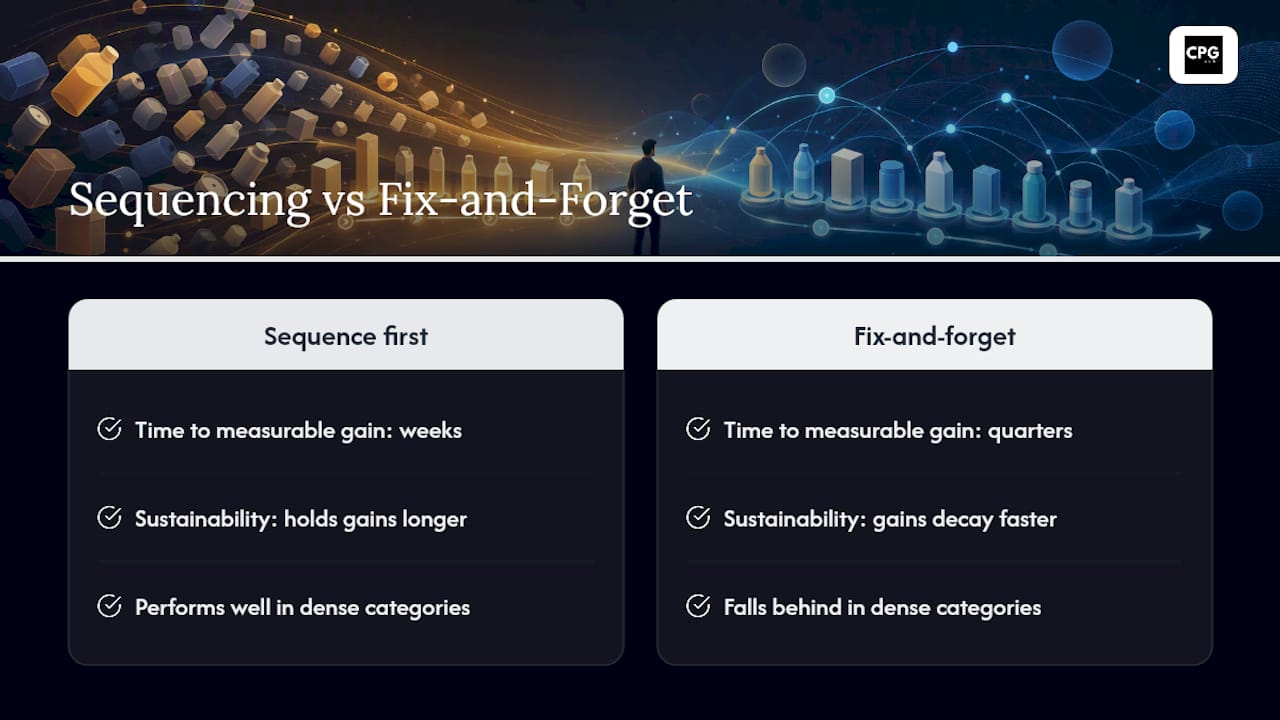
The common thread is sequencing. Brands that fix the highest-impact issue first, rather than working alphabetically through a spreadsheet of problems, see measurable share-of-search gains within weeks rather than quarters. A founder-focused approach to retail placement shows this pattern clearly: brands that treat shelf presence as an ongoing discipline, not a one-time project, tend to hold their gains longer than brands that fix and forget.
Categories with high competitive density, where dozens of near-identical SKUs compete for the same search terms, show the sharpest split between brands that monitor continuously and brands that check in quarterly. The gap between those two groups tends to widen over time, not shrink, because retailer algorithms reward consistency as much as quality.
What the Data Actually Says About Digital Shelf Priorities
Most digital shelf advice treats every metric as equally urgent, and that's the biggest mistake I see in how brands approach this. Availability and content completeness fix more revenue leakage, faster, than chasing marginal gains in review sentiment or price positioning. If your team has limited bandwidth, start there and only there.
The conventional wisdom also oversells "more data" as the answer. A dashboard tracking forty metrics across twelve retailers is useless if nobody owns the fixes. Cpgagent's own approach reflects a defensible bet: pair the monitoring layer with prescriptive prioritization and someone accountable for shipping the fix, or the data just becomes another report nobody reads.
What the reader should prioritize first is unglamorous but effective: audit your top 20% of SKUs by revenue, fix availability and content gaps in that order, and only then start optimizing price and reviews. Speed of execution beats sophistication of measurement almost every time.
— Matthew
Run Your Digital Shelf Audit With Cpgagent
Cpgagent replaces the weeks-long agency discovery process with an audit you can act on in days, not quarters. 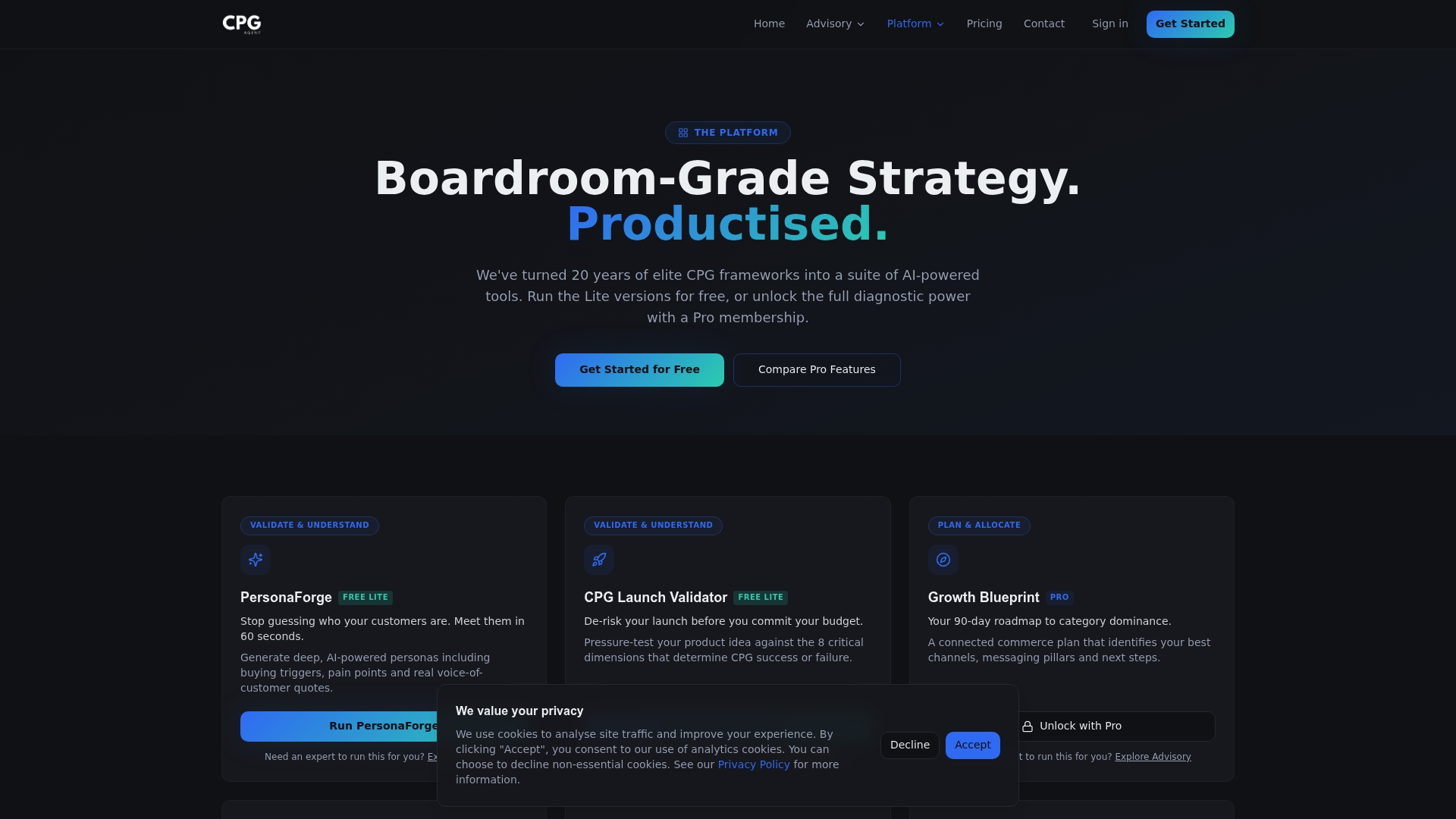
The Cpgagent platform combines AI-driven content and availability scoring with fractional CMO support for teams that need execution help, not just another dashboard. You get the SaaS tooling for ongoing monitoring plus advisory access when a fix needs a strategic decision, not just a checklist. The outcome most teams report is faster time-to-fix and lower overhead than a traditional retainer-based agency. Start with a shelf audit on your own SKUs through the Cpgagent platform and see where your biggest revenue leak actually is.
Where to Read More on Digital Shelf Analytics
- Gartner's digital shelf analytics category for vendor reviews and market coverage context
- Shopify's guide to digital shelf ecommerce for structured data and AI-readiness tactics
- Statista's e-commerce retail data for macro-level context on online retail growth
- NielsenIQ's overview of digital shelf analytics for CPG-specific KPIs and platform features
Sources
- Best Digital Shelf Analytics Reviews 2026
- Digital shelf ecommerce (Shopify enterprise blog)
- E-commerce share of retail sales worldwide (Statista)
- What are digital shelf analytics? (NielsenIQ)
- What is Digital Shelf Optimization? | Inriver
FAQ
Is Walmart Moving Toward Digital Shelf Labels?
Large retailers including Walmart have piloted electronic shelf labels in physical stores, but digital shelf analytics as covered here refers to online listing monitoring, not in-store hardware.
What Is the Purpose of Digital Analytics?
Digital analytics measures how users interact with digital content and channels; in retail, digital shelf analytics applies that same discipline specifically to product listings, search visibility, and conversion performance.
What Are the Four Types of Analytics?
The four commonly recognized types are descriptive (what happened), diagnostic (why it happened), predictive (what will happen), and prescriptive (what to do about it), and mature digital shelf platforms increasingly aim for the prescriptive tier.
What Do Digital Shelf Labels Look Like?
In physical retail, digital shelf labels are small electronic displays showing price and product information that update automatically; they're a separate concept from the digital shelf analytics tools covered in this guide, which track online listings rather than in-store hardware.
How Quickly Can a Brand See Results From Digital Shelf Analytics?
Brands that fix high-impact issues like availability and content gaps first often see measurable share-of-search improvement within a few weeks, while broader benchmarking gains typically take a full quarterly cycle to show clearly.