
For most CPG and FMCG brands, the fastest route to defensible retail media results is pairing an enterprise-grade retail media platform with fractional marketing expertise that can run the measurement work correctly from day one. Three things separate winners from wasted spend: real first-party data access, closed-loop SKU-level measurement, and how fast the platform gets you to a working campaign. Cpgagent exists specifically to help brands move through that evaluation and activation process without the usual agency lag.
TL;DR:
- Access to first-party data and SKU-level measurement are crucial for proving actual sales impact and avoiding vanity metrics.
- The best platform depends on your brand's distribution, objectives, team maturity, and the category's purchase cycle, not just size.
- A hybrid approach pairing a proven platform with fractional marketing leadership accelerates results and ensures measurement accuracy.
- Full integration and measurement setup typically take four to eight weeks, with internal resourcing and clean data being key to hitting launch timelines.
- Key KPIs include incremental sales, ROAS, and CPA, with rigorous attribution methods necessary to validate sales lift.
Table of Contents
- What Are Retail Media Platforms, and What Types Exist?
- Which Platform Fits Your Brand's Goals and Distribution?
- The Non-Negotiable Checklist for Evaluating Any Platform
- How Measurement and KPIs Should Actually Work
- What to Expect for Timeline and Cost
- How Cpgagent Helps Brands Get This Right
- Compliance and Data Privacy in Retail Media
- Build vs. Buy: An Editorial Take on the Real Trade-offs
- Get Your Retail Media Program Running Faster
- Sources
- FAQ
What Are Retail Media Platforms, and What Types Exist?
Retail media platforms are the software and ad infrastructure that let brands buy advertising placements inside a retailer's digital and physical environment, then tie those placements back to actual purchase data. That last part is what separates a retail media platform from a generic ad server: it connects to a retailer's own transaction data, so a brand can see whether an ad next to a product page actually sold units, not just clicks. Retail media platforms convert first-party shopper data into sellable audience products and link that activation directly to SKU- and store-level sales proof, which is the entire value proposition retailers use to justify premium ad rates.
You'll run into four broad categories when evaluating options:
- Retailer-owned networks built and operated directly by the retailer, giving brands access to that retailer's shopper data and inventory exclusively.
- Third-party RMN platforms that retailers license to power their own network, often faster to stand up than building in-house.
- Brand-side management solutions that help advertisers plan, buy, and optimize across multiple retailer networks from one interface, similar to how Skai's retail media solutions centralize campaign management across many retail consoles.
- Full-service operators that combine a platform with a managed team handling strategy, creative, and reporting on the brand's behalf.
Inventory surfaces vary widely across these options: on-site search results, product detail pages, retailer app placements, off-site extensions into programmatic display, and increasingly in-store digital signage. First-party data matters here because it's the only reliable signal for conversion once cookies and third-party identifiers keep eroding. A platform that can only tell you impressions and clicks, without linking to an actual basket, is not offering retail media in any meaningful sense. It's offering display advertising with a retailer's logo on it.
The reason platforms push so hard toward audience products, packaged segments built from purchase history rather than raw impressions, is renewal economics. A brand that can prove incremental sales against a specific audience segment renews. A brand staring at a CTR number with no sales linkage usually churns after two quarters.
Which Platform Fits Your Brand's Goals and Distribution?
Matching platform type to business objective saves months of trial and error. Here's how the mapping tends to break down by scenario:
- DTC or emerging brands building awareness typically get more value from broader off-site extensions and self-serve platforms with lower minimums, since the priority is reach and testing creative angles cheaply before committing to a single retailer's ecosystem.
- Enterprise CPG brands with wide distribution need platforms or unified management layers that can operate across dozens of retailer consoles simultaneously. Trying to manage twelve separate retailer dashboards manually is a resourcing problem, not a strategy problem, and it's exactly where a consolidated management platform earns its cost.
- Grocery and FMCG brands with frequent purchase cycles benefit most from retailer-owned networks with strong loyalty data, because repeat-purchase categories reward audience targeting based on past basket composition far more than one-time impulse categories do.
- Specialty verticals like beauty or electronics often need platforms with strong in-store or DOOH (digital out-of-home) capability layered on top of digital, since purchase decisions in these categories are frequently influenced at shelf, not just online.
Goal should drive platform choice more than brand size alone. A brand chasing full-funnel measurement and scale needs a network with genuine reach; market concentration in retail media is heavy, with Amazon, Walmart, and Target commanding the largest share of spend while more than 150 specialized networks compete for the remainder. A brand more focused on category uplift within a single retailer relationship might do better with a smaller, deeply integrated network than a sprawling multi-retailer platform that spreads budget thin.
Team maturity matters just as much as goal. Self-serve platforms demand an in-house team that can build campaigns, read reporting dashboards, and iterate weekly. If that team doesn't exist yet, a managed service or a fractional lead who has run these programs before will get you to results faster than hiring and training an internal team from scratch. Minimum spend thresholds also vary considerably by network, and committing to a large retailer-owned platform before you have the internal bandwidth to service it is one of the most common ways brands waste a full budget cycle on retail media without much to show for it.
The Non-Negotiable Checklist for Evaluating Any Platform
Before signing anything, run every proposal through the same set of questions. Skipping any one of these tends to surface as a painful surprise around month three.
- Data and identity access: Does the platform give you real access to loyalty data, or just aggregate reporting? Can it support clean-room activation if your brand needs to match its own customer data against retailer data without either side seeing raw records?
- Measurement rigor: Does reporting break down to the SKU and store level, or only category-level rollups? What attribution window does the platform use, and is it disclosed clearly or buried in fine print?
- Inventory and reach: Which surfaces are actually included, on-site search, PDP placements, off-site extensions, in-store assets, and which cost extra or require a separate contract?
- Operational model: Is this self-serve, fully managed, or hybrid? What's the actual service-level agreement on creative turnaround and campaign launch time?
- Tech integration: Does the platform offer usable APIs, or does data live in a locked dashboard you have to export manually every week? Will it connect to your existing CDP or ERP stack without custom engineering work?
- Commercial terms: What's the minimum spend commitment, and what does the rate card actually look like once you're past the introductory tier?
Pro Tip: Ask any platform rep to walk you through a live SKU-level report from an existing client campaign before you sign anything. If they can't produce one on the spot, the "closed-loop measurement" language in their deck is marketing copy, not a working feature.
Data access and measurement rigor deserve extra scrutiny because they're the two areas vendors most often oversell. A dashboard full of impressions and click-through rate is not proof of sales impact, and any platform that leans on vanity metrics instead of SKU-level linkage is not built for the closed-loop measurement expectations that define a mature 2026 retail media program.
How Measurement and KPIs Should Actually Work
Closed-loop attribution means the platform can trace an ad impression through to an actual transaction at the SKU and, ideally, store level. This is the feature that separates a serious retail media platform from a generic programmatic buy, and retail media networks earn their premium ad rates specifically because they can show ads near the point of purchase and prove the resulting sale. Attribution windows typically run anywhere from a few days to 30 days depending on category purchase cycles, and any platform unwilling to disclose its window plainly is a red flag on its own.
Primary KPIs worth tracking:
- Incremental sales (the sales lift that wouldn't have happened without the ad).
- ROAS (return on ad spend, revenue divided by media cost).
- CPA (cost per acquisition, useful for new-to-brand or new-to-category buyers).
Secondary KPIs like share-of-search and category lift matter too, but they should support the primary numbers, not replace them.
The biggest red flag in vendor reporting is a pre/post comparison presented as proof of incrementality. Sales often rise around any promotional period regardless of the ad campaign running alongside it, so a rigorous evaluation uses holdout groups, geographic splits, or matched cohort designs instead of simple before-and-after snapshots. That distinction alone determines whether your ROAS number is real or a coincidence dressed up as a result.
What to Expect for Timeline and Cost
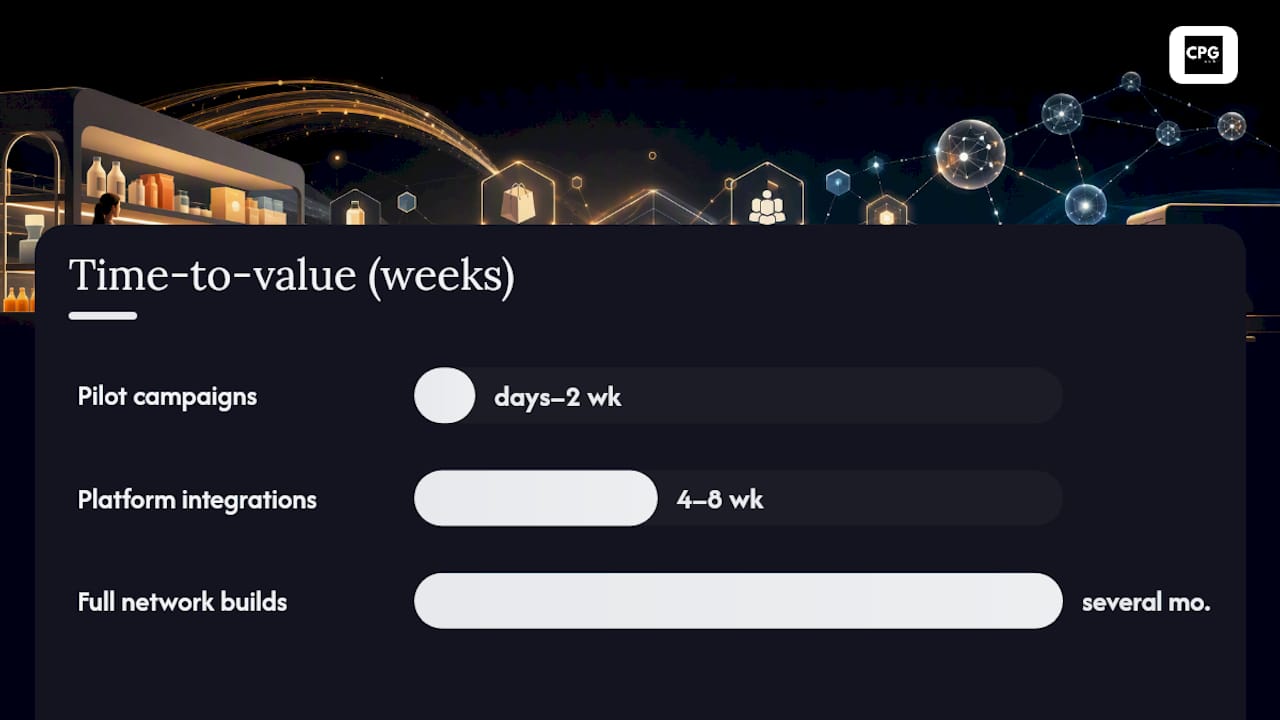
Time-to-value varies enormously depending on scope. Here's a rough sequence most brands go through:
- Pilot campaigns on an existing self-serve platform can launch within days to a couple of weeks, mainly limited by creative readiness and account setup.
- Platform integrations connecting a brand's CDP or ERP to a retailer's data environment typically take four to eight weeks, depending on how clean the brand's own data is going in.
- Full retail media network builds, whether in-house or through an API-first Retail Media Cloud approach that accelerates a custom build, run several months from kickoff to a fully operational program.
Cost structures differ sharply by network, and minimum spend commitments and pricing shapes vary widely across vendors, which directly determines which brands can even access certain inventory tiers or advanced measurement features. Enterprise programs with dedicated account support carry materially higher minimums than self-serve entry points.
Internal resourcing is the part brands consistently underestimate. Someone needs to own the data pipeline, someone needs to own creative production and localization across retailer specs, and someone needs to own measurement interpretation, ideally not the same person juggling all three.
Pro Tip: Assign measurement ownership to a single accountable person before launch, not after the first report comes in. Retail media data gets contested fastest when nobody agreed in advance on what counts as a valid attribution window.
Common blockers that stretch timelines include messy first-party data that isn't ready for clean-room matching, legal review cycles for data-sharing agreements, and creative teams unfamiliar with retailer-specific spec requirements. Planning for these upfront, rather than discovering them mid-launch, is the single biggest lever for hitting a realistic go-live date. For a broader view of how retail media fits into the rest of a brand's channel mix, see this FMCG media planning guide.
How Cpgagent Helps Brands Get This Right
Choosing between platform types is only half the work. Getting a program running and proving results inside a single quarter is where most internal teams stall out, usually because retail media measurement requires a specific skill set that general marketing hires don't always have. Cpgagent was built around closing that exact gap for CPG and FMCG brands.
The approach combines AI-driven strategy tools with fractional senior marketing leadership, so a brand gets both the analytical horsepower and the experienced judgment needed to interpret SKU-level results correctly. That pairing matters because combining a platform with experienced fractional leadership is often the fastest path to defensible measurement for brands that don't have a dedicated retail media team in-house yet.
Concretely, Cpgagent supports brands through:
- A pilot measurement audit that reviews existing retail media reporting and flags where attribution claims don't hold up.
- Creative-to-activation workflow support, so retailer-specific creative specs stop being a bottleneck between strategy and launch.
- Fractional CMO-led rollout, giving brands senior oversight on platform selection and commercial negotiation without a full-time executive hire.
Every engagement runs through Cpgagent's AI-powered platform, which automates the workflows that traditionally eat weeks of agency time, product development, media planning, and retail audit tools included. The goal isn't to replace human judgment on measurement decisions. It's to remove the operational drag that keeps brands from getting to a working retail media program inside one quarter instead of three.
Compliance and Data Privacy in Retail Media
Retail media platforms sit on top of first-party purchase data, which puts them squarely inside consumer privacy regulation, not just advertising policy. In the United States, that means compliance with state-level privacy laws like the California Consumer Privacy Act, along with sector rules that apply if the retailer handles health, financial, or children's data alongside general purchase history.
Clean-room technology has become the standard mechanism for matching brand and retailer data without either party seeing the other's raw records, and it's increasingly a baseline expectation rather than a premium feature. Retail media platforms are emphasizing privacy-safe targeting and closed-loop measurement as core 2026 priorities, largely because regulators and consumers are both losing patience with opaque data-sharing arrangements.
Before signing with any platform, ask directly how consumer opt-outs propagate through the ad targeting system, whether data-sharing agreements have been reviewed by legal counsel on both sides, and what happens to matched audience segments if a consumer revokes consent mid-campaign. A platform that can't answer these questions clearly is a compliance liability waiting to surface, usually right around the time a regulator or a retailer's own legal team starts asking the same questions you should have asked first.
Build vs. Buy: An Editorial Take on the Real Trade-offs
Building your own retail media capability in-house gives you total control, but it's slow and expensive, and most CPG teams underestimate the engineering lift required for clean-room matching. Buying an out-of-the-box platform is faster but leaves you at the mercy of someone else's roadmap and pricing changes.
The hybrid path, an established platform paired with fractional leadership who has actually run these programs, tends to win on speed and cost without sacrificing measurement rigor. It works because the hard part usually isn't the technology. It's governance: who owns the data, who signs off on attribution methodology, and who keeps creative and measurement teams pulling in the same direction. Get that alignment wrong and even the best platform underperforms.
— Matthew
Get Your Retail Media Program Running Faster
Cpgagent is the direct alternative to hiring a full internal retail media team or waiting months for a traditional agency to ramp up. Where most brands lose time is stitching together data access, measurement setup, and creative workflows across separate vendors and internal silos. Cpgagent replaces that patchwork with AI-driven strategy tools and fractional leadership that plug straight into your existing tech stack, so you're not rebuilding your marketing operation from scratch to run a competent retail media program.
If you're evaluating platforms right now, or already running one and getting reporting you don't fully trust, start with a pilot measurement audit through the Cpgagent platform. It's the fastest way to find out whether your current attribution numbers hold up before you commit another quarter of budget to them. You can also explore the full suite of tools and fractional services at Cpgagent to see how the pieces fit your specific brand stage.
Sources
- Retail Media Network Platform for Retailers | Footprints AI
- What Is Retail Media? The 2026 Guide for Platforms & Marketplaces
- Top 15 Retail Media Networks 2026: Rankings & Benchmarks
FAQ
What Are the Top Retail Media Networks?
Market spend concentrates heavily among a small number of large retailer-owned networks, with the three largest platforms accounting for the majority of ad spend, while more than 150 specialized networks serve narrower categories and regional retailers.
What Are Some Examples of Retail Media Platforms?
Examples span retailer-owned networks with proprietary consoles, third-party platforms retailers license to power their own network, and brand-side management tools like Skai's unified retail media solution that let advertisers run campaigns across many retailer consoles from one place.
What Makes a Retail Media Platform "Best" for a Given Brand?
The best fit depends on data access, measurement depth, and inventory reach relative to your brand's distribution and team capacity, not a single universal ranking. Brands lacking in-house measurement expertise often get better results pairing a platform with fractional leadership through a partner like Cpgagent than committing to a large network alone.
How Long Does It Take to Launch a Retail Media Program?
Pilot campaigns can launch within days on a self-serve platform, while full platform integrations connecting a brand's data systems to a retailer typically take four to eight weeks, and complete network builds run several months.
What KPIs Should Brands Track in Retail Media?
Incremental sales, ROAS, and CPA are the primary KPIs, with share-of-search and category lift serving as useful secondary signals once the primary numbers are validated through proper holdout or geo-split testing.