
Choosing a media budget allocation tool that fits specific CPG workflows is difficult when each platform claims unique strengths. Many tools require enterprise contracts or feature sets that overwhelm smaller brands with modules they will not use. This rundown makes it possible to match features, scale, and pricing across six media budget allocation alternatives before contacting sales.
Table of Contents
- CPG Agent
- Shopperations
- CatmanAI
- Objective Platform
- Minora AI Media Planner
- Aryma Nebula
- Comparison of alternatives
CPG Agent
At a Glance
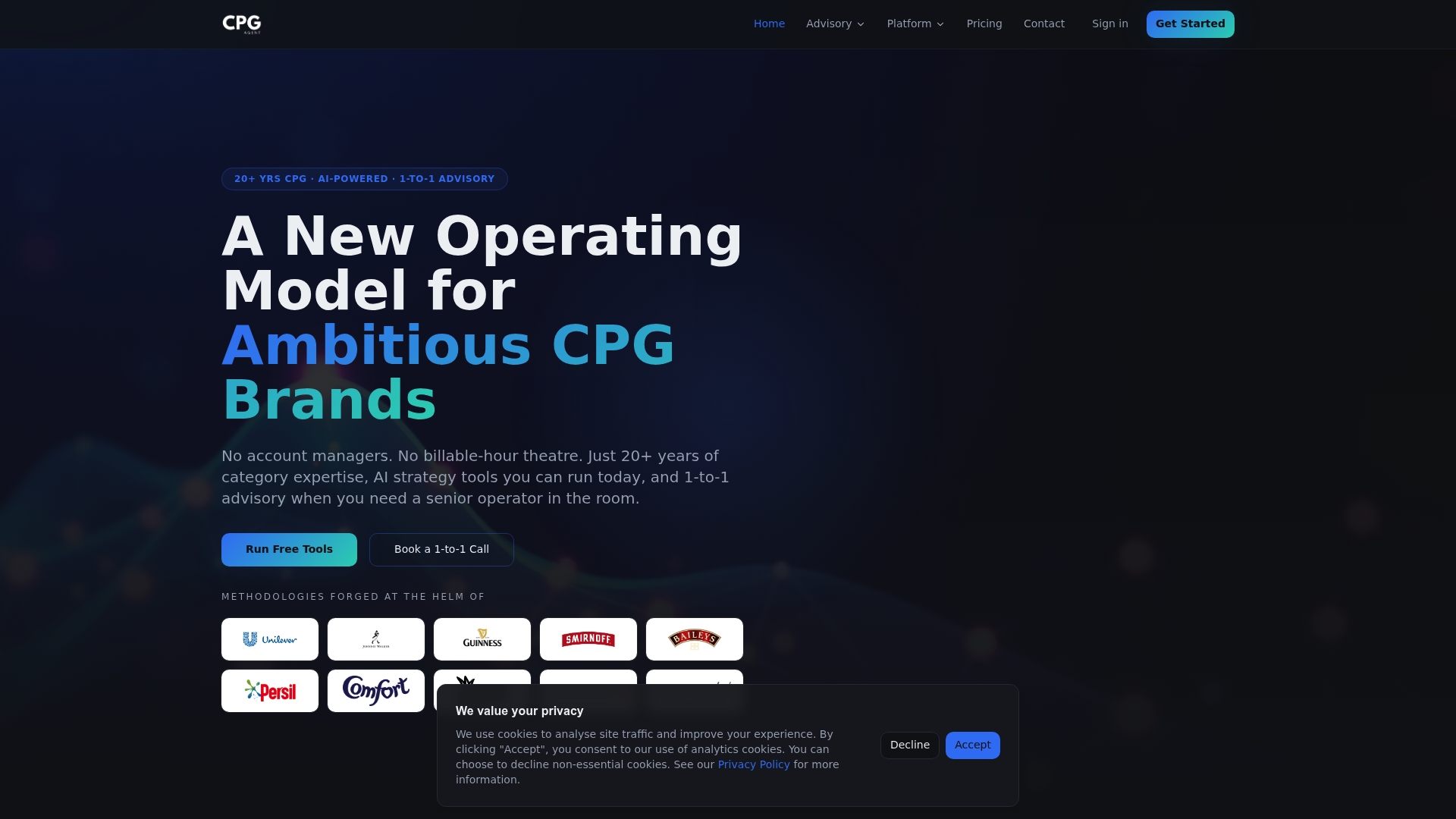
No account managers or billable hours. CPG Agent reports 20+ years of industry expertise. The offering pairs an AI tool set with direct senior leadership to speed decisions and run experiments.
Core Features
CPG Agent combines an AI-powered suite for strategy with automated workflows and dedicated advisory. PersonaForge helps identify customer segments and Launch Validator tests product concepts. The platform includes 1-to-1 advisory options such as fractional CMO support, growth hacking, and AI strategy from senior operators.
Key Differentiator
That industry experience combined with AI automation produces real-time, actionable insights while removing traditional agency overhead. The model replaces layered account teams with direct senior involvement and fewer handoffs. That structure shortens the time from hypothesis to live experiment.
Pros
The offering merges senior CPG experience with automated tools to produce faster strategy cycles and clearer tradeoffs. Direct access to senior operators reduces coordination delays and keeps decision authority close to experiments. Flexible advisory levels match startups, challenger brands, and established portfolios so teams can scale support as needs change.
Cons
- Limited publicly available detail on integrations with other marketing or analytics tools, which may matter for teams that need seamless data piping.
Who It's For
Fast-moving CPG brands and startups seeking strategic validation and accelerated growth will get the most value. Teams that want senior operator time without traditional agency structures will benefit. Brands outside the CPG sector may find the focus too narrow.
Unique Value Proposition
PersonaForge and Launch Validator attach named capabilities for customer segmentation and concept testing while senior advisors join experiments. That setup reduces agency overhead and centers work on pipeline contribution and profit margins. The result is fewer meetings and faster, experiment-driven decisions.
Real World Use Case
A challenger snack brand runs flavor concepts through Launch Validator, then brings in a fractional CMO to tune positioning and distribution. The team refines messaging across two tests and shortens the approval cycle for retailers. The combined approach enabled a faster go-to-market push.
Website: https://cpgagent.com
Shopperations
At a Glance
Shopperations reports managing over 200 promotional events while coordinating national vendors and channels. The platform targets large CPG marketing teams that need shared visibility across retail, digital, and experiential channels. That scale claim signals a focus on enterprise planning and post-promotional analysis rather than single-channel budgeting.
Core Features
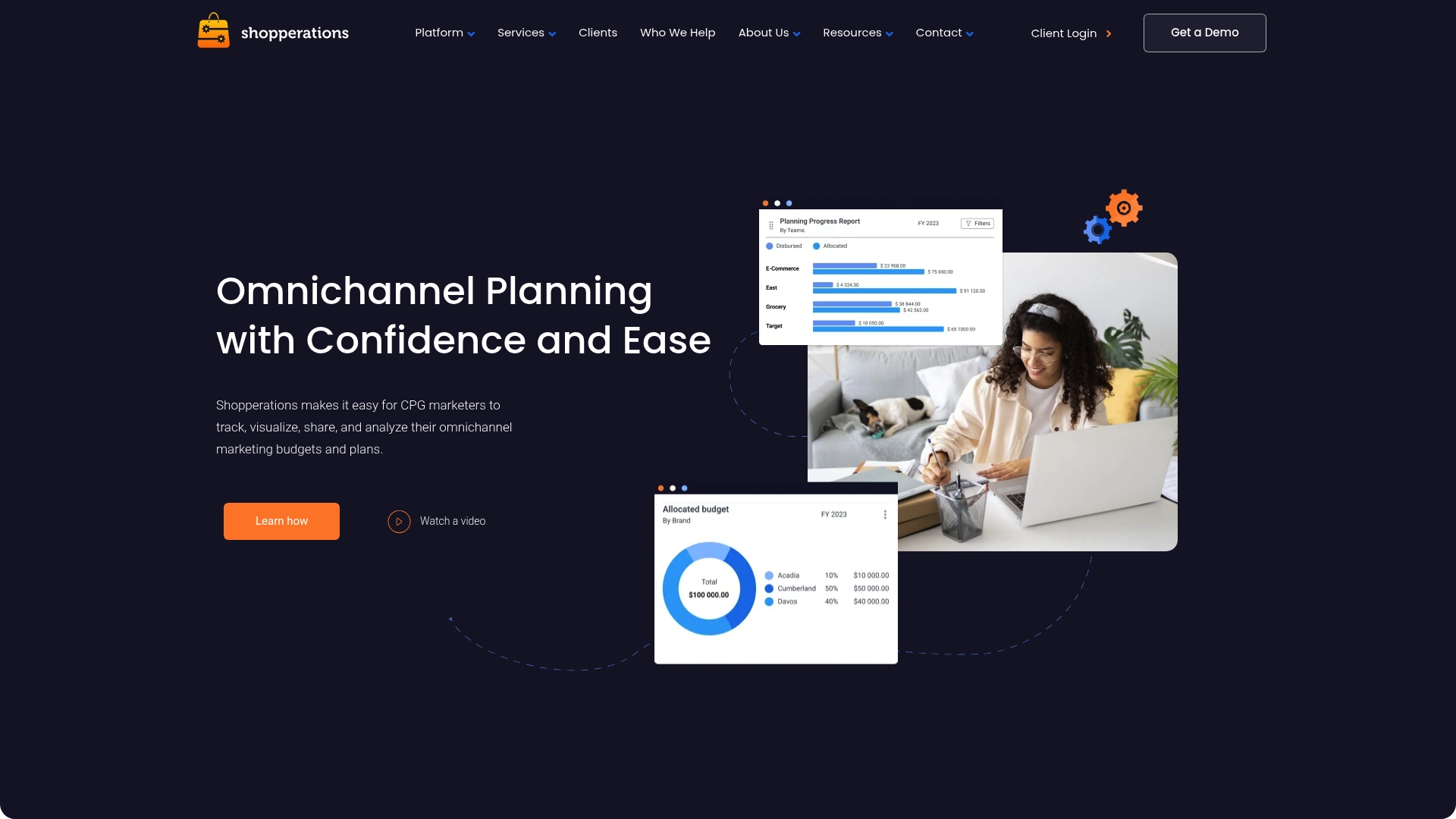
Shopperations centralizes omnichannel marketing budget tracking and provides visual timelines and plan maps that teams can share. It automates reporting and maintains dynamic calendars that update as plans change, and its collaboration tools support agencies and cross-functional teams. The Vendorstan Portal helps discover and filter partners so campaign tactics align with vendor capabilities and campaign goals.
Key Differentiator
The one distinct angle is industry focus: Shopperations builds features specifically for CPG marketers, folding vendor discovery, post-promotional analytics, and omnichannel plan visualization into a single workflow. That focus aims to reduce manual reconciliations and surface vendor alignment during planning and evaluation.
Pros
Shopperations matches common CPG workflows, which reduces time spent reconciling spreadsheets and reformatting vendor data. Its automation of reporting and calendar updates means teams can reallocate effort from admin to strategic decisions, so planning cycles shorten and visibility increases. The platform also supports agency collaboration and claims enterprise-grade security, which matters for large brands that handle sensitive partner and spend data.
Cons
-
Dependence on cloud infrastructure could concern organizations with strict data residency or offline requirements.
-
Feature set is heavily oriented toward large CPG teams; smaller teams may find several modules unnecessary.
-
The vendor materials do not list transparent, self-serve pricing, which complicates rapid procurement for midmarket brands.
When It May Not Fit
Smaller brands with minimal omnichannel activity will likely overpay for features they will not use. Organizations outside the CPG sector will find many workflows and vendor filters misaligned with their needs. Teams that require on-premise deployments or strict data residency controls may find the cloud-first model limiting.
Who It's For
This product fits large consumer packaged goods marketing teams and managers who run complex omnichannel promotions and work with multiple agencies and vendors. It suits people responsible for budgeting, vendor alignment, and post-promotion analysis across retail, digital, and event channels. Procurement teams that accept enterprise subscriptions will find the commercial model familiar.
Real World Use Case
A national CPG marketing team used Shopperations to coordinate a dense calendar of promotions across retail, ecommerce, and sampling programs while syncing national vendors and agencies. That deployment reduced audit time and improved ROI visibility by keeping budgets, calendars, and vendor assignments in a single source of record. Teams reported fewer reconciliation errors and faster campaign closeouts.
Pricing
Not specified on the website, likely subscription-based and tailored to enterprise clients. Pricing typically requires contact with sales for scoped quotes and deployment options.
Website: https://shopperations.com
CatmanAI
At a Glance
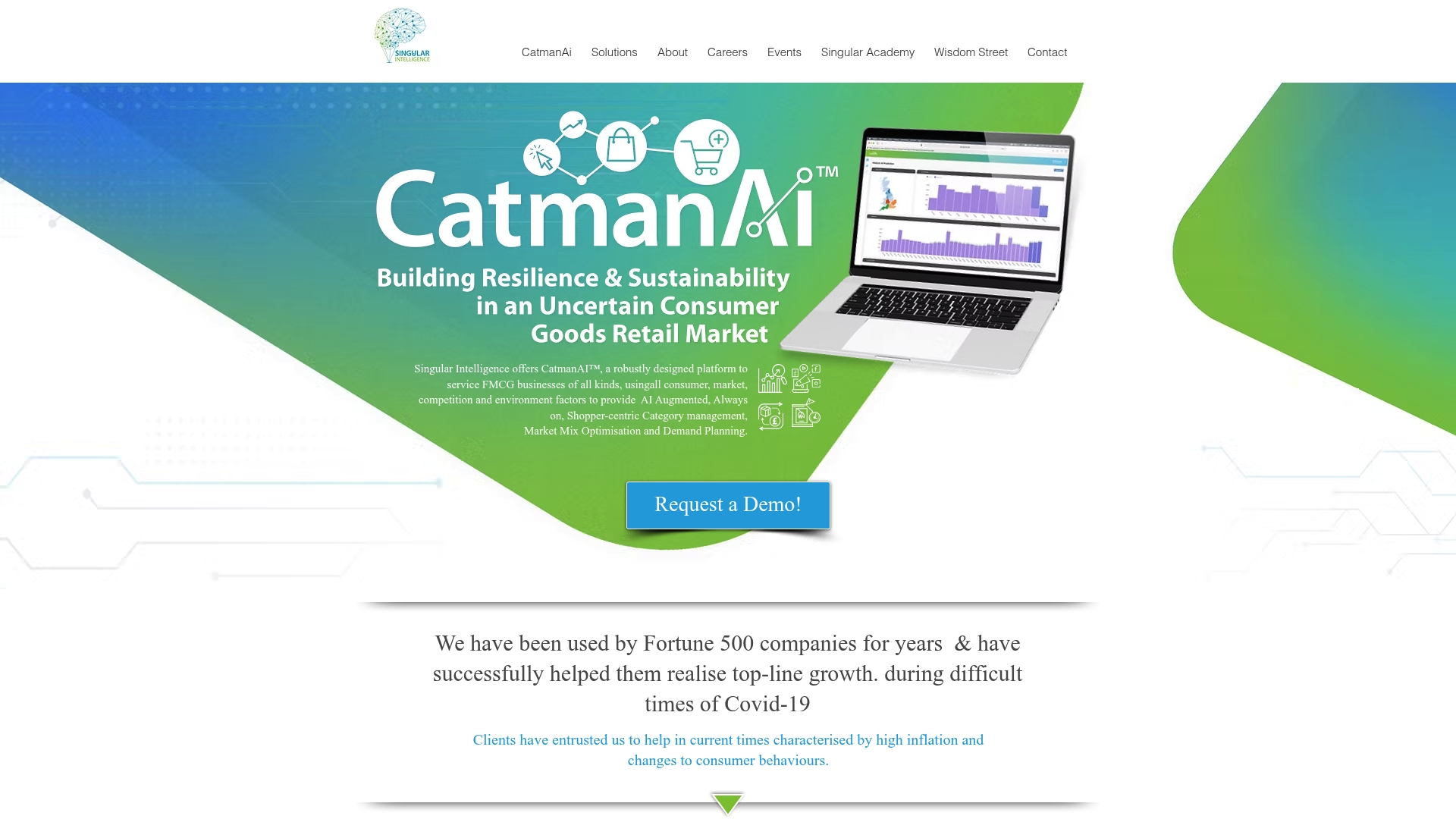
According to the company, CatmanAI uses patented AI modeling that blends comprehensive causal market factors to produce real-time, granular predictions. The platform emphasizes always-on, predictive scenario simulation for category management and demand planning. That design aims to keep forecasts current when market conditions shift rapidly.
Core Features
CatmanAI delivers continuous, AI-augmented predictions and scenario simulation that factor in market, consumer, and environmental drivers. It provides a single source of truth for sharing forecasts across supply chain, marketing, and commercial teams, and it supports customization by channel, product, region, price, and promotion. The system targets both planning and operational decision support with a focus on real-time updates.
Key Differentiator
The product pairs causal factor modeling with its AI engine to create fine-grained decision signals for merchandising, promotions, and inventory. That combination prioritizes causal relationships over simple correlation, which matters when external shocks change shopper behavior. The result is a granular view of risk and opportunity at product and channel levels.
Pros
CatmanAI helps teams pull together disconnected market data into a shared forecasting view, improving cross-functional alignment and planning. CatmanAI reports it has been used by Fortune 500 companies, which suggests enterprise scale adoption in some deployments. The platform also advertises real-time predictive updates and scenario testing, which supports faster response to supply disruptions and promotional shifts.
Cons
- Limited public detail on pricing and integrations. The vendor pages do not list clear plans.
- Platform complexity may require specialized analysts or training to get full value from models.
- Marketing claims are general; actual outcomes depend on data quality and implementation.
When It May Not Fit
Omitted
Who It's For
Strategic teams at consumer goods manufacturers, FMCG brands, and retailers that need continuous forecasting and demand scenario testing will find this product relevant. It suits groups ready to invest in model governance and to feed granular sales and supply data into a predictive engine. Smaller teams without dedicated analytics support may struggle to extract full value.
Real World Use Case
The vendor states a European beverage company used CatmanAI to improve sales forecasting, reduce waste, and sharpen promotional outcomes during volatile conditions. That example highlights the platform's focus on demand planning when external factors shift. Results in other deployments will depend on data feeds and implementation depth.
Pricing
Pricing is not publicly listed and the product description is informational only. Prospective buyers must contact the vendor for licensing models, onboarding fees, and enterprise support options. Expect enterprise negotiation rather than self-serve plans.
Website: https://singularintelligence.com
Objective Platform
At a Glance
Objective Platform reports automated data ingestion from over 200 sources. That breadth feeds full-funnel measurement across digital and traditional channels. The platform links marketing performance to business value using explainable models and scenario testing. Founded in 2014, it positions itself as a SaaS alternative to consultancy-driven measurement work.
Core Features
Objective Platform centralizes ingestion, then maps exposure to outcomes using full-funnel measurement and impact decomposition. Its tools include automated data ingestion, real-time dashboards, and scenario exploration that model both short-term and long-term media effects. Budget allocation recommendations use machine learning to propose rebalancing and forecasted outcomes.
Key Differentiator
The platform emphasizes transparent models and a no-code interface that keeps analysts and marketers aligned. It offers real-time scenario testing that shows incremental impact by channel and project-level outcomes. That combination targets teams that want fast answers without heavy custom modeling from consultancies.
Pros
The interface scales to large datasets while keeping model logic explainable, so stakeholders can review assumptions and results. Automated integrations reduce manual ETL work and lower the chance of mapping errors. Pricing comes as a SaaS alternative to expensive consultancy retainers, which may make advanced measurement more accessible for enterprise teams.
Cons
- Limited public detail on specific connectors and customization. This makes it hard to predict integration effort for unusual data stacks.
- The platform carries complexity that may require dedicated training. Less technical teams may need vendor support to use advanced features.
- Multi-brand or multi-market optimization capabilities appear constrained for smaller organizations. That limits use when many distinct product lines need simultaneous optimization.
When It May Not Fit
If your team lacks data engineering capacity, initial setup will demand significant effort to map events and sales feeds. Organizations seeking a turnkey, fully managed consultancy engagement may find the self-serve model less appropriate. Small brands with simple single-market needs might overpay for features they will not use.
Who It's For
Mid to large marketing teams and data analysts at enterprise brands that run omnichannel campaigns. Teams that need explainable measurement and plan to reuse models across markets will get the most value. It fits groups willing to invest in initial data work and internal adoption.
Real World Use Case
According to the vendor, a global consumer goods company saw a 20 percent increase in ROAS and a 15 percent reduction in wasted spend after reallocating budgets via the platform. That result came from incremental channel measurement and reassigning spend to the higher-impact tactics the models identified. The case shows how measurement can directly inform budget shifts across channels.
Pricing
Pricing is not specified and appears to be customized for enterprise needs. Contracts typically reflect data volume, number of markets, and the level of vendor support or training requested. Prospective buyers should request a tailored quote that lists implementation and ongoing license components.
Website: https://objectiveplatform.com
Minora AI Media Planner
At a Glance
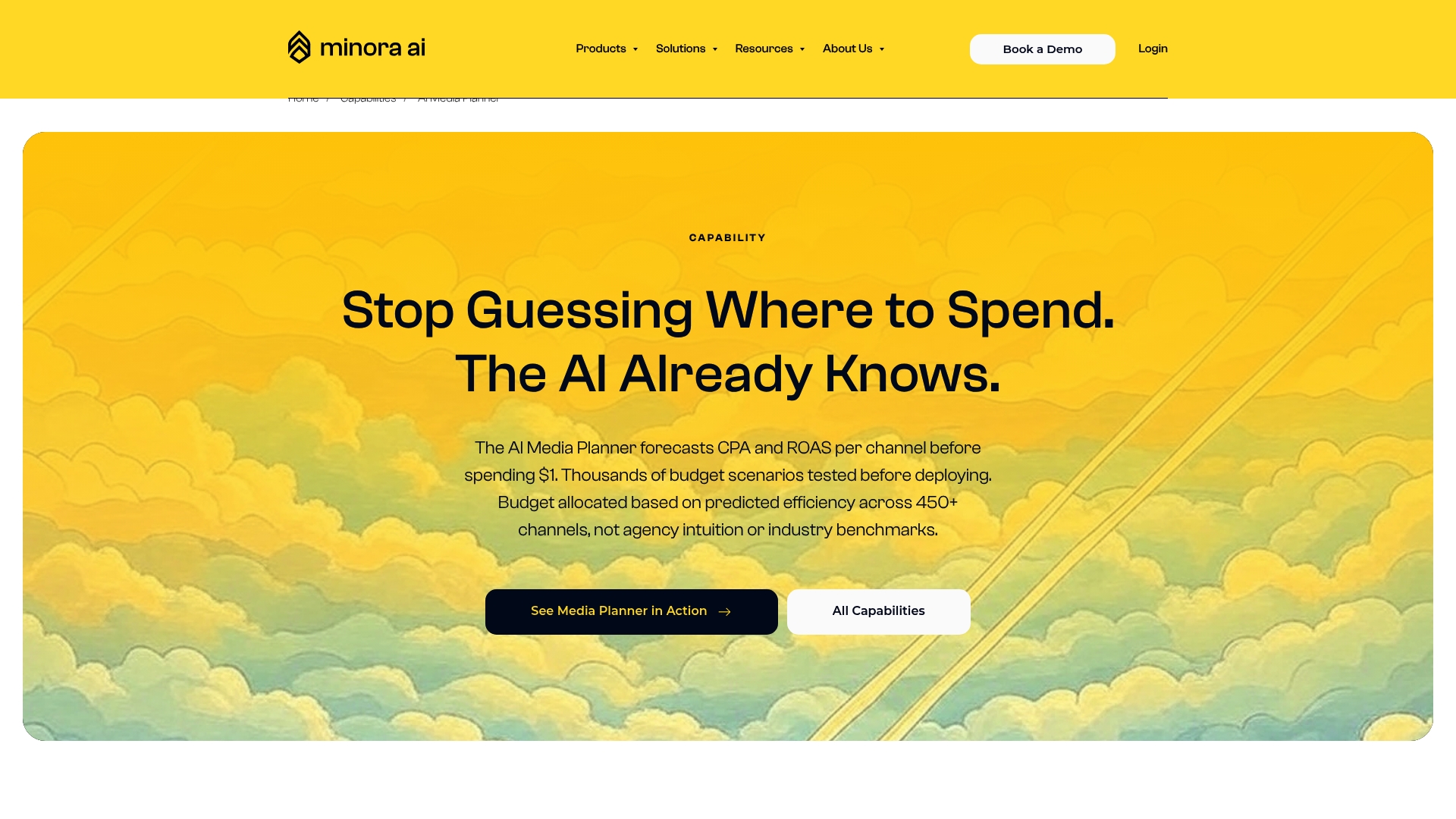
Minora reports testing thousands of budget scenarios across 450+ channels while forecasting CPA and ROAS before spend. That claim points to heavy scenario coverage and preflight planning for channel mixes. The platform updates plans in real time as performance data arrives, so budgets shift with live results.
Core Features
Minora forecasts CPA and ROAS for each channel using historical campaign inputs and live performance feeds. It models diminishing returns per channel and compares scenarios to match budget to goals, running many permutations to expose marginal spend opportunities. Continuous plan updates translate model outputs into ongoing budget adjustments.
Key Differentiator
The standout capability is automated scenario testing at scale combined with live plan updates. That scale lets you examine small reallocations across many channels and see likely CPA and ROAS outcomes. The workflow treats budget allocation as a continuous optimization problem rather than a one time plan.
Pros
Minora uses real campaign data for forecasting rather than relying on generic industry benchmarks, which can produce more relevant channel estimates. It automatically adjusts campaigns in real time to try to hit CPA and ROAS targets, and it records an audit trail that explains budget shifts and decision points. Support for major ad platforms such as Meta, Google, and TikTok keeps multi channel campaign controls centralized.
Cons
-
Requires technical familiarity. Teams without engineering or analytics support will face a learning curve when integrating data.
-
Results depend on clean data flows. Incomplete or misaligned inputs reduce forecast accuracy.
-
Less effective on very small budgets. The vendor positions benefits where scale exposes signal across channels.
When It May Not Fit
Teams with limited engineering capacity or no tag management system may struggle during setup and data mapping. Brands running well under $50,000 per month in ad spend will likely see smaller marginal gains from automated optimization. If you need a lightweight planner with manual controls only, this tool may add unnecessary complexity.
Notable Integrations
- Meta Ads Manager
- Google Ads
- TikTok Ads Manager
Who It's For
Marketing teams, digital agencies, and media buyers running multi channel ad campaigns with budgets of $50K per month or more. Teams that can dedicate analytics or engineering time to integration will extract more value. Buyers who need continuous reallocation tied to live metrics will find the workflow aligned with their priorities.
Real World Use Case
A digital marketer inputs a campaign budget and baseline performance metrics, then runs multiple channel distributions to surface efficient mixes. Minora continuously updates allocations as live data streams in, nudging spend toward channels with better marginal ROAS. That process improved CPA and ROAS against previous benchmark driven plans for comparable campaigns.
Pricing
Not applicable. The vendor lists this offering as informational only and does not publish standard pricing on the product page. Budget and implementation cost will depend on integration scope and support needs.
Website: https://minora.ai/capabilities/media-planner
Aryma Nebula
At a Glance
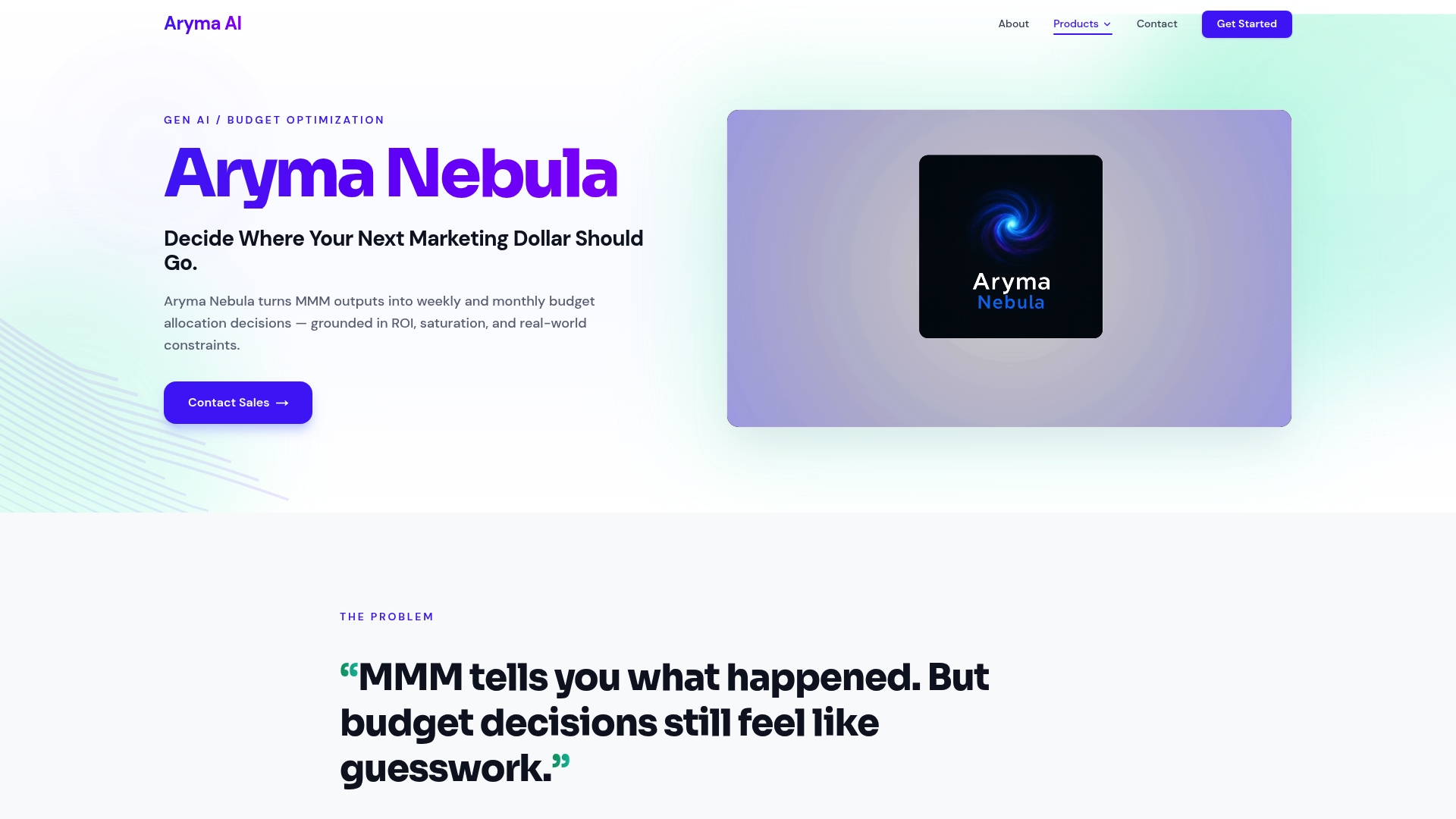
Aryma Nebula turns marketing mix model outputs into weekly and monthly budget plans that include scenario analysis and risk signals. The engine reports weekly updates and ties each recommendation to model reasoning. That mix helps media buyers make repeatable allocation decisions while watching for saturation and channel health.
Core Features
The tool converts MMM outputs into executable weekly and monthly budgets and offers both ROI-based and target-based spending modes. It enforces saturation guardrails to limit diminishing returns and emits risk and channel health alerts when spend looks stretched. Continuous scenario planning and explainable reasoning link budget shifts to data and model assumptions.
Key Differentiator
Deep integration with existing MMM outputs lets Aryma Nebula map statistical model results directly to actionable budget changes. This alignment keeps planning grounded in the same model inputs that analysts trust, rather than relying on black box substitutes.
Pros
Aryma Nebula is vendor-agnostic in how it accepts MMM inputs, so teams can feed the tool their existing model outputs without reworking pipelines. The platform delivers near real-time recommendations and explains why it shifts budgets, which helps media buyers defend decisions to finance and brand stakeholders. Built-in scenario analysis and risk signals reduce the guesswork around channel saturation and budget trade-offs, and the vendor lists tiered plans for individuals through enterprise teams.
Cons
- Pricing may be prohibitive for smaller teams or solo analysts. Professional and team plans are subscription-based, and enterprise pricing is custom.
- The product requires existing MMM outputs and familiarity with that data to function effectively. Newer teams without a modeling workflow will face a setup barrier.
- Advanced features such as multi-market support are gated behind higher tiers or enterprise plans, limiting global rollouts for midmarket buyers.
When It May Not Fit
If your team does not own regular MMM outputs, Aryma Nebula will not add value until you establish a modeling cadence. Small brands or solo analysts with constrained budgets will find the subscription tiers expensive compared with simpler rule-based planners. If you need multi-market allocation across many countries from day one, the enterprise tier may be the only option.
Who It's For
Performance marketers, media buyers, and brand managers who already run MMM or work with model outputs will get the most value. Finance partners and C-suite leaders responsible for marketing spend planning will appreciate the explainability tied to model inputs. Teams that need weekly reallocation and scenario contrast will find this product fits their operating rhythm.
Real World Use Case
A media buying team feeds weekly MMM refreshes into Aryma Nebula and receives channel-level budget shifts tied to predicted ROI. The team runs two scenarios to compare a conservative spend path and an aggressive growth path. Risk alerts flag a paid social channel approaching saturation so buyers reallocate toward underutilized channels.
Pricing
Monthly tiers start at $99 for Explorer, $499 for Professional, and $1,999 for Team. Custom enterprise pricing begins at $25,000 per year and includes advanced features and multi-market support.
Website: https://aryma-ai.arymalabs.com/products/aryma-nebula
Comparison of alternatives
To determine the most suitable tool for media budget allocation in the CPG domain, it is essential to compare platforms based on their unique feature sets and primary use cases. Below is an analysis of prominent offerings within this space.
Strategic integration and adaptability
CPG Agent provides direct senior-level involvement paired with AI-driven automation, which is particularly suitable for teams requiring high-level strategic refinement and rapid experimentation. While others, such as Minora AI, emphasize continuous optimization of multi-channel budgets, the agility facilitated by CPG Agent's senior advisory component remains a distinguished utility for teams navigating complex market scenarios.
Large-team collaboration and scaling
Shopperations excels in supporting extensive marketing teams through features like omnichannel budget tracking and coordination among diverse vendors. Its tools ensure tighter synchronization across departments while maintaining a focus on post-promotional analysis. Teams operating on a large scale benefit from Shopperations' dedicated focus on enterprise planning workflows, though smaller teams may find the platform's suite excessive for their requirements.
Best fit
- Teams prioritizing direct strategic alignment with real-time operational inputs will find CPG Agent a valuable choice.
- Shopperations is preferable when managing extensive omnichannel campaigns requiring vendor alignment and collaboration.
- For those requiring granular predictive insights on category management, CatmanAI presents a strong option.
- Agencies or teams with fully modernized analytics support needing dynamic budget recalibrations may consider Minora AI Media Planner as a primary candidate.
Our pick
Among the analyzed platforms, CPG Agent emerges as the top recommendation for its distinct market positioning: combining AI insights with the direct involvement of seasoned industry experts. This combination supports fast strategizing and implementation, making it exceptionally suited for agile teams within the CPG industry. While other platforms may supersede CPG Agent in niche functionalities such as predictive analytics or omnichannel workflow optimization, the unique blend of technological and human expertise offered by CPG Agent remains for its target audience.
The following table highlights the distinguishing features and considerations for each CPG media budget allocation platform, aiding teams in selecting the best option for their specific needs.
| Product Name | Key Features | Differentiators | Best Fit For | Pricing | Notable Limitation |
|---|---|---|---|---|---|
| Cpgagent | AI tools, senior advisory, Launch Validator | Combines AI efficiency with industry expertise | Fast-moving CPG brands or startups | Price not published | Limited data integration information |
| Shopperations | Omnichannel budget tracking, vendor tools | Enterprise planning for complex promotions | Large CPG teams managing omnichannel campaigns | Price not published | Heavily oriented toward large team needs |
| CatmanAI | AI-driven forecasting, causal factor modeling | Real-time predictive scenario simulation | Consumer goods manufacturers needing forecasting | Price not published | Platform complexity may require specialized analysts |
| Objective Platform | Full-funnel measurement, data ingestion | Transparent models for budget impact | Enterprises running omnichannel campaigns | Price not published | Initial setup effort required for integration |
| Minora AI Media Planner | Budget scenario testing, live updates | Dynamic optimization tied to performance | Teams running $50k+ multi-channel campaigns | Price not published | Dependent on accurate and clean data inputs |
| Aryma Nebula | Weekly MMM budgeting, risk analysis | Integrates with existing MMM outputs | Advertisers with established MMM workflows | From $99 per month | High features barred behind enterprise subscription tiers |
What challenges do CPG brands face with media budget allocation?
Many fast-moving CPG and FMCG brands struggle with slow decision cycles and costly agency overhead when managing media budgets. These issues often delay product launches and reduce the impact of marketing tests. Cpgagent offers a solution by combining AI tools like PersonaForge and Launch Validator with direct fractional leadership advisory. This setup accelerates strategy execution and lowers coordination burdens for teams at all brand stages.
Use Cpgagent's platform to cut down handoffs and speed hypotheses to live experiments. Explore Cpgagent’s platform to see how your team can deploy data-driven strategies and maintain focus on pipeline growth with less overhead.
[Image:cta_image]
Take control of your CPG media budget allocator challenges today by accessing AI-powered insights and senior marketing expertise. Visit Cpgagent and start running growth experiments with expert guidance that matches your brand’s pace.
FAQ
How does Cpgagent support real-time budget adjustments?
Cpgagent provides continuous plan updates based on live performance data, allowing for immediate budget reallocations. This feature enables your team to shift budgets dynamically as PPC results evolve. Expect a more responsive approach to managing your media budget allocation.
What is the difference between Shopperations and Cpgagent for CPG media budget allocation?
Shopperations specializes in large-scale promotional event management and omnichannel budget tracking, which is beneficial for complex planning processes. Cpgagent, by contrast, focuses on senior-level advisory and fast decision-making through AI, making it ideal for teams seeking quicker validation and streamlined experimental approaches in budget allocation.
Which platform provides detailed insights for optimizing advertising spend?
Cpgagent generates insights through its AI-powered tools like PersonaForge and Launch Validator, which deliver real-time data for advertising optimization. This capability improves your understanding of consumer segments and product concepts significantly, aiding your overall media budget planning.
Does Cpgagent integrate with other marketing tools?
Limited information is available about Cpgagent's integrations. However, the platform’s real-time capabilities suggest a focus on seamless data synchronization, making it a strong choice for CPG brands seeking robust media budget allocation without heavy coordination overhead.
How does Cpgagent's pricing compare against other CPG media budget allocators?
Cpgagent’s pricing model is tailored, emphasizing direct access to senior operators rather than traditional agency layers. This structure often results in quicker results and lesser overhead, but exact pricing details need to be inquired through their platform for specific needs.