
Finding a retail sentiment analysis tool that actually fits your workflow or budget is harder than it should be. Many popular platforms keep their prices hidden, push long-term retainers, or need complex setup before you can even test them. This comparison covers pricing models, setup effort, and use case fit across four leading consumer insights software alternatives so brand teams can pick the right match without wasted trials.
Table of Contents
CPG Agent
At a Glance
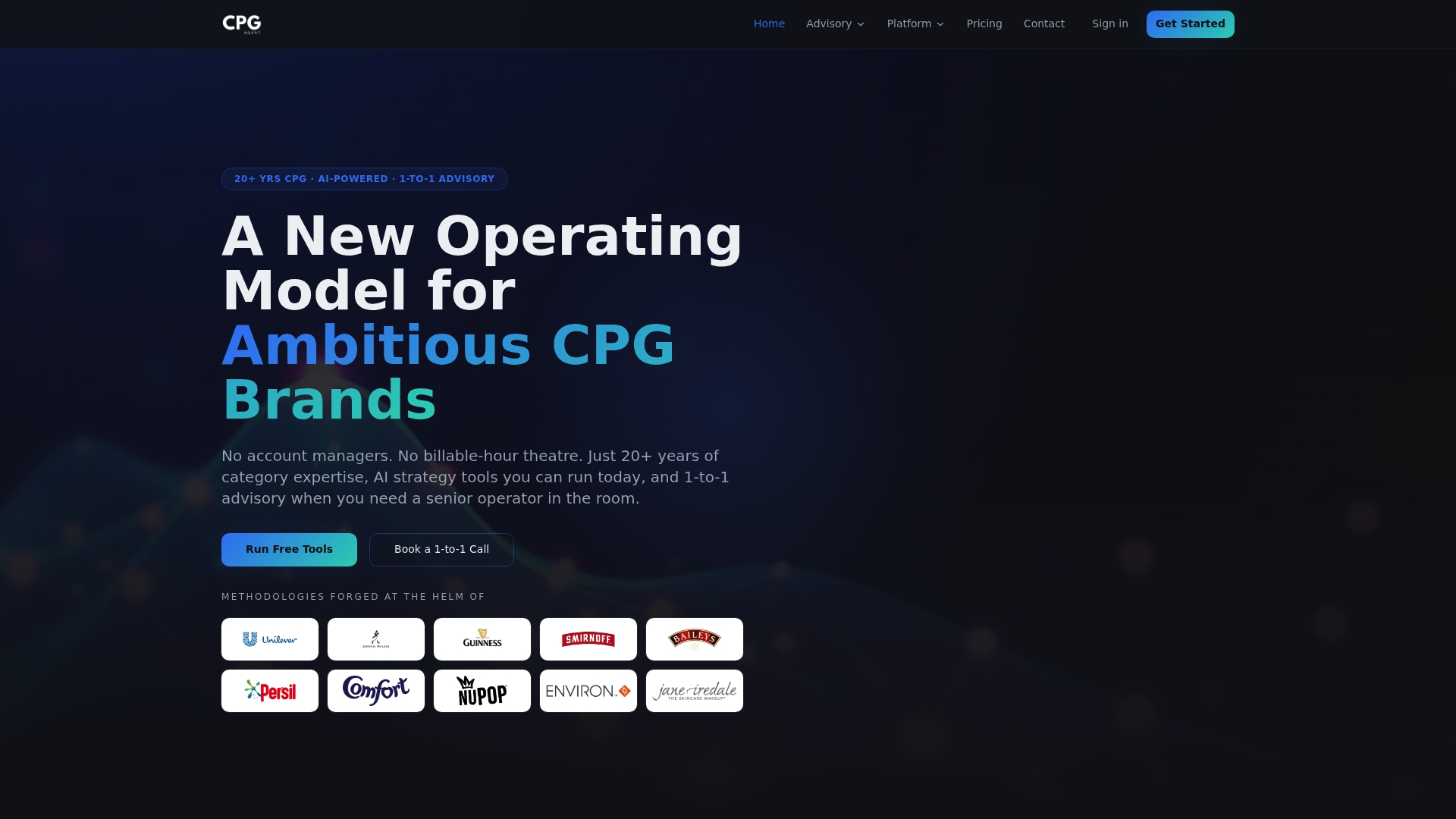
CPG Agent reports 20+ years of industry expertise paired with AI tools and senior advisory for consumer packaged goods teams. The firm combines branded tools with one-to-one advisory to shorten test and launch cycles. That approach removes long retainers and shifts budget toward validated experiments and execution.
Core Features
CPG Agent bundles AI-powered strategy tools with hands-on senior advisory and automated workflows that speed decisions. The suite includes PersonaForge for customer identification and Launch Validator for testing product concepts, plus fractional CMO and growth hacking consulting. These pieces work together to push validated concepts from idea to market faster than long discovery engagements.
Key Differentiator
The offering pairs deep CPG experience with automation and senior operators who act as fractional leaders. That configuration replaces traditional agency retainers with direct advisory tied to tool-driven validation. The result is a single operating model that centers on deployment, measurable pipeline contribution, and profit margin focus.
Pros
CPG Agent combines sector knowledge and tooling so brand teams get method and execution in one place. The platform reduces reliance on long agency cycles by putting senior operators into tactical experiments. Tools and workflows are shaped specifically for CPG and FMCG scenarios, which helps teams validate audiences, test product concepts, and move to market faster. Integration is positioned as a background engine so internal teams keep existing systems while adopting new processes.
Cons
- Pricing details are not publicly available, which requires direct contact to assess cost and fit.
Who It's For
This offering fits ambitious CPG brands that need faster product validation and senior marketing leadership without hiring full-time executives. Startups use it for audience and concept proofing. Challenger and legacy brands use it to inject agility and to scale high-velocity experiments with experienced operators.
Unique Value Proposition
PersonaForge and Launch Validator connect directly with one-to-one advisory so testing produces clear next steps for launch. That connection changes where budget flows. Teams spend less on long discovery and more on validated experiments guided by senior marketers who can execute or hand off work to internal teams.
Real World Use Case
A challenger beverage company used the tools and advisory to map new customer segments, validate three product concepts, and run rapid go-to-market tests. Senior advisors helped interpret results and set a prioritized test roadmap. The team launched the top concept without a lengthy agency retainer.
Pricing
Pricing is not listed on the site. Engagements appear to combine tool access with advisory services and flexible advisory scopes rather than fixed long-term retainers. Contacting CPG Agent is required to get quotes and to outline a custom engagement.
Website: https://cpgagent.com
Yogi
At a Glance
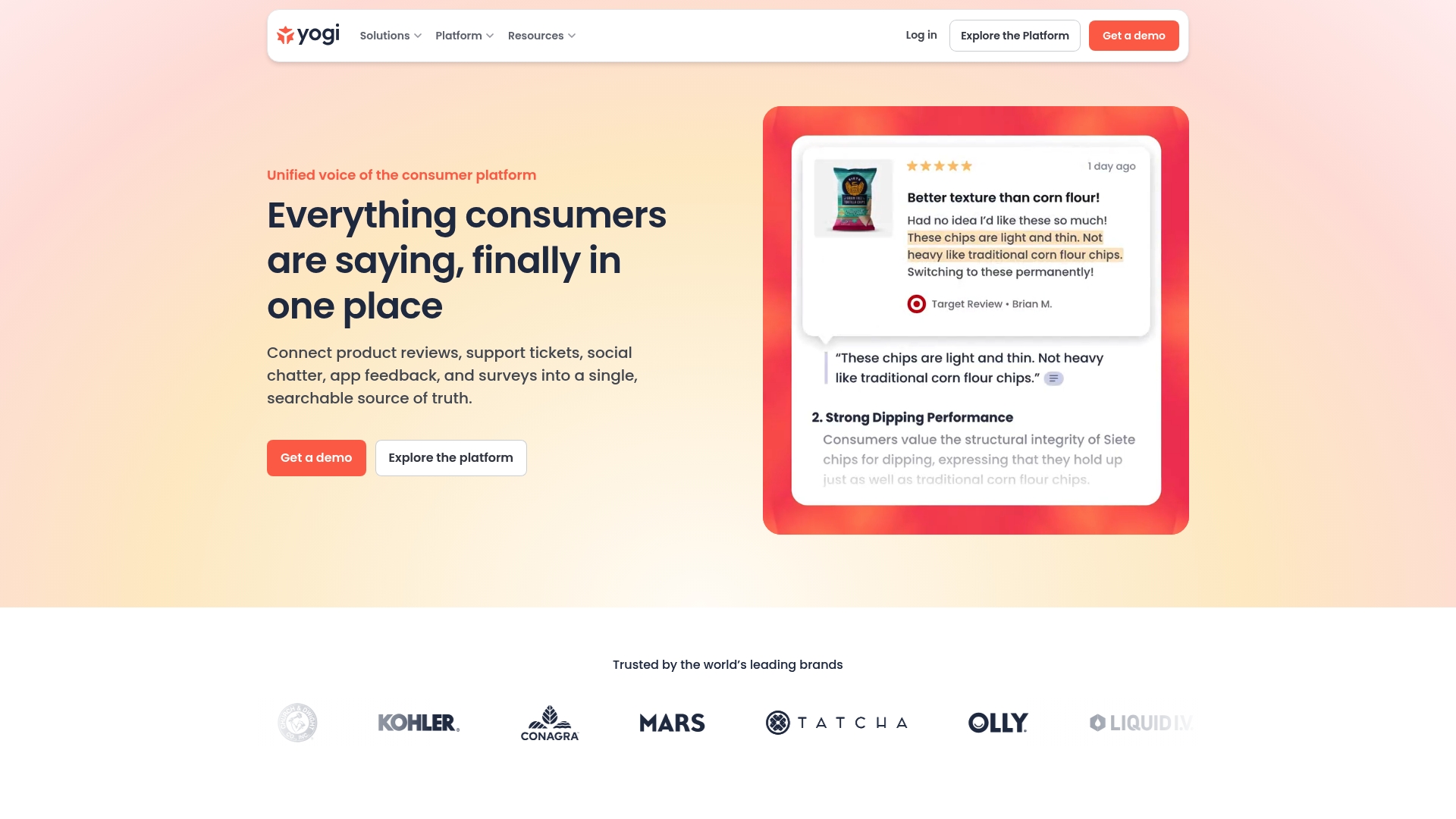
SKU level sentiment analysis isolates product specific praise and complaints across reviews, support tickets, social posts, app feedback, and surveys. The vendor advertises integration with over 400 retail and support tools, a figure presented in its marketing materials. Yogi targets enterprise consumer goods and retail brands with real time AI summaries and trend alerts.
Core Features
Yogi consolidates multi source consumer feedback into a single searchable index and adds advanced filtering for team specific views. The platform delivers AI driven instant summaries and proactive alerts that highlight sudden perception shifts. Teams can build customizable dashboards and drill into SKU level signals for product level decisions.
Key Differentiator
Yogi unifies diverse consumer feedback sources into a single AI powered, real time insights layer for enterprise brands. That fusion of reviews, support tickets, social chatter, app feedback, and surveys reduces the need to stitch separate systems manually. The approach favors product level analysis over high level sentiment alone.
Pros
Yogi supplies a single searchable source of truth for feedback across channels, which reduces time spent hunting disparate reports. Its AI summaries and trend detection cut manual triage and let teams focus on fixes and experiments. The platform supports SKU level detail and benchmarking, and it includes enterprise grade security and scalability for large brand deployments.
Cons
-
Setup and integration can feel complex for smaller teams or less technical staff.
-
Pricing is not publicly listed, which complicates budget planning for startups and midsize brands.
-
The breadth of features creates a learning curve. Some teams will need training to get value quickly.
When It May Not Fit
Small brands or teams without an engineer or integration budget may find the initial setup difficult. Transparent list pricing is not available publicly, so procurement cycles could lengthen. Organizations seeking a minimal, out of the box tool may find the feature set more than they need.
Notable Integrations
-
Zendesk
-
Salesforce
-
Bazaarvoice
-
Qualtrics
-
Sprout Social
-
Gladly
Who It's For
Enterprise consumer goods and retail brands that must correlate product feedback across many channels will get the most from Yogi. Marketing, product, and consumer insights teams with access to engineers or integration support will extract SKU level value fastest. Smaller brands should plan for onboarding effort.
Real World Use Case
Microsoft uses Yogi to aggregate and analyze large volumes of consumer feedback, enabling faster decisions and deeper product understanding. That use case shows how a global brand centralizes disparate signals to prioritize fixes and roadmap items.
Pricing
Pricing is not specified publicly. The vendor signals a likely enterprise tier, with custom quotes and implementation services for large accounts. Teams should request a demo and a tailored pricing proposal for accurate budgeting.
Website: https://meetyogi.com
Simporter
At a Glance
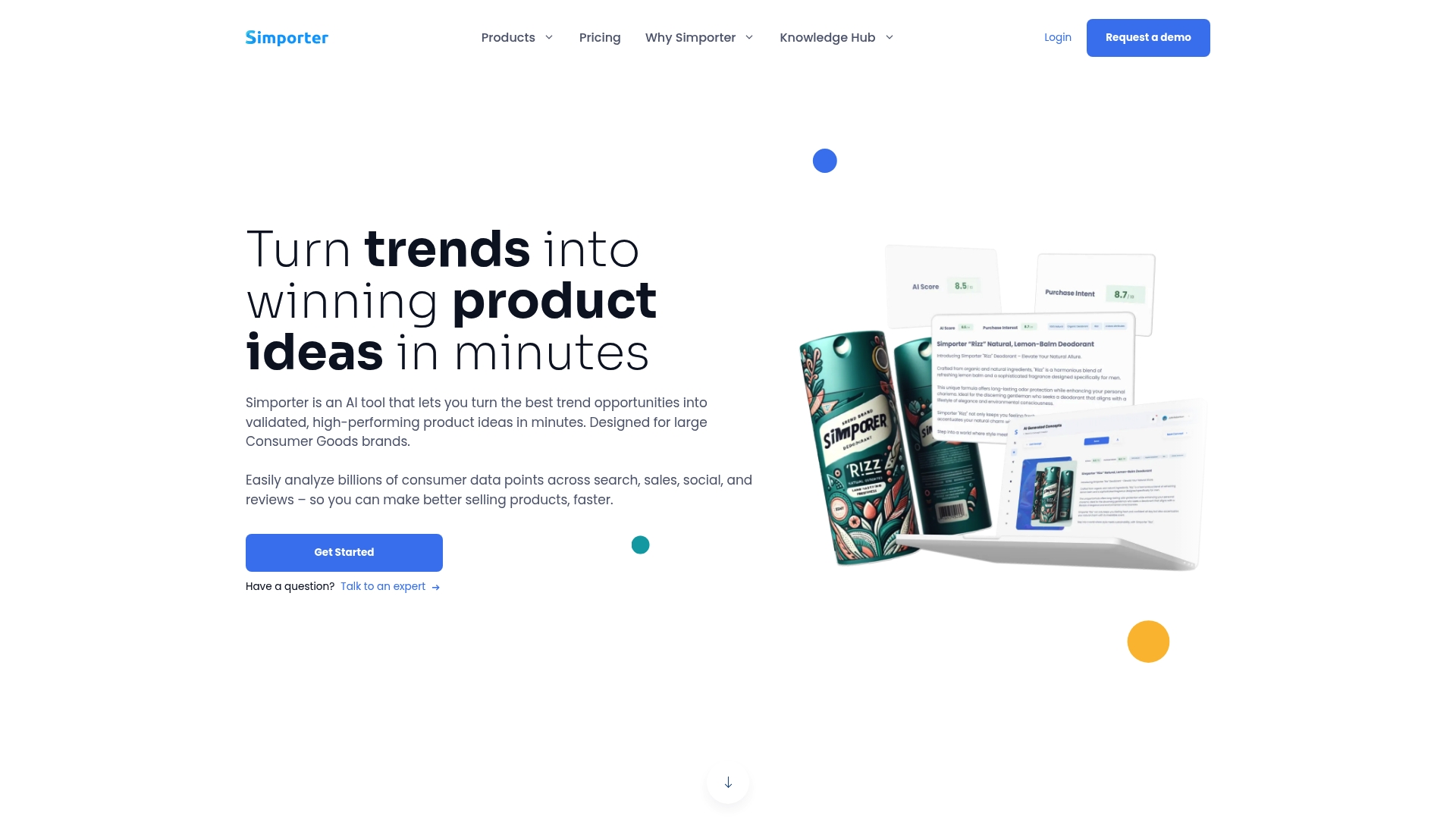
Simporter reports pre launch sales forecasts with 93% accuracy. It ingests billions of consumer data points from search, social media, reviews, and sales to surface early trend signals. The platform aims to shorten concept validation and speed product launches for large consumer goods brands.
Core Features
The system consolidates search, social, review, and sales signals to identify emerging trends and score product concepts. It pairs AI driven ideation with simulations for pricing, promotion, and distribution planning. The vendor lists 86% accuracy for pre launch sales forecasts, and the tool includes cannibalization prediction and regional SKU level forecasting.
Key Differentiator
Simporter centers on multi source AI driven analysis that blends many public and commercial signals for one view of market demand. It focuses on SKU and regional granularity rather than top level brand trends. That design targets product teams that must validate hundreds of concepts quickly with data tied to likely sales outcomes.
Pros
Simporter consolidates multiple data streams into one model, saving teams time on data wrangling and manual research. The platform automates large scale concept scoring and scenario simulations, which suits teams that run many parallel experiments. Monthly data refreshes and global market coverage help keep insights current and usable for multi region rollouts, and the accuracy figures above support confidence in forecast outputs.
Cons
- Pricing starts high and may block smaller teams. The Starter plan begins at $15,000 one time, and annual plans start significantly higher.
- The product targets large consumer goods brands, so smaller niche companies may not need its scope or cost structure.
- Trial access is limited; the vendor favors paid pilots and subscription arrangements over broad free trials.
When It May Not Fit
If your team runs fewer than a handful of product concepts per year, Simporter is likely oversized and costly. Companies outside consumer packaged goods will find feature coverage narrow for their use cases. Early stage startups that need free trials or pay as you go access should look at lower entry price alternatives.
Who It's For
Product innovation teams and market researchers at large consumer goods companies will get the most value. The platform fits teams that require SKU and regional level forecasts and that run systematic concept pipelines. It suits organizations staffed to act on frequent, data driven product recommendations.
Real World Use Case
A major beverage company used Simporter to spot emerging flavor preferences, score concepts, and run distribution and pricing simulations by region. The insights guided which SKUs to pilot and where to allocate promotional spend. That approach reduced time to market for the winning concepts.
Pricing
Pricing varies by plan and is customized to client needs. Starter costs $15,000 one time. Ideation and Validation and Validation and Forecasting are listed at $60,000 annually each. The Advanced plan runs $80,000 annually.
Website: https://simporter.com
Xploro CX Intelligence Platform
At a Glance
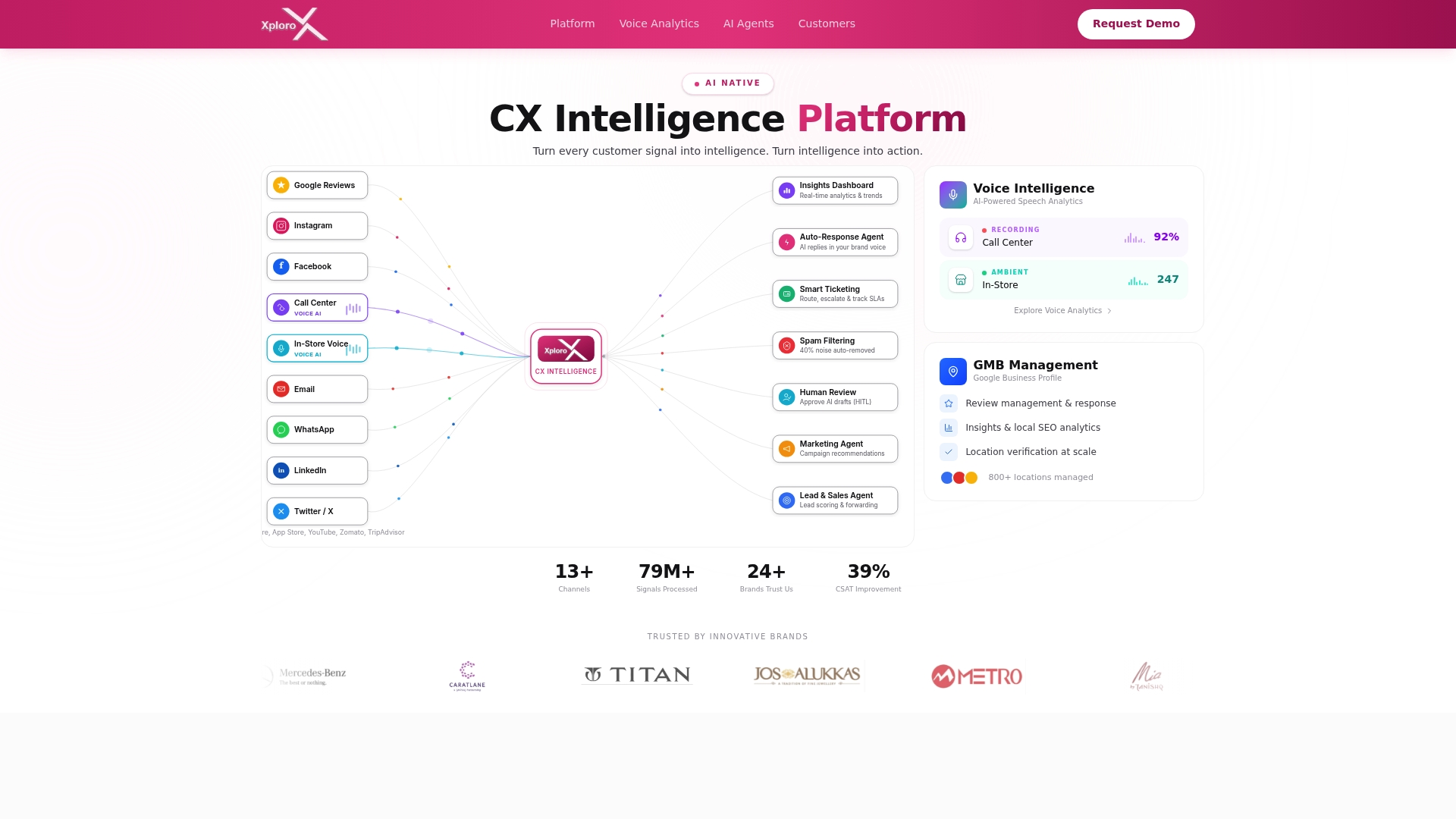
Several public pages on the vendor site return 404 errors, leaving feature detail and pricing unavailable. The visible marketing emphasizes built-in AI agents and a real-time analytics dashboard for multi-channel customer interaction. That combination aims to automate responses, ticketing, and sentiment tracking across channels where customers engage.
Core Features
Xploro advertises a real-time insights dashboard that surfaces analytics and trend signals alongside NPS and survey results. The product includes an AI-powered auto-response agent that replies in brand voice and a smart ticketing system with SLA tracking and escalation workflows. The vendor also lists integrations across 14-plus channels and an AI agent suite named Response Genie, Cortex, Resolve, Nexus, Shield, and Sentinel for engagement and quality assurance.
Key Differentiator
The platform centers on built-in AI agents that autonomously respond, analyze, and act across all customer interaction channels. That agent-first design bundles response automation, sentiment analysis, and ticket routing into a single operational flow. For multi-site teams this reduces the number of manual handoffs between analytics and response.
Pros
Multi-channel consolidation reduces the time teams spend switching between systems and brings review management and surveys into one place. The AI-driven automation improves response speed and consistency, which the vendor links to higher CSAT and NPS outcomes. Proactive signals such as churn prediction and customer health scores give customer experience teams early warnings for retention work.
Cons
- Public documentation gaps: pages for features, pricing, and use cases return errors, which limits independent evaluation.
- Pricing not listed: the vendor does not publish costs, making budget comparisons difficult.
- Unknown implementation complexity: the site does not describe setup steps or required technical resources.
- AI accuracy and training details are not disclosed, so performance expectations remain unclear.
When It May Not Fit
If your team requires full online documentation before vendor contact, the missing pages will slow evaluation. Companies that need transparent, published pricing for procurement will find the site lacking. Teams that require proof of AI accuracy or detailed implementation guides may need to ask the vendor for technical papers or a demo before committing.
Who It's For
Customer experience teams at enterprise, multi-site organizations that want to centralize feedback and automate routine replies will find the design relevant. Operations leaders who manage reviews, surveys, and ticket SLAs across locations will appreciate the focus on channel consolidation. Smaller teams or solo CX managers may find the lack of public pricing and documentation a barrier to fast procurement.
Real World Use Case
According to the vendor, Zeon Charging Network manages 400-plus locations with AI-driven review responses and location verification. In that scenario the AI agents handle location-level review replies while the ticketing system tracks escalations and SLAs. For retail analysts this setup frees analysts to focus on trend signals rather than manual reply work.
Pricing
Pricing is not published on the website and the vendor lists pricing as not applicable for public viewing. That means procurement teams will need to request a quote or demo to get costs. Expect to discuss volume, channel count, and support SLAs during vendor conversations.
Website: https://xploro.io
Comparison of alternatives
Among retail sentiment and product validation tools, CPG Agent uniquely integrates AI capabilities with direct access to senior advisors experienced in Consumer Packaged Goods workflows. This allows brands to execute faster product tests and launches compared to conventional agency contracts or non-specialized platforms.
Where competitors differentiate
Yogi excels in simplifying SKU-specific sentiment analysis by consolidating multi-channel feedback into an AI-driven insights dashboard. This capability suits enterprise customers looking to track product-level perception changes promptly. However, its setup complexity and unclear pricing may deter smaller teams navigating limited resources. By contrast, Simporter stands out with its capability to forecast pre-launch sales with accuracy rates reaching 93%, making it a strong contender for brands focused on validating product forecasts and optimizing regional and SKU strategies. These insights prove especially relevant for teams operating in diverse markets.
Best fit
- Teams prioritizing rapid test cycles driven by senior consumer goods advisors will find CPG Agent directly tailored to this need.
- Enterprises requiring SKU-specific sentiment data integrated from diverse channels for product performance evaluation can benefit from Yogi's AI-powered tools.
- Large brands desiring high-accuracy regional sales forecasts for pre-launch validation should explore Simporter.
Our pick
For teams seeking a suite that combines AI-driven market insights with expert CPG advisory, CPG Agent is the solution. The exclusive pairing of high-level expertise with specialized AI tools ensures focused and agile workflows, yielding superior product validation and accelerated market readiness.
The following table outlines key factors for evaluating the best consumer insights software options for enhancing product validation and market analysis:
| Product | Core Feature | Key Differentiator | Best For | Notable Limitation |
|---|---|---|---|---|
| Cpgagent | AI strategy tools + senior advisory for CPG brands | Combines tools with expert advisory for execution | Brand teams needing validated insights quickly | Pricing details require direct inquiry |
| Yogi | SKU-level feedback analysis | Centralizes multi-source consumer feedback | Enterprise brands with technical teams | Initial integration can challenge smaller teams |
| Simporter | Pre-launch sales forecast with 93% accuracy | Integrates billions of data points for trend signals | Product innovation teams in large organizations | High pricing excludes smaller or emerging companies |
| Xploro CX Intelligence Platform | Multi-channel customer interaction AI agents | AI-driven automation for feedback management | Enterprise CX teams handling complex operations | Public documentation and pricing details are missing |
How Can Retail Sentiment Analysis Tools Accelerate Your CPG Brand's Growth?
Retail sentiment analysis tools reveal what customers truly think but often scatter data across countless platforms. That challenges CPG and FMCG brands looking for fast, validated insights to guide product launches and marketing moves. Cpgagent combines AI-powered tools like PersonaForge and Launch Validator with senior marketing advisory to shorten test cycles and focus budgets on proven experiments.
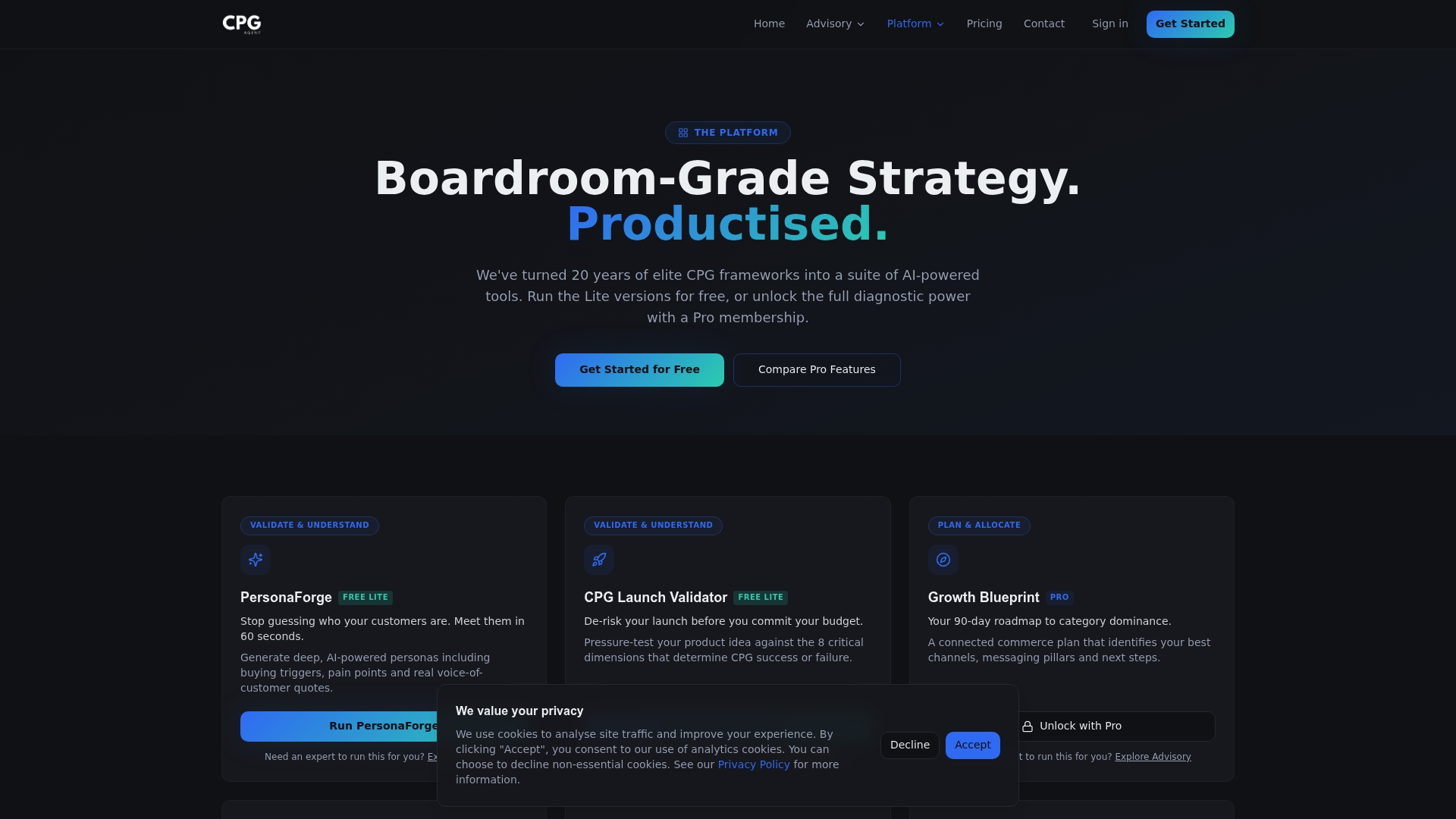
Explore how Cpgagent speeds up concept validation and market entry while integrating effortlessly with your existing systems. Visit Cpgagent platform to learn how to use AI-driven workflows and fractional leadership to turn feedback into growth steps. Connect with expert guidance tailored for startups and legacy brands aiming to boost product success and maximize return on investment.
FAQ
Which platform offers direct advisory alongside automated workflows for retail sentiment analysis?
Cpgagent provides a combination of AI-powered strategy tools and hands-on senior advisory. Its offerings include PersonaForge for customer identification and Launch Validator for testing product concepts. Consider using Cpgagent to benefit from a seamless integration of tools and expert advice, allowing for rapid validation of concepts and market launch.
What is the difference between Simporter’s predictive capabilities and Cpgagent's approach?
Simporter reports that it delivers pre-launch sales forecasts with 93% accuracy by analyzing billions of consumer data points. In contrast, Cpgagent focuses on hands-on advisement combined with automated workflows for faster decision-making. If you seek direct advisory for execution, Cpgagent may be the better choice for your retail sentiment analysis needs.
How does Yogi support consumer feedback analysis?
Yogi consolidates diverse consumer feedback into a searchable index, allowing teams to filter specific views across channels. This setup enables teams to see real-time insights and trend alerts, which can be useful for making effective product decisions. If your focus is on product validation through consumer insights, explore Cpgagent's tools that also prioritize quick market launches.
Can I use Cpgagent if I have a small marketing team?
Cpgagent is suitable for small teams seeking faster product validation without hiring full-time executives. Its service model allows for flexibility in engaging senior marketing leadership, which can match the needs of smaller brands. This approach enables you to quickly move from concept testing to market launch while maintaining a manageable budget.
Which tool provides advanced filtering for team-specific views of consumer feedback?
Yogi offers advanced filtering and customizable dashboards for team-specific views of feedback across channels. This feature enhances usability for larger teams seeking targeted insights. If you prefer a combination of insights and execution support, Cpgagent's tools can be tailored to fit various team structures.