

TL;DR:
- An automated CPG growth roadmap uses phased AI deployment and structured governance to accelerate revenue growth. Success depends on solid data, organizational readiness, workflow integration, and continuous monitoring of KPIs. Effective decision orchestration and disciplined sequencing build trust and drive measurable commercial impact over time.
An automated CPG growth roadmap is a phased, AI-governed plan that applies automation across commercial levers including pricing, promotions, assortment, and trade investment to accelerate brand scaling. The industry term for the core discipline is Revenue Growth Management (RGM), and AI-enabled RGM transforms quarterly planning into a continuous, data-driven practice rather than a periodic exercise. McKinsey research shows AI-driven RGM programs can deliver 2–5% net revenue uplift and 1–3% margin expansion when scaled portfolio-wide. That kind of return does not come from deploying a single tool. It comes from sequencing automation phases deliberately, embedding governance at every step, and connecting AI recommendations to real execution workflows.
What prerequisites does an automated CPG growth roadmap require?
The most common reason CPG automation initiatives stall is not bad technology. It is a weak foundation underneath the technology. Before you build any automated brand development program, three areas need to be solid.
Data quality and integration sit at the top of the list. Your commercial and operational systems, point-of-sale data, trade spend records, demand forecasts, and supply chain inputs, must feed into a single integrated environment. Fragmented data produces fragmented recommendations. AI tools cannot optimize what they cannot see.
Organizational readiness is the second prerequisite. RGM transformation is a 5-year journey that requires process redesign and organizational adoption alongside technology. Teams need to understand why automation is being introduced, what decisions it will influence, and how their roles change. Without that clarity, adoption fails regardless of how capable the platform is.
Workflow integration is the third requirement. AI outputs that sit in a separate dashboard and never connect to planning rhythms produce no commercial impact. The goal is to embed recommendations directly into the meetings, reviews, and decision cycles your teams already run.
The most common barriers to watch for include:
- Siloed data across trade, supply chain, and finance systems with no unified view
- Manual reconciliation processes that consume analyst time and delay insight delivery
- Governance gaps where no one owns the AI output or acts on its recommendations
- Stakeholder skepticism driven by past analytics projects that produced reports but no action
Pro Tip: Before selecting any automation platform, audit your data pipeline first. Map every commercial data source, identify where gaps or delays exist, and fix those before you layer AI on top. A clean data foundation multiplies the value of every tool you add later.
How to phase and sequence AI automation in a CPG growth roadmap
Sequencing matters more than speed. Practitioners who start with high-volume, low-risk, well-instrumented processes reduce failure risk and build team confidence before progressing to strategic use cases. A three-phase structure is the proven approach for a CPG market expansion plan.
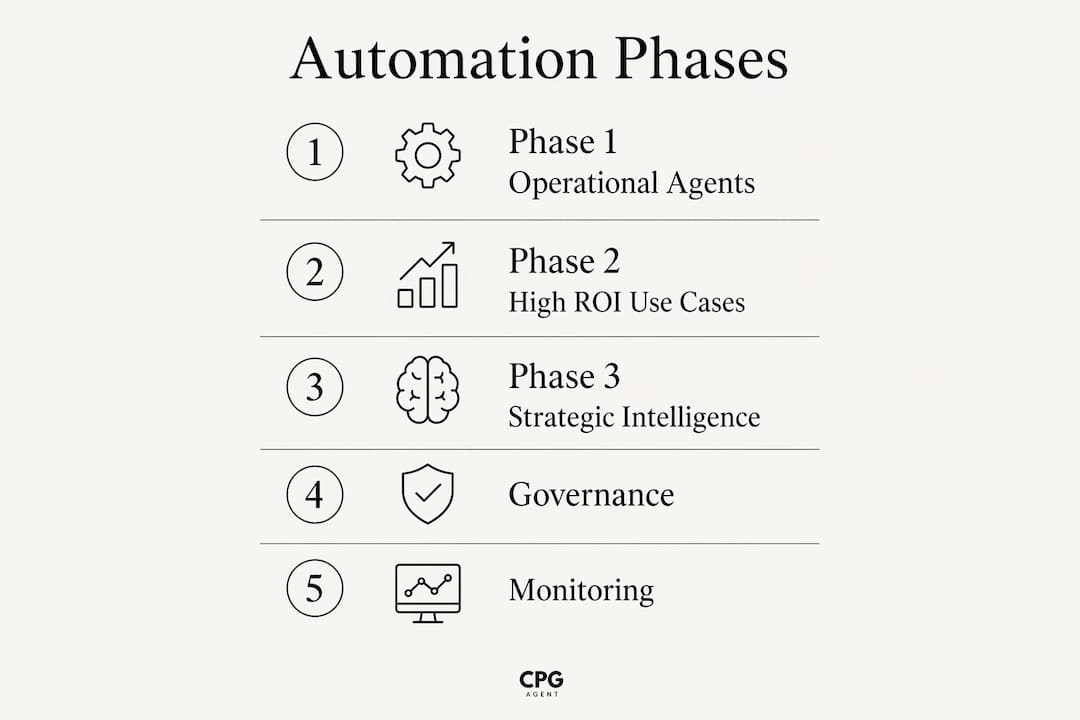
Phase 1: Operational Agents
Start with processes that are high-volume, rule-based, and easy to measure. Examples include:
- Automated demand forecasting using historical sales and external signals
- Deduction and invoice reconciliation to reduce manual finance workload
- Out-of-stock alerts and replenishment triggers tied to POS data
These use cases deliver fast, measurable ROI. They also prove to your organization that AI can be trusted before you ask it to influence bigger commercial decisions.
Phase 2: Optimization Agents
Once Phase 1 is stable, move to decisions that require optimization across competing variables:
- Trade spend allocation across accounts and events
- Pricing agility based on competitive signals and elasticity models
- Promotional calendar planning with predicted lift and cost per incremental dollar
Phase 3: Strategic Intelligence Agents
The final phase embeds AI into strategic choices. This includes margin governance across the full portfolio, pack-price architecture decisions, and assortment rationalization tied to retailer-specific performance data.
| Phase | Focus Area | Risk Level | Time to ROI |
|---|---|---|---|
| Phase 1: Operational | Forecasting, reconciliation | Low | 3–6 months |
| Phase 2: Optimization | Trade spend, pricing | Medium | 6–12 months |
| Phase 3: Strategic | Margin governance, assortment | Higher | 12–24 months |
Governance-in-the-loop is the mechanism that makes this sequencing work safely. Governance embedded in automation enables faster, safer scaling by requiring human review at defined decision thresholds before the system acts autonomously. This is not a limitation. It is the trust-building mechanism that gets your commercial team to actually use the outputs.
Pro Tip: Sequence your roadmap phases by three criteria: risk level, ROI measurability, and process stability. If a process has unclear rules or inconsistent data, it is not ready for automation regardless of its strategic importance.
What is decision orchestration in a CPG automation roadmap?
Decision orchestration is the coordination layer that connects AI-generated commercial recommendations to supply chain and operational reality before any commitment is made. This is where most CPG automation programs leave money on the table. They generate strong pricing or promotional recommendations but never check whether those decisions are actually executable.

AI coordination engines bridge commercial decisions to supply chain execution, evaluating pricing, promotion, and assortment choices against inventory and logistics constraints before commitment. The practical result is fewer operational surprises and significantly less promotional ROI leakage. When a promotional event is approved without checking warehouse capacity or supplier lead times, the brand absorbs hidden costs and risks damaging retailer relationships.
The key benefits of a decision orchestration layer include:
- Real-time feasibility checks on promotional events before they are locked into retailer agreements
- Automated triggers that push approved decisions downstream to ERP, logistics, and finance systems
- Closed-loop feedback that captures actual promotional performance and feeds it back into the next planning cycle
- Reduced reliance on manual cross-functional coordination that slows execution and introduces errors
"Failing to check execution feasibility before committing promotional or pricing decisions leads to hidden costs and eroded retailer trust. Coordination engines prevent this by sitting above ERP and logistics systems to automate execution checks." — r4.ai on CPG RGM
The orchestration layer effectively sits above your existing ERP and logistics platforms. It does not replace them. It reads from them in real time and uses that data to validate or flag commercial decisions before your team commits. For brands expanding into new retailers, this layer is especially critical because execution failures at new accounts carry outsized reputational risk.
How do you monitor and evolve a CPG growth roadmap over time?
A growth roadmap for CPG brands is not a one-time deployment. It is a continuous improvement system. Agentic analytics platforms automate promotion ROI decomposition, growth driver analysis, and monitoring within 48 hours. That speed shifts your team from post-event analysis to in-flight decision making.
The KPIs that matter most for continuous monitoring fall into four categories:
- Promotion ROI: Sales lift, cost per incremental dollar, and event spend as a percentage of revenue
- Forecast accuracy: Variance between predicted and actual volume at the SKU and account level
- Trade ROI: Return on trade investment by account, event type, and product category
- Deduction aging: Time to resolve deductions and the dollar value of unresolved claims
Continuous KPI evaluation improves forecast accuracy and trade ROI post-go-live. The act of measuring consistently forces the commercial planning process to become more disciplined over time.
| KPI Category | What to Measure | Why It Matters |
|---|---|---|
| Promotion ROI | Sales lift, cost per incremental dollar | Identifies which events generate real volume vs. subsidized switching |
| Forecast accuracy | SKU-level volume variance | Reduces over-production and out-of-stock costs |
| Trade ROI | Return by account and event type | Guides reallocation of trade budget to highest-performing accounts |
| Deduction aging | Days to resolve, dollar value outstanding | Reduces cash flow drag from unresolved retailer deductions |
Organizational change management is the part most brands underinvest in. Technology adoption and organizational readiness matter more than the technology stack itself for automation success. Schedule regular reviews where commercial teams see the AI outputs, challenge them, and build the habit of acting on recommendations. That rhythm is what converts a pilot into a permanent capability.
Pro Tip: Assign a named owner to each KPI category. Accountability gaps are the most common reason monitoring programs produce data but no decisions. One person per category, reviewed monthly, changes that dynamic fast.
Avoid the two most common pitfalls at this stage. First, do not let technology implementation crowd out people and process change. Second, do not run isolated pilots without a clear vision for how they scale. Both patterns produce impressive demos and no commercial impact. For brands working with limited budgets, phased investment tied to proven ROI at each stage is the most defensible path forward.
Key takeaways
An automated CPG growth roadmap delivers measurable revenue uplift and margin expansion only when data foundations, governance, and decision orchestration are built before scaling AI across commercial workflows.
| Point | Details |
|---|---|
| Build the data foundation first | Integrate commercial and operational data before deploying any AI automation layer. |
| Sequence phases by risk and ROI | Start with operational agents, then optimization, then strategic intelligence to build trust and prove value. |
| Embed governance at every phase | Governance-in-the-loop is the mechanism that makes autonomous AI decisions safe and adoptable. |
| Use decision orchestration | Connect AI recommendations to supply chain feasibility checks before committing to promotions or pricing. |
| Monitor continuously, not periodically | Track promotion ROI, forecast accuracy, and trade ROI in real time to convert insights into decisions. |
Where most CPG automation programs go wrong
I have seen a consistent pattern across CPG brands that invest in automation and then wonder why growth did not follow. The technology worked. The data was reasonably clean. The platform was capable. What failed was the assumption that deploying AI is the same as transforming how commercial decisions get made.
The brands that get real results from an automated growth roadmap treat it as a multi-year commercial transformation. They do not measure success by the number of tools deployed. They measure it by how many commercial decisions now happen faster, with better information, and with fewer surprises downstream. That is a fundamentally different definition of success, and it requires a different kind of leadership commitment.
The sequencing discipline matters more than most teams expect. Starting with operational agents in Phase 1 is not just about picking easy wins. It is about building the organizational muscle of acting on AI outputs before the stakes are high. By the time you reach Phase 3 strategic intelligence, your team has already developed the habit of trusting and challenging the system. That habit is worth more than any individual recommendation the platform produces.
The governance layer is where I see the most shortcuts taken, and it is the most expensive shortcut you can make. Governance is not bureaucracy. It is the mechanism that lets you increase AI autonomy safely over time. Skip it and you will spend years rebuilding trust after one high-profile recommendation goes wrong.
Treat your CPG success blueprint as a living document. Revisit phase sequencing every six months. Incorporate new AI capabilities as they mature. The brands winning on shelf in 2026 are not the ones who deployed the most tools. They are the ones who built the most disciplined commercial operating model around those tools.
— Matthew
Build your automated growth roadmap with Cpgagent
Cpgagent is built specifically for CPG and FMCG brands that want to move from manual commercial planning to AI-driven execution without a multi-year agency engagement. The Cpgagent platform integrates AI-enabled RGM, decision orchestration, and agentic analytics into a single environment that connects directly to your existing tech stack.
Whether you are in Phase 1 building operational automation or Phase 3 embedding margin governance across your portfolio, Cpgagent provides the tools, workflows, and fractional leadership support to move fast. The platform is designed to embed AI outputs into your existing commercial planning rhythms so insights become decisions, not reports. If you are ready to operationalize your CPG growth strategy, Cpgagent removes the overhead and accelerates the path to measurable results.
FAQ
What is an automated CPG growth roadmap?
An automated CPG growth roadmap is a phased plan that applies AI and automation across commercial levers including pricing, promotions, assortment, and trade investment to scale brand growth systematically. It is grounded in Revenue Growth Management (RGM) principles and governed by structured adoption and decision orchestration frameworks.
How long does a CPG automation roadmap take to implement?
A full RGM transformation is a 5-year journey covering data foundation, process redesign, and organizational adoption. Phase 1 operational agents typically deliver measurable ROI within 3–6 months, making early phases the fastest path to proving value.
What revenue impact can CPG brands expect from ai-driven RGM?
AI-driven RGM programs can yield 2–5% net revenue uplift and 1–3% margin expansion when scaled portfolio-wide. The impact depends on data quality, organizational adoption, and the depth of integration between AI recommendations and commercial workflows.
What is decision orchestration in a CPG context?
Decision orchestration is the coordination layer that validates commercial decisions including promotions, pricing, and assortment changes against real-time supply chain and inventory data before commitment. It prevents promotional ROI leakage and protects retailer relationships by catching execution gaps before they become operational problems.
How do you measure success in a CPG growth roadmap?
The four core KPI categories are promotion ROI, forecast accuracy, trade ROI, and deduction aging. Continuous KPI tracking embedded in commercial planning workflows converts measurement into faster, better-informed decisions rather than periodic reporting exercises.