

TL;DR:
- Automated go-to-market validation uses AI tools to assess demand, positioning, and launch readiness rapidly and affordably. Human review gates remain essential to verify AI outputs and refine strategies. This approach enables quick testing and decision-making, reducing traditional costs and timelines significantly.
Automated go-to-market validation is the process of using AI-powered tools and workflows to assess market demand, product positioning, and launch readiness in hours rather than months. Tools like TestFast deliver purchase intent predictions with 90% accuracy within 24 hours, replacing the traditional consulting cycles that cost $50,000 or more. Platforms built on synthetic persona simulations and automated research pipelines now give CPG startups and established brands the speed they need to test before they invest. This article breaks down the tools, the workflow, the pitfalls, and how to connect validation data directly to your launch execution.
What tools power automated go-to-market validation?
The market validation automation category now includes both commercial platforms and open-source engines, each with distinct strengths. The right choice depends on your budget, your team's technical depth, and how much customization you need.

Commercial AI validation platforms
TestFast is the clearest benchmark in the space. It generates purchase intent scores, competitive positioning maps, and concept feedback reports within a single business day. That 90% accuracy in 24 hours makes it a credible replacement for traditional focus groups on initial concept screening. IdeaFloat takes a similar approach, using AI to surface pricing misalignment and poor problem-solution fit before a brand commits to production tooling.
AIdeator focuses on the ideation-to-validation pipeline, generating product concepts, brand names, and early messaging frameworks from a single brief. It feeds directly into landing page and ad copy generation, which means a team can move from concept to testable creative in one session.
Open-source swarm intelligence tools
Sybil Swarm is the most technically ambitious option available without a licensing fee. It spawns 1,000 synthetic AI personas to simulate buyer behavior, producing real-time sentiment heatmaps and conversion predictions at a scale no human panel can match. That scale matters because it exposes edge-case objections and niche audience reactions that small sample surveys miss entirely.
Autogtm is an open-source AI GTM engine designed to automate outreach sequencing and signal-triggered workflows. It is best used after initial validation, when you have a confirmed concept and need to build pipeline fast.
Cost comparison: automated vs. traditional
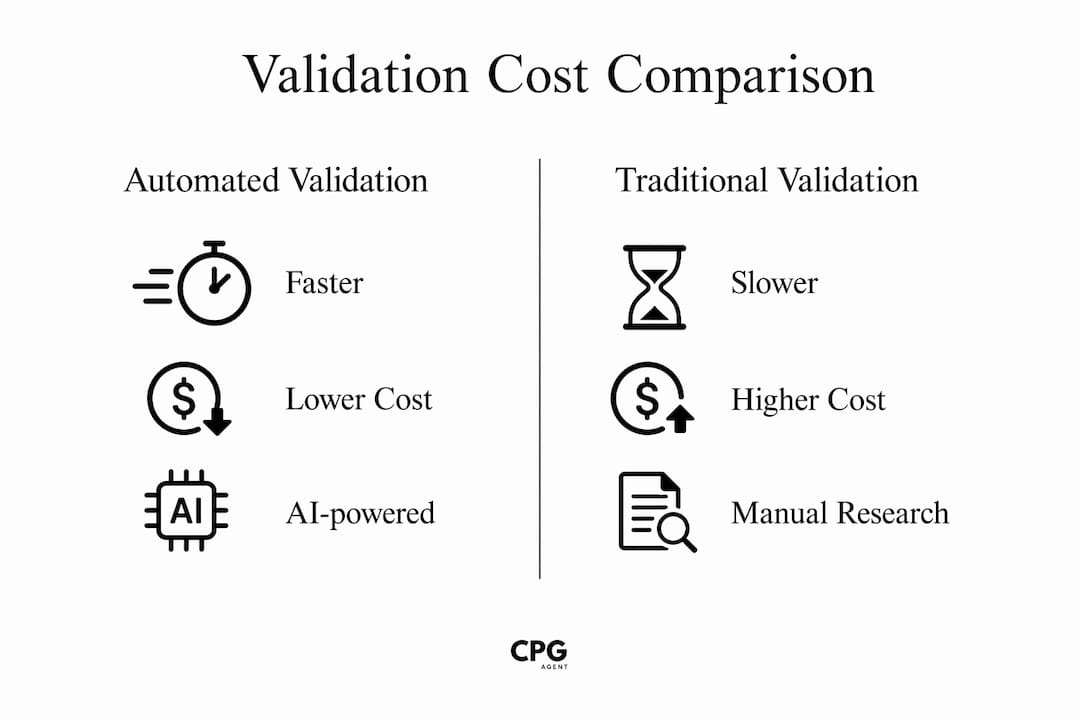
The cost difference is not marginal. Luv Sheth's documented workflow generates market research, landing pages, and ad copy in roughly 20 minutes for approximately $3.70 in API costs. Traditional market research firms charge $25,000–$50,000 for comparable outputs delivered over 6–12 weeks. For CPG startups with limited runway, that gap is the difference between testing five concepts and testing none.
| Tool | Type | Key output | Approx. cost |
|---|---|---|---|
| TestFast | Commercial | Purchase intent score, 90% accuracy | Not publicly listed |
| Sybil Swarm | Open-source | 1,000-persona sentiment heatmap | Free (API costs apply) |
| AIdeator | Commercial | Concept-to-creative pipeline | Not publicly listed |
| Autogtm | Open-source | Signal-triggered GTM workflows | Free |
| Luv Sheth workflow | DIY pipeline | Full research + landing page + ads | ~$3.70 per run |
Pro Tip: Run your concept through at least two tools before committing to a positioning direction. A purchase intent score from TestFast paired with a Sybil Swarm sentiment heatmap gives you both quantitative and behavioral signal in the same afternoon.
How to build a step-by-step automated market validation workflow
A validated go-to-market process requires more than picking a tool. You need a defined sequence that moves from hypothesis to decision-ready output without losing signal quality along the way.
-
Write a clear product hypothesis. State the problem you solve, the buyer you serve, and the price point you are targeting. Vague inputs produce vague outputs. One sentence per element is enough.
-
Run automated market research. Feed your hypothesis into an AI research tool or a GPT-based pipeline. The output should include market size estimates, competitor positioning, and consumer sentiment trends. Flag any data point that references import regulations, manufacturing costs, or local distribution rules for manual review.
-
Generate synthetic personas. Use Sybil Swarm or a comparable persona engine to build buyer profiles from your target market description. These personas drive the simulation layer that follows.
-
Simulate buyer behavior. Run your concept through the persona swarm. Review the sentiment heatmap for objection clusters. High objection density around price is a pricing signal. High objection density around the problem statement means your positioning is off.
-
Build a landing page and ad creative. Use AIdeator or a GPT-based copy pipeline to generate three to five concept variants. Each variant should test a different value proposition or visual angle.
-
Score purchase intent. Run the landing page variants through TestFast or a comparable intent-scoring tool. Prioritize the variant with the highest intent score for live testing.
-
Set a manual review gate. Before moving to paid traffic or retail outreach, a human reviewer should check the AI outputs for factual errors, regulatory issues, and brand consistency. This step is not optional.
Pro Tip: Ground every AI research prompt with a specific geography and retail channel. "Natural grocery buyers in the Pacific Northwest" produces far more useful output than "health-conscious consumers." Local intent grounding is the single biggest quality lever in automated market research.
For CPG brands working with tight budgets, the guide on how to validate a CPG concept on a tight budget walks through a practical version of this workflow with real cost breakdowns.
What mistakes and limitations should you watch for?
Automated business validation is fast, but speed creates its own risks. The most common failure mode is treating AI output as final rather than as a first draft.
AI hallucination is the primary technical risk. Research pipelines regularly generate plausible-sounding but incorrect details on import regulations, manufacturing lead times, and distributor margin structures. Human oversight corrects these errors before they reach a buyer or a retail partner. A single incorrect claim about FDA compliance or shelf-life requirements can derail a launch conversation.
Synthetic persona feedback has a ceiling. Sybil Swarm's 1,000-agent simulation is powerful for identifying broad sentiment patterns, but it does not fully replace qualitative human interviews. Real buyers surface emotional nuance, cultural context, and purchase occasion details that no current persona engine captures reliably. Use simulation to narrow your hypotheses, then confirm with 10–15 real interviews before finalizing positioning.
Overbroad data is a subtler problem. National-level consumer trend data often masks the local dynamics that determine shelf performance in specific retail chains. A product that scores well against a generic "millennial health buyer" persona may underperform in a regional grocery chain where the actual buyer skews older and price-sensitive.
Automation is a starting point, not a finish line. Every output requires a human reviewer who understands the market well enough to catch what the model missed.
Full autopilot is the riskiest configuration. Maintaining manual review gates for 30–60 days while you establish conversion baselines is the standard best practice for automated GTM engines. Turning off human oversight before you have stable data is the fastest path to a failed launch. The automated CPG growth roadmap covers how to phase human review out gradually as your baselines mature.
How does automated validation connect to your full GTM strategy?
Validation data is only useful if it flows into the decisions that follow. The most common mistake brands make is treating validation as a one-time gate rather than a continuous input.
Pricing and positioning decisions should come directly from your intent scoring and sentiment heatmap outputs. If your highest-intent variant leads with a functional benefit rather than a lifestyle claim, that is your positioning direction for launch. If the price point in your simulation consistently triggers objections, test a lower anchor before you print packaging.
Messaging refinement works the same way. The objection clusters from your persona simulation are your copywriting brief. Address the top three objections in your product description, your retail sell sheet, and your first email sequence.
Established brands use automated validation not just for new product testing but for unified sales and marketing workflows where validation signals trigger downstream actions automatically. A strong intent score on a new SKU can automatically queue a retailer outreach sequence, a paid social test, and a PR pitch without a human scheduling each step.
Key integration points for your GTM workflow include:
- Pricing: Use intent score variance across price points to set your launch price and promotional floor.
- Retail targeting: Use sentiment heatmap geography data to prioritize regional retail partners over national chains in early distribution.
- Demand generation: Connect validation outputs to your email and paid media platforms so high-intent signals trigger campaign activation automatically.
- Sales enablement: Feed validation reports directly into your broker and distributor pitch decks to show market demand evidence before you ask for shelf space.
The article on go-to-market strategy tools for CPG brands covers how to select the right platform stack for each of these integration points.
Key takeaways
Automated go-to-market validation cuts launch risk by delivering AI-powered purchase intent data, persona simulations, and positioning insights in hours, but only when paired with disciplined human review gates.
| Point | Details |
|---|---|
| Speed and cost advantage | Automated workflows deliver research, landing pages, and ad copy in 20 minutes for roughly $3.70, versus months and $50,000 with traditional methods. |
| Persona simulation at scale | Sybil Swarm generates 1,000 synthetic buyer personas to surface objection clusters and sentiment patterns before any real spend. |
| Human review is non-negotiable | AI outputs require manual checks for regulatory accuracy, niche market nuance, and brand consistency before reaching buyers or retail partners. |
| Baseline before full automation | Run manual review gates for 30–60 days to establish stable conversion baselines before reducing human oversight in GTM workflows. |
| Validation feeds GTM execution | Intent scores and sentiment data should directly inform pricing, retail targeting, messaging, and demand generation sequencing. |
Why I think most brands automate in the wrong order
Most teams I see reach for the automation tool first and write the product hypothesis second. That sequence produces fast garbage. The quality of every AI output in a validation workflow is a direct function of the specificity of the input. A vague brief about a "better-for-you snack" will generate generic market research, generic personas, and generic copy that tells you nothing useful about your actual launch.
The brands that get real value from market entry automation techniques start with a sharp, falsifiable hypothesis. They know the exact buyer, the exact retail channel, and the exact price point they are testing. The AI tools then have something concrete to work with, and the outputs are specific enough to make real decisions.
I also think the industry undersells the value of running multiple concept variants simultaneously. The cost of running five concept variants through an automated pipeline is nearly identical to running one. The information gain is enormous. You learn which value proposition resonates, which price point clears the objection threshold, and which visual direction drives intent. That is three strategic decisions made before you spend a dollar on production.
The limitation I keep coming back to is cultural and emotional nuance. Swarm simulations are excellent at predicting rational purchase behavior. They are much weaker at capturing the social identity signals that drive CPG purchases in categories like food, personal care, and beverage. A product that scores well on functional intent may still fail if it does not fit the buyer's self-image. That gap is where qualitative interviews still earn their place in the process.
Use automation to move fast and narrow your options. Use human judgment to make the final call.
— Matthew
Cpgagent brings automated validation into your full launch workflow
Cpgagent is built specifically for CPG and FMCG brands that need to move from concept to shelf without the overhead of a traditional agency. The platform combines AI-driven validation tools, including PersonaForge and Launch Validator, with automated marketing workflows and fractional CMO advisory.
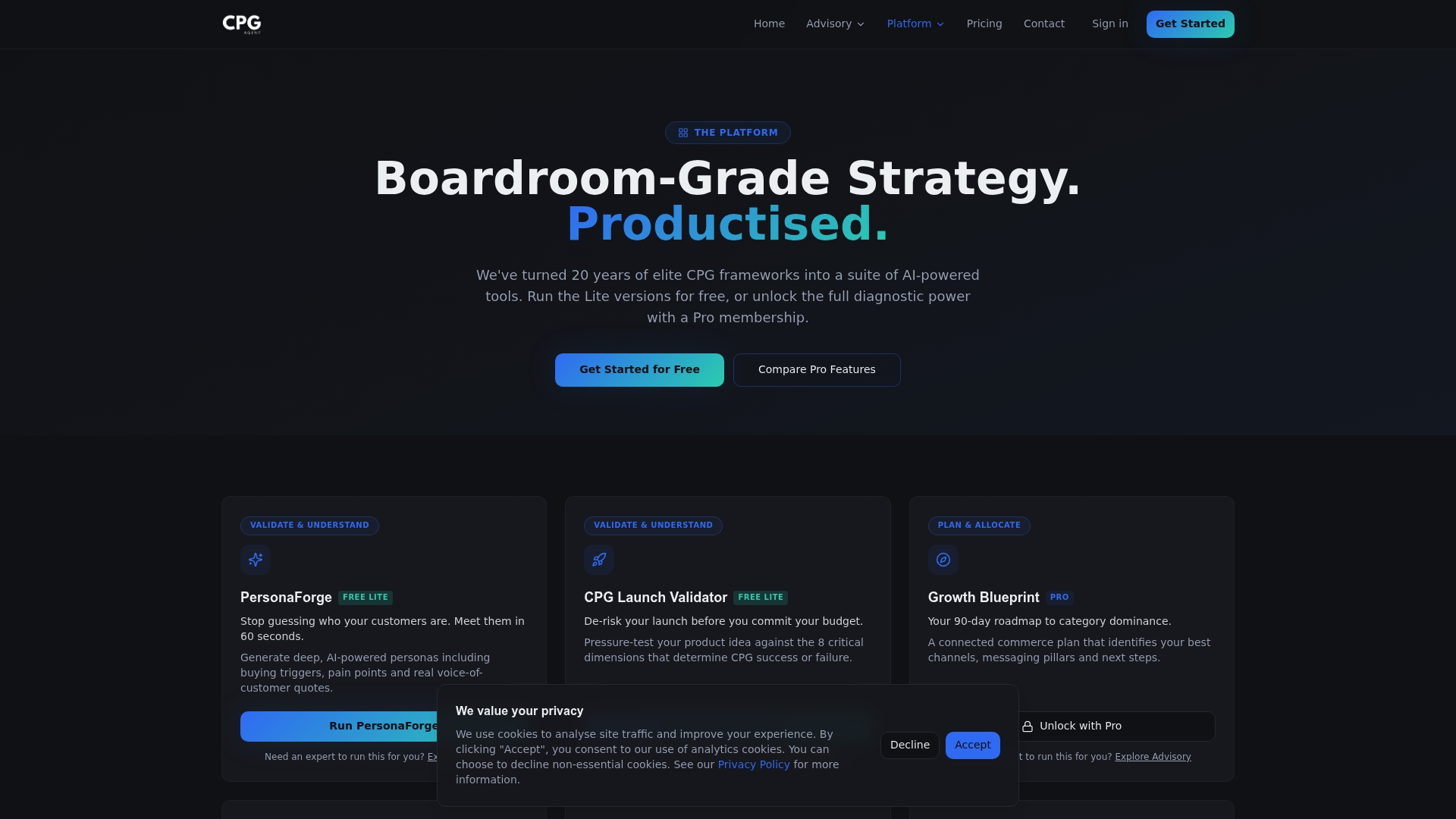
Where most validation tools stop at a report, Cpgagent connects that report to your pricing strategy, your retail outreach, and your demand generation campaigns. Startups use it to validate and launch their first SKU without a full internal team. Established brands use it to test line extensions and reposition legacy products without a six-month agency engagement. The platform integrates with existing tech stacks and focuses on pipeline contribution and margin impact from day one.
FAQ
What is automated go-to-market validation?
Automated go-to-market validation is the use of AI tools and workflows to assess market demand, product positioning, and launch readiness without traditional research methods. Tools like TestFast deliver purchase intent predictions with 90% accuracy within 24 hours.
How accurate are AI-powered purchase intent predictions?
TestFast reports 90% accuracy on purchase intent predictions delivered within 24 hours. Accuracy improves when inputs include specific buyer demographics, price points, and retail channel context rather than broad market descriptions.
Can synthetic persona simulations replace real customer interviews?
Synthetic persona simulations like Sybil Swarm accelerate feedback collection at scale but do not fully replace qualitative human interviews. Use simulations to identify objection patterns, then confirm findings with 10–15 real buyer conversations before finalizing positioning.
How long should I keep manual review gates active in an automated GTM workflow?
Best practice is to maintain manual review gates for 30–60 days while you establish stable conversion baselines. Reducing human oversight before baselines are proven increases the risk of acting on misleading AI outputs.
What is the cost difference between automated and traditional market validation?
Automated workflows can generate market research, landing pages, and ad copy in roughly 20 minutes for approximately $3.70 in API costs. Traditional market research firms typically charge $25,000–$50,000 for comparable outputs delivered over several months.