

TL;DR:
- Strategic advisors for CPG brands include fractional, M&A, consulting, and board-level experts. Choosing the right type depends on the brand’s revenue, challenges, and goals to avoid wasted budget and stalled growth.
Strategic advisors for CPG brands are senior operators, governance experts, or deal specialists who provide judgment, accountability, and direction that internal teams cannot supply alone. The types of strategic advisors CPG brands engage fall into four distinct categories: fractional advisors, M&A advisors, strategic consultants, and board-level advisors. Each category solves a different problem. Picking the wrong type wastes budget and stalls growth. This guide maps each advisor role to the revenue stage, business challenge, and engagement model where it delivers the most value for brand managers and founders.
1. What is a fractional advisor and when should CPG brands engage one?
A fractional advisor delivers judgment and strategic ownership without a full-time commitment. This fills a unique gap between agencies, which execute defined scopes, and full-time executives, who require salary, benefits, and long onboarding periods. The fractional model gives brands access to senior-level thinking at a fraction of the cost.

Fractional CFO hiring in CPG typically aligns with specific revenue thresholds: $1–3M for pre-retail financial planning, $3–10M for working capital management, $10–30M for trade spend discipline, and $30–50M+ for multi-distributor complexity. Each stage brings a different financial challenge that a generalist cannot handle well. A brand crossing into retail distribution needs someone who understands UNFI and KeHE margin structures, not a SaaS-trained CFO.
The same logic applies to fractional CMOs. A brand launching its second retail account needs a marketing leader who has managed trade spend ROI and category reviews, not someone whose entire background is direct-to-consumer. Domain-specific expertise in CPG channels is often overlooked but consistently separates effective fractional advisors from expensive disappointments.
- Fractional advisors own decisions, not just recommendations.
- They work part-time but carry accountability like a full-time executive.
- They are not project-based like consultants or output-based like agencies.
- Engagement typically runs 6–18 months, scaling up or down with brand needs.
Pro Tip: Before hiring a fractional advisor, write a one-page brief that defines the three decisions you need them to own. If you cannot name those decisions, you are not ready for a fractional hire.
2. How do M&A advisors support CPG brands and what fee structures apply?
M&A advisors guide CPG brands through acquisitions, divestitures, and strategic exits. Their work covers deal sourcing, buyer identification, negotiation support, and integration planning. Without one, founders routinely leave value on the table or accept terms that damage long-term brand equity.
Fee structures vary significantly by advisor type. Boutique M&A firms typically charge a retainer plus a success fee of 1%–3% of enterprise value. Large investment banks charge higher success fees in the 3%–6% range. That difference matters enormously on a $20M deal.
| Advisor type | Retainer | Success fee |
|---|---|---|
| Boutique firm | Monthly retainer | 1%–3% of enterprise value |
| Large investment bank | Higher monthly retainer | 3%–6% of enterprise value |
| Independent advisor | Negotiable | Varies by deal size |
Boutique firms specialize in food and CPG transactions and often bring a more targeted buyer network. Large banks offer broader reach but prioritize larger deals. Independent advisors work well for smaller exits under $10M where a full boutique engagement is cost-prohibitive.
- Match advisor type to deal size and strategic goal.
- Boutique firms outperform on CPG-specific buyer relationships.
- Confirm the advisor has closed deals in your category, not just adjacent ones.
- Negotiate retainer credits against the success fee to align incentives.
3. What are strategic consultants for CPG brands and how do they differ from advisors and agencies?
Strategic consultants deliver analysis, strategy decks, and playbooks for a defined project scope. They do not own outcomes. Consultants analyze and recommend; fractional advisors take accountability for judgment calls; agencies execute defined deliverables. Brands must match the problem type to the right talent model.
Strategic consultants typically charge project or retainer fees for scopes like merchandising strategy, category review preparation, or retail expansion planning. They do not execute deals or manage ongoing operations. Their value is concentrated in the diagnostic and planning phase.
The clearest signal that you need a consultant rather than a fractional advisor is a bounded question. "Which three retailers should we target next year?" is a consultant question. "Help us build and manage the retail expansion plan over the next 12 months" is a fractional advisor question. Confusing the two leads to overpaying for analysis or underutilizing an embedded operator.
Agencies sit in a third category. They execute creative, media, or trade marketing programs within a defined brief. They do not set strategy and they do not own business outcomes. Brands that hand strategy work to agencies consistently report misaligned priorities and wasted spend.
When to engage a strategic consultant:
- Pre-launch category analysis and competitive positioning
- Retail readiness audits before approaching a major buyer
- Post-acquisition integration planning
- Annual brand strategy refresh with a defined deliverable
4. What roles do board-level advisors or independent board members play for CPG brands?
Board-level advisors provide governance, networks, and high-level oversight that no fractional hire or consultant can replicate. Board advisors are typically compensated with equity plus a retainer, and their value compounds over time as the brand grows and approaches an exit.
Their primary contribution is credibility. A well-known former category buyer or a CPG executive with a successful exit on their record signals to investors and retail partners that the brand has serious governance. That signal accelerates conversations that would otherwise take months.
"Advisors function best as trusted thought partners, not just consultants. Founders should prioritize relationship chemistry and shared vision over rigid criteria when selecting board-level advisors." Understanding Advisors with Jamie Borteck
Board advisors are most valuable at two stages: the growth phase when a brand is entering multiple retail channels, and the pre-exit phase when governance credibility directly affects valuation. They are not the right resource for day-to-day operational problems. Founders who treat board advisors as on-call operators burn the relationship quickly.
- Equity compensation typically ranges from 0.1% to 0.5% depending on stage and advisor seniority.
- Limit board advisor commitments to 2–4 hours per month to preserve relationship quality.
- Prioritize advisors with direct buyer or distributor relationships in your target channels.
- Board advisors should open doors, not walk through them for you.
5. How to choose the right CPG brand advisor for your stage and goals
The right advisor type depends on three variables: revenue size, the nature of the problem, and whether you need judgment, capacity, or execution. Mapping these variables before you start outreach saves months of misaligned engagement.
Pre-retail brands ($0–$3M): The priority is market validation and financial structure. A fractional CFO helps set up clean books and unit economics. A strategic consultant can run a retail readiness audit. Board advisors add credibility for investor conversations.
Growth-stage brands ($3–$30M): This is where fractional CMOs and CFOs deliver the most value. Trade spend management, distributor relationships, and category review preparation all require embedded judgment, not project-based analysis. A retail expansion advisor with multi-retailer experience becomes critical at this stage.
Exit-preparation brands ($30M+): M&A advisors and board-level advisors take priority. The brand needs deal expertise and governance credibility simultaneously. Fractional advisors may continue in operational roles but the strategic center of gravity shifts toward the transaction.
- Define the problem type first: judgment, capacity, or execution.
- Match the problem type to the advisor category, not the other way around.
- Set clear KPIs upfront before any engagement begins.
- Build in a 90-day review to assess whether the engagement is delivering.
- Never hire an advisor whose only CPG experience is in a different channel than yours.
The biggest mistake in CPG advisor engagements is failing to define clear success metrics and scopes upfront. Misaligned expectations produce poor outcomes regardless of advisor quality. A well-structured brief with defined deliverables and review cadences separates successful engagements from expensive ones.
Pro Tip: Ask every advisor candidate to describe a CPG engagement where they failed to deliver. Their answer tells you more about fit than any success story.
6. How fractional advisors compare to agencies and full-time hires
The distinction between advisor types comes down to who owns the outcome. Advisors own judgment calls and strategic decisions. Consultants analyze and hand off recommendations. Agencies execute within a defined brief. Full-time hires own everything but cost three to five times more than fractional alternatives at early growth stages.
Brands that confuse these roles end up with consultants making operational decisions they were never accountable for, or agencies setting strategy they were never equipped to own. The fractional CMO versus agency question is one of the most common points of confusion for CPG founders. The answer is almost always to hire the fractional advisor first and use the agency for execution once the strategy is set.
Full-time hires make sense when the role requires daily presence, institutional knowledge, or management of a large team. Below $10M in revenue, most CPG brands cannot afford the fully loaded cost of a senior full-time executive in every function. Fractional models close that gap without sacrificing the quality of judgment.
Key Takeaways
The most effective approach to CPG advisory is to match the advisor type to the problem category: fractional advisors for judgment and accountability, consultants for analysis, M&A advisors for transactions, and board advisors for governance and credibility.
| Point | Details |
|---|---|
| Match advisor to problem type | Fractional advisors own decisions; consultants analyze; agencies execute. |
| Revenue stage drives advisor choice | Fractional CFOs add most value at $3–30M; M&A advisors at $30M+ exit stage. |
| Define scope before engagement | Clear KPIs and deliverables prevent misaligned expectations and wasted spend. |
| Domain expertise is non-negotiable | CPG-specific knowledge in trade spend and distributor margins separates effective advisors from costly mistakes. |
| Board advisors compound over time | Equity-compensated board members add credibility and networks that accelerate retail and investor conversations. |
What I have learned about picking CPG advisors the hard way
The most common mistake I see CPG founders make is hiring for pedigree instead of fit. A former VP at a major consumer goods company sounds impressive until you realize their entire career was in a category with completely different retail dynamics than yours. Impressive titles do not transfer across categories the way founders assume.
The second mistake is treating the advisor relationship as passive. Effective advisor relationships require structured, regular check-ins tailored to the brand's lifecycle stage. A monthly 30-minute call is not an engagement. It is a status update. Real advisory value comes from the advisor being close enough to the business to challenge assumptions before they become expensive decisions.
The third thing I have learned is that cultural and strategic alignment matters more than most founders admit. You will share uncomfortable truths with this person. You will ask them to weigh in on decisions that affect your livelihood. If the chemistry is not there in the first two conversations, it will not improve under pressure. Trust your gut on fit, then verify with references.
The best advisor I have ever seen in action was someone who consistently said "I don't know, but here is how I would find out." That intellectual honesty, combined with deep CPG channel knowledge, was worth more than any polished deck.
— Matthew
Cpgagent connects CPG brands with the right advisory expertise
CPG brands that move fast need advisory support that keeps pace. Cpgagent's platform combines AI-driven strategy tools with fractional leadership advisory, giving brand managers and founders access to senior-level judgment without the overhead of full-time hires or traditional agency retainers.
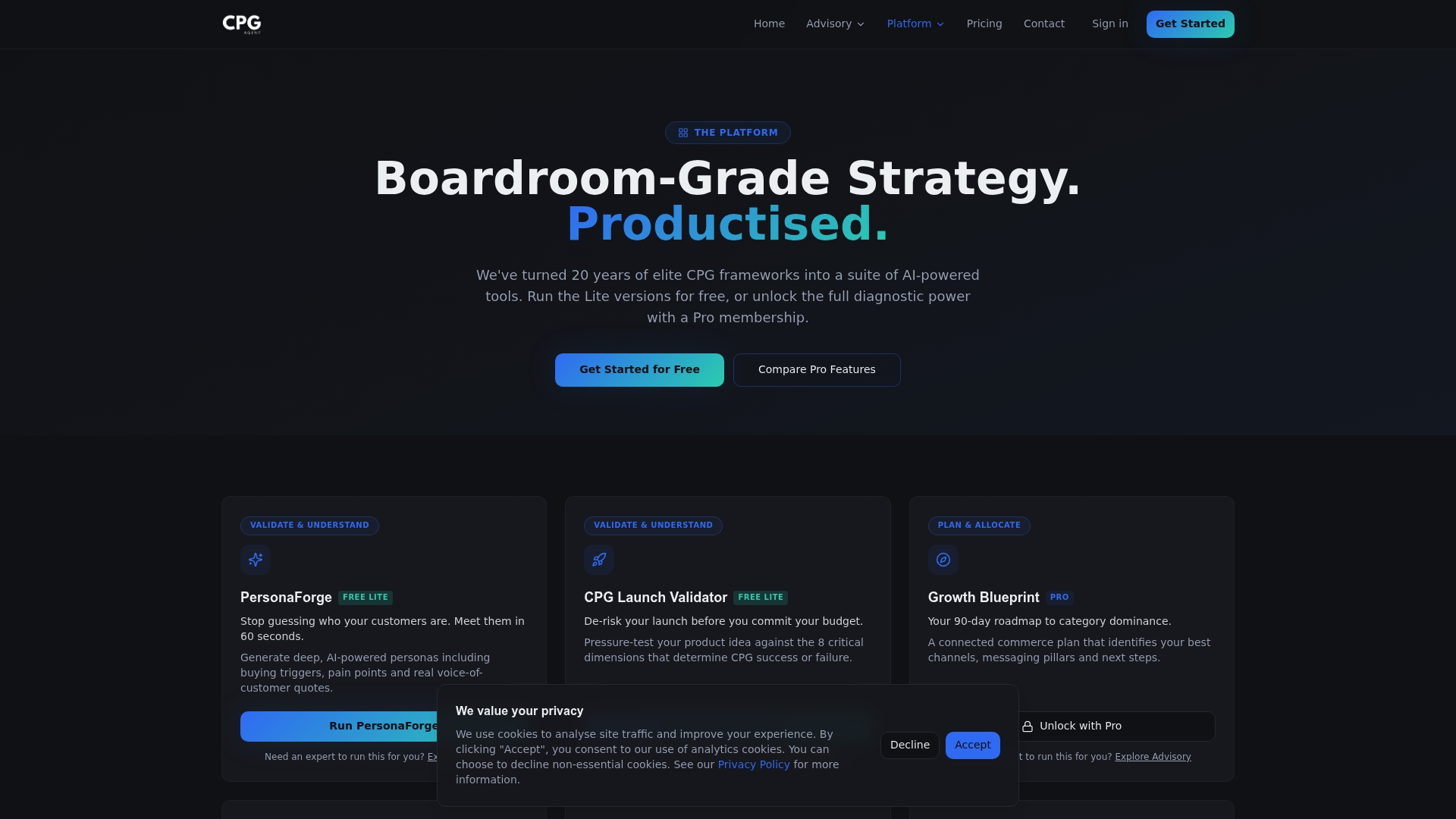
Whether you are preparing for a retail expansion, managing trade spend complexity, or building toward an exit, Cpgagent matches your brand's stage and goals to the right advisory model. The platform's tools, including PersonaForge and Launch Validator, give your advisors the data they need to make faster, better decisions. Explore how Cpgagent supports CPG brands at every growth stage.
FAQ
What are the main types of strategic advisors for CPG brands?
The four main types are fractional advisors, M&A advisors, strategic consultants, and board-level advisors. Each serves a distinct function: judgment and accountability, deal execution, analysis and planning, and governance.
When should a CPG brand hire a fractional CFO?
A fractional CFO becomes valuable at $1–3M for pre-retail planning and grows in importance through $30M+ as distributor and trade spend complexity increases. Domain-specific CPG experience is critical for this role.
How much do M&A advisors charge for CPG transactions?
Boutique M&A firms typically charge a retainer plus a success fee of 1%–3% of enterprise value. Large investment banks charge 3%–6%, making boutique firms the better fit for most mid-market CPG exits.
What is the difference between a strategic consultant and a fractional advisor?
Consultants deliver analysis and recommendations without owning outcomes. Fractional advisors take accountability for judgment calls and act as embedded decision-makers within the brand team.
How do CPG brands avoid bad advisor engagements?
Define clear success metrics and scope before any engagement begins. The most common cause of failed advisor relationships is misaligned expectations, not advisor quality.