
Relying on the traditional model of tying marketing agency retainers to a percentage of media spend leads challenger CPG brands to overspend on creative while falling short on agile, accountable leadership. Full service agencies often demand large upfront retainers and multiweek workflows that slow campaign launches and limit the speed of test-and-learn cycles. This comparison lets you weigh fixed retainer costs, strategy ownership, and execution speed between fractional CMO engagements and traditional creative agencies so you can match your marketing investment to your brand's stage and budget.
Table of Contents
Fractional CMO
At a Glance
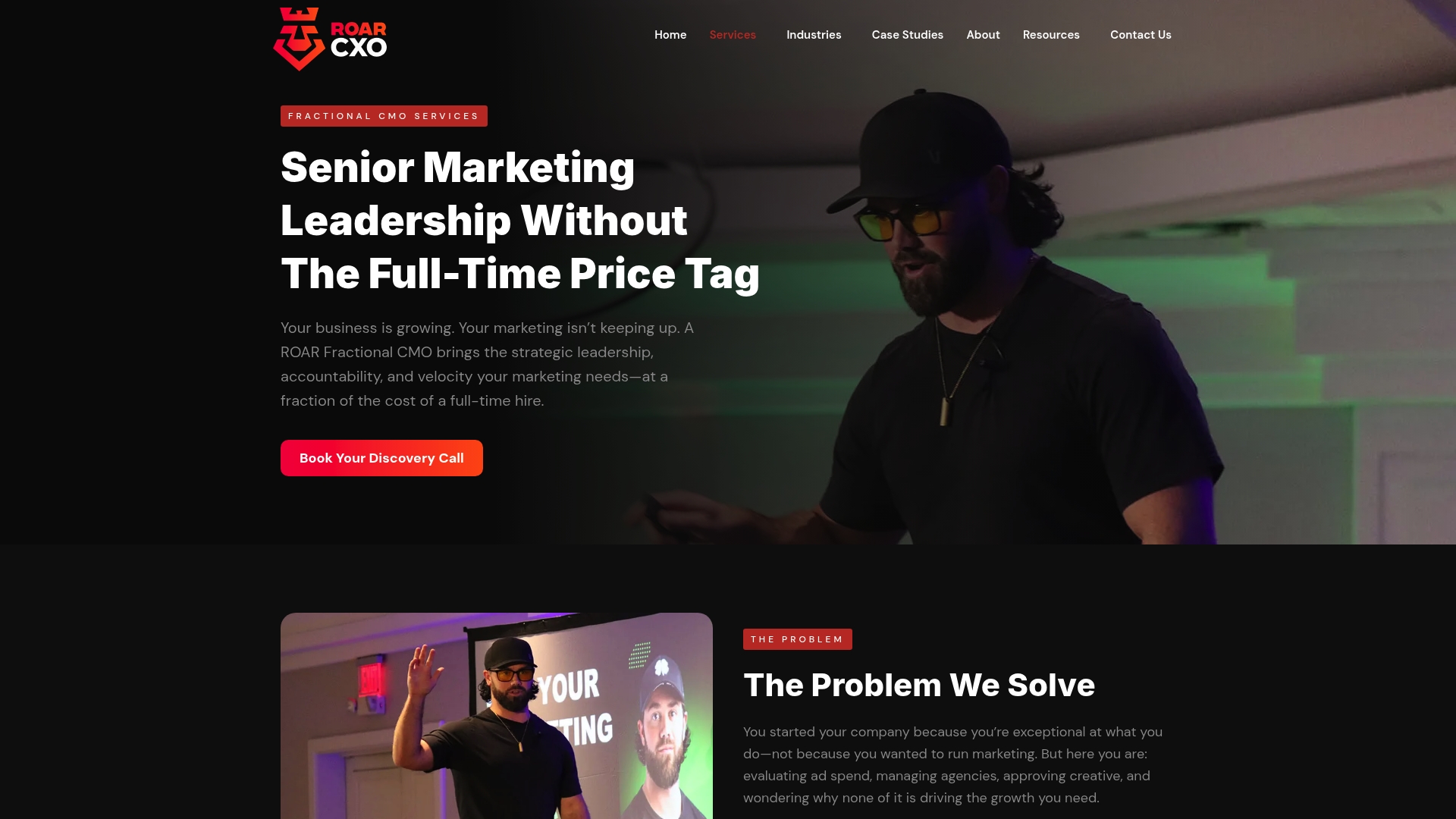
$5,000 to $15,000 monthly retainers are the typical range for Fractional CMO engagements, with average retainers often landing near $10,000 to $12,000 per month. This model gives access to senior marketing leadership without a full-time salary or executive-level overhead.
Core Features
- Strategic marketing leadership on a part time or outsourced basis, providing roadmap and priority setting.
- Development of clear marketing blueprints and growth strategies mapped to 90 day, 12 month, and 24 month goals.
- KPI alignment with business objectives and regular performance check ins to keep teams accountable.
- Management and execution oversight of campaigns across channels, with hands on coordination and vendor management.
- Team leadership, coaching, hiring support, and guidance for internal staff or external agencies.
Key Differentiator
The offering centers on senior level CMO expertise delivered on a flexible, part time basis so companies get executive oversight without the fixed cost of a full time hire. That combination aims to speed decision making while keeping monthly cash outflow predictable.
Pros
- Cost effective executive leadership compared with hiring a full time CMO, freeing payroll budget for execution and media.
- Flexible engagement terms let you scale hours up or down as product launches or seasonality demand.
- Strategic guidance paired with execution oversight reduces strategy drift and improves the odds campaigns hit ROI targets.
- Access to specialized marketing expertise tailored to stage of growth, from product market fit to scaling paid channels.
- Fast diagnosis of marketing gaps and a single point of accountability to coordinate agencies, vendors, and internal teams.
Cons
- Limited hours of availability relative to a full time CMO can constrain responsiveness during crisis or rapid pivots.
- Some ramp up time is required before full impact is realized, which means the first 30 to 60 days are heavy on onboarding.
- Success often depends on competent internal teams or reliable agencies to execute the plan, reducing fit for companies with no execution capacity.
- Less direct day to day control over execution for founders who prefer hands on oversight of every campaign.
When It May Not Fit
If you need a CMO onsite daily or someone who can dedicate full time hours to deeply embedded operations, this part time model will feel limiting. It also underperforms when a company lacks an internal marketer or agency to convert strategy into daily execution.
Notable Integrations
- Works collaboratively with in house marketing teams.
- Coordinates with external creative and performance agencies.
- Integrates with whatever technology vendors you already use to run campaigns and analytics.
Who It's For
Growing startups, SMEs, and mid market brands that need seasoned marketing leadership but are not ready to commit to a full time Chief Marketing Officer. Ideal when you want executive strategy, KPI alignment, and vendor coordination on a predictable monthly retainer.
Real World Use Case
According to the vendor, Winmo engaged a fractional CMO through TechCXO to address stagnant lead flow, high churn, and marketing misalignment. That engagement reportedly relaunched the site, refocused PPC, and launched targeted awareness campaigns, improving lead generation and retention within a few months.
Pricing
Typical engagements range from $5,000 to $15,000 per month, with average retainers cited around $10,000 to $12,000. Hourly rates for senior fractional CMOs are commonly reported between $200 and $500 per hour. Contracts often run six to twelve months.
Website: https://roarcxo.com/fractional-cmo/
Traditional Creative Agency
At a Glance
Produces high-profile mass-reach work such as Super Bowl commercials and cinematic product launches that require large crews and multiweek production schedules. Their model relies on linear workflows, heavy production budgets, and dedicated account teams that manage end-to-end offline campaigns.
Core Features
A full-service delivery model for legacy channels and premium creative.
- Campaign management across TV, print, radio, and direct mail with agency-led media planning.
- High-production-value creative development including video shoots, photography, and brand identity systems.
- Linear process from client brief to internal concepting, approvals, production, and final asset delivery.
- Dedicated account management and specialized departments handling creative, media, digital, and PR.
Key Differentiator
Deep expertise in orchestrating large-scale, high-production campaigns across traditional media sets these agencies apart. They combine experienced creative directors, negotiators for media placements, and production buying power to reach broad demographics through broadcast and out-of-home channels.
Pros
- Strong brand storytelling. These teams focus on emotionally resonant concepts that translate well to TV and print audiences.
- Reach for less digitally engaged consumers. Legacy channels still capture older demographics that digital-first shops often miss.
- Production scale. The agency model supports complex shoots, union crews, and cinematic post-production workflows.
- Media leverage. Their relationships and negotiation experience can secure premium placements and bundled buys.
- Institutional processes. Long-standing systems protect brand consistency across large campaigns and multiple markets.
Cons
- Longer timelines. Linear and siloed workflows add weeks or months to deliverables compared with agile models.
- Higher overhead. Large teams and physical offices translate into higher retainers and project fees.
- Slower iteration. Rapid test-and-learn cycles are harder to run when production and approvals are heavyweight.
- Integration gaps. Pulling performance data back into creative development often requires extra coordination.
When It May Not Fit
If you need fast experiment cycles, rapid creative iterations, or continuous digital activation, this model will feel slow and costly. Small, early-stage CPG brands with constrained budgets will find the minimum retainers and production scale misaligned with their needs. Targeting Gen Z on social-first channels is better served by digital-native providers.
Notable Integrations
- Media buying platforms used for national and local broadcast placements.
- Content production vendors handling crews, studios, and post-production.
- Creative asset management tools for distributing final brand assets.
- Market research and analytics platforms used to inform targeting and creative testing.
Who It's For
Medium to large CPG brands and companies planning flagship launches or broad brand refreshes that require premium production value and national reach. Best when the marketing budget supports multiweek productions and six-figure annual retainers.
Real World Use Case
A mid-sized CPG brand hires an agency to run a product launch with TV spots, print ads, and radio buys. The engagement includes brand messaging, a multiweek shoot, national media placement, and a phased rollout across offline channels over several months.
Pricing
Pricing normally follows monthly retainers ranging from $5,000 to $15,000 for smaller engagements, with full-stack partnerships reaching higher monthly figures. Expect retainers decoupled from ad spend plus a media fee commonly around 10 to 20 percent of media buy.
Website: https://linkedin.com/company/collemcvoy
Fractional CMO vs. Traditional Creative Agency
Selecting the right marketing engagement model directly impacts the marketing outcomes and related operational effectiveness for growing CPG brands. Both the Fractional CMO model and the Traditional Creative Agency model offer distinct advantages and tradeoffs depending on the brand's goals, resources, and timeframe.
Cost Efficiency and Resource Allocation
Fractional CMOs provide executive-level marketing leadership on a part-time basis, offering cost savings compared to hiring a full-time CMO. This flexibility is particularly advantageous for mid-sized companies seeking expert guidance while maintaining budgetary prudence. In contrast, Traditional Creative Agencies, while delivering high-value production and media placement expertise, encompass higher operational costs stemming from their larger teams and extensive resources. For smaller brands, these expenses may be difficult to justify given their more immediate and focused marketing requirements.
Flexibility in Strategic Deployment
The Fractional CMO model excels in providing adaptable marketing strategies, able to align with rapid changes in market conditions and evolving brand objectives. This contrasts with the traditional agency's more linear and often slower processes. Traditional Creative Agencies, however, bring depth in executing campaigns across established channels such as television, radio, and print, where intricate production schedules necessitate their structured approach. Brands with predictable schedules may find this advantageous, whereas those in a dynamic testing phase might favor the nimbleness of a Fractional CMO setup.
Strengths in Creative Execution
When it comes to delivering high-impact creative assets and widespread media coverage, Traditional Creative Agencies undoubtedly lead. Their infrastructure and access to premium creative talent and resources enable them to produce large-scale, resonant campaigns. Meanwhile, while Fractional CMOs emphasize coordination and oversight of existing teams and vendors, the execution depth relies on the capabilities of third-party collaborators.
Best Fit
- Select Fractional CMO services if budgeting constraints influence your approach or if adaptable leadership fits your fast-changing or project-specific needs.
- Engage a Traditional Creative Agency if you require full-scale campaign production, including high-definition media and extensive distribution, supported by a predictably allocated budget.
- Smaller, earlier-stage CPG brands often achieve better alignment with Fractional CMO engagements, balancing strategic clarity and cost.
- Expansive outreach programs requiring orchestration across multiple traditional channels benefit from the expertise of Traditional Creative Agencies.
- Choose the Fractional CMO model if your goals include bridging gaps in internal execution without committing to a permanent role.
Our Pick
For budget-conscious brands requiring flexible, high-level marketing leadership, the Fractional CMO model offers strategic oversight and executional coordination. Conversely, for brands planning expansive, multi-channel productions aiming for broader audience reach, Traditional Creative Agencies provide the necessary resources and creative prowess. The tradeoff lies in agility versus production scope; understanding your brand's immediate and long-term priorities will help navigate this decision effectively.
Fractional CMO vs Traditional Creative Agency
This table compares key features, pricing, and suitability for decision-making regarding utilizing a Fractional Chief Marketing Officer or engaging a Traditional Creative Agency.
| Aspect | Fractional CMO | Traditional Creative Agency |
|---|---|---|
| Core Feature | Part-time senior marketing expertise for strategic oversight | High-production-value campaign creation across media channels |
| Key Differentiator | Flexible executive leadership without full-time overhead | Expertise in delivering large-scale, high-impact offline campaigns |
| Ideal For | Startups and SMEs needing part-time strategic marketing guidance | Medium to large brands requiring premium production campaigns |
| Pricing | $5,000 to $15,000/month, average $10,000 to $12,000 | From $5,000/month, higher for full-service retainers |
| Notable Limitation | Limited hours and dependency on strong execution resources | Longer timelines and higher overhead costs |
Choosing the Right Marketing Model for Your Growing CPG Brand
The choice between hiring a fractional CMO or a traditional creative agency often comes down to balancing strategic oversight with execution speed and budget flexibility. As highlighted in the article, many consumer packaged goods brands face challenges like costly retainers, slow turnaround times, and limited adaptability when relying solely on legacy agency models or full-time executives.
Cpgagent offers a data-driven platform tailored to these pain points. Our AI-powered tools and fractional leadership advisory help brands make confident marketing decisions quickly while reducing overhead and streamlining workflows. Whether you need rapid market validation, strategic alignment, or scalable growth experiments, our platform supports multiple brand stages without the delays of traditional agencies.
Ready to compare approaches and accelerate your brand’s growth? Explore how Cpgagent’s platform integrates AI-driven strategy and fractional executive support so you can deploy smarter marketing plans faster.
Frequently Asked Questions
What is the pricing range for a Fractional CMO?
A Fractional CMO typically charges between $5,000 to $15,000 monthly, with average retainers often around $10,000 to $12,000. This pricing model provides access to senior marketing leadership without the full-time salary commitment associated with a traditional CMO. Companies needing strategic guidance without the overhead of a full-time hire should consider a Fractional CMO.
How do execution speeds compare between a Fractional CMO and a Traditional Creative Agency?
A Fractional CMO offers fast diagnosis of marketing gaps and strategic alignment, enabling quicker decision-making and execution compared to a Traditional Creative Agency, which often has longer timelines due to linear workflows. Brands that need agile and rapid adjustments to their marketing strategies are better suited for a Fractional CMO.
What type of specific expertise do Traditional Creative Agencies bring?
Traditional Creative Agencies are known for their deep expertise in orchestrating large-scale, high-production campaigns across legacy media channels like TV, print, and radio. Their ability to manage high-production-value creative work makes them ideal for brands looking to create compelling advertisements aimed at wide demographics. Brands planning high-profile launches or requiring extensive production support should consider hiring a Traditional Creative Agency.
Can a Fractional CMO effectively manage execution across multiple channels?
Yes, a Fractional CMO can manage and oversee campaigns across various channels, providing hands-on coordination and vendor management. This capability ensures that marketing strategies are executed effectively, aligning with the business objectives set forth. Companies that need strategic oversight coupled with execution capacity should look into engaging a Fractional CMO for their marketing needs.
When might a Traditional Creative Agency not be the right fit?
A Traditional Creative Agency may not be ideal if a brand requires rapid experimentation cycles or continuous digital activation, as their linear processes can delay deliverables. Smaller, emerging brands with tight budgets or a focus on digital-first strategies may benefit more from a Fractional CMO's agile approach.