

TL;DR:
- A strategic pivot in CPG brands involves a fundamental change in business model, product, or target customer, not just surface adjustments. Market pressures, industry digitization, and private label competition necessitate timely, structured pivots to sustain growth and relevance. Effective execution depends on data-driven frameworks, clear communication, internal alignment, and technology platforms like Cpgagent for accelerated decision-making.
Most CPG professionals have sat in a boardroom where someone suggested "tweaking the strategy." A new flavor here, a price promotion there. That is not a strategic pivot. Understanding what is a strategic pivot in CPG brands is the difference between a brand that survives category disruption and one that quietly loses shelf space until it disappears. A strategic pivot is a structured, fundamental course correction. It touches your product portfolio, your business model, your customer base, or your distribution channels. This article breaks down exactly what that means, why it matters in 2026, and how to execute one without destroying what you have already built.
Table of Contents
- Key takeaways
- What is a strategic pivot in CPG brands
- Why CPG brands must pivot right now
- Frameworks for executing CPG pivots
- Real-world pivot examples and what they teach us
- Technology and data as pivot accelerators
- My honest take on what makes pivots succeed or fail
- Execute your next pivot with the right platform
- FAQ
Key takeaways
| Point | Details |
|---|---|
| Pivots are structural, not cosmetic | A true strategic pivot changes your business model, portfolio, or customer base, not just your packaging or pricing. |
| Market pressure is forcing change now | Margin compression and private label growth are pushing CPG brands to shift from price-led to volume-driven growth strategies. |
| Frameworks reduce execution risk | Structured approaches like build-measure-learn and phased portfolio rationalization significantly improve pivot success rates. |
| Data platforms accelerate decisions | Integrated, real-time data systems give CPG brands the speed and accuracy needed to act on pivot opportunities before competitors do. |
| Internal alignment is non-negotiable | The most technically sound pivot will fail without clear communication and cross-functional buy-in from leadership to field teams. |
What is a strategic pivot in CPG brands
A strategic pivot is a structured, fundamental shift in how a CPG brand creates and delivers value. It is not a product refresh or a quarterly promotion adjustment. It means changing one or more core dimensions of the business: what you sell, who you sell it to, how you reach them, or how your business model generates profit.
There are several distinct types of pivots a CPG brand might execute:
- Product portfolio pivot: Exiting underperforming categories and doubling down on high-growth segments, such as moving from sugary snacks to better-for-you alternatives.
- Customer segment pivot: Shifting focus from mass-market retail buyers to a specific demographic, like Gen Z consumers who shop primarily through DTC channels.
- Distribution pivot: Moving from traditional grocery retail to foodservice, club channels, or direct-to-consumer e-commerce.
- Business model pivot: Transitioning from a sell-in wholesale model to a subscription or licensed brand model.
- Technology pivot: Restructuring operations around AI-driven demand forecasting and automated replenishment rather than manual planning cycles.
What separates a pivot from a standard optimization is the scope and intent. Optimization improves how you execute your current strategy. A pivot changes the strategy itself. The trigger is usually a signal that the current model has hit a ceiling. Plateauing growth or disruption from new competitors, shifting consumer behavior, or technology change are the most common causes.
Pro Tip: Before labeling any initiative a "pivot," ask whether it changes your revenue model, your primary customer, or your core product category. If the answer is no to all three, you are optimizing, not pivoting.
Why CPG brands must pivot right now
The 2026 CPG market is not forgiving of inertia. Pricing as a growth lever has essentially run its course. CPG companies are abandoning pricing-led growth due to margin compression, shifting instead toward volume-increasing strategies through innovation, portfolio optimization, and operational efficiency. That is a structural shift in how the industry thinks about profit.
The private label threat has also intensified. Retailers like Walmart have invested heavily in redesigning their store brands to compete on quality and cultural relevance, not just price. Brand differentiation through unique brand stories, design, and cultural leadership is now the primary defense for A-brands facing private label pressure. Competing on price alone is a losing position.
"Consumers increasingly seek culturally resonant brand experiences. Successful pivots recognize and amplify this shift rather than competing solely on price." — Campaign Live
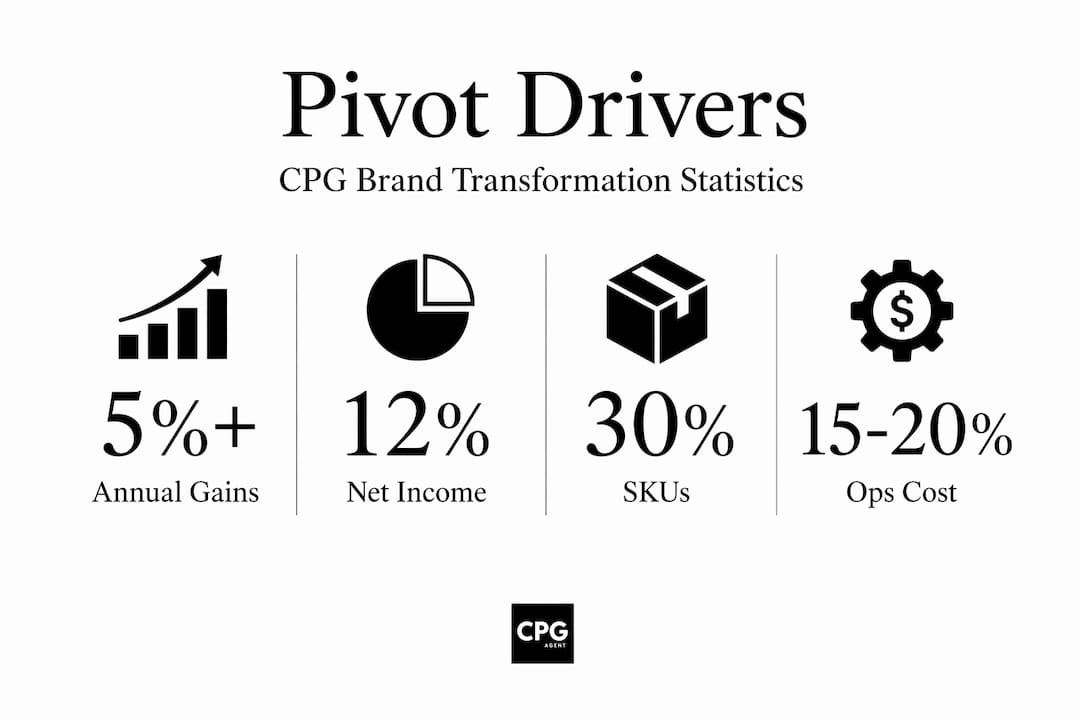
Digitization is accelerating the urgency. Annual productivity gains of 5% or more are now required for competitiveness, shifting from traditional cost-cutting to technology-enabled growth. Brands that cannot build that kind of operational efficiency into their cost structure will not have the margin to fund the innovation their pivot requires.
Kraft Heinz is a useful benchmark here. The company invested $600 million in R&D and marketing, resulting in a 12% net income increase in Q1 2026. That is not a company that cut its way to growth. It pivoted its investment thesis from austerity to offense, and the results are visible.

Frameworks for executing CPG pivots
Knowing you need to pivot and knowing how to execute one without destabilizing your business are two very different problems. The brands that get this right use structured frameworks rather than gut instinct.
The build-measure-learn approach
The Lean Startup methodology translates well to CPG. Pivot decisions based on validated learning consistently outperform intuition-driven changes. The process is straightforward: build a minimum viable version of your pivot hypothesis, measure real market response, and learn before scaling. In CPG, this might mean launching a new product format in a single region before committing to national distribution.
SKU rationalization as a pivot enabler
SKU rationalization is often mishandled. The bottom 30% of SKUs generate only 2% of revenue but consume 15 to 20% of operational capacity. That is not a minor inefficiency. It is structural drag that limits your ability to invest in the new direction your pivot requires.
The sequencing matters as much as the decision itself. Providing at least 90 days notice to retailers and monitoring weekly service levels during SKU retirements mitigates shelf space loss and prevents retailer escalations. Treating rationalization as a quick cost-cut rather than a managed transition is how brands damage retail relationships they spent years building.
Here is a practical sequencing framework for a CPG pivot execution:
- Audit and map: Identify which products, channels, and customer segments are underperforming relative to operational cost.
- Validate the new direction: Test the pivot hypothesis with a defined market segment before committing resources at scale.
- Sequence the exits: Retire low-value SKUs with proper retailer communication and service level monitoring.
- Align the organization: Ensure sales, marketing, supply chain, and finance are operating against the same pivot roadmap.
- Measure and iterate: Set clear KPIs for the pivot's first 90 days and adjust based on real data, not projections.
Pro Tip: Map your pivot against your current retail planogram commitments before announcing anything internally. Misaligned timing between your pivot timeline and your retailer contract cycles is one of the most common and avoidable execution failures.
Real-world pivot examples and what they teach us
The most instructive pivot examples in CPG share a common thread: the brands that succeeded did not wait until they were in crisis. They moved while they still had resources to invest.
Kraft Heinz's current transformation is a live case study. Rather than continuing to optimize a declining portfolio, the company made a deliberate decision to invest in growth capabilities. The $600 million commitment to R&D and marketing represents a business model pivot from efficiency-first to innovation-first, and the early financial results validate the approach.
Starbucks offers a parallel lesson adapted for CPG context. Proactive pivots for long-term competitive advantage like Starbucks's repeated reinventions of its customer experience model demonstrate that even dominant brands need to cannibalize their current success to protect their future position. In CPG terms, this means being willing to exit a profitable but declining category to fund entry into a growing one.
The cannabis beverage category illustrates how emerging CPG brands execute distribution and portfolio pivots simultaneously. Brands repositioning around premium THC beverages are not just launching new products. They are redefining their customer segment, their retail channel strategy, and their brand positioning in one coordinated move.
Key lessons from these examples:
- Pivots that succeed are funded before they are forced. Waiting for a crisis limits your options.
- Cannibalizing your own portfolio is sometimes the right move. Protecting legacy revenue at the cost of future relevance is a losing trade.
- Measuring results at 90-day intervals keeps the pivot accountable without creating premature pressure to abandon a sound strategy.
Technology and data as pivot accelerators
No CPG brand executes a meaningful pivot on spreadsheets and intuition anymore. The speed and complexity of the current market demand integrated data infrastructure.
Integrated data platforms combining internal and external consumer data enable near real-time decision-making, which is critical in CPG's fast-moving promotional environment. When your pivot depends on responding to a competitor's pricing move or a sudden shift in consumer sentiment, a two-week data lag is a competitive disadvantage you cannot afford.
The capabilities that matter most for pivot execution include:
- AI-enhanced promotional planning: Optimizing trade spend allocation in real time rather than relying on historical averages.
- Demand forecasting at SKU level: Understanding which products in your new portfolio direction will actually move before you commit supply chain resources.
- Revenue growth management tools: Modeling the margin impact of your pivot across different channel and pricing scenarios before you execute.
- Collaboration platforms: 73% of CPG and retail companies have increased collaboration in the last five years, and shared planning frameworks are now a baseline expectation, not a differentiator.
Flatter organizational structures that centralize data accelerate AI-driven value creation and enable faster, more informed pivot decisions. If your data lives in six different systems that do not talk to each other, your pivot speed is capped by your data architecture.
Pro Tip: Before investing in new technology for your pivot, audit what data you are already collecting but not using. Most CPG brands have more usable insight sitting in their existing systems than they realize.
My honest take on what makes pivots succeed or fail
I have watched CPG brands execute pivots that looked perfect on paper and collapse in execution. The pattern is almost always the same. The strategy is sound, the data supports the direction, and then the organization does not move with it.
What I have learned is that the internal communication plan for a pivot is as important as the strategic plan itself. Sales teams that do not understand why you are exiting certain SKUs will undermine the rationalization with retailers. Marketing teams that are not aligned on the new customer segment will continue producing content for the old one. The strategic logic of your pivot means nothing if the people executing it are working from a different map.
The other thing I would push back on is the instinct to move too fast once a pivot is decided. Validated learning takes time. The brands I have seen execute pivots well treat the first 90 days as a test, not a launch. They set narrow success metrics, measure honestly, and adjust before scaling. The ones that fail tend to commit too much capital too early and then cannot afford to course-correct when the initial data comes back mixed.
My practical advice: get your CFO and your head of sales in the same room before you finalize your pivot roadmap. If those two functions are not aligned on the financial model and the retailer communication plan, you do not have a pivot. You have a deck.
— Matthew
Execute your next pivot with the right platform
If you are serious about executing a CPG brand transformation, the tools you use will determine how fast and how accurately you can move. Cpgagent is built specifically for this.
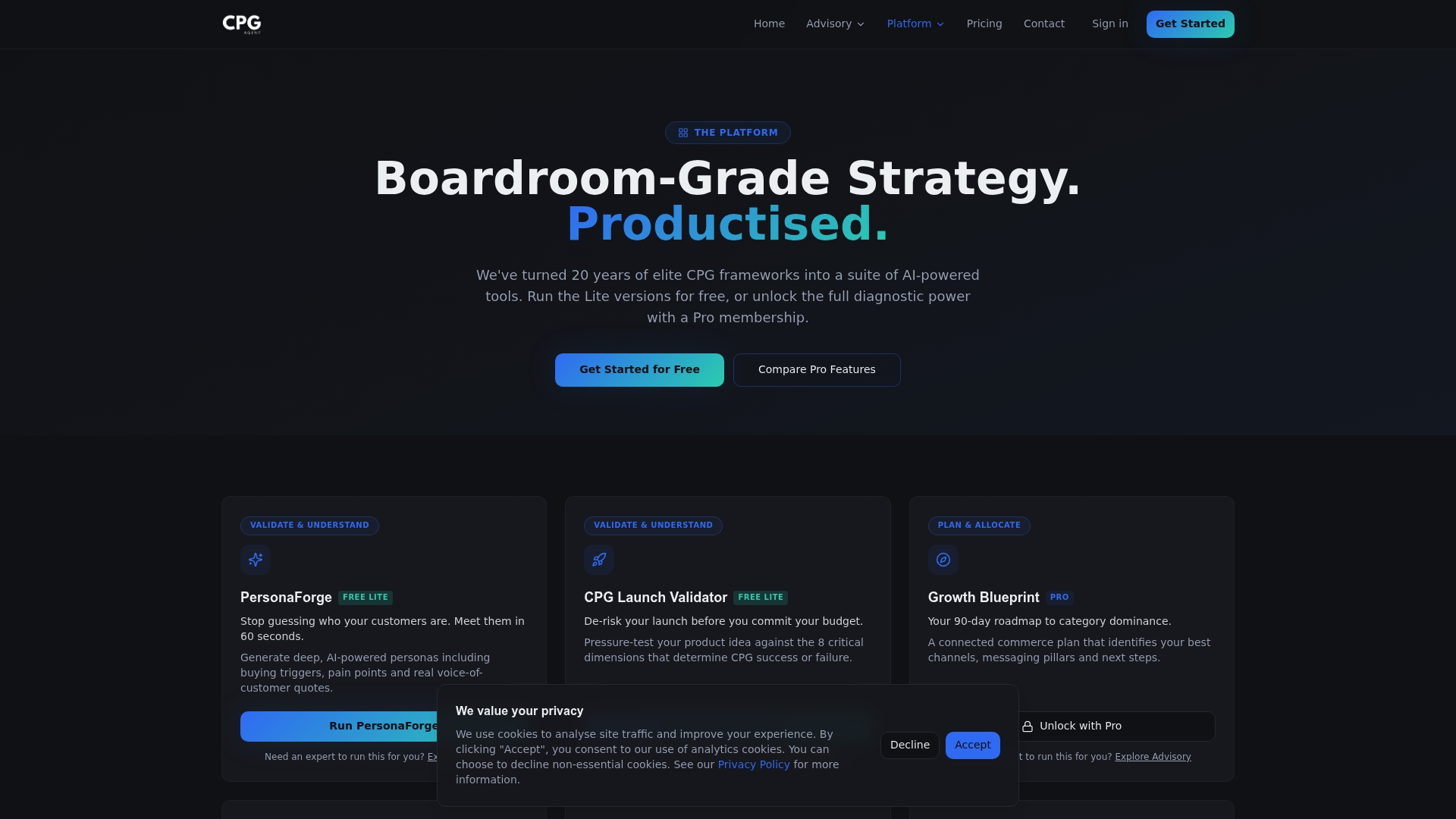
The Cpgagent platform combines AI-driven strategy tools, SKU rationalization support, and revenue growth management capabilities into one system designed for CPG brands at every stage. Whether you are a startup testing a new category or an established brand restructuring a legacy portfolio, Cpgagent gives you the data infrastructure and fractional leadership advisory to move with confidence. Explore the platform and see how it supports the kind of disciplined, data-backed pivot execution this article describes.
FAQ
What is a strategic pivot in CPG brands?
A strategic pivot in CPG brands is a fundamental shift in one or more core business dimensions, including product portfolio, target customer, distribution model, or revenue structure. It goes beyond incremental optimization to address structural challenges or unlock new growth opportunities.
What causes a strategic pivot in CPG?
The most common causes include margin compression, private label competition, shifting consumer behavior, market saturation, and disruptive technology. Plateauing growth or disruption from new market entrants typically triggers the decision to pivot.
How long does a CPG brand transformation take?
The timeline depends on the scope of the pivot, but most structured CPG pivots operate in 90-day validation phases before scaling. SKU rationalization alone requires at least 90 days of retailer notice to execute without damaging shelf relationships.
What is the importance of a strategic pivot for CPG brands?
Without the ability to pivot, CPG brands risk losing relevance as consumer preferences, retail dynamics, and competitive conditions shift. Volume-boosting strategies through innovation and portfolio optimization have replaced pricing as the primary growth lever in 2026.
How do you avoid failure when pivoting a CPG brand?
The most common failure points are insufficient internal alignment, premature scaling before data validation, and poor retailer communication during SKU exits. Using structured frameworks like build-measure-learn and ensuring cross-functional buy-in before execution significantly reduces pivot risk.