

TL;DR:
- Validating CPG launch success requires measuring adoption, behavior, and outcomes using real-time data and preset targets. Most brands miss long-term signals by focusing only on sales, risking ineffective launches. Digital rebate programs, controlled pilots, and household tracking enable quick validation and better decision-making.
Validating CPG launch success dimensions means measuring a new product's performance across adoption, consumer behavior, and business outcomes, not just first-week sales. Most brands track revenue and miss the signals that actually predict whether a launch will survive past month three. Only one in four new FMCG launches reaches 1% household penetration in its first year. That number tells you the bar is low and most brands still miss it. The brands that do succeed share one habit: they define what success looks like before launch day, then measure it in real time across multiple dimensions.
What are the key dimensions to validate CPG launch success?
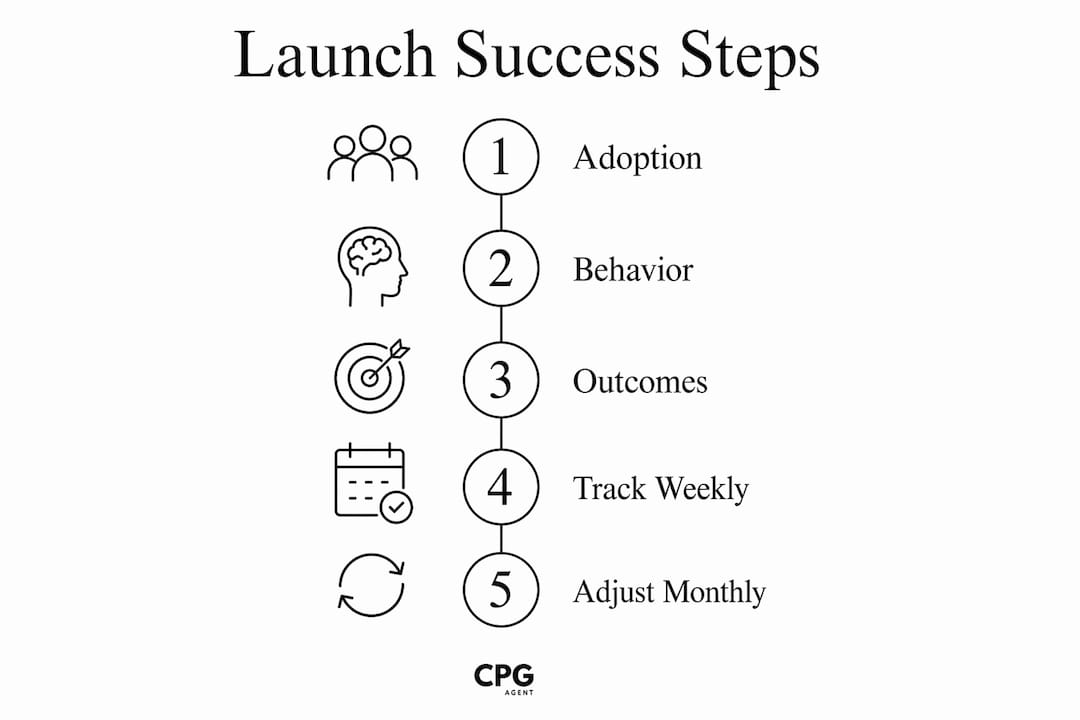
Success must be measured across adoption, behavior, and outcomes, not just revenue. This three-part framework is the industry standard for CPG performance evaluation, and it separates brands that scale from brands that stall.

Adoption metrics capture whether new consumers are finding and trying your product. Trial rate and household penetration are the two numbers that matter most here. A product with strong distribution but weak trial rate has a messaging or placement problem, not a product problem.
Behavior metrics reveal what consumers do after that first purchase. Repeat purchase rate, purchase frequency, and basket attachment all fall into this category. High trial with low repeat is the most common failure pattern in CPG launches. It signals a product experience gap, not a marketing gap.
Outcome metrics measure the business result of all that activity. Incrementality (did you grow the category or steal from yourself?), retention lift, and cost per acquired household are the numbers your CFO and retail buyers actually care about. ROAS alone is unreliable in physical retail, which is why outcome metrics must be tracked separately from media performance.
| Metric | Dimension | Why It Matters |
|---|---|---|
| Trial rate | Adoption | Shows whether marketing is driving first purchase |
| Household penetration | Adoption | Benchmark against the 1% threshold in year one |
| Repeat purchase rate | Behavior | Predicts long-term retention and loyalty |
| Cost per acquired household | Outcome | Ties marketing spend to real consumer acquisition |
| Incrementality | Outcome | Confirms category growth vs. cannibalization |
| Velocity per distribution point | Outcome | Signals shelf productivity to retail buyers |
Pro Tip: Track leading indicators (trial, redemption rate) weekly and lagging indicators (repeat rate, retention) monthly. Mixing the two on the same reporting cadence creates false confidence or false panic.
Which tools enable real-time validation of a CPG launch?
Three methodologies produce the most reliable, real-time data for measuring product launch success: digital rebate programs, controlled pilot testing, and household-level purchase tracking.
Digital rebate programs are the fastest way to confirm actual purchases at launch. Every rebate redemption represents a confirmed purchase, with SKU, retailer, and timing all verified. One brand ran a real-time pilot using digital rebates and engaged 2,100 consumers in under 36 hours, confirming 712 purchases with 93% of buyers identified as new-to-brand. That kind of data is impossible to get from syndicated sales reports two weeks after the fact.
Pilot testing in controlled geographies lets you stress-test your launch model before committing national distribution dollars. The key is treating the pilot as a conversion funnel, not a sales event. You want to know whether your messaging, price point, and shelf placement work together before you scale.
Household-level purchase signal tracking through retail data partners gives you penetration and repeat data at a granular level. Retailers value verified purchase velocity data over aggregate post-launch sales reports. That preference shapes how you should present your launch performance to buyers.
| Tool | Data type | Best for | Limitation |
|---|---|---|---|
| Digital rebate programs | Verified purchase, buyer profile | New-to-brand acquisition, velocity | Requires consumer opt-in |
| Controlled pilot testing | Conversion, velocity, store-level | Pre-scale validation | Limited geographic signal |
| Household panel tracking | Penetration, repeat rate | Long-term behavior trends | Slower data cycle |
| In-store intercepts | Qualitative, intent | Messaging and placement feedback | Not scalable |
Pro Tip: Match your tool to your launch scale. A regional pilot with 50 stores needs digital rebates and store-level velocity data. A national launch needs household panel tracking and syndicated data layered together.
For a broader view of go-to-market validation tools available to CPG brands, the options have expanded significantly in 2026.
How to set quantitative targets before your CPG launch
Defining quantitative success windows before launch is the single most important discipline in CPG performance evaluation. Without preset targets, teams rationalize results after the fact. A 2% trial rate feels like a win if you never wrote down that you needed 4%.
The standard framework uses 30, 60, and 90-day windows, each tied to a specific dimension of success.
- 30-day target: Activation and trial. Set a minimum trial rate and a redemption rate for any promotional offers. This window tells you whether your launch mechanics are working.
- 60-day target: Repeat behavior. Set a minimum repeat purchase rate and a velocity per distribution point. This window tells you whether the product experience is delivering.
- 90-day target: Retention and incrementality. Set a household penetration target and a cost per acquired household ceiling. This window tells you whether the launch is commercially viable.
Additional best practices for target-setting:
- Write targets down before launch and share them with your retail, marketing, and finance teams.
- Tie each target to a decision rule. If trial rate falls below X by day 30, you adjust messaging or promotion. If repeat rate falls below Y by day 60, you investigate the product experience.
- Align targets with commercial and operational plans so that finance and supply chain teams are not surprised by pivot decisions.
- Avoid setting targets in isolation. Penetration without a repeat rate target is incomplete. Both numbers together tell the real story.
How to execute a CPG launch validation plan step by step
Execution is where most validation plans break down. The framework is sound, but the data collection falls apart in the field. Here is a process that works.
-
Define your pilot scope. Choose 2–3 retail accounts and a geography small enough to control but large enough to generate statistically meaningful data. A single city or region with 30–75 stores is a workable starting point for most emerging CPG brands.
-
Deploy digital rebate offers at launch. Set up rebate offers tied to specific SKUs and retailers before your product hits the shelf. This creates a data capture mechanism from day one. Retail teams get instant velocity and new-buyer acquisition data without waiting for syndicated reports.
-
Monitor early velocity weekly. Pull store-level velocity data every week for the first 30 days. Flag stores that are underperforming against your target. Underperformance at the store level is usually a placement or execution issue, not a product issue.
-
Analyze new-to-brand acquisition rates. Your rebate data will show you what percentage of buyers are new to your brand. A high new-to-brand rate (above 80%) confirms you are growing your consumer base, not just rewarding existing buyers.
-
Assess repeat purchase signals at day 45. By day 45, you should have enough data to see whether early buyers are coming back. If repeat rate is below your preset target, investigate whether the issue is product, price, or availability.
-
Make a go or adjust decision at day 60. Treat initial market entry as a controlled testing ground with clear conversion metrics that trigger rollout decisions. At day 60, you either expand distribution, adjust your launch model, or pause and regroup.
-
Document every decision and its data trigger. This creates an institutional record that improves your next launch. Most CPG teams repeat the same validation mistakes because they never wrote down what the data said the first time.
How to handle conflicting or slow-moving validation data
Conflicting data is normal. High trial with low repeat is the most common conflict, and it almost always points to a product experience gap rather than a marketing failure. Before you cut your media budget, check whether the product is delivering on the promise your marketing made.
Slow-moving data is a different problem. Household panel data from providers like NielsenIQ or Circana typically lags by two to four weeks. If you are relying solely on syndicated data for early validation, you are making decisions with a rearview mirror. Digital rebate data and store-level velocity reports solve this problem because they are available in near real time.
Common data issues and how to handle them:
- Low trial despite strong awareness: Check price point, shelf placement, and packaging clarity. Consumers are seeing the product but not picking it up.
- High trial, low repeat: Investigate the product experience. Survey early buyers. The product is not delivering on the promise.
- Strong velocity in some stores, weak in others: Look at store-level execution. Facing, shelf height, and adjacency vary by store and directly affect velocity.
- Conflicting signals between rebate data and syndicated data: Trust the rebate data for buyer-level insights and the syndicated data for category-level trends. They measure different things.
Early, multi-dimensional data guides launch investment decisions and prevents costly assumptions from hardening into strategy. When data conflicts, the answer is almost always to collect more data at a more granular level, not to pick the number that supports your hypothesis.
Key Takeaways
Validating CPG launch success dimensions requires measuring adoption, behavior, and outcomes across defined time windows before and during launch, using real-time purchase data to make decisions with confidence.
| Point | Details |
|---|---|
| Use three dimensions | Measure adoption, behavior, and outcomes together. Revenue alone misses the signals that predict long-term viability. |
| Set targets before launch | Define 30, 60, and 90-day benchmarks upfront to avoid rationalizing results after the fact. |
| Use digital rebates for real-time data | Rebate programs confirm purchases from day one, giving you SKU-level, buyer-level, and store-level data immediately. |
| Treat pilots as conversion funnels | A pilot is not a sales event. It is a structured test with decision rules tied to specific metrics. |
| Separate leading from lagging indicators | Track trial and redemption weekly. Track repeat rate and penetration monthly. Mixing them distorts your read on launch health. |
What I have learned from validating CPG launches the hard way
The most expensive mistake I see CPG teams make is waiting for syndicated data before acting. By the time NielsenIQ or Circana reports confirm what you suspected, you have already lost shelf space or burned through your launch budget on a mechanic that was not working.
The brands that validate well share a mindset shift: they treat launch as a hypothesis test, not a rollout. Every decision, from the pilot geography to the promotional offer, is designed to generate a specific data signal. That discipline forces you to define what you are trying to learn before you spend a dollar.
Cross-functional alignment matters more than most product managers expect. When finance, sales, and marketing are not looking at the same metrics with the same decision rules, you get paralysis at exactly the moment you need speed. I have watched brands miss a 30-day pivot window because the sales team was tracking velocity and the marketing team was tracking impressions, and nobody had agreed on which number triggered a decision.
Building a defensible innovation slate means scoring concepts on weighted dimensions with consumer evidence and business feasibility. That same logic applies to validation. You are not just measuring whether the launch worked. You are building evidence that tells you why it worked or why it did not, so your next launch starts smarter.
The iterative mindset is the real competitive advantage. Brands that validate fast, learn fast, and adjust fast consistently outperform brands that launch big and hope.
— Matthew
How Cpgagent helps you validate your CPG launch in real time
Cpgagent's platform is built for exactly this kind of evidence-based launch management. The Launch Validator tool structures your pilot design, tracks adoption and behavior metrics against your preset targets, and surfaces retailer-ready reporting without manual data wrangling.
If you are preparing a new product launch or running a pilot right now, Cpgagent gives you the data infrastructure to validate your launch without the overhead of a traditional agency. The platform connects purchase validation, rebate management, and performance reporting in one place, so your team spends time making decisions, not chasing spreadsheets. You can also validate on a tight budget using Cpgagent's guided pilot frameworks designed for emerging brands.
FAQ
What does it mean to validate CPG launch success dimensions?
Validating CPG launch success dimensions means measuring a new product's performance across adoption, consumer behavior, and business outcomes using real-time data and preset quantitative targets. It goes beyond revenue to include trial rate, repeat purchase rate, household penetration, and incrementality.
What is the most important metric for a new CPG launch?
Repeat purchase rate is the strongest predictor of long-term launch viability. High trial with low repeat signals a product experience problem that no amount of media spend will fix.
How quickly should CPG brands expect to see meaningful launch data?
Digital rebate programs generate verified purchase data within the first 24–48 hours of launch. Household penetration and repeat rate data typically require 45–60 days to become statistically reliable.
What is a realistic household penetration target for a new CPG product?
Reaching 1% household penetration in the first year is the benchmark most new FMCG launches fail to hit, according to NielsenIQ. Setting that as a minimum 90-day target gives your team a concrete, defensible goal.
Why is ROAS an unreliable metric for CPG launch validation?
ROAS measures media efficiency, not consumer acquisition or retention. In physical retail, a strong ROAS can coexist with weak velocity and poor repeat rates, which means the launch is not actually building a consumer base.