

TL;DR:
- Modern CPG growth frameworks focus on consumer insight, AI-driven cost reductions, and retailer collaboration to drive volume growth in a stagnant market. Successful strategies involve continuous data integration, behavioral market segmentation, and agile operating rhythms to stay responsive and competitive. Implementing these frameworks requires operational discipline, cross-functional alignment, and leveraging AI tools for demand management and spend optimization.
CPG growth frameworks are structured, data-driven strategic models that help consumer packaged goods companies identify, prioritize, and execute sustainable growth opportunities. The industry now calls this discipline Revenue Growth Management, or RGM, though the broader term covers everything from consumer insight methodology to retailer collaboration. Global CPG volume growth was less than 1% in 2024, according to NielsenIQ. That stagnation makes the old playbook of price-led expansion obsolete. Modern frameworks from NielsenIQ, BCG, McKinsey, Deloitte, and PwC now center on AI-enabled productivity, penetration-led volume growth, and consumer-first decision-making as the pillars of competitive advantage.
What core components do effective CPG growth frameworks include?
Effective consumer goods growth strategies share six foundational components. Brands that skip any one of them tend to hit a ceiling faster than they expect.
- Consumer insight methodology. Jobs-To-Be-Done and Category Entry Points identify why shoppers buy, not just what they buy. This distinction drives product positioning that actually converts.
- Integrated sales and market data. Diagnostic rigor requires combining point-of-sale data, panel data, and shopper analytics into a single view. Fragmented data produces fragmented decisions.
- Advanced analytics and AI. AI-driven spend assessment can eliminate 5%–20% of a brand's cost base while improving speed to market, per BCG. That cost recovery funds growth investments without requiring new capital.
- Collaborative retailer models. Joint business planning, shared data access, and early-stage innovation collaboration replace transactional vendor relationships with genuine partnerships.
- Cross-functional alignment. Finance, marketing, supply chain, and sales must operate from the same growth hypothesis. Siloed teams produce conflicting priorities and wasted spend.
- Agile operating rhythms. Weekly sales reviews, monthly margin checks, and quarterly strategy resets keep execution connected to market reality.
Pro Tip: Full organizational integration is not a nice-to-have. Brands that embed growth frameworks only inside the commercial team consistently underperform those that align finance and operations to the same model.
The most overlooked component is the agile operating rhythm. Most brands build a strategy document and revisit it annually. The brands gaining share in 2026 treat their framework as a living system, not a static plan.

How do modern CPG growth frameworks respond to today's market challenges?
The market has shifted in three concrete ways, and each shift demands a specific framework adaptation.
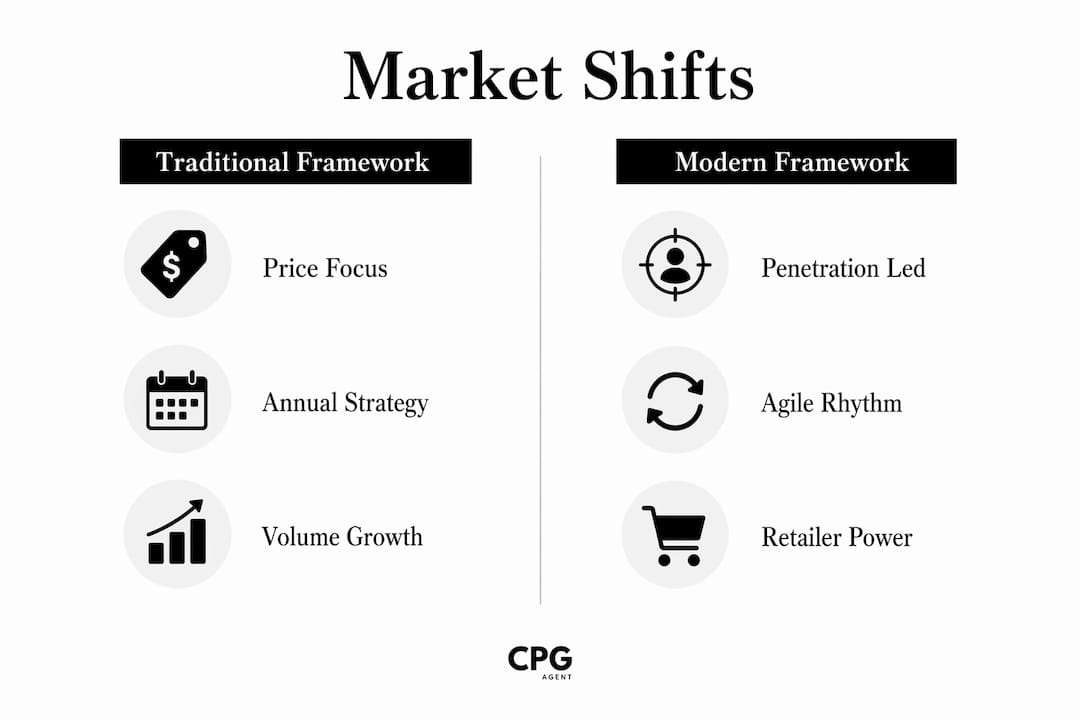
Volume growth is structural, not cyclical. Penetration-led volume growth is now the primary lever because price increases have exhausted consumer tolerance. Winning more buyers at current price points beats squeezing more margin from existing ones.
Retailer power is accelerating. 79% of CPG executives expect retailer power to increase, according to Deloitte's 2026 Global Consumer Products Industry Outlook. That shift means brands can no longer negotiate from a position of brand pull alone. Joint operating models and early innovation collaboration become the price of shelf access.
Consumer needs are fragmenting faster than category structures. Consumer-first decision-making reverses the traditional finance-first approach, as Nestlé India has demonstrated publicly. Starting with consumer needs and building the business case backward produces more durable growth than starting with margin targets.
| Dimension | Traditional Framework | Modern Framework |
|---|---|---|
| Growth driver | Price and promotion | Penetration and occasion expansion |
| Retailer relationship | Transactional vendor | Joint operating partner |
| Consumer insight | Annual research cycles | Continuous, AI-assisted listening |
| Market segmentation | Geographic regions | Behavioral archetypes |
| Cost management | Periodic cost reduction | AI-funded continuous reinvestment |
| Decision authority | Finance-first | Consumer-first |
Pro Tip: Segment your markets by behavioral archetypes before you build your RGM model. PwC research shows that tailored archetype-based models consistently outperform one-size-fits-all geographic strategies.
The comparison above is not academic. Brands still operating on the left column of that table are competing with a slower engine against brands running the right column. The gap widens every quarter.
What are the leading CPG growth frameworks to implement?
Several proven frameworks now define best practices for CPG growth. Each addresses a different layer of the growth problem.
- NIQ Growth Pathways. NielsenIQ's integrated framework connects market realities, consumer insight, and growth levers into a single diagnostic model. It identifies where volume is available and which levers unlock it fastest.
- McKinsey's Dual Agenda. McKinsey outlines two simultaneous agendas for CPG leaders: Agenda 1 reshapes the portfolio toward high-growth categories, and Agenda 2 optimizes full-organization performance using AI-driven productivity. The productivity gains from Agenda 2 fund the portfolio investments in Agenda 1.
- BCG's AI-Powered Cost Reduction. BCG's framework uses AI to identify cost elimination opportunities across functions, then redirects those savings into growth investments. The 5%–20% cost base reduction is the fuel, not the destination.
- Revenue Growth Management (RGM) by Archetype. Rather than applying a single RGM model globally, this approach segments markets by consumer behavior patterns and tailors pricing, promotion, and pack architecture to each archetype. PwC identifies this as the replacement for generic global strategies.
- Consumer-First Growth Model. Pioneered publicly by Nestlé India, this model starts every business decision with a consumer need and builds the financial case backward. It directly challenges the orthodoxy of margin-first planning.
- Retail-Ready Margin Structure. Target Accelerators outlines a financial framework where brands plan for 30%–40% retailer margin and 15%–25% trade investment from the start. Building these numbers into unit economics early prevents the discount spiral that kills emerging brands.
Pro Tip: Balance cost efficiency improvements with portfolio innovation investments. Brands that use AI savings purely for margin expansion without reinvesting in product development lose category relevance within two to three years.
The McKinsey dual agenda is the most complete of these models because it addresses both the portfolio question and the operational question simultaneously. Most brands pick one or the other. The leaders run both in parallel.
How do you apply CPG growth frameworks to accelerate revenue?
Activating a consumer product growth model requires operational discipline, not just strategic clarity. Here is a practical sequence that works for both startups and established brands.
- Stress-test your internal hypotheses. Compare your brand's assumed growth drivers against integrated sales data and consumer panel data. Most teams discover that their top assumed growth lever is not the actual driver of volume.
- Build consumer-centric targeting. Use Jobs-To-Be-Done to map the occasions and needs your product serves. Then build your product, pack, and channel strategy around those occasions rather than around your existing SKU lineup.
- Establish retailer partnerships with data. Successful retail expansion relies on data analysts who demonstrate incremental category growth, not sales pitches. Hire or contract a data analyst before your first major retail negotiation. The conversation changes completely when you show a buyer how your brand grows their category.
- Build retail-ready margin structures early. Plan for 30%–40% retailer margin and 15%–25% trade investment from day one, per Target Accelerators. Brands that model these numbers into their unit economics before launch avoid the renegotiation trap that forces unsustainable discounting later.
- Deploy AI tools for spend and demand management. Use AI-powered platforms to assess promotional ROI, forecast demand by channel, and identify where trade spend is generating no measurable return. BCG's research confirms that this approach eliminates significant cost while accelerating market response.
- Implement repeatable operating rhythms. Run weekly sales reviews against your growth hypothesis. Conduct monthly margin checks against your retail-ready structure. Align your innovation pipeline to retail reset calendars so new products land when buyers are actively making shelf decisions.
Pro Tip: Invest in financial clarity before you scale distribution. Brands that expand retail presence without a validated margin structure often grow revenue while shrinking cash. Read more on budget-efficient CPG growth to understand how to sequence spend correctly.
For brands expanding into new retail channels, the data-backed entry proposition is the single highest-leverage step. Buyers at major retailers see hundreds of pitches. The ones that advance are built around category growth data, not brand story alone. A practical guide on expanding into new retailers covers the entry proposition structure in detail.
Key takeaways
Effective CPG growth frameworks combine consumer-first insight, AI-enabled cost reduction, and retailer collaboration to drive penetration-led volume growth in a market where price-led expansion no longer works.
| Point | Details |
|---|---|
| Consumer-first beats finance-first | Start every growth decision with a consumer need, then build the financial case backward. |
| AI funds growth investment | Use AI-driven cost reduction to eliminate 5%–20% of your cost base and redirect savings into portfolio development. |
| Retailer power demands data | Bring category growth data to retail negotiations; sales pitches alone no longer secure shelf space. |
| Margin structure must come first | Plan for 30%–40% retailer margin and 15%–25% trade investment before scaling distribution. |
| Archetypes replace geography | Segment markets by behavioral patterns, not regions, to build RGM models that actually fit each market. |
Why most CPG brands are running the wrong framework
I have worked with brands across both ends of the spectrum: startups with a single SKU trying to crack their first regional retailer, and established players managing portfolios across dozens of markets. The pattern that kills growth is almost always the same. The team builds a framework around what they can measure easily, which is usually financial metrics, and then reverse-engineers a consumer story to justify it.
The finance-first trap is seductive because it feels rigorous. Margin targets, trade spend caps, and volume forecasts are concrete. Consumer needs feel soft by comparison. But the brands I have watched sustain growth through market disruptions are the ones that genuinely start with the consumer and let the financials follow. Nestlé India's public commitment to this model is notable precisely because it runs against the instincts of most large CPG organizations.
The other mistake I see constantly is treating retailer relationships as a sales problem rather than a data problem. The brands that win shelf space in 2026 are not the ones with the best pitch decks. They are the ones who walk into a buyer meeting with a clear story about how their brand grows the category for that specific retailer. That requires a data analyst, not a better sales script.
On AI: the opportunity is real, but most brands are using it for the wrong thing. They apply AI to marketing copy and social content, which is fine, but the bigger return is in spend assessment and demand forecasting. The BCG finding that AI can eliminate 5%–20% of the cost base is not theoretical. I have seen it play out in trade spend analysis alone, where brands discover that 30%–40% of their promotional budget is generating no measurable volume lift.
The brands that will define the next five years of CPG are the ones building frameworks that are genuinely integrated: consumer insight driving portfolio decisions, AI funding the investment, and retailer collaboration creating the distribution engine. The pieces exist. The discipline to connect them is what separates the leaders.
— Matthew
Activate your growth framework with Cpgagent
Knowing the right framework is step one. Executing it at speed is where most brands stall.
Cpgagent's AI-driven platform gives CPG and FMCG brands the tools to move from strategy to execution without the overhead of a traditional agency. The platform integrates data analytics, spend assessment, and market insight tools that directly support the frameworks covered in this article. Whether you are a startup building your first retail entry proposition or an established brand modernizing your RGM model, Cpgagent deploys the infrastructure to run repeatable growth rhythms at scale. Tools like PersonaForge and Launch Validator accelerate the consumer insight and product validation steps that most brands spend months on. Visit Cpgagent to see how the platform fits your current growth stage.
FAQ
What is a CPG growth framework?
A CPG growth framework is a structured, data-driven model that helps consumer packaged goods brands identify growth levers, prioritize investments, and execute market expansion systematically. Leading examples include NielsenIQ's Growth Pathways, McKinsey's Dual Agenda, and BCG's AI-powered cost and growth model.
Why is penetration-led growth replacing price-led growth?
Global CPG volume growth was less than 1% in 2024, meaning price increases have largely exhausted consumer tolerance. Winning new buyers at current price points now delivers more sustainable volume than extracting additional margin from existing customers.
How important is retailer collaboration in modern CPG strategy?
Deloitte reports that 79% of CPG executives expect retailer power to increase. That shift makes joint operating models and shared data planning a requirement for securing and maintaining shelf space, not a competitive advantage.
What margin structure should CPG startups plan for in retail?
Target Accelerators recommends planning for 30%–40% retailer margin and 15%–25% trade investment from the start. Building these numbers into unit economics before launch prevents the discount cycles that erode brand profitability during scaling.
How does AI fit into a CPG growth framework?
AI enables cost base reductions of 5%–20% across functions, per BCG analysis. Those savings fund portfolio reshaping and market expansion investments, making AI a growth enabler rather than just an efficiency tool.