

A working retail media strategy treats every network as one channel in a full-funnel system, not a shelf for last-minute coupon spend, and it runs on measurement standards that hold up across retailers. Start with two moves this week: audit every dollar currently live across your retail media networks, and standardize attribution so a click on Amazon means the same thing as a click on Walmart Connect. Retail media has grown into a broad commerce media model built on first-party shopper data, and brands that skip governance usually overpay for sales they'd have gotten anyway.
TL;DR:
- Most brands over-invest in bottom-funnel sponsored product ads without balancing top and mid-funnel awareness and consideration tactics; a full-funnel approach is necessary.
- Standardize attribution windows across networks to enable accurate measurement of ROAS and conduct regular incrementality tests such as geo holdouts and brand lift studies.
- Prioritize retail media networks based on category fit, attribution maturity, scale, minimum spend, and competitive context to maximize return on effort and budget.
- Creative assets must be tailored to format and funnel stage, with on-site assets being actionable and off-site videos designed to land messages visually within the first three seconds.
- Building a measurement-driven, full-funnel retail media strategy requires disciplined governance and SKU-tiering, which can be accelerated with automation tools and expert support like Cpgagent.
Table of Contents
- What Is Retail Media, and How Do Retail Media Networks Fit Together?
- Retail Media Ad Formats and How to Build Creative for Each
- Building a Full-Funnel Retail Media Strategy and Budget Split
- Measurement and Attribution: Building One Standard Across Networks
- How to Prioritize Retail Media Networks and Build Your Stack
- Your 90-Day Retail Media Launch Plan
- How Cpgagent Deploys Retail Media Strategy for CPG Brands
- Connecting Retail Media to Your Broader Marketing and Sales Plan
- Where Retail Media Strategies Usually Break
- What Successful Retail Media Campaigns Have in Common
- A Practitioner's Note on Where Teams Waste the Most Effort
- How Cpgagent Helps You Build and Scale a Retail Media Strategy
- Sources
- FAQ
What Is Retail Media, and How Do Retail Media Networks Fit Together?
Retail media is advertising that runs inside or around a retailer's owned digital properties, powered by that retailer's first-party shopper and purchase data. A retail media network (RMN) is the ad platform a retailer built to sell that inventory, whether it's Amazon Ads, Walmart Connect, Target Roundel, or a grocery chain's in-app placements.
Picture the ecosystem in three rings. The innermost ring is retailer-owned inventory: search results, product pages, and app placements where a shopper is already hunting for something to buy. The middle ring is off-site activation, where a retailer's DSP lets you serve ads on the open web, streaming apps, or social feeds using its shopper data instead of yours. The outer ring is in-store digital: shelf screens, radio, and connected coolers that reach people mid-aisle.
This is why "retail media" and "commerce media" increasingly get used interchangeably. Retail media networks have expanded past on-site monetization into a data-driven advertising model that follows the shopper wherever they go.
Common placement types you'll encounter across networks include:
- Sponsored product listings in search and category pages.
- On-site display on homepages, category tabs, and product detail pages.
- Off-site display and DSP campaigns delivered through the retailer's data on outside media.
- Video and connected TV (CTV) slots, often sold through the same off-site DSP.
- In-store digital screens and audio tied to loyalty or app data.
Retail Media Ad Formats and How to Build Creative for Each
Every format asks the shopper to do something different, and using one static creative asset across all of them wastes money. Sponsored products and sponsored brands are the closest thing to search advertising: they need a strong product image, a competitive price, and a headline that answers "why this one." On-site display works the same way, since the person is already inside the shopping mindset. Off-site display and DSP placements, along with video and CTV, reach someone before they've opened a shopping app at all, so the job shifts to storytelling and brand recall rather than an immediate add-to-cart.
That distinction isn't optional creative polish. Retailers and platforms are explicit that creative needs to match proximity to purchase: on-site assets should be actionable, with price, promotion, and a clear call to action front and center, while off-site and CTV assets should build a story and use frequency sequencing so a shopper sees an awareness message before a conversion-focused one.
Before you brief your creative team, prepare assets against this checklist:
- Sponsored product/brand images: square and portrait crops, price and promo callouts, one clear CTA.
- On-site display banners: standard IAB sizes for the retailer's ad manager, with promo pricing baked into the design.
- Off-site display: brand-forward creative with minimal text, built for programmatic delivery across sizes.
- Video/CTV: 15 and 30-second cuts, sound-off legibility, a soft CTA rather than a hard sell.
- In-store digital: short-loop assets legible from a few feet away, no fine print.
Pro Tip: Build your off-site video with the sound off in mind. Most CTV inventory plays in living rooms where the volume is already on something else, so your message needs to land visually in the first three seconds.
Building a Full-Funnel Retail Media Strategy and Budget Split
The single biggest budget mistake in retail media is pouring everything into bottom-funnel sponsored products because that's where attribution is easiest to see. It feels efficient. It's also why so many brands hit a spend ceiling: you're paying to win shoppers who were already going to buy your product, and once brand-loyal demand is saturated, more spend just bids against yourself.
A full-funnel structure fixes this. Top-of-funnel activity (off-site display, CTV, sponsored brand video) builds awareness and consideration among shoppers who haven't searched for you yet. Mid-funnel (on-site display, category takeovers) keeps your brand visible while a shopper compares options. Bottom-funnel (sponsored products, keyword bidding) converts intent that already exists. A mature approach distributes budget deliberately across all three instead of defaulting to whichever layer is easiest to measure.
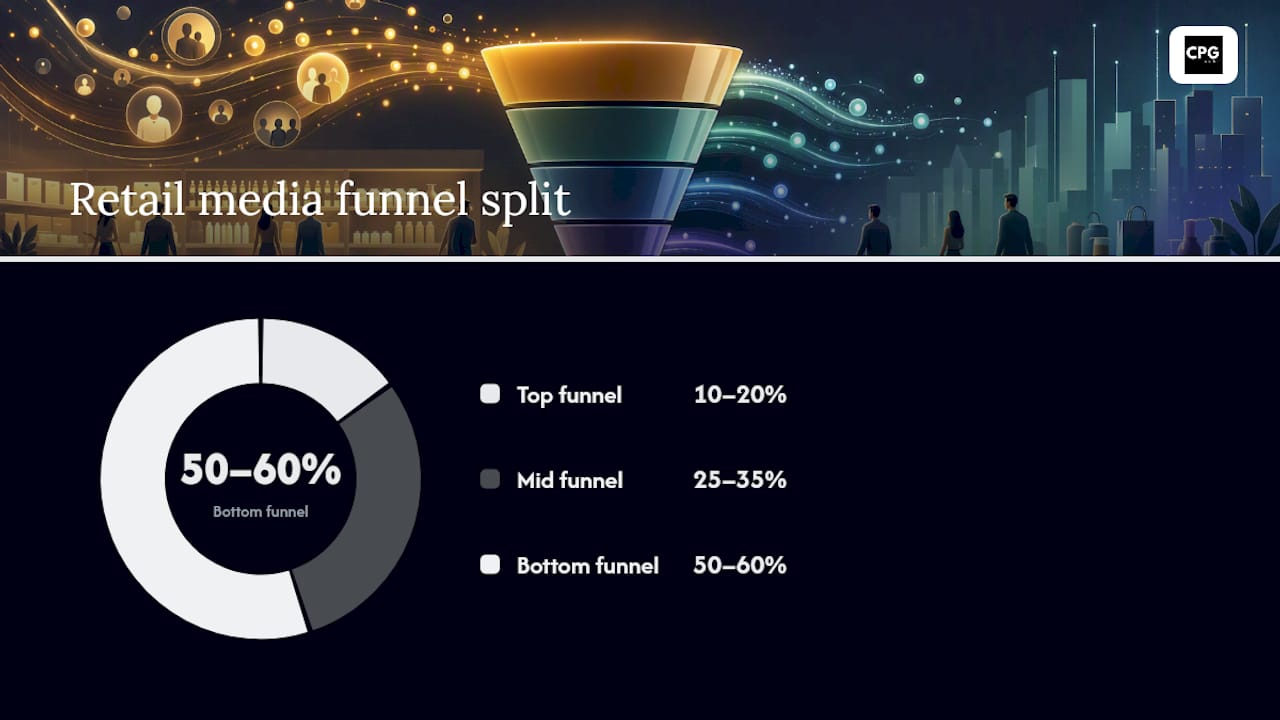
As a starting range, many brand teams allocate roughly 50 to 60 percent to bottom-funnel conversion tactics, 25 to 35 percent to mid-funnel consideration, and 10 to 20 percent to top-funnel awareness, then adjust based on category maturity and margin. A brand with high awareness but flat repeat purchase should shift weight toward mid-funnel; a new-to-market brand needs more top-funnel spend even though it will look "inefficient" on early ROAS reports.
Pair that funnel split with SKU tiering:
- Hero SKUs: your highest-margin, highest-velocity items get the most aggressive bids and steady budget.
- Growth SKUs: newer or expanding items get test budgets and looser bid caps to build data.
- Long-tail SKUs: low-velocity items get capped, defensive bids that only protect against competitor takeover on your own product pages.
Retail media ad spend in the US continues to climb as more categories adopt dedicated retail media networks, which means the brands still treating it as a bottom-funnel afterthought are competing against rivals who've already moved to full-funnel budgeting.
Measurement and Attribution: Building One Standard Across Networks
Every retail media network grades its own homework, and that's the core measurement problem. Amazon's default attribution window differs from Walmart Connect's, which differs from a grocery RMN's, so a "500% ROAS" claim from one network isn't comparable to another network's number unless you force them onto the same clock.
Standardize on one attribution window across every network you run, even if it means overriding a platform's default dashboard. A common practitioner baseline is a 7-day click and 0-day view window, applied uniformly, so a sale is only credited to the ad that most plausibly caused it rather than any ad the shopper glanced at over the past month. Pair that with a unified TACOS (total advertising cost of sales) metric calculated against your actual revenue, not platform-reported revenue, so you catch cannibalization between paid and organic sales.
Then go beyond correlation. Retail media measurement maturity depends on running real incrementality tests instead of trusting native attribution alone:
- Geo holdouts: pause retail media in select markets or DMAs and compare sales lift against active markets.
- Matched market tests: pair similar-performing markets, run spend in one, hold the other flat.
- Brand lift studies: measure awareness and purchase intent shifts from top-funnel exposure, not just clicks.
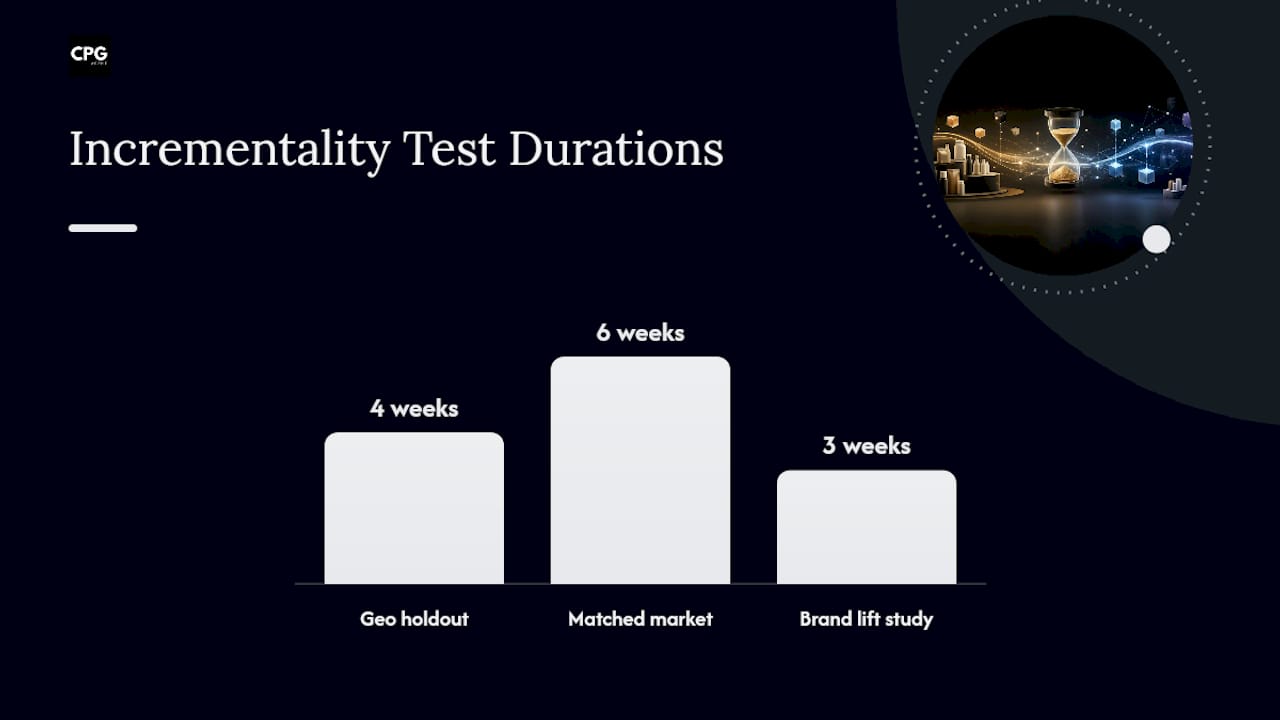
| Test type | Best used for | Typical duration |
|---|---|---|
| Geo holdout | Bottom-funnel sponsored product spend | 4 weeks |
| Matched market | Mid-funnel display and category campaigns | 6 weeks |
| Brand lift study | Top-funnel video and CTV | 3 weeks |
Marketers consistently name measurement and cost as top retail media challenges, and a standardized window paired with regular incrementality testing is the most direct way to close that gap. A unified measurement framework that spans retail media and your other performance channels makes these numbers usable in the same board deck.
How to Prioritize Retail Media Networks and Build Your Stack
Not every RMN deserves your team's attention, and spreading thin across a dozen platforms is a common way to drown in reporting without moving sales. Score each network on five criteria before committing budget:
- Category fit: does this retailer's shopper base actually buy your category at meaningful volume?
- Attribution maturity: does the network offer clear, exportable reporting or only a walled-garden dashboard?
- Minimum spend: can you meet the network's minimum without starving a higher-fit network?
- Scale: does the retailer's audience size justify a dedicated team's time?
- Competitive intensity: are your direct competitors already bidding aggressively here, inflating cost per click?
Networks that score well on category fit and scale but have immature attribution are still worth testing, just with tighter budget caps and manual reporting until their measurement catches up. For lower-priority networks with real audience overlap, a retailer's own DSP or a cross-network aggregation layer often makes more sense than building a native team for each one.
Four roles matter most in your stack: identity resolution to match shopper data across networks, a data clean room or data-sharing agreement so you can measure without exposing raw customer data, bidding automation that respects inventory levels so you're not paying to promote out-of-stock SKUs, and unified reporting that rolls every network into the same attribution standard. Getting the network mix right also means understanding which retailers fit your category before you commit media budget to shelf space you haven't earned yet.
Your 90-Day Retail Media Launch Plan
Before any campaign goes live, run a pre-launch audit: confirm product content and images meet each retailer's spec, check inventory rules so ads pause automatically on out-of-stock SKUs, and build a negative keyword list so you're not paying for irrelevant search terms on day one.
From there, a 90-day cadence keeps testing disciplined instead of reactive:
- Days 1 to 30: launch bottom-funnel sponsored campaigns at conservative bids to establish a clean baseline, and start one mid-funnel display test in parallel.
- Days 31 to 60: run your first creative test (two on-site variants, one off-site variant) and launch a geo holdout on your highest-spend network.
- Days 61 to 90: scale winning creative and SKU-tier bids based on the holdout results, and add a second network only after the first hits stable, standardized reporting.
Governance prevents this from sliding into chaos. One owner should hold the retail media budget across networks, weekly check-ins should track spend pacing against the funnel allocation, and you need a clear escalation rule, such as pausing any campaign that exceeds its margin-adjusted target ROAS for two consecutive weeks.
Pro Tip: Set your escalation threshold before launch, not after you see a bad week of data. Deciding "we pause at X" in the heat of a spend spike almost always gets rationalized away.
How Cpgagent Deploys Retail Media Strategy for CPG Brands
Cpgagent builds retail media plans on top of real shopper persona work instead of generic category benchmarks, so your funnel allocation reflects who actually buys your product rather than an industry average. Persona research feeds directly into which formats get creative priority, and launch validation data flags which SKUs deserve hero-tier bidding before you overspend testing a slow mover.
That data flows into media planning automations that map budget across bottom, mid, and top funnel activity, so you're not manually rebuilding spreadsheets every time a network changes its dashboard. Where a team lacks the internal bandwidth to run this daily, Cpgagent's fractional CMO support steps in to close the execution gap without a full agency retainer.
Teams building this out step by step can lean on:
- The Cpgagent platform for persona-driven media planning and automated playbooks.
- Guidance on media planning for FMCG brands for budget-mix examples beyond retail media alone.
- A full-funnel marketing framework for aligning retail media with your broader channel mix.
Connecting Retail Media to Your Broader Marketing and Sales Plan
Retail media performs worse when it's treated as its own silo, separate from brand marketing, trade spend, and sales forecasting. A shopper who sees your CTV ad on a streaming platform, then your on-site display on a retailer's app, then converts through a sponsored product listing isn't experiencing three campaigns. They're experiencing one journey, and your budget should be planned that way.
That means your retail media calendar needs to sit inside the same planning cycle as your broader media plan, not get finalized separately. If your brand marketing team is launching a national campaign in a given quarter, your retail media top-funnel spend should ramp alongside it, not lag a month behind because a different team owns the budget. The same applies to trade promotions: a price drop negotiated with a retailer's category buyer is far more effective when your sponsored product bids increase in the same window, since paid visibility amplifies a promo that would otherwise get buried in search results.
Sales teams also need a seat at this table, because retail media data is often the earliest signal of a SKU's real market performance. A sudden lift in add-to-cart rate on a specific retailer's app can inform inventory planning weeks before that lift shows up in shipment data. Mapping this connection point across departments is easier when everyone is working from the same view of the shopper journey, from first exposure to repeat purchase.
Retail media works best as one input to a shared forecast, not a budget line that only your digital team ever looks at.
Where Retail Media Strategies Usually Break
Most retail media programs don't fail because of bad creative or a weak product. They fail because of process gaps that compound quietly over months.
The most common one is over-reliance on bottom-funnel harvesting, discussed earlier in the funnel section, but it's worth naming as a pitfall in its own right: teams keep pouring budget into sponsored products because the ROAS number looks great, without realizing that number reflects demand they already had. The fix is the full-funnel allocation covered above, revisited quarterly rather than set once and forgotten.
A second pitfall is inconsistent attribution across networks, which makes it impossible to know where the next incremental dollar should go. Teams that skip standardization end up making six-figure budget decisions off numbers that aren't actually comparable.
A third is bidding blind to inventory. Automated bid rules that don't account for stock levels keep spending on SKUs that are out of stock at a given retailer, burning budget on ads that funnel shoppers to a "currently unavailable" page. Inventory-aware bidding, tied directly into your SKU tiers, closes this gap.
A fourth is optimizing for ROAS instead of contribution margin. A campaign can post an excellent ROAS while quietly losing money on a low-margin SKU once trade spend and cost of goods are factored in. Margin-adjusted target ROAS, set per SKU tier rather than as one blanket number, avoids this trap.
The last is running retail media in isolation from trade and brand teams, covered in the previous section. Left unaddressed, that isolation is usually what causes the first four pitfalls to persist quarter after quarter instead of getting fixed.
What Successful Retail Media Campaigns Have in Common
The retail media wins that hold up over multiple quarters, not just one good promo cycle, tend to share a few traits rather than one clever tactic.
Successful campaigns treat off-site and on-site as connected, not separate budgets. A brand running CTV or off-site display to build awareness during a launch window, then layering on-site sponsored placements as that awareness converts to search intent, sees stronger blended performance than either tactic run alone. This mirrors how retail media networks are evolving toward interoperability between owned inventory and off-site environments like streaming and social.
Another common trait: campaigns built around a specific SKU tier objective instead of a vague "grow sales" brief. A hero SKU campaign built to defend market share against a specific competitor performs differently, and gets measured differently, than a growth SKU campaign built to build trial. Blending both objectives into one undifferentiated campaign is a common reason results look mediocre even when spend is reasonable.
The strongest campaigns also treat creative testing as ongoing, not a one-time setup step. Brands that run structured on-site creative tests, even simple two-variant tests on product imagery or headline, consistently find incremental conversion lift that a "set it and forget it" campaign misses. Retailers and platforms alike now flag creative quality, tailored to proximity to purchase, as one of the more controllable levers left in a category where bid costs keep climbing.
A Practitioner's Note on Where Teams Waste the Most Effort
The recurring mistake I see is treating retail media as a bid-management job instead of a measurement job. Teams obsess over adjusting keyword bids by a few cents while running on three different attribution windows across networks, which means they're optimizing numbers that were never comparable in the first place.
If you have limited hours to invest this quarter, put them into measurement governance before you put them into more spend. A standardized attribution window and one incrementality test will tell you more about where your next dollar should go than a week of manual bid tweaking ever will. Once that foundation exists, scaling the SKU tiers and funnel mix in this guide becomes a much faster exercise, and one you can actually trust.
— Matthew
How Cpgagent Helps You Build and Scale a Retail Media Strategy
Building the full-funnel structure, SKU tiers, and measurement discipline in this guide by hand takes months most brand teams don't have. Cpgagent compresses that timeline by pairing AI-driven persona and launch validation tools with media planning automation built specifically for CPG and FMCG brands, so your retail media budget gets structured around real shopper data from week one instead of a generic template.
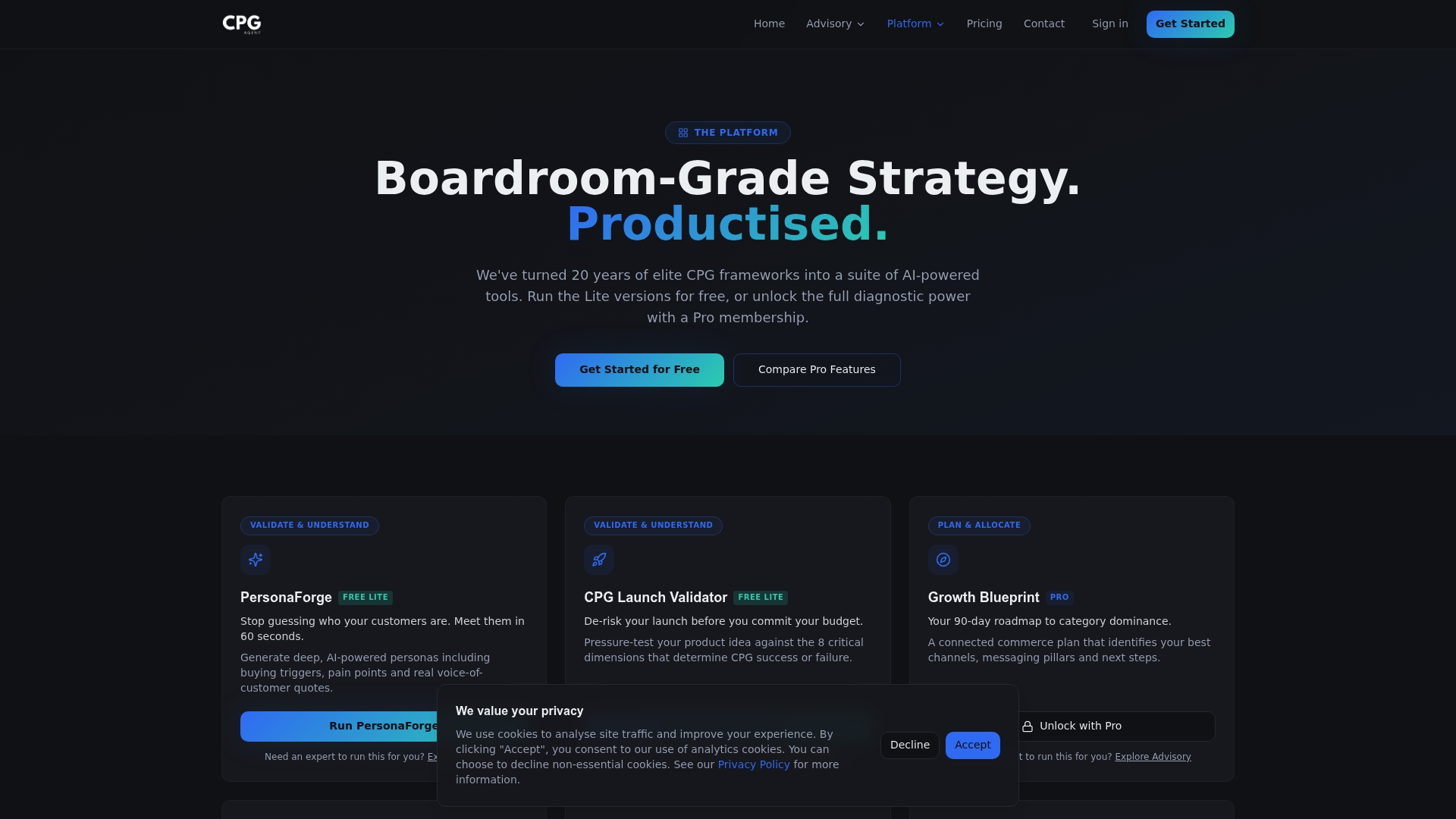
The platform handles the heavy lifting: persona research that informs which formats deserve creative priority, launch validation that flags which SKUs are ready for aggressive bidding, and automated media plans that translate the funnel allocation covered in this guide into a working budget. For teams that need senior direction without a full-time hire, Cpgagent's fractional CMO advisory can close execution gaps fast, without the overhead of a traditional agency retainer.
If your team is ready to move past manual spreadsheets and native dashboards, start with the Cpgagent platform and request a short scoping session to map your first 90-day retail media plan.
Sources
- How to build a retail media strategy on Amazon, Walmart, and beyond in 2026
- How to build a retail media strategy that actually pays off
- The marketers’ 2026 guide to retail media marketing
- The right creative can supercharge retail media campaigns to build brand awareness
- Statista: Retail media networks - USA
FAQ
What Are the 5 P's of Retail, and How Do They Relate to Retail Media?
The 5 P's are product, price, place, promotion, and people, and retail media mainly acts on promotion and place by putting your product in front of shoppers at the exact moment and location they're deciding what to buy.
What Is the 3-3-3 Rule in Marketing?
Definitions vary across marketing disciplines, and there's no single agreed-upon version specific to retail media, so it's best treated as a general marketing heuristic rather than a retail media standard.
What Is an Example of a Retail Media Strategy?
A full-funnel example is a CTV campaign that builds awareness for a new SKU, followed by on-site display retargeting shoppers who saw it, followed by sponsored product bids that capture the resulting search intent, all measured on one standardized attribution window.
What Are Some Examples of Retail Media?
Common examples include sponsored product listings on a retailer's search results, on-site display banners on category pages, off-site display and video delivered through a retailer's DSP, and in-store digital screens near the shelf.
How Do I Know Which Retail Media Networks to Prioritize First?
Score each network on category fit, attribution maturity, minimum spend requirements, audience scale, and competitive intensity, then start with the one or two networks that score highest on fit and scale before expanding further.