

TL;DR:
- Effective FMCG media planning requires integrating purchase behavior data, AI-driven buyer personas, and supply chain coordination to avoid wasted spend and maximize ROI. Relying solely on demographics or ROAS can lead to misaligned campaigns and stockouts that damage retailer confidence and brand trust. Utilizing tools like PersonaForge and stage-weighted budgets enables smarter, data-driven decisions that align media flights with actual product availability and shopper behavior.
FMCG marketers face a brutal reality: you are spending serious budget across fragmented channels, competing for attention in milliseconds, and then watching a stockout or a poorly timed flight date wipe out your ROI. Effective media planning for FMCG is not about spending more. It is about spending smarter, with precise personas, purchase behavior data, and channel sequencing that actually maps to how your shoppers buy. This guide walks you through every step, from building the right data foundation to measuring incremental impact, so your next campaign moves product off the shelf instead of burning budget.
Table of Contents
- Key takeaways
- Media planning for FMCG: building the right foundation
- How to build your FMCG media plan step by step
- Common pitfalls in FMCG media planning
- Measuring FMCG media impact that actually means something
- What I've learned about FMCG media planning the hard way
- How Cpgagent makes FMCG media planning faster and smarter
- FAQ
Key takeaways
| Point | Details |
|---|---|
| Start with buyer personas | AI-powered personas like PersonaForge surface buying triggers and pain points before you commit a dollar to media. |
| Use purchase behavior data | Targeting based on proven shopper history dramatically improves campaign relevance over demographic-only approaches. |
| Sequence your media flights | A phased launch approach tied to confirmed inventory availability prevents wasted spend and retailer friction. |
| Measure what matters | FMCG-specific KPIs like incremental ROAS, stockout rate, and household penetration reveal what standard metrics miss. |
| Synchronize media with supply chain | Media flights that outrun inventory distribution create stranded demand and damage brand credibility. |
Media planning for FMCG: building the right foundation
Before you open a media buying platform or brief a channel partner, you need three things locked in: rich buyer personas, purchase behavior data, and a disciplined budget framework. Most campaigns that underperform skip at least one of these, and you can feel it immediately in your cost-per-acquisition numbers.
Why demographics alone will get you burned
Standard demographic targeting, age, gender, household income, gets you into the right neighborhood but not into the right purchase mindset. Purchase-based audience targeting feeds shopper panel data directly into programmatic platforms, so you reach people who have already bought in your category, from your brand, or from a direct competitor. That is a fundamentally different signal than "adults 25 to 54."
The tool that makes this practical at the persona level is PersonaForge, Cpgagent's free AI persona generator built specifically for CPG and FMCG brands. PersonaForge does not give you a stock description of a "busy mom." It generates detailed buyer profiles that include real voice-of-customer language, pain points, purchase triggers, and the specific moments when a shopper is most persuadable. That output feeds directly into your channel selection and creative briefing.
Setting a budget framework that does not waste money
The most common FMCG budget mistake is flat allocation. Every channel gets a similar slice, regardless of where your buyer actually is in the purchase journey. A stage-weighted approach, concentrating heavier spend during awareness phases for a new SKU and shifting weight toward retail media as distribution confirms, produces meaningfully better marginal ROI. Brands increase budgets selectively, focusing on platforms and regions that demonstrate superior returns rather than spreading investment evenly across every touchpoint.
Pro Tip: Use Cpgagent's Media Budget Allocator to build a stage-weighted media plan before your campaign goes live. It forces you to justify each channel's allocation with a rationale and testing framework, which eliminates the "we've always done it this way" budget inertia that kills FMCG campaign efficiency.
The table below summarizes the core inputs your media plan needs before execution begins.
| Input | Data type | Why it matters |
|---|---|---|
| Buyer personas | AI-generated, behavior-enriched profiles | Informs channel selection and creative tone |
| Purchase behavior data | Shopper panel or loyalty card data | Enables precise, intent-based targeting |
| Budget framework | Stage-weighted allocation model | Prevents flat-spend waste across channels |
| Distribution confirmation | Retailer inventory reports | Synchronizes media flights with in-store availability |
| Competitive context | Share of voice and category spend data | Calibrates your spend levels against market pressure |
How to build your FMCG media plan step by step
With your foundation in place, you can move to actual plan construction. The following steps reflect a structure that holds up across both new SKU launches and ongoing brand media, scaled for either a regional test or a national push.
-
Define your campaign objective precisely. Are you driving trial for a new product, recapturing lapsed buyers, or protecting shelf share against a competitor launch? Your objective determines which FMCG marketing channels you weight heavily and which you treat as supporting reach drivers. A trial objective leans into in-store digital, sampling, and search. A penetration objective leans into broadcast video and social with a strong call to find the product.
-
Map your shopper's purchase journey by channel. Where does your target buyer first become aware of a product like yours? Where do they research, shortlist, and ultimately decide? For most FMCG categories, the decision happens at the shelf or the digital cart, not earlier. Your media plan should reflect that reality with spend concentrated near the moment of purchase, not front-loaded into brand awareness that has no path to conversion.
-
Apply PersonaForge outputs to channel weighting. Once you have AI-generated personas, look at the specific triggers and barriers each persona carries. A persona whose primary trigger is "on-sale discovery" points you toward trade media and digital circular ads. A persona driven by "health claims from a trusted source" points you toward editorial content and influencer partnerships. Channel weighting becomes a logical output of persona behavior, not a gut decision.
-
Build your phased launch sequence aligned with supply chain. A three-phase retail media sequence, pre-launch readiness, confirmed availability plus visibility, and optimization, is the most reliable structure for new FMCG launches. Pre-launch is about seeding awareness with zero promotional spend on channels where the product is not yet available. Availability phase concentrates budget on retail media, paid search, and in-store placements once distribution is confirmed. Optimization phase shifts spend to what is working and cuts what is not.
-
Set your measurement checkpoints before launch. Agree on the specific metrics you will evaluate at 2 weeks, 4 weeks, and 8 weeks. Without pre-set checkpoints, FMCG campaigns drift, spending continues on underperforming channels because no one has scheduled the conversation to cut them.
-
Build in real-time adjustment protocols. Assign someone on your team to monitor weekly velocity data against media spend. If retail velocity is flat but digital engagement is high, you likely have a distribution gap, not a creative problem. That distinction changes your response entirely.
Pro Tip: Coordinate your media plan calendar with your supply chain team at least six weeks before launch. The number of FMCG campaigns that run promotional media against a product that is not yet on shelf is genuinely shocking, and the damage to retailer confidence takes months to repair.
Common pitfalls in FMCG media planning
Even well-funded campaigns with experienced teams walk into predictable traps. Understanding these mistakes before they happen is cheaper than diagnosing them after the fact.
"Launching promotional media before confirmed inventory distribution leads to stranded demand and weak retailer confidence." — Retail Media Playbook for New Food SKU Launches
The disconnect between media flights and supply chain readiness is the single most expensive mistake in FMCG media. You create demand, the shopper arrives at the shelf, the product is not there, and you have effectively paid to train that shopper to buy your competitor instead.
Beyond timing, here are the other mistakes that show up repeatedly across FMCG campaigns:
- Audience targeting without purchase data. Running campaigns against demographic segments only means you are reaching millions of people who have no interest in your category. Purchase-based targeting costs more per impression but delivers far better conversion efficiency.
- Ignoring regional variation. A national media plan that does not account for regional distribution differences will overspend in markets where your product has no meaningful shelf presence. Regional customization is a competitive advantage, not a nice-to-have.
- Over-relying on ROAS without context. A strong ROAS number during a stockout period means your ads drove demand you could not fulfill. That ROAS figure is misleading. Always read performance metrics alongside operational data like fill rate.
- Skipping mid-flight optimization. Advertising planning for FMCG that does not include a structured mid-flight review locks you into inefficiencies for the full campaign duration.
- Misaligned creative and distribution stage. Running a "buy now" message in a market where you have 20% distribution is wasted creative spend. Match your message to your actual availability.
Pro Tip: Build a simple shared dashboard that shows both media spend pacing and retail velocity data side by side. When those two lines diverge, you have a problem worth diagnosing before the next weekly spend cycle.
Measuring FMCG media impact that actually means something
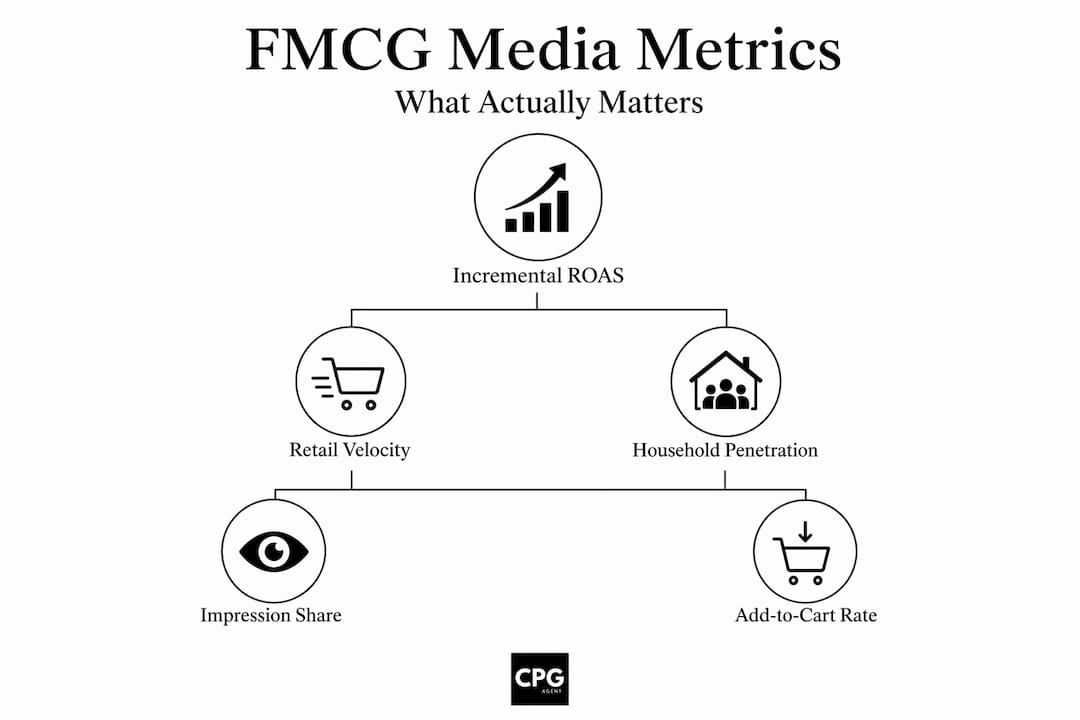
Standard digital metrics, clicks, impressions, CTR, tell you very little about what matters in FMCG: did media actually move product? The measurement framework for FMCG needs to connect digital activity to physical or digital shelf outcomes.

In-store digital retail media has demonstrated this connection clearly. One summer campaign achieved $934,000 in incremental sales, a 2.1x incremental ROAS, and a 7.5% sales lift for core products, with an average 14% sales lift and 4.7x ROAS across CPG campaigns. That level of lift comes from in-store media reaching shoppers during decision moments, with unaided brand awareness increasing 10% and household penetration climbing 7.3% in measured campaigns.
The table below outlines the metrics that matter most for FMCG media measurement and what each one tells you.
| Metric | What it measures | Insight it provides |
|---|---|---|
| Incremental ROAS | Revenue driven beyond baseline by media | True media contribution to sales |
| Stockout rate | Inventory availability during campaign | Whether demand creation can be fulfilled |
| Household penetration lift | New buyer acquisition vs. baseline | Trial and awareness effectiveness |
| Retail velocity | Units sold per store per week | In-market product performance |
| Impression share | Share of available ad inventory captured | Competitive presence in category |
| Fill rate | Order fulfillment accuracy from retailer | Supply chain readiness relative to media spend |
Phased measurement using metrics like impression share, search rank, add-to-cart rate, and retail velocity gives you the ability to diagnose what is actually wrong when a campaign underperforms. If penetration is flat but impressions are high, your creative or targeting is off. If velocity is strong but ROAS is weak, you may be over-spending on channels that are not incremental to the purchase.
For a broader look at how strategic pivots in CPG brands connect to media investment decisions, the underlying principles of regional focus and premiumization apply directly to how you weight your measurement approach by market.
What I've learned about FMCG media planning the hard way
I have seen extremely well-resourced FMCG campaigns fail not because of bad creative or insufficient budget, but because the media plan operated in a silo from the supply chain team. The ads ran. The demand spiked. The shelves were empty. Retailers lost confidence, reduced reorder volumes, and the brand spent the next quarter rebuilding relationships instead of scaling.
What changed everything in my experience was treating media planning as an integrated operational function, not a marketing-only exercise. When you bring your FMCG media strategy into the same room as your supply chain and retail execution team before a campaign goes live, the quality of decisions improves dramatically.
The other shift that matters is moving from demographic personas to behavior-driven personas. The moment I started using AI-generated personas with real voice-of-customer language embedded in them, briefing documents got sharper, channel selection got more defensible, and creative teams stopped guessing about what tone would land.
My caution on ROAS: it is a useful ratio, but FMCG marketers who optimize purely for ROAS without reading it alongside operational data will consistently make bad budget decisions. A 6x ROAS during a stockout week is not success. It is a measurement artifact. Always triangulate.
The brands I have seen win consistently are not the ones with the biggest budgets. They are the ones with the tightest integration between media, supply chain, and shopper data. That combination is now accessible without a full agency retainer. You just need to use the right tools.
— Matthew
How Cpgagent makes FMCG media planning faster and smarter
Building the kind of media plan described in this article used to require a media agency, a research budget, and weeks of planning cycles. Cpgagent compresses that process significantly.
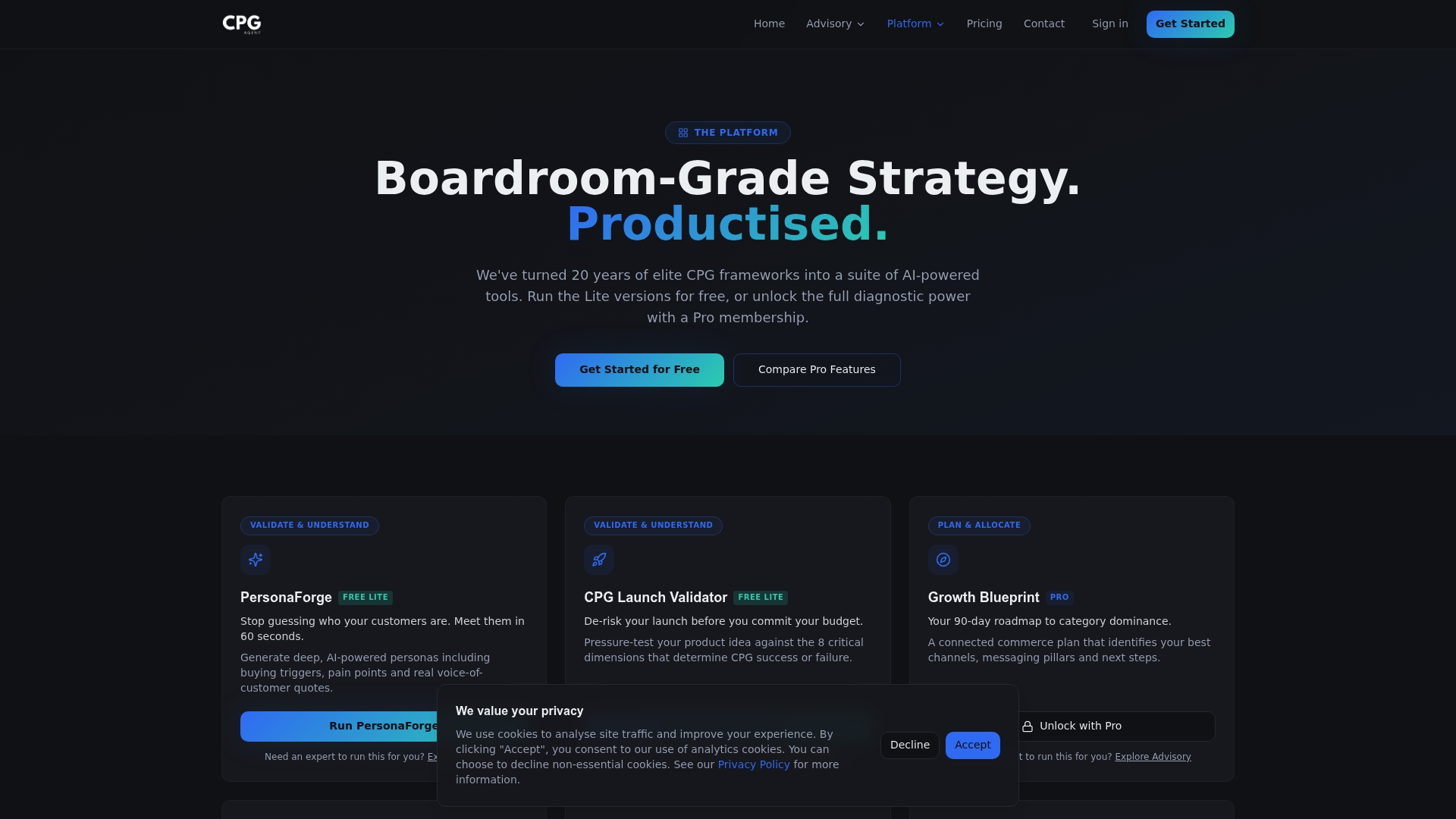
PersonaForge is free, and it generates the AI-powered buyer personas that should sit at the foundation of every FMCG media strategy you build. Buying triggers, barriers, voice-of-customer language, and purchase context come out of the tool in minutes, not weeks. Pair that with the Media Budget Allocator, which turns your budget inputs into a stage-weighted media plan with clear channel rationale and testing frameworks, and you have the two most critical inputs for effective media buying for FMCG ready before your next planning session. Explore the full Cpgagent platform to see how these tools fit into your existing workflow.
FAQ
What is media planning for FMCG?
Media planning for FMCG is the process of selecting, sequencing, and budgeting across channels to maximize campaign relevance and ROI for fast-moving consumer goods. It requires aligning media flights with buyer personas, purchase behavior data, and confirmed in-store distribution.
How do you choose the right FMCG marketing channels?
Channel selection should follow your buyer's actual purchase journey rather than general reach metrics. Purchase behavior data and AI-powered personas help identify where your specific shopper segment is most likely to be persuaded before reaching the shelf.
Why does supply chain coordination matter in media planning?
Launching media before your product is confirmed in retail distribution creates stranded demand and damages retailer confidence. Synchronizing your media calendar with inventory readiness is one of the highest-ROI decisions you can make in FMCG campaign planning.
What KPIs should FMCG media plans track?
Beyond standard digital metrics, FMCG campaigns should track incremental ROAS, retail velocity, household penetration lift, stockout rate, and fill rate to connect media activity to actual in-store or digital shelf outcomes.
How does PersonaForge help with FMCG media strategy?
PersonaForge generates free, AI-powered buyer personas with buying triggers, pain points, and real voice-of-customer language. These outputs directly inform channel weighting, creative briefing, and audience targeting decisions for FMCG media plans.