

Full-funnel marketing for CPG is the coordinated integration of brand-building and performance tactics across every stage of the customer journey, from first awareness through repeat purchase. It is not a campaign type or a budget allocation. It is a system where awareness work feeds consideration, consideration feeds conversion, and post-purchase data loops back to sharpen the top of the funnel. McKinsey describes this as a transformational shift requiring linked teams, shared measurement systems, and unified KPIs across every funnel stage.
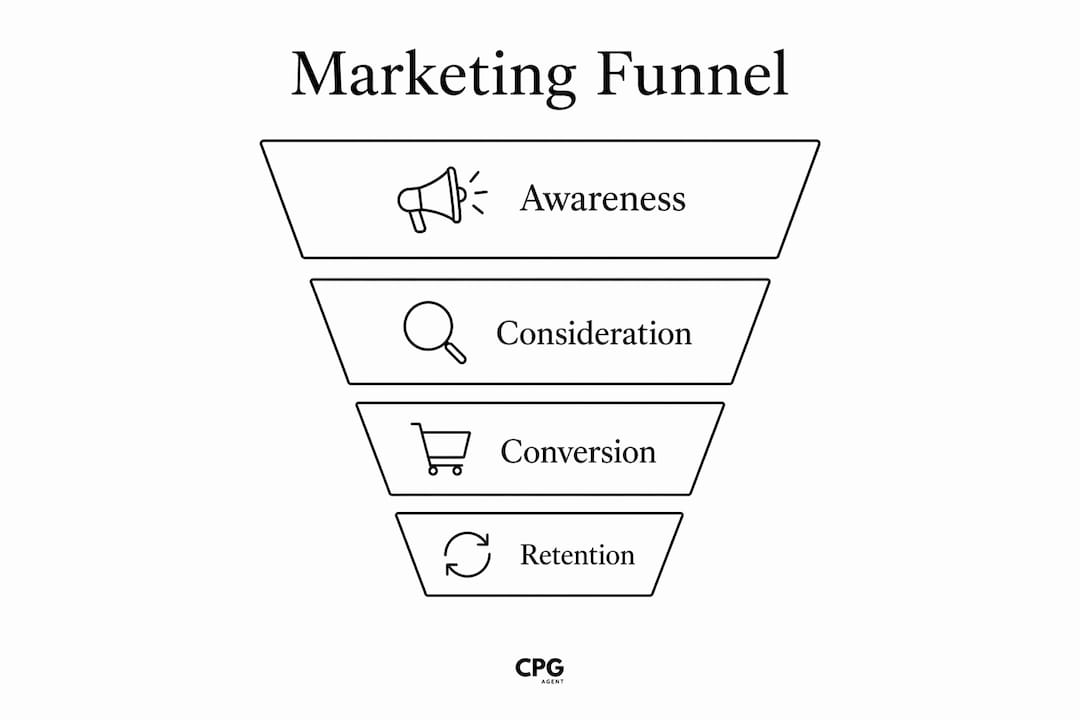
For CPG brand managers, the practical definition comes down to four connected stages:
- Awareness (top of funnel): Broad reach tactics that build brand recognition and mental availability before a shopper reaches the shelf or the digital cart.
- Consideration (mid-funnel): Content, retail media placements, and category-level messaging that help shoppers evaluate your product over alternatives.
- Conversion (bottom of funnel): Performance-driven tactics, including paid search, Sponsored Products on Amazon, and shoppable social formats, that close the purchase.
- Retention and loyalty (post-purchase): Email, SMS, subscription programs, and community tactics that drive repeat buying and turn customers into advocates.
The system only works when all four stages are measured together. Running awareness campaigns and conversion campaigns as separate budget lines with separate teams and separate KPIs is not full-funnel marketing. It is siloed marketing with a full-funnel label.
Table of Contents
- Why most CPG marketing falls short of a true full-funnel approach
- What does each funnel stage actually require in CPG?
- How do you measure full-funnel performance in CPG?
- Channel-specific tactics for full-funnel execution in CPG
- How AI and fractional leadership sharpen full-funnel execution
- Cpgagent gives CPG brands a faster path to full-funnel execution
- FAQ
- Key takeaways
Why most CPG marketing falls short of a true full-funnel approach
Most CPG brands run some version of every funnel stage. The problem is that those stages rarely talk to each other. Brand teams own awareness. Performance teams own conversion. Retail teams own in-store. Nobody owns the connection between them.
The result is a set of predictable failure modes:
- Over-indexing on mid-funnel. Trade promotions, coupon drops, and retailer co-op programs dominate CPG budgets because they produce measurable short-term sales. But Nielsen found that only a minority of marketing channels perform above average for both revenue generation and brand building simultaneously. Brands that rely entirely on mid-funnel tactics are buying sales without building the brand equity that sustains them. Nielsen found that only 36% of marketing channels perform above average for both revenue generation and brand building simultaneously.
- Weak measurement linkage. Click-through rates and impression counts are reported separately from in-store sales lift. Without a shared attribution model, brand managers cannot demonstrate how a TV campaign influenced a paid search conversion two weeks later.
- Siloed teams with misaligned incentives. Brand marketers are rewarded for awareness metrics. Performance marketers are rewarded for ROAS. Neither is rewarded for the compounded effect of both working together. McKinsey notes that cross-functional collaboration among brand managers, performance marketers, analytics teams, and finance is the single most critical operating requirement for full-funnel success.
- Single-channel fixation. Brands that concentrate spend on one channel, whether that is TV, Amazon, or social, miss the non-linear reality of how shoppers actually move. A shopper might see a streaming ad, search on Amazon, read reviews on a retailer's site, and buy in a physical store. No single channel captures that journey.
- No post-purchase loop. Retention is treated as a CRM function disconnected from media. First-party data from existing customers never feeds back into upper-funnel targeting or lookalike audience creation.
The opportunity cost is real. A Nielsen meta-analysis of CPG campaigns found that full-funnel strategies produce significantly higher ROI and increased offline sales compared to campaigns focused on a single purchase stage. That analysis covered more than 1,300 unique campaigns across 20 CPG brands spanning personal care, beauty, food, beverage, and home care.
What does each funnel stage actually require in CPG?
Amazon Ads defines full-funnel marketing as crafting strategies across all channels and touchpoints in the customer journey, with an explicit acknowledgment that customer journeys are not linear. That non-linearity is especially pronounced in CPG, where purchase decisions often happen in seconds at the shelf or in a digital cart, and brand familiarity built weeks earlier is what tips the choice.
Top of funnel: building brand familiarity at scale
The goal at awareness is reach and recall, not clicks. CPG purchase decisions happen fast, which means the brand that already lives in a shopper's memory wins before the performance campaign even fires.
Effective top-of-funnel tactics for CPG brands include:
- Connected TV and streaming audio ads targeting category buyers
- Programmatic display on high-reach publisher networks
- Influencer content and social video for younger demographics
- Out-of-home placements near retail locations
The KPIs here are unaided brand awareness, reach, frequency, and branded search volume. A lift in branded search queries is one of the clearest signals that upper-funnel spend is working, because branded searches carry a lower cost per click than generic category searches.
Mid-funnel: turning awareness into active consideration
Shoppers in the consideration stage know the brand exists. They are comparing. Mid-funnel tactics need to answer the question "why this product over the alternatives?" with specificity.
- Retail media sponsored placements on major retailer platforms position products in relevant search environments where shoppers are actively browsing the category.
- Educational content marketing, including how-to videos, ingredient explainers, and comparison guides, addresses the questions shoppers have before committing.
- Customer reviews and social proof surfaced through retargeting ads reinforce the purchase case for shoppers who have already visited a product page.
- Email nurture sequences for DTC shoppers who have browsed but not purchased.
Content marketing is particularly effective at this stage because it answers real questions at the moment shoppers are asking them. A protein bar brand that publishes a clear comparison of its macros against category averages captures consideration-stage intent that a banner ad cannot.
Bottom of funnel: removing friction at the point of purchase

Conversion tactics work best when the brand has already done the work upstream. Shoppers who arrive at the bottom of the funnel with strong brand familiarity and answered questions convert at higher rates and at lower cost per acquisition.
Core bottom-of-funnel tactics for CPG:
- Sponsored Products and Sponsored Brands on Amazon, capturing shoppers with high purchase intent
- Shoppable social formats on Instagram and TikTok that reduce steps to purchase
- Geo-targeted mobile ads near retail locations
- Retailer-specific promotions and digital coupons tied to loyalty programs
- Remarketing ads with direct calls-to-action for DTC shoppers who abandoned cart
Pro Tip: Do not judge bottom-of-funnel ROAS in isolation. A high ROAS on conversion campaigns often reflects the halo effect of upper-funnel investment. Cut awareness spend and watch conversion efficiency drop within two to three months.
Post-purchase: retention as a growth lever
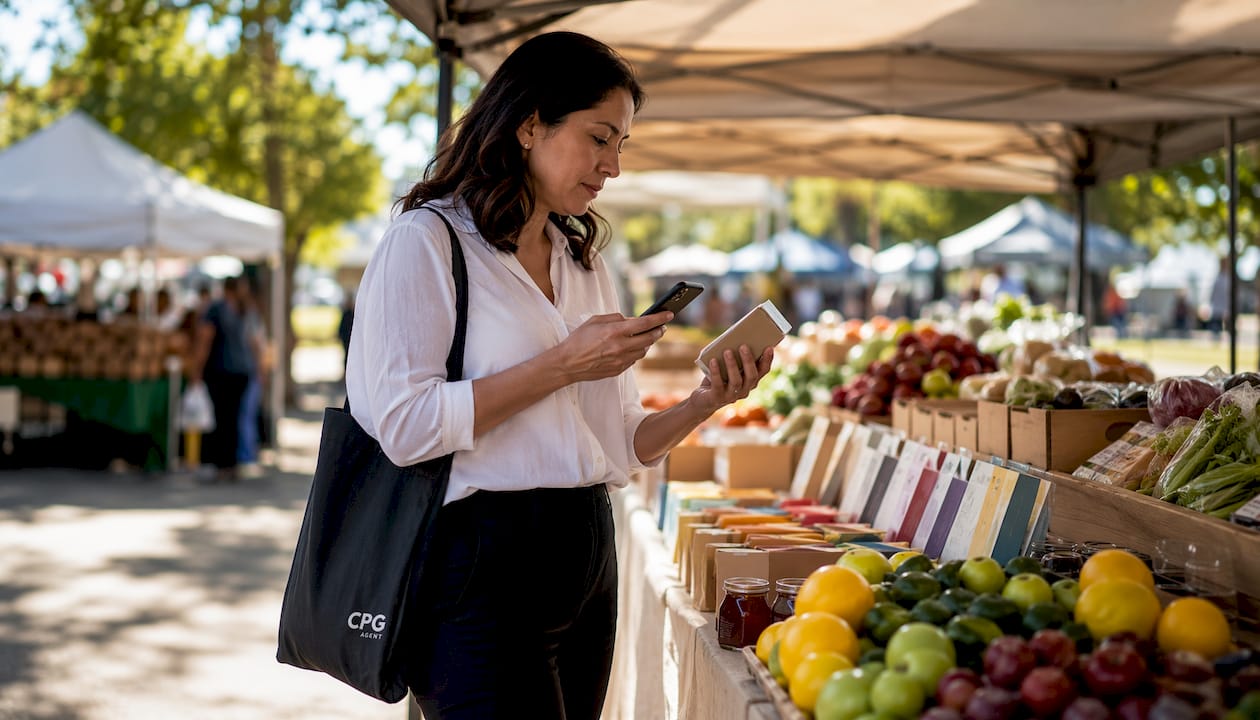
Retention is where CPG brands leave the most money on the table. Acquiring a new customer costs far more than keeping an existing one, yet most CPG media plans allocate almost nothing to post-purchase engagement.
Retention tactics that compound over time:
- Subscribe-and-save programs on Amazon and DTC channels that lock in repeat purchase cadence
- Post-purchase email and SMS sequences with usage tips, reorder reminders, and loyalty rewards
- Community-building through branded social groups or ambassador programs
- First-party data capture at purchase that feeds back into lookalike audience targeting for new customer acquisition
The loyalty stage also feeds the advocacy stage. Satisfied customers who leave reviews, share unboxing content, or refer friends become an organic awareness channel that costs nothing per impression.
How do you measure full-funnel performance in CPG?
Measurement is where most CPG full-funnel strategies break down. The tools exist. The data exists. The problem is that brand metrics and sales metrics are reported in separate systems by separate teams on separate timelines.
A unified measurement framework connects three layers:
| Metric type | Funnel stage | What it measures |
|---|---|---|
| Unaided brand awareness | Top of funnel | Percentage of category buyers who recall the brand unprompted |
| Branded search volume | Top/mid-funnel | Organic interest generated by awareness investment |
| Consideration rate | Mid-funnel | Share of category shoppers who actively evaluate the brand |
| Add-to-cart and page view rates | Mid/bottom-funnel | Engagement quality on product pages |
| Conversion rate and ROAS | Bottom of funnel | Purchase efficiency of performance spend |
| Repeat purchase rate | Post-purchase | Retention health and loyalty program effectiveness |
| Incremental sales lift | Full funnel | Sales attributable to marketing above baseline |
The most important metric on that list is incremental sales lift, because it is the only one that tells you whether your marketing spend is actually driving growth or just capturing demand that would have happened anyway. Nielsen's research found that clicks are a weak indicator of incremental sales in CPG digital marketing. Delivered impressions are far more predictive of sales lift, particularly for top-of-funnel investment.
Two measurement approaches work best for CPG full-funnel attribution:
- Marketing mix modeling (MMM): A statistical model that correlates sales with marketing spend across channels and time periods. MMM captures the long-term brand-building effects that last-click attribution misses entirely.
- Incremental testing: Controlled experiments, including geo holdout tests and A/B media tests, that isolate the causal effect of specific campaigns on sales. MMM tells you what happened historically; incremental testing tells you what is working right now.
The practical challenge is that neither approach is cheap or fast. Brands running on lean budgets can start with a simpler version: track branded search volume as a proxy for awareness impact, monitor add-to-cart rates as a mid-funnel signal, and use retailer closed-loop data to connect ad exposure to actual purchases. Retail media platforms operated by major retailers offer exactly this kind of closed-loop measurement, connecting ad impressions to verified sales data within the same ecosystem.
Pro Tip: Link your KPIs across teams before you launch a campaign, not after. If brand managers and performance marketers are reporting to different dashboards with different success definitions, you will never see the compounded effect of the funnel working as a system.
Channel-specific tactics for full-funnel execution in CPG
Amazon Ads across all three funnel levels
Amazon is the most complete full-funnel environment available to CPG brands because it captures shoppers at every stage within a single platform. Amazon recommends combining Sponsored Products, Sponsored Brands, and display advertising as a baseline full-funnel approach, with streaming TV ads added for brands ready to build broader awareness.
A practical Amazon full-funnel playbook looks like this:
- Upper funnel: Streaming TV ads and audio ads on Amazon Music reach category buyers who are not yet in purchase mode. These build the brand familiarity that makes lower-funnel ads more efficient.
- Mid-funnel: Sponsored Brands campaigns with custom headline copy and brand store links capture shoppers who are browsing the category. Amazon DSP display ads retarget shoppers who have viewed the product page but not purchased.
- Lower funnel: Sponsored Products ads on high-intent search terms close the purchase. Subscribe-and-save placements convert one-time buyers into recurring customers.
For a deeper look at how to align Amazon ad formats with specific shopper missions, the Amazon product page optimization framework covers the connection between shopper intent and ad placement strategy.
Retail media networks beyond Amazon
Retail media has become a core channel for CPG full-funnel execution because it sits at the intersection of brand messaging and purchase behavior. Sponsored product placements on major retailer platforms drive visibility at the point of purchase. Display ads within retailer ecosystems reinforce brand messaging to shoppers who are already in a buying mindset. The closed-loop measurement that retail media provides, connecting ad exposure directly to verified sales, is something that most other digital channels cannot match.
DTC channels for conversion and loyalty
A direct-to-consumer channel gives CPG brands something retail cannot: first-party customer data. Every purchase through a DTC site or subscription program creates a data point that can be used to personalize retention communications, build lookalike audiences for new customer acquisition, and test messaging before scaling it to retail.
DTC conversion tactics that work for CPG include landing pages built around a single product benefit, bundle offers that increase average order value, and post-purchase email sequences that reduce churn from subscription programs.
Social media across the funnel
Social platforms serve different roles at different funnel stages. At the top, broad-reach video content on platforms like TikTok and Instagram builds brand awareness through organic and paid distribution. At mid-funnel, user-generated content and influencer reviews answer consideration-stage questions in a format that feels credible. At the bottom, shoppable posts and retargeting ads with direct purchase links capture high-intent shoppers.
The Kraft Heinz Company's shift toward lower-funnel digital tactics illustrates how a top-of-funnel-heavy CPG brand can rebalance. By moving to Video Reach Campaign formats on YouTube and applying machine learning to identify the right viewer at scale, Kraft Heinz saw an 11% year-over-year decrease in costs per impression, while simultaneously building a stronger first-party data strategy through search.
Email and SMS for retention and remarketing
Email and SMS are the highest-ROI channels for post-purchase engagement in CPG, particularly for DTC brands. A well-structured email program covers four jobs: welcome sequences that set expectations for new customers, educational content that builds product loyalty, reorder reminders timed to consumption cycles, and win-back campaigns for lapsed buyers. SMS works best for time-sensitive offers and reorder nudges, where the immediacy of the channel matches the urgency of the message.
For CPG brands working with limited budgets, performance marketing channels that deliver measurable returns at each funnel stage are worth prioritizing before scaling to broader awareness investment.
How AI and fractional leadership sharpen full-funnel execution
The operational challenge of full-funnel marketing is not strategic. Most CPG brand managers understand the framework. The challenge is execution speed and measurement sophistication. Running coordinated campaigns across Amazon, retail media, social, email, and DTC simultaneously, while tracking incremental impact across all of them, requires either a large internal team or a smarter way of working.
AI-driven tools change the math on both fronts. Audience intelligence tools like PersonaForge, available through Cpgagent's platform, build detailed consumer personas from behavioral and category data, so mid-funnel messaging can be personalized to specific shopper segments rather than broadcast to the entire category. Launch Validator tests product and campaign concepts against real market signals before significant budget is committed, which reduces the cost of learning at the top of the funnel.
Fractional CMOs and senior marketing advisors bring a different kind of leverage. A fractional marketing leader embedded in a CPG brand for a defined engagement can build the cross-functional operating model that full-funnel marketing requires, including the weekly huddles, shared KPI dashboards, and joint decision-making forums that McKinsey identifies as essential, without the overhead of a full-time executive hire. For growth-stage brands that cannot yet justify a full C-suite, this model compresses the time between strategy and execution.
Pro Tip: Before integrating AI tools into your existing marketing workflow, map your current data flows first. AI tools produce better outputs when they are connected to clean, structured first-party data. A CRM with inconsistent tagging will produce audience segments that are no more useful than broad demographic targeting.
The combination of AI-driven analytics and fractional leadership addresses the two most common reasons full-funnel strategies stall: lack of measurement infrastructure and lack of senior coordination. Brands that solve both move faster and waste less budget on funnel stages that are not contributing to overall growth.
Cpgagent gives CPG brands a faster path to full-funnel execution
Running a true full-funnel strategy without a large agency or a full internal team used to mean choosing between speed and quality. Cpgagent was built specifically to close that gap for CPG and FMCG brands.
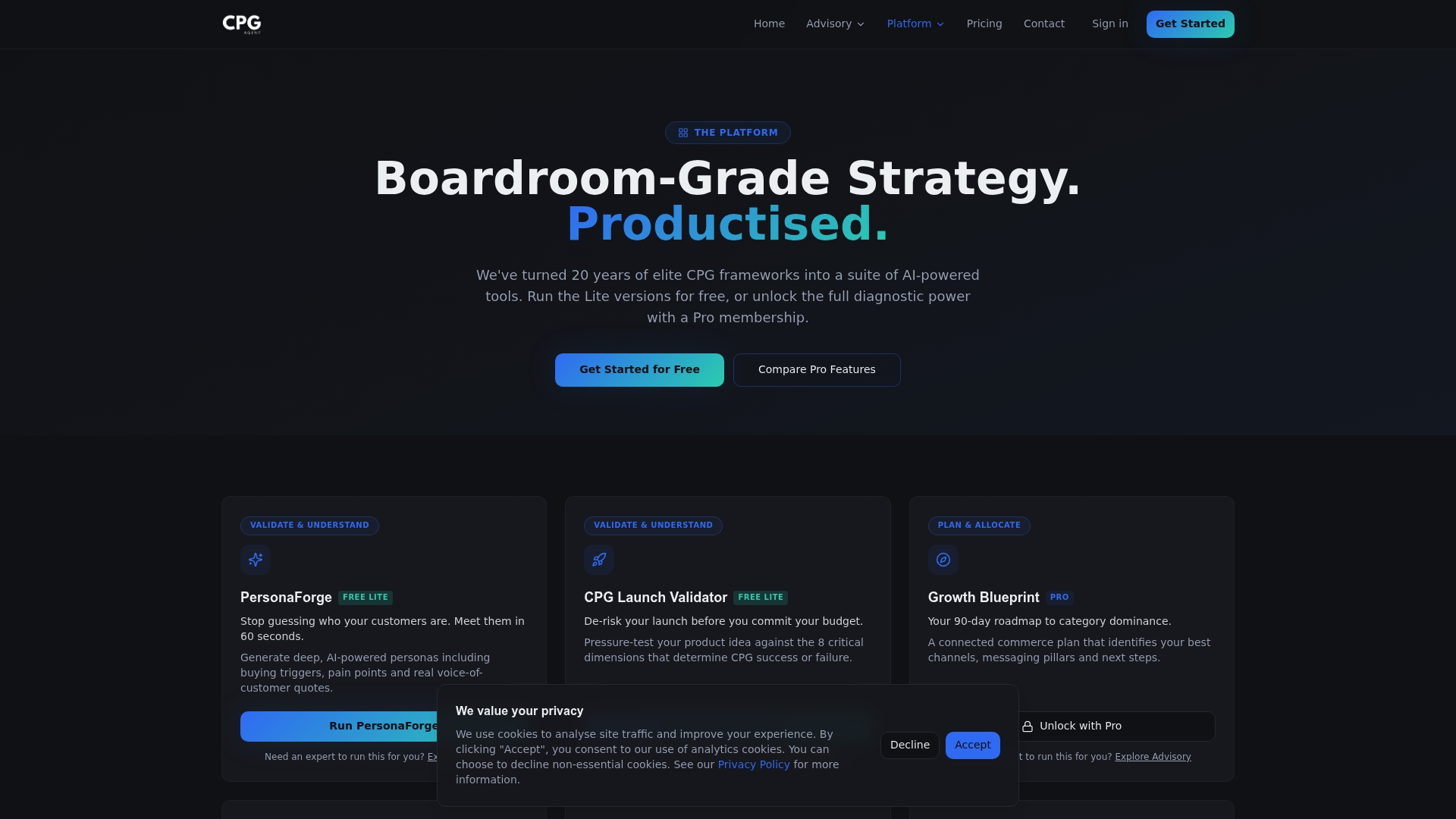
The platform combines AI-driven strategy tools, including PersonaForge for consumer segmentation and Launch Validator for concept testing, with fractional CMO and senior marketing advisory services. That means you get the measurement infrastructure, the cross-functional coordination model, and the channel-specific playbooks without a six-month agency onboarding process or a retainer built for a brand ten times your size. Cpgagent integrates directly into your existing tech stack, so the tools work with your current CRM, retail media accounts, and analytics setup rather than replacing them.
For brand managers who need to move from strategy to execution quickly, the Cpgagent platform is where the tools and fractional leadership services live. If you want to understand how the full offering fits your brand's stage and category, start at cpgagent.com to see what the platform covers and how it is structured.
FAQ
What is the CPG marketing funnel?
The CPG marketing funnel covers four stages: awareness, consideration, conversion, and post-purchase retention. Each stage requires different tactics and metrics, and full-funnel success depends on connecting them into a single measurable system.
What does full-funnel marketing mean?
Full-funnel marketing means running coordinated strategies across every stage of the customer journey simultaneously, from brand awareness through repeat purchase, with linked KPIs that measure how each stage influences the others.
What are the four levels of the marketing funnel?
The four levels are awareness (top of funnel), consideration (mid-funnel), conversion (bottom of funnel), and retention or loyalty (post-purchase). Some frameworks add a fifth advocacy stage, where satisfied customers actively refer others.
Why do CPG brands struggle with full-funnel marketing?
Most CPG brands run siloed campaigns with separate teams, separate budgets, and separate metrics for each funnel stage. Without a shared measurement model and cross-functional coordination, the compounded effect of the funnel working as a system never materializes.
How does Cpgagent support full-funnel marketing for CPG brands?
Cpgagent provides AI-driven tools like PersonaForge and Launch Validator alongside fractional CMO services, giving CPG brands the measurement infrastructure and senior coordination needed to execute full-funnel strategies without traditional agency overhead.
Key takeaways
Full-funnel marketing for CPG works only when awareness, consideration, conversion, and retention are measured together as a single system, not managed as separate campaigns.
| Point | Details |
|---|---|
| Integration over isolation | Full-funnel marketing requires linked teams, unified KPIs, and shared measurement across all four funnel stages. |
| Measurement is the hard part | Nielsen found that only 36% of marketing channels perform above average for both revenue generation and brand building simultaneously. |
| Nielsen ROI advantage | CPG brands using full-funnel strategies see up to 45% higher ROI and 7% higher offline sales versus single-stage campaigns. |
| Amazon as a full-funnel platform | Combining Sponsored Products, Sponsored Brands, and display advertising covers awareness through conversion within a single ecosystem. |
| Cpgagent for faster execution | Cpgagent's AI tools and fractional CMO services give CPG brands the infrastructure to run coordinated full-funnel strategies without traditional agency overhead. |