

TL;DR:
- Shopper marketing uses data-driven tactics to influence purchasing decisions at the retail point of sale. It is integrated into joint planning efforts with retailers and measured by incremental sales lift to prove ROI. Effective programs require sufficient budgets, digital and physical integration, and continuous organizational alignment.
Shopper marketing in CPG is defined as the practice of using data-driven strategies to influence purchasing decisions at the retail point of sale, both in-store and online. The term is the industry's recognized label for what some call "path-to-purchase marketing," and it sits at the intersection of brand strategy and retail sales execution. Unlike brand marketing, which builds awareness over time, shopper marketing targets the conversion moment directly. Endcap placements alone can drive 2 to 10 times the unit sales of standard shelf placement. That single statistic explains why CPG brands allocate dedicated budgets to this discipline rather than folding it into general marketing spend. Retailers have also evolved: they now sell audiences, not just shelf space, making shopper marketing more complex and more critical than ever.
What is shopper marketing in CPG, and how does it work?
Shopper marketing is the structured effort to reach consumers while they are in "shopping mode," meaning the mental state where they are actively evaluating and selecting products. This differs from the broader consumer marketing goal of building preference over weeks or months. The shopper and the consumer are often the same person, but they behave differently depending on context. A parent who loves a cereal brand at home may still switch to a competitor in the aisle if a better promotion is visible.
The discipline spans the full path to purchase: from sponsored search on retail platforms to in-store displays, retail media ads, and loyalty app promotions. That scope has expanded significantly as retailers built out their own media networks. A CPG brand now manages shopper activations across physical stores, retailer websites, and third-party digital platforms simultaneously.
Shopper marketing strategy requires understanding how shoppers make decisions under time pressure, with limited attention, and often on autopilot. Most grocery purchase decisions happen in under 10 seconds at the shelf. The goal is to interrupt that autopilot with the right message, format, and incentive at exactly the right moment.
What are the key shopper marketing tactics used by modern CPG brands?
CPG brands use a layered mix of physical and digital tactics to reach shoppers at multiple points along the path to purchase.
In-store tactics remain the foundation:
- Endcap displays: High-traffic placements at the end of aisles that command attention and drive significant sales lifts compared to standard shelf positions.
- Point-of-purchase displays: Free-standing units, shelf talkers, and header cards that communicate value or differentiation at the exact moment of decision.
- In-store demos: Sampling programs that convert trial into purchase, particularly effective for new product launches or premium-priced items.
- Coupons and instant rebates: Paper and digital offers that reduce perceived price risk and accelerate trial among new-to-brand shoppers.
Digital and retail media tactics now carry equal weight:
- Sponsored search on retail platforms: Appearing at the top of search results on retailer websites when shoppers type category keywords.
- Shoppable content: Social posts, recipe pages, and video ads with direct links to product pages on retail sites.
- Mobile coupons and QR codes: Connecting physical shelf presence to digital offers, enabling closed-loop attribution that tracks which shoppers converted after seeing an in-store activation.
- Loyalty app promotions: Personalized offers delivered through retailer apps to high-value or lapsed shoppers.
Mission-based bundling is an underused tactic worth highlighting. Grouping complementary products around a shopper mission (weeknight dinners, game-day snacks) increases basket size and positions your brand as a solution rather than a single SKU.
Pro Tip: When you run a QR code on an in-store display, make sure the landing page is mobile-optimized and loads in under two seconds. A slow page kills the conversion you just paid to earn.
Integrating digital and physical touchpoints is not optional for CPG brand growth. Shoppers move fluidly between channels, and brands that treat them as separate audiences leave measurable revenue on the table.

How does shopper marketing integrate with Joint Business Planning and retailer partnerships?
Shopper marketing functions best when it is built into Joint Business Planning (JBP) with retailers, not treated as a separate line item managed in isolation. Brands that silo shopper budgets from their retail sales agreements consistently struggle to prove ROI and rarely secure the high-value activations that move the needle.
JBP is the annual or semi-annual planning process where a CPG brand and a retailer align on shared growth goals, promotional calendars, and investment commitments. Shopper marketing activations, such as endcap placements, feature ads, and digital media buys, are negotiated within this framework. Brands that arrive at JBP with a clear shopper plan get better placements and better data sharing in return.
The practical steps for integrating shopper marketing into JBP:
- Align on retailer priorities first. Understand the retailer's category goals, seasonal calendar, and shopper data capabilities before proposing activations.
- Map your activations to their calendar. Propose shopper programs that support the retailer's key selling periods, not just your brand's launch schedule.
- Commit to lead times. Retail media placements and in-store support materials require 8–16 weeks of lead time at most major retailers. Missing deadlines means losing placements to competitors.
- Negotiate data access. Push for loyalty card data, scan data, and digital engagement metrics as part of the JBP agreement. This data is what makes measurement possible.
- Present a unified budget. Show the retailer a combined view of trade spend, shopper marketing investment, and retail media commitment. Fragmented budgets signal disorganization and reduce negotiating leverage.
Retail media budgets now represent the majority of shopper activation spend for large CPG brands. That shift introduces coordination complexity across agencies, finance teams, and retailer portals, but it also creates a critical opportunity for brands that get organized early.
Pro Tip: Bring a one-page shopper marketing summary to every JBP meeting. It shows the retailer you treat their business as a priority and makes it easier for their buyer to advocate for your programs internally.
What measurement practices best demonstrate shopper marketing impact in CPG?
The most common measurement mistake in shopper marketing is reporting reach and impressions as proof of performance. Reach tells you how many people saw your activation. It does not tell you whether they bought anything.
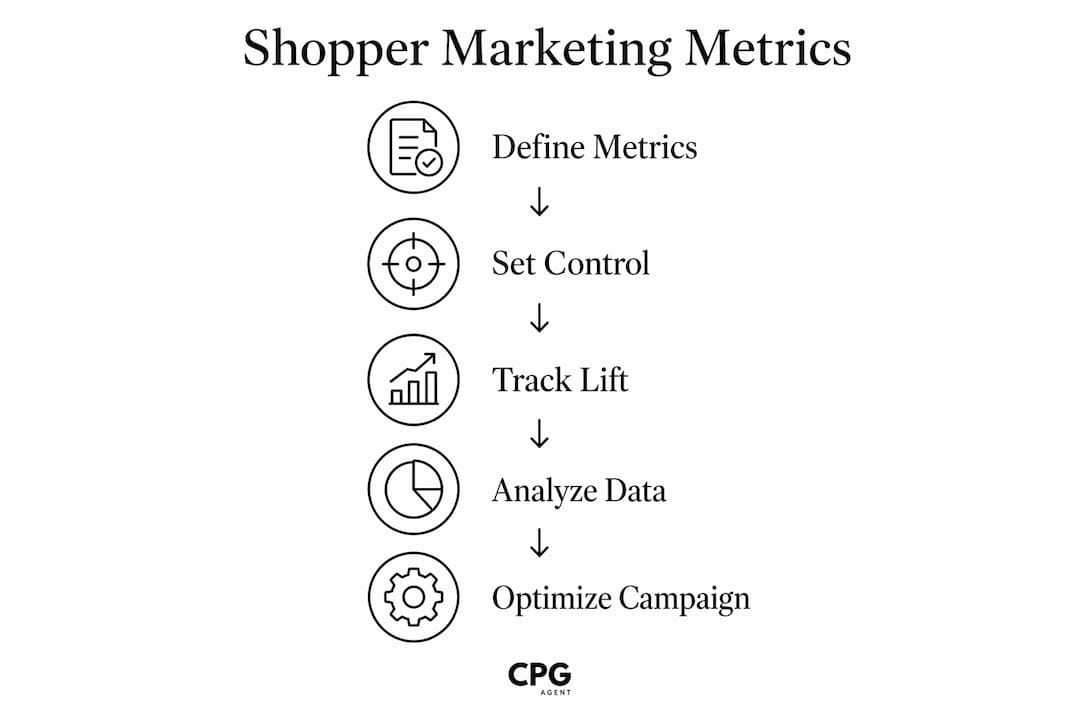
Incremental sales lift in activated stores, measured against a matched control group, is the metric that actually demonstrates shopper marketing ROI. The control group approach compares sales in stores where your activation ran against similar stores where it did not. The difference is your incremental lift.
| Metric type | Example | What it tells you |
|---|---|---|
| Vanity metric | Impressions, reach, clicks | How many people were exposed |
| Lag metric | Incremental sales lift | Whether exposure drove purchase |
| Attribution metric | QR code scans, digital coupon redemptions | Which shoppers converted after activation |
| Efficiency metric | Cost per incremental unit | Whether the investment was worth it |
Combining digital and in-store tactics with trackable elements like QR codes and digital coupons enables closed-loop measurement. You can identify new-to-brand buyers, track repeat purchase rates, and calculate true return on shopper investment. This level of attribution is what separates brands that grow their shopper budgets from brands that see them cut.
Experiential marketing, including demos and sampling, is notoriously hard to measure. The fix is to pair every experiential activation with a digital touchpoint: a coupon code, a loyalty app check-in, or a QR code that drives to a trackable landing page. Without that link, you are relying on correlation rather than causation.
Pro Tip: Before any shopper activation launches, define your primary metric and set up your control group. Retrofitting measurement after the fact almost always produces inconclusive data.
How do CPG marketers prepare for trends shaping shopper marketing's future?
The shopper marketing environment is shifting faster than most annual planning cycles can accommodate. The brands that stay ahead are the ones building structural flexibility into their programs now.
Key trends reshaping the discipline:
- AI shopping assistants and agentic commerce: One-quarter of US shoppers are forecast to use specialty retail chatbots in 2026. These tools filter and recommend products based on shopper preferences, which means your product data, content, and ratings must be clean and complete to appear in AI-generated recommendations.
- Smart carts and in-store personalization: Retailers are piloting cart-based screens that deliver personalized offers as shoppers move through the store. Brands that have retailer data-sharing agreements in place will be first to access these placements.
- Omnichannel spend orchestration: Managing retail media, trade promotion, and shopper marketing as one connected investment rather than three separate budgets is becoming a competitive requirement, not a best practice.
- Budget realism at scale: Showing up to Walmart with $18,000 or less is insufficient for effective activation. Large retailers require commensurate investment to unlock meaningful placements and data access.
- Message alignment across channels: Shoppers who see a brand message on a retail media ad, then find a different message on the shelf, experience cognitive friction that reduces conversion. Aligning brand, trade, and retail media messaging is a basic execution requirement that many brands still get wrong.
CPG marketers who want to grow with limited budgets need to prioritize the channels where their investment can reach the threshold for meaningful activation, rather than spreading thin across every retailer simultaneously.
Key Takeaways
Shopper marketing in CPG drives the highest returns when it integrates physical activations, digital media, retailer partnerships, and causal measurement into one coordinated plan.
| Point | Details |
|---|---|
| Define the conversion moment | Shopper marketing targets the buying decision directly, not general brand awareness. |
| Integrate with JBP | Brands that embed shopper plans into Joint Business Planning secure better placements and data access. |
| Measure incremental lift | Use control groups and digital attribution to prove ROI, not reach or impressions. |
| Budget to the retailer's scale | Small budgets fail at large retailers; invest at the level required to unlock meaningful activations. |
| Prepare for agentic commerce | Clean product data and omnichannel alignment are now prerequisites for AI-driven shopper discovery. |
Why shopper marketing is the most underestimated function in CPG
The most persistent misconception I see in CPG organizations is that shopper marketing is a tactical support function, something the sales team handles with a few displays and some coupons. That framing costs brands real money.
Shopper marketing is the connective tissue between brand strategy, retail sales, and consumer behavior. When it works, it is because someone aligned the brand's growth goals with the retailer's category priorities and then built activations that spoke directly to how shoppers actually make decisions in that specific store environment. That requires organizational integration that most brands have not achieved.
The brands I have seen execute this well share one habit: they treat shopper marketing planning as a year-round discipline, not a quarterly scramble. They know their retailer's calendar better than the retailer's own category managers do. They show up to JBP with data, not just proposals.
The measurement gap is where most programs fall apart. Reporting impressions to leadership feels safe because the numbers are always large. Reporting incremental sales lift feels risky because the lift is smaller and harder to explain. But lift is the number that determines whether the budget grows or gets cut next year. The brands that learn to tell that story clearly are the ones that compound their shopper marketing advantage over time.
The future of this discipline belongs to brands that treat the shelf, whether physical or algorithmic, as a dynamic media channel that requires the same rigor as any performance marketing investment.
— Matthew
How Cpgagent supports your shopper marketing execution
Shopper marketing plans fail most often at the execution and measurement stage, not the strategy stage. Cpgagent is built for CPG brands that need to move from plan to activation without losing weeks to internal alignment or agency back-and-forth.
The Cpgagent platform gives marketing teams AI-driven tools to build shopper programs, align them with retailer calendars, and track performance against incremental sales metrics in real time. From JBP preparation to retail media coordination, the platform replaces the spreadsheet chaos that slows most shopper marketing teams down. If your brand is ready to treat shopper marketing as a growth driver rather than a support function, Cpgagent gives you the infrastructure to do it at speed.
FAQ
What is shopper marketing in CPG?
Shopper marketing in CPG is the practice of using data-driven tactics to influence purchasing decisions at the retail point of sale, both in-store and online. It targets the conversion moment directly, unlike brand marketing, which builds awareness over time.
How does shopper marketing differ from trade marketing?
Trade marketing focuses on securing shelf space and retailer agreements, while shopper marketing focuses on influencing the shopper's decision once they are in the store or on the retailer's website. The two disciplines overlap but serve different objectives.
What metrics should CPG brands use to measure shopper marketing?
Incremental sales lift in activated stores, measured against a control group, is the primary metric. Digital attribution tools like QR codes and digital coupons add closed-loop tracking that connects in-store activations to actual purchase behavior.
How much budget does shopper marketing require at large retailers?
Budget requirements scale with the retailer. Activating effectively at a major national retailer like Walmart requires investment well above $18,000; smaller budgets rarely unlock the placements or data access needed to generate meaningful results.
How is AI changing shopper marketing in CPG?
AI shopping assistants are forecast to influence a significant share of US retail purchases by 2026. Brands need clean product data, strong ratings, and consistent omnichannel content to appear in AI-generated recommendations and maintain visibility on algorithmic shelves.