

Modernizing a legacy CPG portfolio comes down to eight steps: set strategy, build governance, audit SKUs, apply decision rules, validate changes, execute renovation, phase out discontinued SKUs, and institutionalize a continuous cadence. Run in sequence over 90 days, these steps let product managers and brand leaders cut complexity, protect margin, and keep retailer relationships intact. Here is the checklist you can act on today:
- Set strategy: Define growth vs. profitability objectives and identify hero SKUs to protect.
- Build governance: Stand up a steering committee and a leadership dashboard tracking velocity, ABC margin, and on-shelf availability (OSA).
- Audit SKUs: Collect units per store per week, activity-based cost-per-SKU, and substitution index for every item.
- Apply decision rules: Score each SKU as Grow, Modify, or Discontinue using incrementality and transferable-demand testing.
- Validate: Run controlled geography pilots or e-commerce holdout tests before committing to full rollout.
- Execute renovation: Reformulate, repackage, or re-price, then relaunch with a 90-day milestone plan.
- Phase out: Liquidate inventory, communicate with retailers, and verify shelf execution within 60 days.
- Institutionalize: Set a quarterly SKU health review cadence and define who owns each decision.
Key Takeaways
Modernizing a legacy CPG portfolio requires ABC costing, incrementality testing, and shelf-level execution verification working together, or the decisions made in the boardroom never show up on the shelf.
| Point | Details |
|---|---|
| Start with strategy, not data | Agree on thresholds and portfolio principles before the SKU audit begins. |
| ABC costing is non-negotiable | True per-SKU profitability, including changeover and complexity costs, changes which items survive. |
| Validate before you commit | Controlled pilots or e-commerce holdouts de-risk renovation and delist decisions. |
| Verify shelf execution | Field audits within 30 days of any delist confirm decisions actually reach the shelf. |
| Cpgagent maps to every step | The platform covers dashboard automation, Launch Validator, and fractional CMO support for governance. |
Table of Contents
- What does a modern CPG portfolio modernization program look like?
- Step 1: Set strategy, objectives, and portfolio principles
- Step 2: Build cross-functional governance and the leadership dashboard
- Step 3: Audit SKUs — the metrics and data you must collect
- Step 4: Apply decision rules — grow, modify, or discontinue
- Step 5: Validate changes before full rollout
- Step 6: Execute renovation, reformulation, packaging, and relaunch
- Step 7: Phase out discontinued SKUs cleanly
- Step 8: Institutionalize continuous modernization
- What tools and templates should you use?
- How Cpgagent supports each step
- The 90-day starter roadmap
- Common pitfalls and how to avoid them
- What the data actually tells you about portfolio cuts
- Cpgagent accelerates your portfolio decisions
- Sources
- FAQ
What does a modern CPG portfolio modernization program look like?
The legacy cpg portfolio modernization steps above are not a one-time project. They form a loop: assess, decide, validate, execute, measure, and iterate. Leading organizations treat this as a continuous strategic priority rather than a periodic clean-up, because SKU creep returns within 18 months without governance.
Ownership matters as much as sequencing. A cross-functional steering committee, typically including a category lead, supply-chain owner, finance partner, and sales lead, meets monthly for portfolio reviews and quarterly for leadership resets. The category lead owns data quality; finance owns ABC costing; sales owns retailer communication.
Core outcomes to target: fewer active SKUs, higher on-shelf productivity per facing, preserved consumer loyalty on hero items, and improved gross margin contribution. Strategy& (PwC) documents programs that eliminated up to 50% of SKUs while improving profitability, which signals the scale of what structured governance can unlock.
Step 1: Set strategy, objectives, and portfolio principles
Before scoring a single SKU, the team needs agreed-upon guardrails. Are you optimizing for topline growth, gross margin, or premiumization? The answer changes which SKUs survive. A brand chasing distribution velocity will protect different items than one protecting premium price points.
Document portfolio principles explicitly:
- Protect hero SKUs regardless of short-term velocity dips.
- Allow niche "attainable splurge" items if they drive basket size or trial.
- Set minimum velocity thresholds (e.g., units per store per week) below which a SKU enters review.
- Define substitution risk tolerance: how much buyer loss is acceptable if a SKU is removed?
Insurgent brands captured nearly 40% of growth in US CPG while holding a small share of market. Incumbents who failed to reinvest in hero brands and divest "zombie" brands lost relevance fast. That data point belongs in your first steering committee deck.
EY-Parthenon's research reinforces the same logic: modern portfolio strategy favors divesting low-velocity legacy assets and reinvesting in a smaller set of consumer-led platforms. Scale alone does not win.
Pro Tip: Align on thresholds in writing before the audit begins. Verbal agreements dissolve when a sales leader sees a beloved regional SKU on the discontinue list.
Step 2: Build cross-functional governance and the leadership dashboard
Governance without a dashboard is just meetings. The leadership dashboard should surface the six fields that drive decisions:
| Dashboard Field | Why It Matters |
|---|---|
| SKU velocity (units/store/week) | Flags slow movers before they become liabilities |
| ABC true profitability | Reveals hidden cost drag from small-batch complexity |
| On-shelf availability (OSA) | Separates demand problems from execution problems |
| Substitution risk index | Quantifies buyer loss if a SKU is removed |
| Incrementality signal | Shows whether a SKU drives new buyers or cannibalizes |
| Innovation pipeline status | Prevents premature cuts that leave shelf gaps |
Monthly portfolio reviews use this dashboard to flag SKUs entering the Modify or Discontinue zone. Quarterly leadership reviews reset thresholds and approve major decisions. Decision rights must be documented: who can approve a discontinue, who can veto a reformulation, and what triggers an off-cycle review.
Step 3: Audit SKUs — the metrics and data you must collect
A SKU audit is only as good as its data. Collect these metrics for every active item:
- Velocity: Units per store per week from retailer POS or syndicated scanner data.
- Contribution margin: Gross revenue minus direct COGS from your ERP.
- Activity-based cost-per-SKU: ABC costing reveals hidden costs including production changeover, small-batch inefficiencies, warehouse complexity, and logistics overhead. It is the most precise way to determine true SKU profitability.
- OSA and facing compliance: Field audits or computer-vision shelf monitoring.
- Substitution index: Consumer survey or panel data showing which SKUs buyers switch to.
- Shopper incrementality: Controlled A/B delist tests or geographic holdouts to separate incremental buyers from transferable demand.
Data sources to map: ERP/COGS for cost data, syndicated scanner data (IRI/Circana) for velocity, retailer POS for account-level performance, e-commerce analytics for digital velocity, and field audit tools for OSA.
Pro Tip: Run an incrementality test on your bottom-quartile SKUs before the steering committee meets. Walking in with real transferable-demand data ends the "but what if buyers leave?" debate in under five minutes.
Step 4: Apply decision rules — grow, modify, or discontinue
SKU rationalization should judge products across consumer value, transferable demand, and operational cost-to-serve. The Grow/Modify/Discontinue matrix operationalizes that judgment:
- Grow: High velocity, positive ABC margin, low substitution risk. Action: prioritize distribution, increase ad spend, protect facings.
- Modify: Acceptable velocity but weak margin or declining consumer relevance. Action: reformulate, repackage, adjust price-pack architecture, or shift channel mix. A brand refresh decision guide can clarify whether a packaging update or a deeper identity change is warranted.
- Discontinue: Low velocity, negative ABC margin, high substitution risk, and no strategic role. Action: phase-out plan with retailer communication and shelf verification.
Weight strategic role alongside pure economics. A low-velocity SKU that anchors a seasonal display or drives trial for a hero item may justify its cost. Seasonality, innovation pipeline fit, and brand halo all belong in the decision.
Pro Tip: Not every low-velocity SKU is expendable. Some deliver distinct consumer roles or basket-building behaviors that disappear from the data only after you remove them.
Step 5: Validate changes before full rollout
Product renovation is a precision tool, not a broad stroke. Validate before committing:
- Select a controlled pilot geography or retailer account.
- Define success criteria: velocity lift, basket retention, retailer repurchase intent, and margin impact.
- Set a minimum pilot duration (8–12 weeks for most categories).
- Confirm retailer agreement and execution verification plan.
- Run an e-commerce holdout test in parallel when digital velocity is material.
Pilot design checklist:
- Sample size sufficient to detect a meaningful velocity change.
- KPI list agreed with finance and sales before launch.
- Retailer planogram confirmation in writing.
- Field rep schedule for in-store verification.
Read results against your pre-set thresholds. A pilot that shows no statistically meaningful loss in basket size and positive retailer repurchase intent is your green light.
Pro Tip: E-commerce-first pilots are faster and cheaper than geographic tests for most innovation or renovation decisions. Run them in parallel, not sequentially.

Step 6: Execute renovation, reformulation, packaging, and relaunch
Renovation execution has three workstreams running simultaneously: product, packaging, and go-to-market. A 90-day relaunch timeline looks like this:
- Days 1–30: Finalize reformulation brief, confirm design-to-value targets, brief packaging supplier, and align procurement on minimum order quantities.
- Days 31–60: Complete production run, conduct pre-launch consumer testing, brief retail partners, and confirm planogram placement.
- Days 61–90: In-store facing confirmation, launch marketing activation, and post-launch measurement against pilot KPIs.
Operational checklist: lock supplier communication early, consolidate SKUs where possible to reduce changeover costs, and align field reps on the new facing before launch day. For deeper guidance on reformulation timelines and regulatory considerations, the technical steps vary by category.
Pro Tip: Packaging harmonization across a sub-range often delivers more margin improvement than a full reformulation. Check design-to-value savings before committing to a formula change.
Step 7: Phase out discontinued SKUs cleanly
A clean phase-out protects the shelf space and velocity of surviving SKUs. Execution verification at store level is a common blind spot in rationalization programs.
Operational steps:
- Set a production stop date and communicate it to procurement and co-manufacturers.
- Liquidate existing inventory through secondary channels or promotional pricing before the delist date.
- Issue retailer communication 8–12 weeks before delist with planogram update and suggested replacement facings.
- Confirm DC pull-through and remove items from retailer ordering systems.
- Schedule field rep visits within 30 days of delist to verify facing changes and OSA for survivors.
| Phase-Out Milestone | Timing |
|---|---|
| Retailer communication issued | 8–12 weeks before delist |
| Production stop confirmed | 6–8 weeks before delist |
| Inventory liquidation complete | 2–4 weeks before delist |
| Field verification of facings | Within 30 days post-delist |
| 60–90 day velocity check on survivors | 60–90 days post-delist |
Step 8: Institutionalize continuous modernization
One-time clean-ups revert. The operating model needs a cadence:
- Quarterly SKU health reviews: Score every active SKU against velocity, ABC margin, OSA, and incrementality thresholds. Flag items entering the Modify or Discontinue zone.
- Annual portfolio resets: Revisit strategic objectives, update thresholds, and approve major decisions for the coming year.
- Off-cycle triggers: A retailer reset, a competitor launch, or a margin shock should trigger an immediate review of affected SKUs.
Core metrics to monitor continuously: SKU health score, SKU churn rate, gross margin contribution per SKU, OSA, and innovation success rate. Org design: assign a cross-functional squad with clear decision rights, and document those rights so new team members can act without a six-week onboarding.
What tools and templates should you use?
Map tools to steps to avoid buying capabilities you will not use:
- ABC costing model + ERP data (Step 3): Reveals true per-SKU profitability. Build in Excel or a dedicated cost-accounting module.
- Controlled delist experiments (Steps 3 and 5): Geographic or account-level A/B tests. Design with a statistician if sample sizes are tight.
- OSA monitoring (Steps 3 and 7): Field audit apps or computer-vision shelf tools for real-time facing compliance.
- SKU-scoring model (Step 4): A weighted scorecard combining velocity, ABC margin, substitution risk, and strategic role.
- Pilot brief template (Step 5): One-page document covering hypothesis, KPIs, geography, duration, and success thresholds.
- Retailer communication template (Step 7): Standardized delist notice with planogram update and replacement facing recommendation.
- Relaunch checklist (Step 6): 90-day milestone tracker covering production, retail sell-in, and post-launch measurement.
Pro Tip: Build the SKU-scoring model before the audit, not after. Teams that score SKUs without a pre-agreed model spend more time debating weights than making decisions.
How Cpgagent supports each step
Cpgagent's platform maps directly to the modernization workflow:
| Modernization Step | Cpgagent Capability |
|---|---|
| Step 1: Strategy | Growth roadmap tools and brand architecture frameworks |
| Step 2: Governance | Leadership dashboard automation and decision-cadence templates |
| Step 3: SKU audit | Retail audit tools and analytics advisory for ABC modeling |
| Step 4: Decision rules | SKU health matrix and portfolio scoring workflows |
| Step 5: Validation | Launch Validator for pilot design and success-criteria tracking |
| Step 6: Renovation | PersonaForge for consumer insight, creative generation tools |
| Step 7: Phase-out | Shelf audit tools and retailer communication workflows |
| Step 8: Continuous cadence | Automated SKU health monitoring and quarterly review templates |
Fractional CMO services cover governance setup and steering committee facilitation, which is where most programs stall. The delivery model is built for speed: no long discovery phase, direct integration with your existing tech stack, and a focus on decisions and margin rather than decks.
The 90-day starter roadmap
- Week 1–2: Convene the steering committee, align on strategic objectives, and document portfolio principles and decision thresholds.
- Week 3–4: Ingest ERP, POS, and scanner data. Build the ABC cost model. Identify data gaps and assign owners.
- Week 5–6: Complete the SKU audit. Score every active item. Present the Grow/Modify/Discontinue draft to the steering committee.
- Week 7–8: Select two to three pilot SKUs (one Modify, one Discontinue). Design pilots with success criteria and retailer agreements.
- Week 9–12: Execute pilots. Track KPIs weekly. Prepare first portfolio decision package for leadership review.
30-day quick wins: Data readiness confirmed, steering committee chartered, ABC model built. 60-day quick wins: SKU audit complete, pilot designs approved, retailer agreements signed. 90-day quick wins: First pilot results in hand, initial portfolio decisions approved, phase-out communications drafted.
Common pitfalls and how to avoid them
- Execution gap: Central decisions never reach the shelf. Fix with mandatory field verification within 30 days of any delist or relaunch, using audit apps or computer-vision monitoring.
- Headline revenue bias: Teams protect SKUs with strong gross revenue but ignore ABC margin drag. Fix by requiring ABC profitability in every decision package, not just contribution margin.
- Stakeholder misalignment: Sales protects volume; finance protects margin; marketing protects brand equity. Fix by defining decision rights in writing before the audit starts and assigning a single decision owner per SKU category.
- Skipping validation: Teams skip pilots to hit a retailer reset deadline. Fix by running e-commerce holdout tests in parallel with geographic pilots to compress timelines without eliminating evidence.
- SKU creep recurrence: New SKUs enter faster than old ones exit. Fix with a quarterly health review cadence and a formal gate process for new SKU approvals.
Pro Tip: The most common failure mode is not a bad decision. It is a good decision that never gets executed at store level. Budget for field verification from day one.
What the data actually tells you about portfolio cuts
Most teams underestimate how much of their complexity is self-inflicted. The instinct is to protect every SKU because someone, somewhere, buys it. But that logic ignores what those SKUs cost in production changeovers, warehouse slots, and sales team attention. ABC costing makes the hidden cost visible, and once it is visible, the decision usually becomes obvious.
The harder judgment call is the "twilight brand" — a SKU with declining velocity but genuine consumer loyalty in a specific region or channel. Cutting it too early damages trust; keeping it too long drains resources that could fund a renovation. The right answer is almost always a time-boxed pilot: give it one more season with a defined exit threshold, and let the data decide.
Cpgagent accelerates your portfolio decisions
Portfolio modernization stalls when teams lack the data infrastructure, governance templates, or senior judgment to move fast. Cpgagent closes that gap without the overhead of a traditional agency engagement. The platform gives product managers and brand leaders a working leadership dashboard, Launch Validator for pilot design, and PersonaForge for consumer insight, all deployable in days rather than months. Pair that with a fractional CMO who has run these programs before, and your first steering committee meeting can happen with real data on the table.
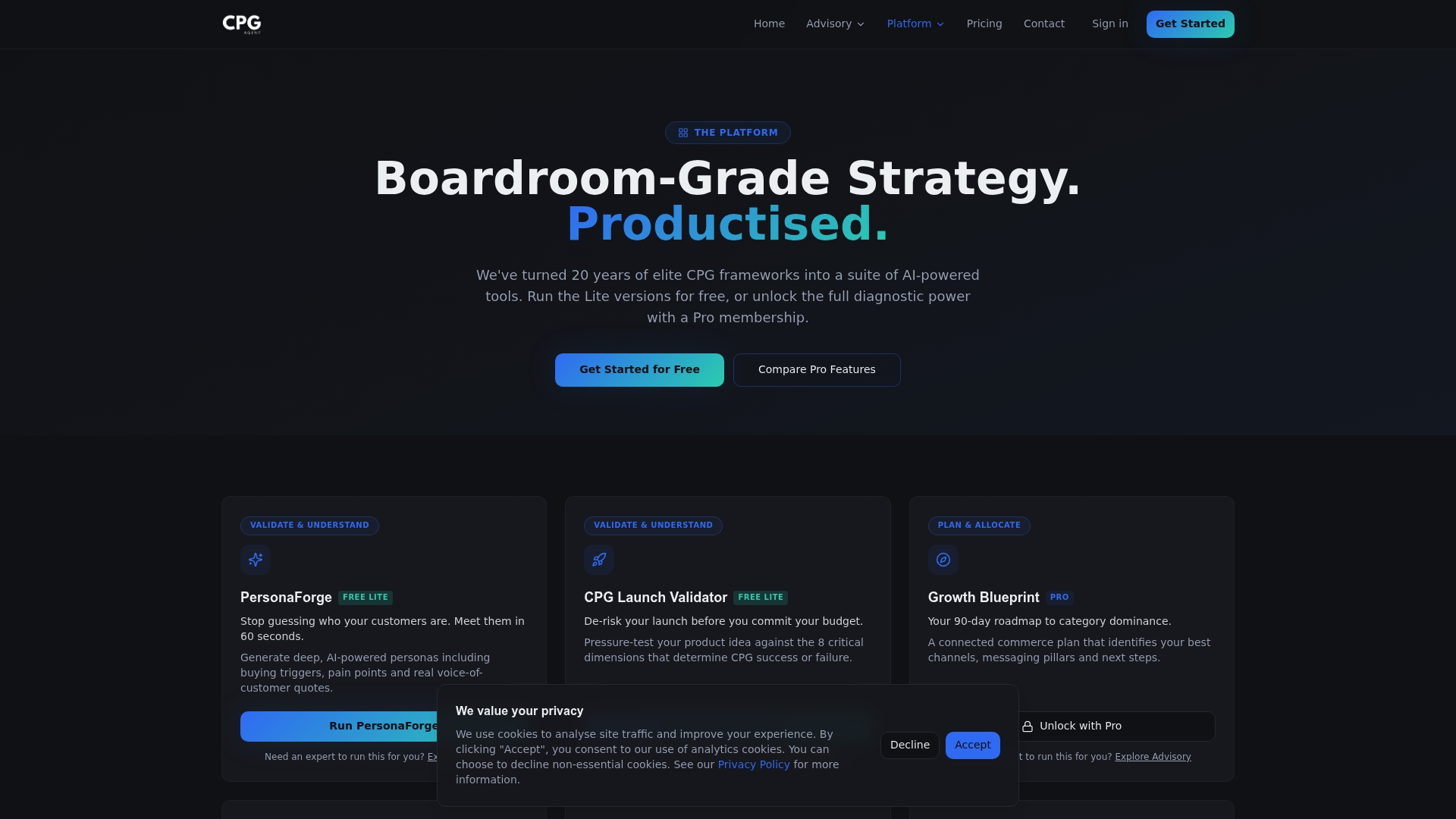
For teams that want to move in 30 or 90 days, Cpgagent offers starter engagements that cover dashboard setup, SKU audit support, and pilot design, with no long-term retainer required. Visit Cpgagent to see the platform or book a call with the advisory team.
Sources
- Where FMCG product renovation fits in the growth equation — NielsenIQ
- New recipe for food brands: a leaner portfolio strategy — EY-Parthenon
- SKU rationalization for growing brands — Circana / Liquid Data Go
- Unlocking hidden value in product portfolios — Strategy& (PwC)
FAQ
What are the first steps to modernize a legacy CPG portfolio?
Start by aligning on strategic objectives and portfolio principles, then build a cross-functional steering committee with a leadership dashboard. Without agreed-upon thresholds, the SKU audit produces data but no decisions.
How does activity-based costing change SKU decisions?
ABC costing surfaces hidden costs like small-batch production runs, changeover downtime, and warehouse complexity that standard contribution margin misses. A SKU that looks profitable on gross margin often turns negative once true cost-to-serve is included.
How long does a CPG portfolio modernization program take?
A structured 90-day starter program can deliver a completed SKU audit, initial pilot results, and first portfolio decisions. Full institutionalization, including a continuous quarterly cadence, typically takes two to three planning cycles.
When should you pilot a change versus rolling it out immediately?
Pilot any renovation or delist where the incremental buyer impact is uncertain or where retailer relationships are at stake. E-commerce holdout tests compress timelines when geographic pilots are too slow for a retailer reset deadline.
How does Cpgagent support portfolio modernization?
Cpgagent's platform covers leadership dashboard automation, Launch Validator for pilot design, and retail audit tools, with fractional CMO advisory available for governance setup and steering committee facilitation.