

TL;DR:
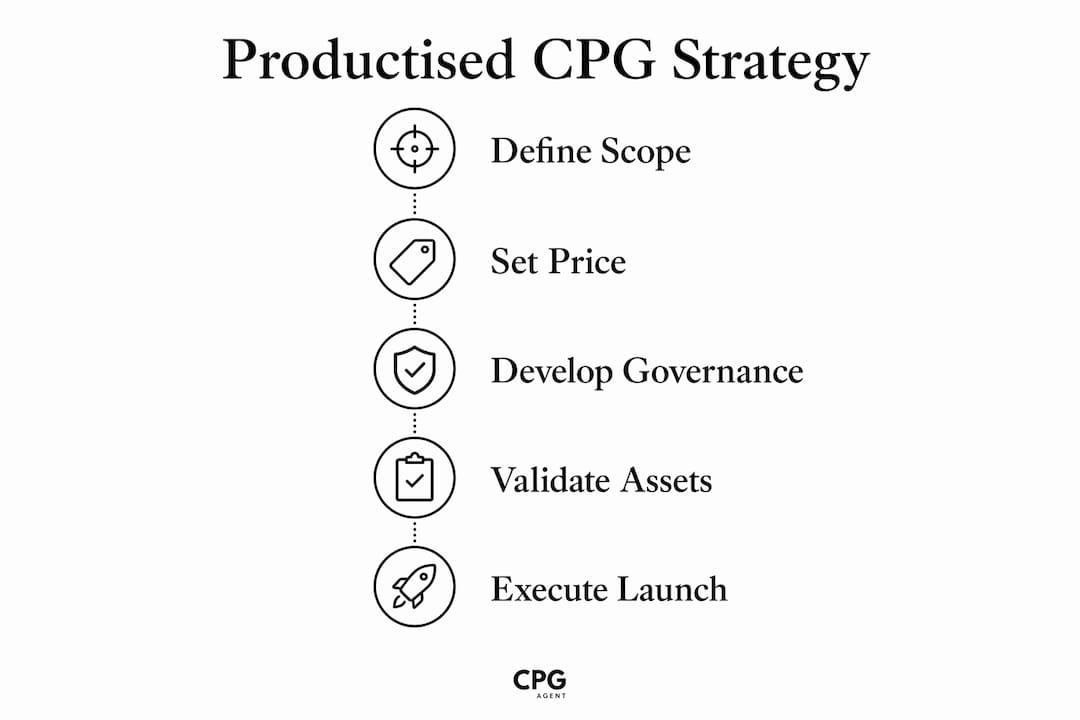
- A productised CPG strategy is a fixed-price, fixed-scope approach that packages development and market work into repeatable systems. It replaces open-ended consultancy with clear deliverables, faster timelines, and predictable results, improving innovation velocity. Key elements include structured governance, asset reuse, cross-functional alignment, and synchronized go-to-market execution.
A productised CPG strategy is a fixed-price, fixed-scope approach to consumer packaged goods brand strategy that packages complex development, governance, and go-to-market work into repeatable, deliverable systems. The industry term for this model is "productized strategy," and it represents a fundamental shift away from open-ended consultancy retainers toward structured offers with defined outputs and timelines. Fixed-scope strategy delivery replaces billable hours with upfront pricing, faster turnarounds, and predictable results. For CPG brand managers facing compressed launch windows and cross-functional coordination challenges, this model directly addresses the operational drag that kills innovation velocity. Platforms like Cpgagent are built specifically to support this kind of execution at speed.
What is a productised CPG strategy and how does it work?
A productised CPG strategy is sold as a standalone deliverable before any retainer engagement begins. Clients pay upfront for fixed outputs such as competitive intelligence reports, audience profiles, and implementation plans, typically within a defined turnaround window. This structure filters out low-commitment engagements and creates a natural commercial path toward ongoing advisory work.

The model works because it forces clarity on both sides. The brand team knows exactly what they are buying. The strategy team knows exactly what they are delivering. That alignment removes the discovery phase drag that plagues traditional CPG consultancy projects, where scope creep and stakeholder misalignment routinely add weeks to timelines.
Productized strategy is not just a pricing decision. It is an operational design choice that requires explicit offer mechanics, defined next steps, and a commercial structure that prevents reverting to hourly work. For CPG brands, this means packaging your product strategy process itself, including the frameworks, decision criteria, and asset libraries, into a system that runs consistently across every launch.
How does productised strategy transform CPG product development?
Traditional CPG product development relies on the stage-gate framework, a sequential process where projects pass through defined review points before advancing. The problem is that stage-gate bottlenecks accumulate at each gate, particularly when decision-makers are not in the room or when cross-functional data is not synchronized. Projects stall. Timelines slip. Market windows close.
A productised approach blends stage-gate structure with agile experimentation to break that pattern. Instead of waiting for a full gate review to validate a concept, teams run smaller, faster experiments that generate real feedback before committing resources. This is how you accelerate iteration cycles without abandoning the governance structure that protects your portfolio.
The critical enabler is cross-functional alignment. Marketing, R&D, supply chain, and finance must operate from shared data and shared goals, not separate project trackers. Shared data across functions is what allows simultaneous demand and supply signals to inform decisions in real time rather than sequentially.
Productised strategy packages these methods into a repeatable system. The key elements include:
- Cross-functional squads with defined roles and decision authority at each stage
- Agile sprint cycles embedded within stage-gate phases to test assumptions early
- Standardized brief templates that capture consumer insight, competitive context, and financial targets before development begins
- Integrated timelines that connect R&D milestones to retail confirmation dates
Pro Tip: Map your predecessor task dependencies before you build your launch timeline. Templates alone do not surface the lead time conflicts that cause launch delays. Backward scheduling from your confirmed retail date is the only way to catch them early.
How should governance work in a productised CPG model?
Decision latency is the primary bottleneck in CPG innovation velocity. Gate decision times averaged 18 days in traditional models before governance redesign reduced them to 4 days per gate. That compression represents a 25% reduction in time to concept approval. The implication is direct: slow gates do not protect quality, they destroy momentum.
A productised governance model redesigns gate reviews around speed and authority. The four operating principles are:
- Set a 5-day decision SLA for every gate review, with a named decision-maker accountable for the outcome
- Require authority in the room at every gate meeting, so no decision gets escalated after the fact
- Replace lengthy gate documents with one-page summaries that surface the three critical questions: Does this fit the portfolio? Is the market signal positive? Are resources available?
- Evaluate portfolio fit using live market data, not internal milestone completion
That last point matters more than most teams realize. Portfolio governance should shift focus from whether a project met its internal targets to whether it still fits the portfolio given current market conditions. A project that passes every internal gate but misreads a shifting consumer trend destroys value regardless of how well it was managed.
Productised strategy embeds kill and pivot criteria directly into the governance system. Without these, standardization fails operationally. Teams revert to slow, custom approval workflows because there is no agreed framework for stopping a project that no longer makes strategic sense.
Does asset reuse actually speed up CPG development?
Asset reuse is the most underutilized efficiency lever in CPG product development. Validated asset reuse reduces redundant work by eliminating repeated reauthorizations of formulations, packaging templates, and compliance data that teams already developed and approved on previous projects.
The problem is organizational. Most CPG teams reset at the start of every project. They rebuild formulation briefs, recreate packaging specifications, and re-engage regulatory teams on inputs that were already validated. That pattern is not just inefficient. It introduces variability into processes that should be stable, and it pushes regulatory input later in the timeline where changes are most expensive.
| Approach | Asset Handling | Timeline Impact | Budget Stability |
|---|---|---|---|
| Project reset model | Rebuild from scratch each launch | Longer cycles, late regulatory input | Unpredictable cost overruns |
| Validated asset reuse | Draw from approved library | Shorter cycles, earlier regulatory alignment | Stable budgets, predictable scale-up |
Digitalization makes asset reuse scalable. When formulations, packaging templates, and compliance data live in a governed digital system, teams can access and adapt them without losing traceability or approval status. The governance layer is what separates a useful asset library from a chaotic shared drive.
Pro Tip: Build your asset library with version control and approval status tags from day one. An asset without a clear approval status is not reusable. It is a liability.
Large CPG organizations have already learned this lesson through master data standardization, which enables automated downstream processes across distributors and SKUs. Smaller brands can apply the same principle at a more focused scale by starting with their highest-frequency formulation and packaging categories.
What does a productised go-to-market execution look like?
A productised go-to-market strategy connects four linked operational stages: distribution model selection, channel partnership development, field sales activation, and retail execution. Retail execution is the critical layer where strategy either proves itself or stalls, regardless of how strong the product is. Shelf audits, planogram compliance, and promotional tracking are not administrative tasks. They are the feedback loop that tells you whether your strategy is working in the real world.
The operational challenge is coordination across all four stages simultaneously. Distribution decisions affect channel partnership terms. Channel terms affect field sales priorities. Field sales priorities affect retail execution quality. A productised approach treats these as an integrated system, not a sequential handoff.
Asset synchronization is the practical mechanism that holds the system together. Backward timelines align packaging print files, manufacturing readiness, and channel asset packs to the confirmed retail date. When these assets lose alignment, launches drift. Packaging arrives before shelf space is confirmed. Digital assets go live before field teams are briefed. Promotional materials reference pricing that has not been finalized.
The brands that execute consistently treat retail readiness as an asset management problem, not a project management problem. Every asset has an owner, a status, and a deadline tied to the retail confirmation date. That structure is what a productised go-to-market system delivers.
For brands expanding into new retailers, this synchronized approach is especially critical. Each new retail relationship introduces new planogram requirements, promotional calendars, and compliance standards that must be absorbed into the existing asset system without disrupting current channel performance.
Key takeaways
A productised CPG strategy works when fixed-scope delivery, speed-focused governance, validated asset reuse, and synchronized go-to-market execution operate as one integrated system.
| Point | Details |
|---|---|
| Fixed-scope delivery | Package strategy as a defined deliverable with set price, scope, and timeline to eliminate open-ended engagement drift. |
| Governance redesign | Set 5-day decision SLAs and require decision authority in every gate meeting to cut approval cycles from 18 days to 4. |
| Asset reuse systems | Build a governed digital library of validated formulations and packaging templates to eliminate redundant rework across launches. |
| Retail execution as feedback | Treat shelf audits and planogram compliance as live strategy signals, not administrative checkboxes. |
| Asset synchronization | Backward-schedule all assets from the confirmed retail date to prevent launch drift across packaging, digital, and field channels. |
The part most teams get wrong about productised strategy
I have worked with CPG teams that invested real effort in productizing their strategy process, built the templates, documented the frameworks, and trained the cross-functional teams. Then they launched and hit the same delays they always had. The templates were not the problem. The lead times were.
Most productization efforts standardize the artifacts: the briefs, the gate documents, the launch checklists. Very few teams map the predecessor task dependencies that determine whether those artifacts can actually be executed on time. A packaging brief template is useless if the regulatory input it depends on has a 14-week lead time that nobody accounted for in the project schedule. Backward scheduling from confirmed retail dates is not a project management best practice. It is the structural foundation that makes productised strategy real rather than theoretical.
The second failure mode I see consistently is treating governance as a separate workstream rather than a core product element. Teams build the strategy system and then assume existing approval processes will accommodate it. They will not. Decision SLAs, kill criteria, and authority-in-the-room requirements need to be embedded into the productised system itself, not bolted on afterward. Without them, the first complex project reverts to custom coordination, and the productised model quietly collapses.
Cross-functional alignment and clean master data are the unglamorous prerequisites that determine whether any of this works. You cannot run a productised CPG model on fragmented data. You cannot maintain asset reuse without version control. You cannot hit 5-day decision SLAs without pre-agreed authority structures. The brands that get this right treat operational infrastructure as a strategic investment, not a back-office function.
— Matthew
How Cpgagent supports productised strategy execution
Cpgagent is built for CPG and FMCG brands that want to execute productised strategy without rebuilding their entire operation from scratch.
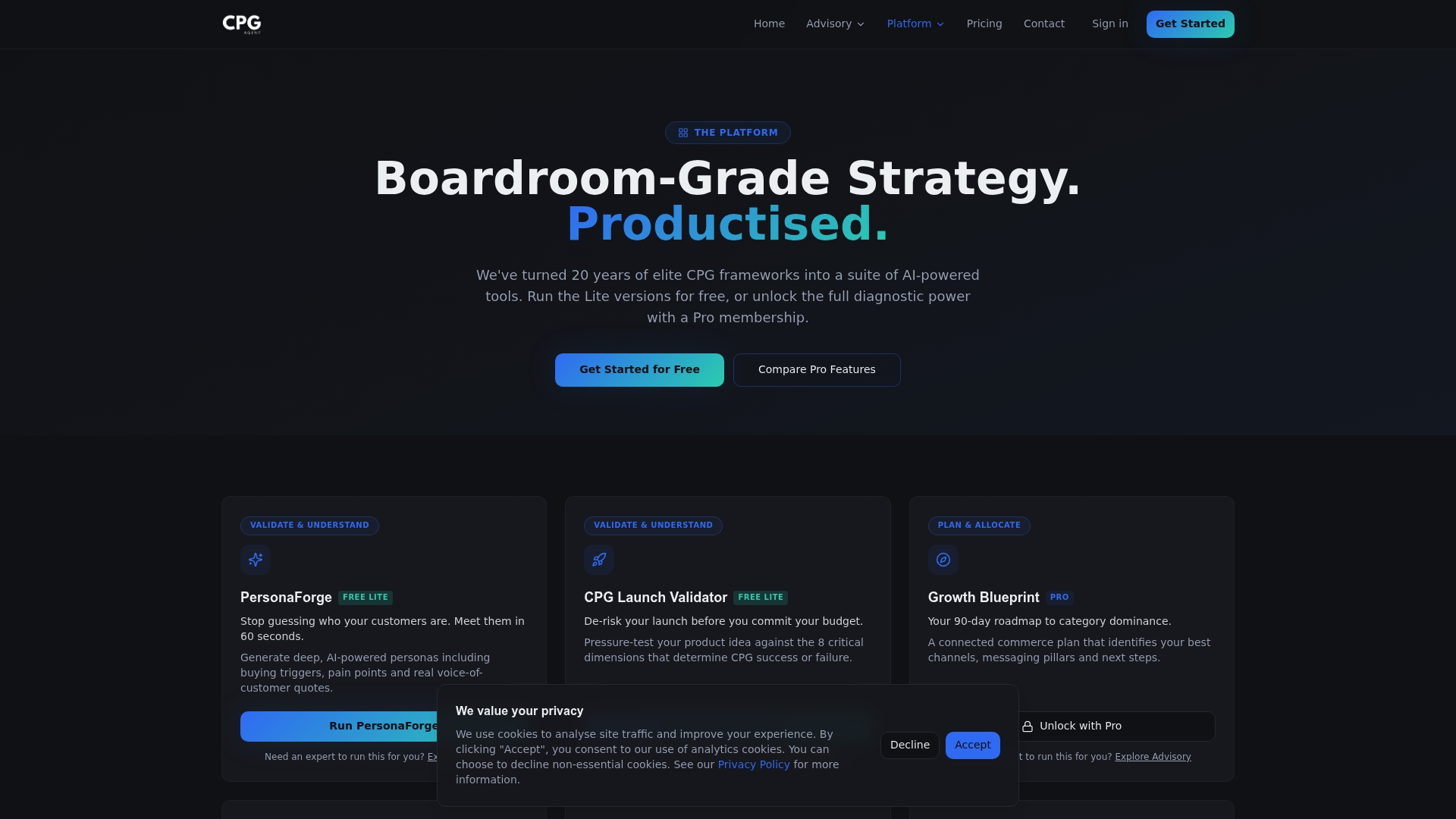
The platform combines AI-driven strategy tools, automated workflows, and fractional leadership advisory to support fixed-scope delivery across product development, marketing, and go-to-market execution. Tools like PersonaForge and Launch Validator provide rapid, data-backed inputs that replace the slow discovery phases traditional agencies rely on. For teams managing asset libraries, cross-functional coordination, and retail execution simultaneously, Cpgagent integrates into existing tech stacks and focuses on pipeline contribution and profit margins from day one. If you are ready to move from strategy documents to operational execution, explore the platform and see how it fits your current stage.
FAQ
What is a productised CPG strategy?
A productised CPG strategy is a fixed-price, fixed-scope approach to brand strategy that packages development, governance, and go-to-market work into repeatable deliverables. It replaces open-ended consultancy with defined outputs and timelines.
How does productised strategy reduce time to market?
Redesigned governance with 5-day decision SLAs cuts gate approval times from an average of 18 days to 4 days per gate, directly compressing the overall development timeline.
What assets should CPG teams reuse across launches?
Validated formulations, packaging templates, and compliance data are the highest-value reusable assets. Storing them in a governed digital system with version control and approval status tags makes them reliably accessible across projects.
Why does retail execution matter in a productised model?
Retail execution is where strategy proves itself in the real world. Shelf audits, planogram compliance, and promotional tracking provide live feedback on whether the productised go-to-market system is delivering results at the shelf level.
How do you prevent launch drift in CPG go-to-market execution?
Backward scheduling from the confirmed retail date aligns all assets, including packaging, digital, and field materials, to a single timeline. Asset synchronization with defined owners and status tracking prevents the coordination failures that cause launch delays.