

The highest-impact legacy brand audience re-engagement tactics are: diagnose and segment your dormant list by churn risk, run a structured re-permission and sunset flow, deploy creative zero-party mechanics (polls, gamified promos, countdowns, nostalgia recaps), design margin-safe personalized incentives, lock down deliverability before any send, and measure everything against a holdout group. That combination works for legacy CPG and FMCG brands specifically because it protects brand equity, limits margin erosion, and generates learning fast enough to compound across campaigns.
Here is what this article covers:
- Diagnose and segment: identify which dormant contacts are worth targeting
- Re-permission and sunset: sequence win-backs responsibly and retire dead addresses
- Creative tactics: polls, gamification, countdowns, and nostalgia recaps
- Incentive design: margin-safe offers and personalization by segment
- Deliverability and list hygiene: technical must-dos before you send
- Measurement and execution: a 6-message win-back sequence with a testing framework
Key Takeaways
Re-engagement programs for legacy brands succeed when they combine precise segmentation, a structured re-permission sequence, creative mechanics that collect zero-party data, and a holdout-controlled measurement framework.
| Point | Details |
|---|---|
| Start within 30–60 days | Trigger re-engagement sequences at 30–60 days of inactivity; waiting longer drops reactivation probability sharply. |
| Segment before you send | Build a reactivation priority score from LTV, purchase recency, and email behavior before writing a single subject line. |
| Lead with value, not discounts | Exhaust loyalty credit, bundles, and experiential offers before applying flat discounts to protect long-term margin. |
| Protect deliverability first | Verify addresses, check DKIM/SPF/DMARC, and throttle sends before any win-back campaign touches a large dormant list. |
| Cpgagent operationalizes this | Cpgagent's platform automates segmentation, creative generation, and test orchestration for legacy CPG re-engagement programs. |
Table of Contents
- How do you diagnose inactivity and build segments worth targeting?
- What does a practical re-permission and sunset policy look like?
- Which creative formats actually get dormant audiences to respond?
- How do you design incentives that protect margin and rebuild habit?
- What deliverability checks must you run before a win-back campaign?
- What metrics and testing framework prove what actually works?
- A ready-to-deploy 6-message win-back sequence
- How an AI platform accelerates re-engagement experiments
- What legacy brands consistently get wrong about re-engagement
- Cpgagent helps legacy brands run this playbook faster
- Sources
- FAQ
How do you diagnose inactivity and build segments worth targeting?
The first step in any re-engagement strategy for brands is data consolidation, not creative. Before you write a single subject line, you need to know which contacts are recoverable and which are costing you sender reputation.
Analytics-driven re-engagement frameworks begin with exactly this: consolidate behavioral data, segment by churn risk, personalize messaging, and track KPIs like reactivation rate and churn reduction. The segmentation step is where most legacy teams underinvest.
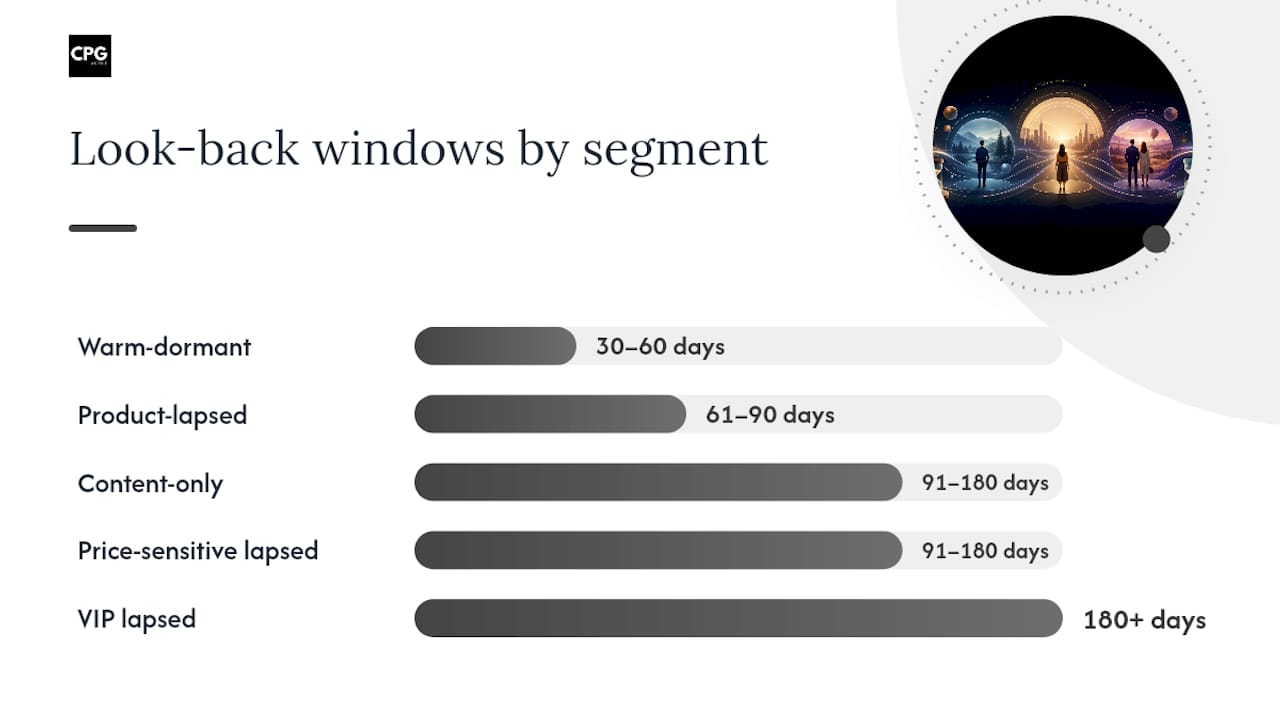
Look-back windows matter more than most teams realize. For legacy CPG brands, shorter windows recover more revenue. A contact inactive for 30 days is far easier to reactivate than one inactive for 180 days. Use these windows as your primary filter:
- 30–60 days: warm-dormant, past purchasers. Highest reactivation probability.
- 61–90 days: product-lapsed repeat buyers. Respond well to category-specific nudges.
- 91–180 days: content-only and price-sensitive lapsed buyers. Need a stronger offer.
- 180+ days: VIP lapsed. Worth a targeted high-value sequence; suppress the rest.
Build a simple reactivation priority score from four behavioral signals: time since last open or click, recency of last purchase, lifetime value (LTV), and last product category purchased. Weight LTV and purchase recency most heavily. A contact who spent $200 last year and opened three emails six weeks ago scores higher than someone who opened once eighteen months ago and never bought; this segmentation method is especially effective when combined with CBD for Rheumatoid Arthritis: What the Evidence Says for health-focused product personalization.
Integrate your CRM with POS data and loyalty program records before you run any campaign. Without that connection, you are segmenting on email behavior alone, which misses your best customers. Behavioral segmentation personas built from combined purchase and engagement signals give you a far more accurate reactivation priority score.
| Segment | Look-back window | Key signals | Suggested channel | Goal metric |
|---|---|---|---|---|
| Warm-dormant | 30–60 days | Last open, recent purchase | Reactivation rate | |
| Product-lapsed | 61–90 days | Category purchase history, LTV | Email + SMS | Repeat purchase rate |
| Content-only | 91–180 days | Opens only, no purchase | Click-to-site rate | |
| Price-sensitive lapsed | 91–180 days | Promo response history | Email + paid social | Conversion rate |
| VIP lapsed | 180+ days | High LTV, multiple categories | Email + direct mail | Revenue recovered |
What does a practical re-permission and sunset policy look like?
Most legacy brands wait too long. Triggered re-engagement sequences that start within 30–60 days of inactivity and run as a short series outperform single late attempts by a wide margin. The re-permission flow below is designed to be automated in any major ESP.
Four-step re-permission flow:
- Warm reminder (Day 30–35): A soft "we noticed you've been away" message. No ask, no discount. Remind them of what they originally signed up for.
- Benefit-led reintroduction (Day 38–42): Lead with what's new or improved. New product line, reformulation, sustainability update. Give them a reason to care again.
- Explicit re-permission ask (Day 45–50): One clear question: "Do you still want to hear from us?" Two buttons. Yes or no. This is your legal checkpoint under CAN-SPAM, which requires a clear opt-out mechanism in every commercial email.
- Final value offer / opt-down (Day 53–60): One last send. Offer a reduced-frequency option ("hear from us monthly instead") or a meaningful incentive. Anyone who does not respond moves to sunset.
Sunset policy checklist:
- Verify all addresses with an email validation tool (ZeroBounce, NeverBounce, or similar) before the sequence starts
- Throttle sends to no more than 10–15% of your dormant list per day during warm-up
- Suppress hard bounces immediately; suppress complaint-risk segments (contacts who have marked previous sends as spam) before the sequence begins
- Set a suppression window: contacts who complete the sequence without engaging get suppressed from active sends for a minimum of 90 days
- Archive suppressed contacts in your CRM with a timestamp and suppression reason; do not delete them outright
Pro Tip: Before removing suppressed contacts from active email, export them as a custom audience for Facebook or Google paid social. You preserve the data for lookalike modeling and retargeting while keeping your active list clean and your deliverability intact.
Which creative formats actually get dormant audiences to respond?
Generic "we miss you" emails do not move legacy audiences. The formats below have demonstrated lift in practitioner programs, and each one collects something useful beyond a click.
Polls, gamified promotions, personalized countdown timers, and value recaps are the four mechanics with the most consistent practitioner evidence for re-engagement lift, particularly when deployed before a peak season.
Email-embedded polls are the fastest way to collect zero-party data from a dormant list. Ask one question: "Which of these products do you still use?" or "What would bring you back?" The act of answering is itself a re-engagement signal, and the answer tells you which segment to move them into. Keep the poll to one question with three options maximum. Anything more complex kills response rate.
Gamified promos (scratch-offs, spin-to-win modules) raise CTR without permanently conditioning your audience to expect discounts. The key distinction: the reward is the experience, not the discount depth. A 10% offer delivered through a spin-to-win mechanic outperforms the same 10% delivered as a flat promo code because the interaction itself creates commitment. Use these sparingly, no more than once per re-engagement sequence, or you train the behavior you are trying to avoid.

Personalized countdown timers add urgency without sounding desperate. The rule for legacy brands: tie the timer to an event (a product relaunch, a seasonal window, a loyalty program deadline), not to an arbitrary "sale ends soon" claim. Arbitrary urgency erodes brand trust with long-term customers who have seen it before.
Nostalgia and value recaps are where legacy brands have a genuine structural advantage over challengers. A brand with 30 years of history can show a customer exactly what they bought in 2019 and what that product has become. Nostalgia, when repackaged with modern relevance, strengthens emotional connection and measurably increases re-engagement, but it requires careful execution to avoid feeling like a museum exhibit. Pair the heritage reference with a concrete "here's what's new" update. For practical guidance on modernizing heritage assets without losing brand equity, the CPG brand refresh strategies guide covers nine repositioning approaches that apply directly to re-engagement creative.
Keep all creative on-brand. Long-time customers are the most sensitive to tone shifts. A legacy brand that suddenly sounds like a DTC startup in its win-back emails will lose credibility with the exact audience it is trying to recover.
How do you design incentives that protect margin and rebuild habit?
The goal of incentive design in a re-engagement program is not to buy a transaction. It is to restart a habit. Those are different objectives, and they require different offer structures.
Offer types ranked by margin impact:
- Loyalty credit (lowest margin risk): award points or credit to an existing loyalty account. The customer perceives high value; your actual cost is the redemption rate, which is typically well below face value.
- Targeted free samples: send a physical sample of a new or reformulated product to high-LTV lapsed buyers. Cost is controlled; the experience is high-touch.
- Product bundles: pair a repurchase trigger (a product the customer bought before) with a new product at a combined price. Drives trial of new SKUs while anchoring on familiarity.
- Time-limited experiential perks: early access to a new product, a virtual tasting, a behind-the-scenes content series. Zero discount, high perceived exclusivity.
- Flat percentage discounts (highest margin risk): use only for price-sensitive lapsed segments and cap at the minimum depth that drives conversion for that segment.
Personalize offer depth by segment signal. A VIP lapsed buyer with $500+ LTV warrants a loyalty credit or a premium sample. A content-only subscriber who never purchased warrants a low-cost introductory offer, not a deep discount that sets a price anchor. For guidance on monetization levers that maintain margin during promotional periods, the brand monetization strategy guide covers this in detail.
When to skip the monetary incentive entirely: if the reason for lapse was not price (the customer simply drifted), a value-led reintroduction (new product, reformulation, mission update) often outperforms a discount. Sending a discount to a customer who left for non-price reasons trains them to wait for one next time.
Quick compliance checklist before applying incentives to existing accounts:
- Confirm the offer does not conflict with existing loyalty program terms
- Check that any "free" claim complies with FTC guidelines on promotional language
- Verify that loyalty credit expiration terms are disclosed clearly in the email
- For subscription-based products, confirm the offer does not trigger an unintended renewal or billing event
What deliverability checks must you run before a win-back campaign?
Sending a win-back campaign to a large dormant list without a pre-flight check is one of the fastest ways to damage your sender reputation permanently. Inbox placement is not guaranteed; it is earned send by send.
Pre-flight checklist:
- Email verification: run the full dormant segment through a validation tool before any send. Remove invalid, role-based, and disposable addresses.
- Authentication: confirm DKIM, SPF, and DMARC records are correctly configured for every sending domain. A misconfigured DMARC policy in reject mode will silently drop your emails.
- Seed list testing: send to a seed list across major ISPs (Gmail, Outlook, Yahoo Mail) before the live send to check inbox vs. spam folder placement.
- Domain warming: if you are using a dedicated re-engagement subdomain (recommended for large dormant lists), warm it over 2–4 weeks before full volume.
- Suppression audit: confirm all previous hard bounces, unsubscribes, and complaint-flagged addresses are suppressed across all sending domains, not just the primary one.
During the campaign, watch three signals daily: bounce rate (pause if hard bounces exceed 2%), spam complaint rate (pause if complaints exceed 0.1% on any single send), and open rate anomalies (a sudden spike can indicate bot activity or a spam trap hit).
Progressive throttling is non-negotiable for legacy lists. Start at 5–10% of the dormant segment per day, monitor deliverability signals for 48 hours, then scale. Do not blast the full list on day one regardless of how clean the verification results look.
Pro Tip: Before the live send, pull a random sample of 50–100 emails from the dormant segment and manually review them for creative issues: broken links, images that trigger spam filters (large single-image layouts with minimal text), and subject lines that contain spam-trigger words. Automated tools miss context that a human catches in five minutes.
What metrics and testing framework prove what actually works?
Re-engagement programs can lift open rates from low double digits toward 45% in some programs, and roughly 71% of marketers report re-engagement efforts successfully reignite inactive subscribers. Those numbers represent the ceiling, not the floor. Your actual results depend entirely on how well you test.
Primary metrics to track:
- Reactivation rate: percentage of dormant contacts who take a qualifying action (purchase, click, opt-in confirmation) within the sequence window
- Short-term conversion rate: purchases within 30 days of first re-engagement touch
- Incremental revenue vs. control group: the revenue attributable to the re-engagement sequence above what the holdout group generated organically
- Deliverability KPI change: bounce rate, complaint rate, and inbox placement rate before and after the campaign
- Downstream CLV lift: 90-day and 180-day purchase value for reactivated contacts vs. the holdout
Testing framework: run every re-engagement sequence with a holdout group of at least 10–15% of each segment. Without a holdout, you cannot separate re-engagement lift from organic return. For A/B tests within the sequence, hold the timing constant and test one variable at a time: subject line, creative format, offer type, or channel. For legacy lists large enough to support it (10,000+ per segment), a technical stack that runs content, channel, and timing experiments simultaneously identifies the best path per segment without manual orchestration.
When resource-constrained, prioritize tests in this order: subject line (highest volume, fastest signal), offer type (highest revenue impact), channel mix (email vs. SMS vs. paid social). Do not run multivariate tests until you have clean A/B baselines for each variable.
A ready-to-deploy 6-message win-back sequence
This sequence maps to the re-permission flow and creative tactics above. Copy it into your automation platform and test immediately. Practical sequence templates are a useful starting point for adapting copy and KPI benchmarks to your category.
| Message | Send timing | Subject-line intent | Content goal | CTA | Channel |
|---|---|---|---|---|---|
| 1 | Day 30 | Soft check-in, no ask | Remind of original value; no offer | "See what's new" | |
| 2 | Day 35 | Product or brand update | Introduce new SKU or reformulation | "Shop the update" | |
| 3 | Day 40 | Zero-party data poll | Collect preference signal; one question | "Tell us what you think" | |
| 4 | Day 45 | Personalized offer | Segment-matched incentive (loyalty credit, bundle, sample) | "Claim your offer" | Email + SMS |
| 5 | Day 52 | Urgency / countdown | Time-limited version of Message 4 offer | "Offer ends [date]" | Email + SMS |
| 6 | Day 58 | Final re-permission ask | Explicit opt-in confirmation or opt-down option | "Stay in / hear less" |
Personalization tokens to use: first name, last product category purchased, last purchase date, loyalty point balance (if applicable), and local store or retailer name for retail-distributed brands.
Fallback rules: any contact who does not open Messages 1–3 moves to a suppressed "low-engagement" tag before Message 4 sends. Any contact who does not respond to Message 6 moves to the sunset suppression list. Do not send more than two messages per week to any single contact.
Variant ideas to A/B test inside the sequence:
- Subject line tone: curiosity vs. direct benefit statement (Message 1)
- Offer type: loyalty credit vs. product bundle (Message 4)
- Urgency framing: specific date vs. "limited quantity" (Message 5)
- Channel mix: email-only vs. email + SMS for Messages 4 and 5
- Poll question: product preference vs. reason for lapse (Message 3)
How an AI platform accelerates re-engagement experiments
Running this playbook manually across five segments and six messages is a significant operational lift. The brands that compress test cycles and improve results fastest are the ones using AI tooling to automate segmentation, serve personalized creative at the segment level, and orchestrate multivariate tests without manual handoffs.
Cpgagent's platform is built for exactly this workflow. PersonaForge automates the behavioral segmentation step, pulling CRM and purchase data into reactivation priority scores without manual scoring. Launch Validator stress-tests offer structures against margin thresholds before a campaign goes live. The fractional CMO service means a senior marketing leader is accountable for the experiment design and the results, not just the execution.
For legacy brands with large dormant lists and legacy CRM silos, the platform's ability to integrate with existing tech stacks and run segment-level personalization without a full data engineering project is the practical advantage. Teams that want to operationalize the sequence above can explore the Cpgagent platform to see how automated segmentation and creative generation map to each stage of the win-back flow.
What legacy brands consistently get wrong about re-engagement
The most common mistake is treating re-engagement as a broadcast problem. Teams pull the dormant list, write one "we miss you" email, send it to everyone, and measure aggregate open rate. That approach tells you almost nothing and often makes deliverability worse.
The second mistake is waiting too long. A contact who has been inactive for eight months is not a re-engagement candidate; they are a list hygiene problem. The 30–60 day trigger window exists because that is when the emotional connection is still warm enough to recover. Every month you wait, the probability of reactivation drops and the risk to your sender reputation rises.
The third, and most expensive, mistake is leading with a discount. A flat 20% off sent to your entire dormant list trains every recoverable customer to wait for the next discount before buying again. Margin erosion compounds across campaigns. The sequence above is designed specifically to exhaust value-led and experiential options before any monetary incentive appears.
My recommendation for the next 30 days: pick one segment (warm-dormant, 30–60 days), run the 6-message sequence with a 15% holdout, and measure incremental revenue against the control. One clean experiment with a real holdout will tell you more than any industry benchmark. Stage the experiment before you scale it.
Cpgagent helps legacy brands run this playbook faster
Legacy brands sitting on large dormant lists and legacy CRM infrastructure need more than a tactical checklist. They need a system that automates the segmentation, generates personalized creative at scale, and tracks incremental results against a holdout without a six-month implementation project.
Cpgagent delivers AI-powered strategy tools and fractional CMO leadership designed for CPG and FMCG brands at exactly this stage. The platform covers automated segmentation via PersonaForge, offer validation against margin thresholds, creative generation for segment-specific messaging, and test orchestration across email, SMS, and paid social. No agency retainer. No long discovery phase. The fractional CMO service puts a senior marketing leader on your re-engagement program from week one.
Ready to run your first structured win-back experiment? Explore the Cpgagent platform and book a discovery call to map the 6-message sequence to your existing tech stack.
Pro Tip: When speaking with any platform or vendor about re-engagement, ask specifically: "How do you handle holdout group measurement?" and "Can you show me a segment-level reactivation rate from a comparable brand?" Those two questions separate platforms that run campaigns from ones that generate learning.
Sources
- How to Send Analytics-Driven Re-Engagement Campaigns | Elastic Email
- 10 examples of effective re-engagement emails | HubSpot
- Here's why your customers are tuning you out and how you can effectively re-engage them | Mastercard
- 4 Re-Engagement Strategies to Win Over Your Customers | Movable Ink
- Re-Engagement Campaigns: Win Back Inactive Subscribers - Beehiiv
- CAN-SPAM Act: A compliance guide for business | FTC
- Business
- Nostalgia marketing needs a Gen Alpha strategy | Adweek
FAQ
What is the best look-back window for legacy brand re-engagement?
For legacy CPG brands, shorter look-back windows—such as 30–60 days—are generally associated with higher reactivation rates. Contacts inactive for more than 180 days should be treated as a separate, lower-priority segment with a more aggressive sunset policy.
What is an example of a re-engagement strategy that works?
A 6-message email sequence triggered at day 30 of inactivity, starting with a soft value reminder and escalating to a personalized offer and an explicit re-permission ask by day 58, is one of the most consistently effective structures. Pairing it with a holdout group lets you measure true incremental lift.
What is the success rate of re-engagement campaigns?
Industry data suggests re-engagement programs can lift open rates from low double digits toward 45% in well-run programs, with roughly 71% of marketers reporting that re-engagement efforts successfully reignite inactive subscribers. Results vary significantly by segment quality and sequence design.
What does "legacy" mean in a marketing context?
In marketing, a legacy brand is an established brand with significant market history, existing customer equity, and often a large but partially dormant customer base. The re-engagement challenge for legacy brands is recovering that dormant base without eroding the brand equity that makes them worth coming back to.
How do you protect deliverability when emailing a large dormant list?
Verify addresses before sending, confirm DKIM/SPF/DMARC authentication, throttle sends to 10–15% of the dormant segment per day, and suppress hard bounces and complaint-risk contacts before the sequence starts. Monitor bounce rate and spam complaint rate daily and pause if either exceeds its threshold.