

TL;DR:
- Behavioral segmentation personas are built on observable actions like purchase patterns and decision triggers, making them more predictive than traditional demographic profiles. They should be validated through controlled shadow tests and reviewed every 90 days to maintain accuracy. Using real-time, consented behavioral data improves campaign performance and customer trust.
Behavioral segmentation personas are customer profiles built on observable actions, purchase patterns, and decision triggers rather than demographic labels. Unlike traditional personas, they capture what customers actually do, not just who they are on paper. 71% of companies exceeding revenue goals use documented buyer personas, and hybrid segmentation that blends behavioral and demographic signals can improve campaign effectiveness by 20–30%. For marketing professionals and business analysts, this distinction is not academic. It directly determines whether your targeting predicts behavior or merely describes it.
What are behavioral segmentation personas and how do they differ from traditional ones?
Behavioral segmentation personas are the industry's answer to a well-documented failure: demographic profiles that describe customers without predicting them. The formal term in customer experience research is "journey-aware personas," and the distinction matters. Journey-aware personas evolve from static demographic snapshots to dynamic models that track behavior across the full customer lifecycle.
Traditional personas group customers by age, income, or job title. These groupings are easy to build but notoriously poor at predicting purchase decisions. A 45-year-old suburban parent and a 45-year-old urban professional may share every demographic trait while buying in completely different patterns. Demographics describe the audience. Behavior reveals the intent.
The difference between a segment and a persona is also worth clarifying. A segment is a quantitative grouping, such as "customers who bought twice in the last 90 days." A persona is a behavioral story built on top of that segment. It names the decision triggers, the friction points, and the emotional context that drives the segment's choices. Effective personas describe decisions, triggers, and objections rather than static traits like job title or household income.
Why demographics alone fail marketers
Most SMB buyer personas are "demographic fanfiction". They read like census data dressed up with a stock photo and a name. The result is copy that sounds generic because it was built on generic inputs. Behavioral traits, by contrast, directly influence the language, offers, and timing that convert.
Consider two customers in the same demographic bracket. One browses three times before buying and always uses a discount code. The other buys immediately after reading a single review. Same demographics. Completely different behavioral profiles. Serving them identical messaging wastes budget on one and insults the intelligence of the other.
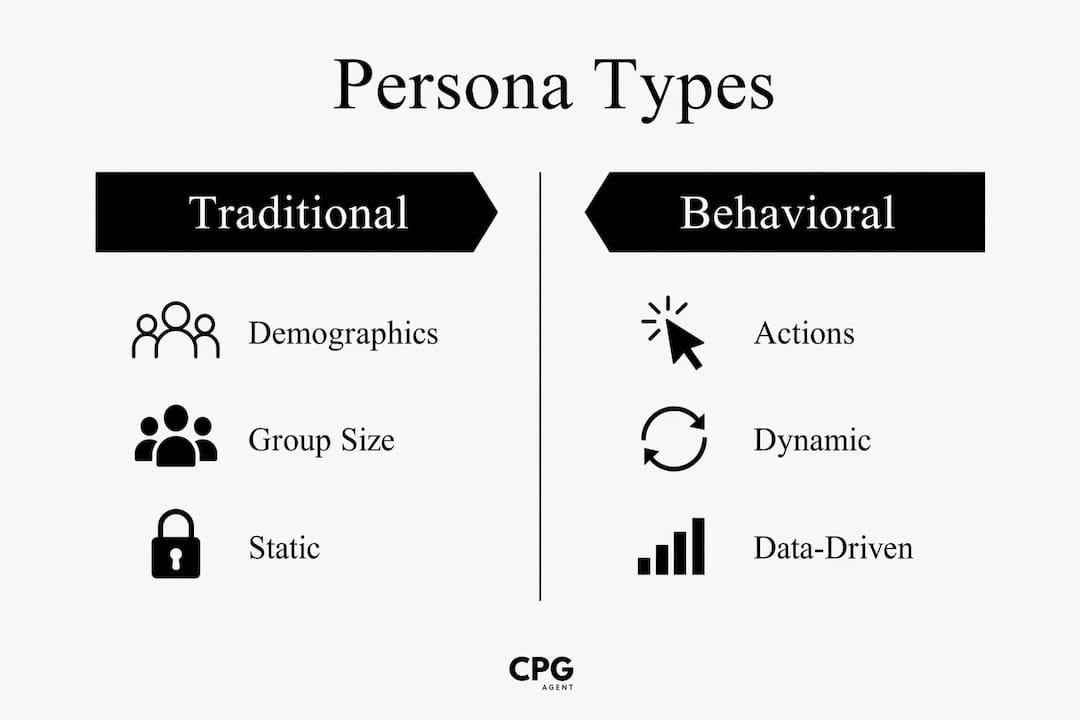
| Dimension | Traditional persona | Behavioral persona |
|---|---|---|
| Primary data source | Demographics, surveys | Purchase history, engagement, clicks |
| Update frequency | Quarterly or annual | Continuous or real-time |
| Predictive power | Low | High |
| Personalization depth | Broad messaging | Trigger-based, journey-stage specific |
| Privacy risk | Moderate | Managed via consent-first design |
What data and signals build strong behavioral personas?
The inputs that make behavioral personas work are specific and observable. Behavioral segmentation analyzes actions like purchase frequency and engagement to anticipate customer needs before the customer articulates them. The strongest signals fall into four categories.
- Purchase behavior: Frequency, recency, average order value, and category switching. These signals reveal loyalty patterns and price sensitivity without asking a single survey question.
- Engagement signals: Email open rates, content consumption depth, session length, and feature usage. High engagement with educational content often predicts a longer consideration cycle.
- Decision triggers: Events that precede a purchase, such as a price drop, a product review, or a lifecycle moment like a subscription renewal date.
- Friction signals: Cart abandonment, hesitation on pricing pages, and repeated returns. Ignoring friction points like hesitation or abandonment reveals missed segmentation opportunities that most teams leave on the table.
First-party data is the foundation. Product analytics, CRM event logs, and preference center inputs give you the cleanest signal with the lowest privacy risk. Micro-experiments, such as A/B tests on messaging or offer sequencing, generate behavioral data while simultaneously improving conversion. Consent-first design is not optional. Collecting behavioral data without explicit consent creates compliance exposure under frameworks like GDPR and CCPA, and it erodes the trust that makes personalization effective.
A minimum segment size of 50 accounts or users is the recommended threshold for an actionable behavioral segment. Below that number, patterns become noise rather than signal. Above it, you have enough behavioral variance to write a persona that reflects a real group rather than an outlier.

Pro Tip: Build a preference signal center into your product or email flow. Let customers self-select content types, communication frequency, and product interests. Consented preference data outperforms inferred behavioral data in both accuracy and regulatory safety.
How do you validate and operationalize behavioral personas?
Building a persona is the easy part. Validating that it actually changes marketing outcomes is where most teams fall short. The gold standard is causal validation through controlled experiments. Before rolling out a persona-driven campaign to your full audience, run a shadow test.
Running shadow tests before full persona rollout allows causal validation and reduces deployment risk. A two-week shadow test exposes a small segment to persona-tailored messaging while the control group receives standard content. The delta in conversion rate tells you whether the persona model is predictive or merely descriptive.
The operationalization process follows a clear sequence:
- Define the behavioral hypothesis. State what action you expect a specific persona to take given a specific trigger. "Customers who viewed a product three times without buying will convert at a higher rate when offered free shipping rather than a discount."
- Build the segment. Pull the behavioral data that matches the hypothesis. Apply the 50-user minimum to confirm the segment is large enough to measure.
- Run the shadow test. Expose the test group to persona-tailored content for two weeks. Measure conversion lift, not just click-through rate.
- Measure business KPIs. Connect persona performance to revenue metrics, not vanity metrics. Conversion lift, customer lifetime value, and retention rate are the signals that matter.
- Iterate or retire. If the persona does not produce measurable lift, retire it. Static personas that outlive their behavioral validity become liabilities.
Edge inference processes behavioral data in real-time on user devices to maintain persona accuracy without sending raw data to a central server. This approach reduces latency and privacy risk simultaneously. For CPG and FMCG brands running high-velocity campaigns, real-time persona accuracy is the difference between a relevant offer and a stale one.
Pro Tip: Set a persona expiration date. Every behavioral persona should be reviewed and re-validated every 90 days. Markets shift, customer behavior changes, and a persona built on last year's data can actively mislead your targeting.
How do behavioral personas improve real campaign performance?
The practical payoff of customer behavior personas shows up at every stage of the campaign lifecycle. The shift is from broad audience targeting to trigger-based, journey-stage specific messaging that shifts personalization toward trust-building and emotional connection.
Here is how behavioral personas translate into campaign decisions:
- Lifecycle messaging: A persona defined by high purchase frequency but low average order value responds to bundle offers. A persona defined by high order value but low frequency responds to exclusivity signals and early access.
- Journey-stage targeting: A persona in the consideration stage needs social proof and comparison content. A persona in the loyalty stage needs recognition and reward signals. Sending consideration-stage content to a loyal customer wastes the relationship.
- Omnichannel sequencing: Behavioral personas reveal which channels each segment uses at each stage. A segment that engages heavily on email during the consideration phase but converts via mobile at checkout needs a cross-channel sequence, not a single-channel push.
- AI-powered personalization: Platforms that integrate behavioral data with AI can update persona assignments in real-time as customer behavior shifts. Implementing consented, behavior-based preference signals boosted conversion rates by 6% and reduced privacy complaints in documented case studies.
| Campaign application | Behavioral signal used | Expected outcome |
|---|---|---|
| Abandoned cart recovery | Session hesitation, exit intent | Higher recovery rate vs. generic reminder |
| Loyalty program upsell | Purchase frequency, recency | Increased average order value |
| New product launch targeting | Category affinity, engagement depth | Faster trial adoption |
| Churn prevention | Declining engagement, reduced frequency | Improved retention rate |
For FMCG brands specifically, behavioral personas tied to performance marketing channels create a direct line between audience insight and shelf velocity. The persona is not a marketing artifact. It is an operational input that drives media spend, creative decisions, and promotional timing.
Key Takeaways
Behavioral segmentation personas outperform demographic profiles because they are built on what customers do, not who they are, making them predictive rather than merely descriptive.
| Point | Details |
|---|---|
| Behavior beats demographics | Purchase frequency, engagement, and friction signals predict intent better than age or income. |
| Minimum segment size matters | Use at least 50 users per segment to generate statistically reliable behavioral patterns. |
| Shadow testing validates personas | Run two-week controlled tests before full rollout to confirm causal lift, not correlation. |
| Personas need expiration dates | Review and re-validate every behavioral persona every 90 days to prevent stale targeting. |
| Privacy compliance is non-negotiable | Consent-first data collection protects both regulatory standing and customer trust. |
Why I think most persona work is still broken in 2026
The uncomfortable truth is that most marketing teams build personas once, present them in a slide deck, and never touch them again. I have seen this pattern repeatedly. A team spends weeks on persona research, produces beautifully designed profiles, and then uses them as creative inspiration rather than operational inputs. The personas sit in a shared drive while the actual campaign targeting runs on demographic filters from three years ago.
The shift that actually moves revenue is treating personas as living models, not documents. Behavior is more predictive and actionable than demographics in modern persona work, and the teams winning on this are the ones connecting persona signals directly to campaign triggers in real-time. The importance of brand personas for FMCG brands is not in the research phase. It is in the activation phase.
The other mistake I see constantly is measuring persona success by creative quality rather than conversion lift. A persona that produces beautiful copy but does not move a KPI is not a good persona. It is expensive decoration. Connect every persona directly to a measurable business outcome before you call it done.
— Matthew
How Cpgagent supports dynamic behavioral segmentation
Cpgagent is built for CPG and FMCG brands that need behavioral segmentation to move at the speed of the market, not the speed of a quarterly agency review.

The Cpgagent platform integrates first-party behavioral data, AI-driven persona modeling, and automated campaign workflows into a single environment. Tools like PersonaForge translate raw behavioral signals into actionable persona profiles without the overhead of a traditional research sprint. For brands that need to test, validate, and activate persona-driven campaigns in days rather than months, Cpgagent provides the infrastructure to do it at scale, with privacy compliance built in from the start.
FAQ
What are behavioral segmentation personas?
Behavioral segmentation personas are customer profiles built on observable actions such as purchase frequency, engagement patterns, and decision triggers rather than demographic data. They predict customer behavior and enable trigger-based, personalized marketing.
How many users do I need to build a valid behavioral segment?
A minimum of 50 accounts or users is the recommended threshold for a statistically actionable behavioral segment. Below that number, patterns are too noisy to support reliable persona modeling.
How often should behavioral personas be updated?
Behavioral personas should be reviewed and re-validated every 90 days. Customer behavior shifts with market conditions, and static personas quickly lose predictive accuracy.
What is the best way to validate a new behavioral persona?
Run a shadow test for two weeks before full rollout. Expose a small test group to persona-tailored messaging and measure conversion lift against a control group to confirm causal impact.
How do behavioral personas improve conversion rates?
Consented, behavior-based preference signals have been shown to boost conversion rates by 6% while also reducing privacy complaints. The gain comes from matching offers and messaging to actual customer intent rather than assumed demographic preferences.