

Slotting fees are the upfront charges retailers collect from manufacturers to place a new SKU on their shelves. Treat them as a negotiable launch cost, not a fixed tax, and model the full P&L before you sign anything. NielsenIQ describes slotting fees as payments that compensate retailers for warehouse setup, planogram changes, and the opportunity cost of displacing an existing product. The headline number is rarely the real number. According to Wikipedia's overview of slotting fee structures, a new product's initial slotting fee can run from moderate amounts in regional clusters of stores to substantially higher sums in very high-demand markets. That range alone tells you why modeling matters before the buyer meeting.
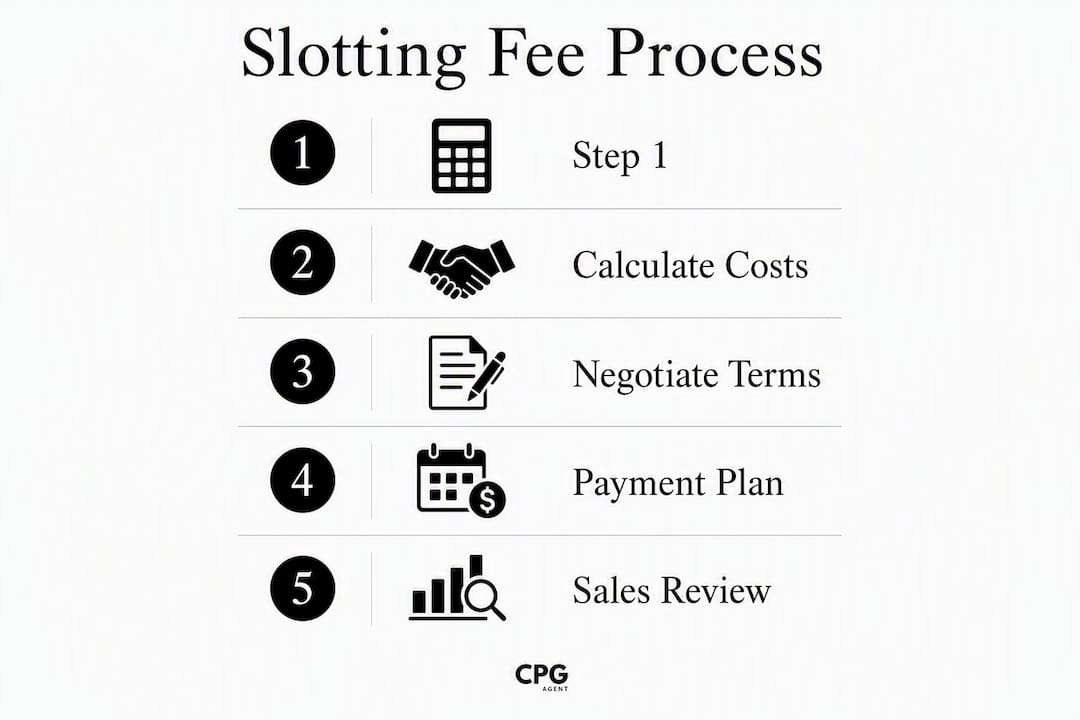
Three things to do before your first buyer conversation: calculate the total introduction cost (cash slotting plus free fills plus first-year trade spend), demand a written fee structure from the retailer, and decide which negotiation lever you will lead with — cash, free-fill product, or a performance-based guarantee.

Table of Contents
- How do retail slotting fees actually work?
- What do slotting fees typically cost by channel?
- Why do retailers charge slotting fees, and is it legal?
- How do you calculate the true P&L impact of a slotting deal?
- What negotiation tactics actually reduce slotting costs?
- What deal structures reduce upfront cash exposure?
- What does the timeline from pitch to first review look like?
- What mistakes do brands make with slotting fees?
- How do modern tools and advisory services help you negotiate better?
- Key Takeaways
- The part of slotting negotiations most brands get wrong
- Cpgagent helps you model and negotiate slotting scenarios
- Useful sources
- FAQ
How do retail slotting fees actually work?
Slotting fees are charged per SKU and can be billed per store, per UPC across a region, or as a single chain authorization fee. Retailers present them in different ways, and recognizing the structure in a contract is half the battle.
Common fee types you will encounter:
- One-time listing fee. A flat charge per SKU to enter the retailer's system. Appears on the first invoice or as a deduction against your first shipment. Example: a buyer quotes "$15,000 per UPC for chain authorization."
- Per-store slotting. Billed at a set dollar amount multiplied by the number of stores carrying the item. A 200-store regional chain at $75 per store equals $15,000 before a single unit sells.
- Free-fill requirement. The retailer requests one to two cases per store at no charge to stock the shelf at launch. On a 200-store rollout with a $20 wholesale case cost, that is $4,000–$8,000 in product out the door immediately.
- Pay-to-stay fee. A recurring charge, often tied to a quarterly or annual category reset, to keep the SKU on shelf. Some retailers frame this as a "shelf renewal" or "reset participation fee."
- Category reset fee. Charged when the retailer reorganizes a category's planogram. Your SKU may be caught in a reset even if it is performing well.
- Merchandising and display fees. Separate charges for end-cap placement, secondary displays, or feature positions. These are negotiated independently from base slotting.
- Chargebacks. Deductions taken against invoices for OTIF (on-time, in-full) failures, labeling errors, or planogram non-compliance. Not technically a slotting fee, but they land in the same budget bucket.
Many retailers also disguise slotting as mandatory promotional commitments. A buyer who says "we don't charge slotting" may still require a $10,000 co-op advertising buy or a two-case-per-store free fill as a condition of listing. Read every line of the commercial terms, not just the section labeled "slotting."

What do slotting fees typically cost by channel?
Costs vary widely by retailer type, category, and store footprint. The table below reflects planning bands used by experienced CPG buyers; treat them as directional, not as quotes.
| Channel | Typical per-SKU range | Notes |
|---|---|---|
| Conventional grocery (regional) | $10,000 | Per-store billing common; DSD products often lower |
| Conventional grocery (national) | Planning bands range from $20,000 to $80,000 per SKU, for chain authorization in high-demand categories, according to MOART's 2026 market-rate analysis. | |
| Mass retail | Planning bands range from $25,000–$60,000 per SKU depending on category velocity and promotional commitment. | |
| Club channel | $10,000 per item | Often structured as free fills or promotional commitments |
| Natural/specialty (regional) | $15,000 | Lower cash fees; trade spend and demos often substituted |
A few variables move a fee from the low end to the high end fast. Store footprint is the biggest lever: a 1,500-store national chain costs more than a 150-store regional by definition. Frozen and refrigerated SKUs carry higher fees because of warehousing complexity. Categories with heavy competition (snacks, beverages, supplements) command more than niche or underdeveloped categories where the retailer wants differentiation. National chain authorization billing consolidates the entire fee into one payment, which hits cash flow harder than per-store billing spread across a rollout.
MOART's 2026 market-rate analysis notes the meaningful difference between cash-heavy slotting and trade-commitment approaches at retailers that claim they "do not charge slotting." The FTC's historical staff research from the early 2000s established directional per-SKU benchmarks that analysts still reference as a baseline, though current ranges have shifted upward with inflation and category consolidation.
Pro Tip: If a retailer quotes a per-store fee, always multiply by the full store count before reacting. A $75-per-store fee sounds manageable until you realize the chain has 800 locations.
Why do retailers charge slotting fees, and is it legal?
Shelf space is finite. A typical supermarket carries tens of thousands of SKUs, and new product failure rates run around 70% according to the FTC's grocery industry study. When a retailer takes on a new product, it absorbs real costs: rearranging warehouse systems, updating planograms, setting up new items in accounting software, and marking down displaced products. Slotting fees offset those costs and shift some failure risk back to the manufacturer.
The FTC's study found the practice "widespread" in the supermarket industry and noted that many grocers earn more from agreeing to carry a product than from actually selling it. That is not a scandal; it is a structural reality of how grocery economics work.
"A manufacturer's willingness to pay slotting allowances further indicates the manufacturer's confidence that the product will be successful, thereby shifting the risk of product failure back to the manufacturer." — FTC Slotting Allowances in the Retail Grocery Industry report
On the legal side, the U.S. Department of Justice frames slotting contracts as an economic allocation mechanism rather than per se illegal behavior. The DOJ's economic note acknowledges competition considerations but does not classify standard slotting as an antitrust violation. The FTC monitors the practice and has published guidance, but paying slotting fees is legal and common across U.S. retail.
The practical takeaway: slotting fees are negotiable, not statutory. Paying them does not obligate the retailer to spend a dollar on marketing your product. Shelf placement is access, not support.
How do you calculate the true P&L impact of a slotting deal?
The headline slotting number is the smallest part of the real cost. SPS Commerce makes the point clearly: slotting is the initial hurdle, but ongoing trade spend, promotions, and deductions make up a larger share of the total cost to sell through retailers.
Here is a step-by-step model for a 100-store regional launch:
| Cost component | Example amount |
|---|---|
| Merchandising/display fees | $2,500 |
Now convert that to breakeven cases. If your gross profit per case is $10, you need to sell 2,500 cases across 100 stores to recover the launch investment. That is 25 cases per store over the review window. If the retailer's standard review window is 26 weeks, you need roughly one case per store per week to break even. Whether that velocity is realistic depends on your category, price point, and promotional support.
Eightx's modeling framework uses a similar conversion approach, translating a total slot cost into per-store velocity targets so brands can stress-test viability before committing.
Sensitivity check: If gross profit per case drops from $10 to $7 (a common scenario after trade discounts), breakeven cases jump to roughly 3,571 — a 43% increase in required velocity from the same store count. That is the number that should drive your go/no-go decision, not the headline slotting fee.
One accounting note: slotting and related promotional commitments should be modeled as contra-revenue (a reduction of net revenue), not as COGS. Booking them as COGS understates the true effect on net margin and makes the deal look more profitable than it is.
What negotiation tactics actually reduce slotting costs?
Preparation is the only real leverage. Buyers negotiate dozens of new items every quarter; a brand that walks in with data stands out from one that walks in with a story.
Pre-negotiation checklist:
- Pull distributor scan data or POS velocity from any doors already carrying the product. Even 10 stores of clean sell-through data changes the conversation.
- Build a one-page velocity forecast with category benchmarks from NielsenIQ or SPINS. Show the buyer where your product sits relative to the category average.
- Prepare a retail audit summary. Shelf-audit photos and compliance data signal operational maturity and reduce the retailer's perceived risk.
- Know your walk-away number. Calculate the maximum total launch investment your P&L can absorb and work backward to the per-store fee you can accept.
- Identify which concession you will offer first: free fills, increased trade spend, a sliding-scale sell-through guarantee, or a longer payment schedule.
- Request the fee structure in writing before the meeting, not after. Verbal quotes shift; written terms do not.
- Ask about the review window length and the specific KPIs the buyer will use to evaluate performance. Vague review criteria are a red flag.
Tactical concessions that work:
- Free fills instead of cash. Offering product at no charge shifts the cost from cash to inventory and can be more palatable for early-stage brands with tight liquidity.
- Higher trade spend commitment. Agreeing to a deeper promotional discount or a funded feature ad can reduce or eliminate the cash slotting ask.
- Sliding-scale guarantee. Offer to pay a higher fee only if sell-through exceeds a defined threshold, and a lower fee if it does not. This aligns incentives.
- Staged rollout. Propose starting with 50 stores instead of 300. Lower store count means lower total slotting, and you generate proof of concept before scaling.
- Co-op marketing commitment. A funded digital or circular ad buy can substitute for part of the slotting fee at retailers with active co-op programs.
Contract terms to request explicitly: a defined review window (minimum 12 weeks, ideally 26), written pay-to-stay triggers with specific thresholds, guaranteed merchandising windows, named KPIs for performance evaluation, and a dispute mechanism for chargebacks.
Pro Tip: A good broker is worth the commission. Experienced brokers carry retailer relationships and know which buyers have flexibility on slotting versus those who hold firm. They also know which retailers disguise slotting as mandatory promotional commitments — and how to negotiate around both.
For founder brands navigating their first major retailer, the playbook for winning retail placement covers negotiation storytelling and data-driven pitch tactics in detail.
What deal structures reduce upfront cash exposure?
The cleanest alternative to a large upfront cash payment is a performance-linked deal. MOART's 2026 analysis confirms that savvy brands are shifting from cash-heavy upfront payments to sliding-scale guarantees tied to sell-through, with defined review windows and clear measurement criteria.
A regional pilot launch is the most common structure. Start with a single region or a subset of stores, generate real velocity data, and use that data to negotiate the national rollout on better terms. The pilot costs less in absolute slotting dollars and gives you proof before you commit to a chain-wide fee.
For performance deals to work, three things must be in the contract: a mutually agreed sell-through window (typically 12–26 weeks), a specific velocity threshold that triggers any pay-to-stay or additional fees, and a data-sharing agreement that defines which POS system or scan data source will be used to measure performance. Without those three elements, "performance-based" is just a verbal promise.
Audit requirements matter here too. Failing OTIF or planogram compliance triggers chargebacks that can quickly erase early promotional gains. Build post-launch audit responsibilities into the negotiation, not as an afterthought. Demand access to the retailer's compliance portal and set up a weekly shelf-audit cadence for the first 12 weeks. Tools that automate AI retail shelf audits can flag compliance gaps before they become chargebacks.
What does the timeline from pitch to first review look like?
Most brands underestimate how long the onboarding process takes. A realistic timeline from first buyer contact to first review window looks like this:
Weeks 1–3: Discovery and pitch. Initial buyer call, data exchange, and pitch deck submission. The buyer evaluates the product alongside other new item proposals. Expect to wait.
Weeks 4–6: Commercial offer. The buyer issues a commercial term sheet including slotting fee, promotional commitments, and review window. This is the negotiation window. Counter with your prepared concessions.
Weeks 7–8: Contract sign and onboarding. Fee terms are finalized, item is set up in the retailer's system, and warehouse or DSD logistics are confirmed.
Weeks 9–12: Merchandising and first shipment. Product hits shelves. This is when planogram compliance and OTIF performance begin to matter.
Weeks 13–26: First review window. The buyer evaluates velocity against category benchmarks. This is when pay-to-stay decisions are made and when your negotiated KPIs are tested.
During the review window, track four things weekly: on-shelf availability (via audit or distributor reports), promotional compliance (are your funded features running?), OTIF metrics from your distributor, and returns or chargebacks against your account. Catching a compliance failure in week 4 is recoverable. Catching it in week 24 is not.
What mistakes do brands make with slotting fees?
Most of the damage happens before the contract is signed, not after.
Common mistakes:
- Budgeting only the headline slotting fee and ignoring trade spend, free fills, and chargebacks. The total first-year cost is often two to three times the headline number.
- Booking slotting as COGS instead of contra-revenue, which overstates gross margin and hides the true net margin impact.
- Accepting verbal fee quotes without written confirmation. Buyers change, terms drift, and an undocumented agreement is unenforceable.
- Assuming shelf placement equals retailer support. Paying to be on shelf does not obligate the retailer to run features, allocate end-caps, or promote your product to shoppers.
- Skipping the pilot and going straight to a national rollout. A failed national launch costs multiples of a failed regional pilot and damages the brand's credibility with the buyer for future items.
Red flags in retailer proposals:
- Vague review windows ("we'll evaluate performance at some point") with no defined timeline or KPIs.
- Unlimited pay-to-stay language with no performance threshold or exit clause.
- One-sided chargeback clauses that allow the retailer to deduct for any compliance issue with no dispute process.
- Fees listed as "non-negotiable" without any data request or category context. Every fee is negotiable when you bring the right data.
Quick prevention actions: require written fee wording before the pitch meeting, propose a pilot before committing to full chain distribution, and insist on defined KPIs and a written dispute process for chargebacks.
How do modern tools and advisory services help you negotiate better?
The brands that negotiate the best slotting terms walk in with better data than the buyer has. That used to require a large trade marketing team. Now it does not.
Modern CPG platforms can run launch validation models, generate breakeven and velocity analyses, produce pitch-ready materials, and track in-store compliance without a full agency engagement. The workflow is straightforward: model the deal first (total cost, breakeven velocity, sensitivity analysis), pilot where possible to generate real scan data, then use that audit data to negotiate the rollout terms.
Fractional advisory fills the gaps that tools cannot. An experienced fractional CMO or category buyer who has sat on the retailer side knows which buyers have flexibility, which fee structures are genuinely non-negotiable, and how to translate retailer language into executable commercial terms. That context is hard to replicate from a blog post.
For brands that want to validate CPG launch success dimensions before committing to a full rollout, combining a modeling platform with fractional advisory is the fastest path to a defensible pitch.
Pro Tip: Run your breakeven model before the first buyer call, not after. Knowing your walk-away velocity number in advance stops you from agreeing to terms that look reasonable in the room but are mathematically impossible to hit.
Cpgagent's platform covers exactly this workflow: launch validation, retail audit tools, and negotiation-ready P&L modeling in one place. For brands preparing a slotting pitch or stress-testing a deal, the Cpgagent platform is a practical starting point.
Key Takeaways
Slotting fees are negotiable launch costs, and the brands that model the full P&L, bring real velocity data, and structure performance-linked deals consistently pay less and win better terms.
| Point | Details |
|---|---|
| Model the full cost | Total launch investment includes cash slotting, free fills, trade spend, and display fees; for national launches, MOART's 2026 planning bands range from $20,000 to $80,000 per SKU, with overall first-year costs often two to three times the headline slotting figure. |
| Demand written terms | Verbal fee quotes shift; require written fee structure and defined KPIs before any commercial commitment. |
| Use data as leverage | NielsenIQ scan data, shelf-audit proof, and velocity forecasts materially improve negotiation outcomes with buyers. |
| Push for performance deals | Sliding-scale guarantees and staged rollouts reduce upfront cash exposure and align retailer incentives with your sell-through. |
| Use Cpgagent to model and audit | The Cpgagent platform supports launch validation, breakeven modeling, and retail audit workflows before you sign. |
The part of slotting negotiations most brands get wrong
There is a version of the slotting conversation that goes badly for brands every time: the brand manager walks in, hears a fee number, decides it is "the cost of doing business," signs, and then spends the next six months hoping velocity materializes. It rarely does at the rate needed to recover the investment.
The DOJ and FTC have both studied this market and reached the same basic conclusion: slotting is legal, widespread, and functions as a risk-transfer mechanism. Retailers are not villains for charging it. But that framing can make brands passive when they should be analytical. The fee is negotiable. The review window is negotiable. The KPIs are negotiable. The payment structure is negotiable. Almost nothing in a commercial term sheet is truly fixed if you arrive with data that changes the buyer's risk calculus.
What actually works is the pilot-first approach: launch in a smaller cluster, generate clean scan data, and use that data to negotiate the national terms. Pair that with a broker who knows the buyer, and you have a real shot at reducing cash slotting by 30–50% or converting it to trade spend. The brands that skip the pilot because they are in a hurry to scale are the ones who end up with a national listing they cannot afford to support.
The other thing worth saying plainly: paying slotting without a funded trade spend plan is a slow margin bleed. The shelf placement gets you seen. The trade spend is what gets you bought. Budget both from day one, or do not sign.
Cpgagent helps you model and negotiate slotting scenarios
Before you agree to a slotting fee, you need to know your breakeven velocity, your total launch investment, and which concessions your P&L can actually absorb. Most brands do that math on a spreadsheet the night before the buyer meeting. There is a better way.
Cpgagent gives CPG and FMCG brand owners the tools to run launch validation, model full P&L scenarios, and generate retailer-ready pitch materials without a traditional agency. The platform's retail audit tools track in-store compliance post-launch, so you catch planogram failures and OTIF issues before they become chargebacks. Fractional CMO and advisory services are available for brands that need experienced retail leadership in the room, not just software.
If you are preparing for a buyer meeting or stress-testing a slotting deal, start with the Cpgagent platform to model the numbers before you commit.
Useful sources
- FTC Slotting Allowances in the Retail Grocery Industry — The FTC's primary staff study on slotting allowances. Covers retailer economics, new product failure rates, and the legal and competitive context. The most authoritative U.S. government source on the topic.
- FTC Press Release: Grocery Industry Slotting Allowance Report — Summary of the FTC's findings and the agency's public position on slotting practices in U.S. grocery.
- DOJ: The Economics of Slotting Contracts — The DOJ's economic analysis of slotting contracts, framing them as allocation mechanisms and addressing competition considerations.
- NielsenIQ: Slotting Fees and Slotting Allowances — NielsenIQ's explainer on fee structures, billing models, and negotiation levers. Practical and current.
- SPS Commerce: The True Cost of Selling to Retailers — Covers slotting as the entry cost and trade spend/deductions as the ongoing cost. Useful for P&L modeling context.
- Eightx: Slotting Fees — What They Cost and How to Model Them — Practitioner-level modeling guide with worked examples converting slot costs into breakeven cases.
- MOART: Slotting Fees and What Brands Pay in 2026 — Current market-rate planning bands and analysis of cash vs. trade-commitment approaches by channel.
FAQ
What are slotting fees in retail?
Slotting fees are upfront payments manufacturers make to retailers for the right to place a new SKU on store shelves. They compensate the retailer for warehousing setup, planogram changes, and the risk of carrying an unproven product.
How much do slotting fees typically cost?
Typical slotting fees are around $10,000 per SKU for a regional grocery rollout, while national chain authorizations in high-demand categories often range from $20,000 to $80,000 per SKU. The total first-year cost, including trade spend and free fills, is usually two to three times the headline slotting figure.
Are slotting fees legal in the United States?
Yes. The DOJ and FTC have both reviewed the practice and treat it as a legal, widespread economic mechanism. The FTC monitors for anticompetitive abuse, but paying or receiving slotting fees is not an antitrust violation under U.S. law.
Can you negotiate slotting fees?
Slotting fees are negotiable. Brands can reduce or replace cash fees by offering free fills, higher trade spend commitments, sliding-scale sell-through guarantees, or staged regional rollouts. Bringing distributor scan data and a data-driven pitch deck materially improves negotiation leverage.
How does Cpgagent help with slotting fee modeling?
Cpgagent's platform provides launch validation, breakeven and velocity modeling, and retail audit tools that help brands calculate the true cost of a slotting deal and build retailer-ready pitch materials before the buyer meeting.