

TL;DR:
- A six-step process, including a detailed brief and a live briefing session, reliably accelerates product shelf placement.
- Front-loading technical, regulatory, and strategic details in the brief and conducting a structured live session minimizes revisions and misalignments.
A repeatable six-step process reliably turns agency output into measurable shelf results: write the brief, run a live briefing session, score partners, agree on timeline and budget, clear regulatory and retail guardrails, then execute a clean handoff. The IPA's briefing guidance puts it plainly: a brief written is a job only half done. The live session is where alignment actually happens. FDA labeling rules and retailer specs add a compliance layer most founders underestimate until a print run is already late.
Your immediate next actions:
- Freeze your objectives and attach all required documents (dielines, brand guide, regulatory hotlist) before the agency sees anything
- Name the reviewers from marketing, legal, supply chain, and sales who must sign off
- Schedule the live briefing shortly after sending the written brief
Table of Contents
- What does a complete CPG agency brief include?
- How do you run a live briefing that actually creates alignment?
- How do you screen agencies and decide when to hire a fractional partner?
- What timeline and costs should you expect from brief to shelf?
- What US regulatory and retail rules must every brief acknowledge?
- What does a ready-to-use briefing template look like?
- What are the recommended next steps for brand leaders?
- Key Takeaways
- Why the live briefing is the investment most brands skip
- Cpgagent cuts brief-to-shelf time for CPG brands
- FAQ
- Authoritative sources and further reading
What does a complete CPG agency brief include?
The IPA guidance confirms that a large share of marketers believe their briefing process needs more structure. A complete brief is that structure, written down.
Core strategic elements every brief needs:
- Business objective (specific, measurable, time-bound)
- Target consumer profile with behavioral and attitudinal detail
- Single-minded proposition: one sentence the creative must prove
- Success metrics and KPIs with agreed evaluation criteria
- Budget envelope and timeline with named approval gates
- Deliverables list: art sizes, file types, digital banners, POS components, sign-off owners
Technical packaging specs belong in a data table attached to the brief, not buried in prose:
| Spec | Requirement |
|---|---|
| Dieline reference | Supplier-issued PDF or AI file |
| Artwork dimensions | Exact mm/inch per panel, including bleed |
| Color profile | CMYK or Pantone, stated per substrate |
| Bleed/safe area | Minimum 3mm bleed, 5mm safe zone |
| Print tolerance | ±1mm register, ±5% color delta |
| Material constraint | Substrate type, recyclability flag |
Regulatory and legal mandatories are non-negotiable. Per FDA labeling requirements, every US CPG pack needs a nutrition facts panel, ingredient declaration, allergen statement, net weight, and country-of-origin mark. Claim substantiation notes belong in the brief before creative starts, not after legal reviews the final artwork.
Retail and e-commerce guardrails vary by retailer but typically include shelf signage size limits, POS mounting constraints, case/shipper dimensions, and e-commerce image specs (usually 2000×2000px minimum, white background for primary images).
Internal alignment checklist before the brief leaves the building:
- Marketing has signed off on the proposition and KPIs
- Supply chain has confirmed material and structural constraints
- Legal has reviewed all claims and mandatory copy
- Sales has flagged retailer-specific requirements
A cross-functional pre-brief checkpoint that freezes objectives before the agency sees anything eliminates most schedule slippage. Run it. Every time.
How do you run a live briefing that actually creates alignment?
The written document transfers information. The live session transfers understanding. IPA guidance is explicit: the briefing injects energy, sets tone, and lets agencies interrogate the task. Without it, you rely on the agency reading between the lines correctly.
Agenda (60 minutes, timeboxed):
- Context and strategy (10 min): open with the desired business outcome and the single question the brief must solve
- Stakeholder perspectives (10 min): brand strategy lead, legal/regulatory owner, and supply/packaging owner each speak for two minutes
- Creative prompts and shelf inspiration (15 min): show physical product on shelf or a digital shelf simulation
- Questions and clarifications (20 min): flush out assumptions; no question is too basic here
- Next steps and commitments (5 min): confirm deliverable dates and named contacts
Roles matrix:
| Role | Responsibility |
|---|---|
| Brand strategy lead | Owns the proposition and KPIs |
| Legal/regulatory owner | Answers claim and compliance questions |
| Supply/packaging owner | Confirms structural and material constraints |
| Decision authority | Final sign-off on scope changes |
For remote briefings, share dieline files on screen, send high-res shelf photos in advance as a pre-read, and record the session for accuracy. Async pre-reads can significantly reduce live Q&A time.

Pro Tip: At the end of the session, ask each agency to summarize the brief back in one sentence. If their summary misses the core problem, you have caught a misalignment before a single concept is developed.
Asking agencies to sketch a live one-minute shelf simulation during the briefing, including which colors they would avoid and which adjacent categories matter, reveals retail savviness faster than any portfolio review.
How do you screen agencies and decide when to hire a fractional partner?
Frame your RFP around the business problem, not a line-item task list. Shifting brief language to problem statements and asking agencies to describe their contingency plans separates partners from vendors.
Scoring rubric:
| Criterion | 1 (Weak) | 3 (Solid) | 5 (Strong) |
|---|---|---|---|
| Strategic thinking | Restates the brief | Adds one insight | Reframes the problem |
| CPG/retail experience | No named shelf wins | One relevant category | Multiple retail channels |
| Technical packaging | No dieline experience | Basic structural knowledge | Full pre-press capability |
| Regulatory familiarity | No process named | General awareness | Named reviewer + workflow |
| Responsiveness | Slow, vague replies | Meets deadlines | Proactive with flags |
| Price realism | Over/under by a notable margin | Within 20% of market | Itemized and defensible |
Interview questions worth asking:
- Walk me through a shelf win: what was the brief, what changed, and what sold?
- Show me how you would handle a legal flag on a health claim mid-project
- Can you produce a rapid concept sketch before we leave today?
Red flags: no questions during the briefing, inability to name a regulatory review workflow, refusal to show a shelf simulation, and timeline promises with no milestone breakdown.
A lean CPG strategy approach makes sense when you need embedded senior decision-making without a full agency retainer. Choose a fractional CMO when you need faster approval loops, direct retail remediation, or a senior voice in buyer meetings without the overhead.
What timeline and costs should you expect from brief to shelf?
| Stage | Typical Duration |
|---|---|
| Briefing and Q&A | 1–2 weeks |
| Concept presentation | 2–3 weeks |
| Revisions | 1–2 weeks |
| Dieline and structural approval | 1–2 weeks |
| Artwork and pre-press | 2–3 weeks |
| Pre-production approval sample (PAS) | 1–2 weeks |
| Print/production | 4 weeks |
| Total to shelf | 12 weeks |
Cost ranges vary widely by scope, from lower-end design through pre-press packages for small brands to higher costs for enterprise CPG programs with structural engineering, sustainability material changes, and multi-SKU rollouts. Generally, brands might budget a notable share of their total marketing spend for packaging and creative when launching a new product line.
Factors that extend timelines:
- Regulatory rework after creative is finalized
- Complex structural or sustainable material changes
- Long legal approval cycles
- Co-packer lead times not confirmed before briefing
To accelerate: freeze objectives before the brief goes out, reduce approval layers to one named decision-maker per function, supply dielines in advance, and use digital shelf simulations to cut physical prototype rounds.
What US regulatory and retail rules must every brief acknowledge?
The FDA and FTC set the floor. Retailer specs set the ceiling. Both belong in the brief before creative starts.
FDA/FTC essentials:
- Nutrition facts panel: format, type size, and placement governed by 21 CFR Part 101
- Ingredient declaration: descending order by weight, no exceptions
- Allergen statement: major allergens per FALCPA must appear in plain language
- Claims: structure/function claims require substantiation; disease claims require FDA authorization; implied claims (e.g., "supports immunity") carry the same burden as explicit ones
Retailer guardrails differ by account. Walmart, Target, and Kroger each publish vendor compliance guides. Common limits include shelf talker size (typically 3"×5" maximum), barcode/UPC placement zones, and e-commerce image file size caps.
Mandatory packaging checks:
- Net weight in both US customary and metric units
- Country-of-origin statement
- Recycling and sustainability labeling (check How2Recycle program requirements)
- Allergen statement placement (typically bottom of principal display panel or information panel)
Assign a named legal reviewer and set a hard pre-press legal sign-off date as a milestone in the project timeline.
Pro Tip: Attach a short regulatory hotlist to the brief: exact legal copy, the regulation or counsel memo it comes from, and the name of the reviewer who approved it. This single document prevents late-stage stops.
What does a ready-to-use briefing template look like?
A complete brief covers ten sections: project overview, objectives and KPIs, target consumer, single-minded proposition, deliverables, technical specs, regulatory mandatories, budget and timeline, approval owners, and attachments.
Dieline spec example (data table for agency pricing accuracy):
| Element | Specification |
|---|---|
| Pack format | Stand-up pouch |
| Dieline file | Supplier AI file |
| Panel dimensions | Front: standard dimensions |
| Bleed | 3mm all sides |
| Print tolerance | ±1mm register |
| Material | Matte laminate, recyclable mono-material |
Post-brief handoff checklist:
- Brief formally accepted in writing by agency lead
- Agency resources and timeline confirmed with named project manager
- NDA and IP/rights agreement signed
- Pre-press schedule agreed with hard dates
- PAS expectations documented (number of rounds, approval authority)
- Post-brief cadence confirmed: weekly status call, shared project tracker
Attachments to include: high-res product photos, physical or simulated shelf photos, brand style guide, and prior sales or performance data summaries where relevant. Drafting the brief before agency engagement means you control the scope from day one.
What are the recommended next steps for brand leaders?
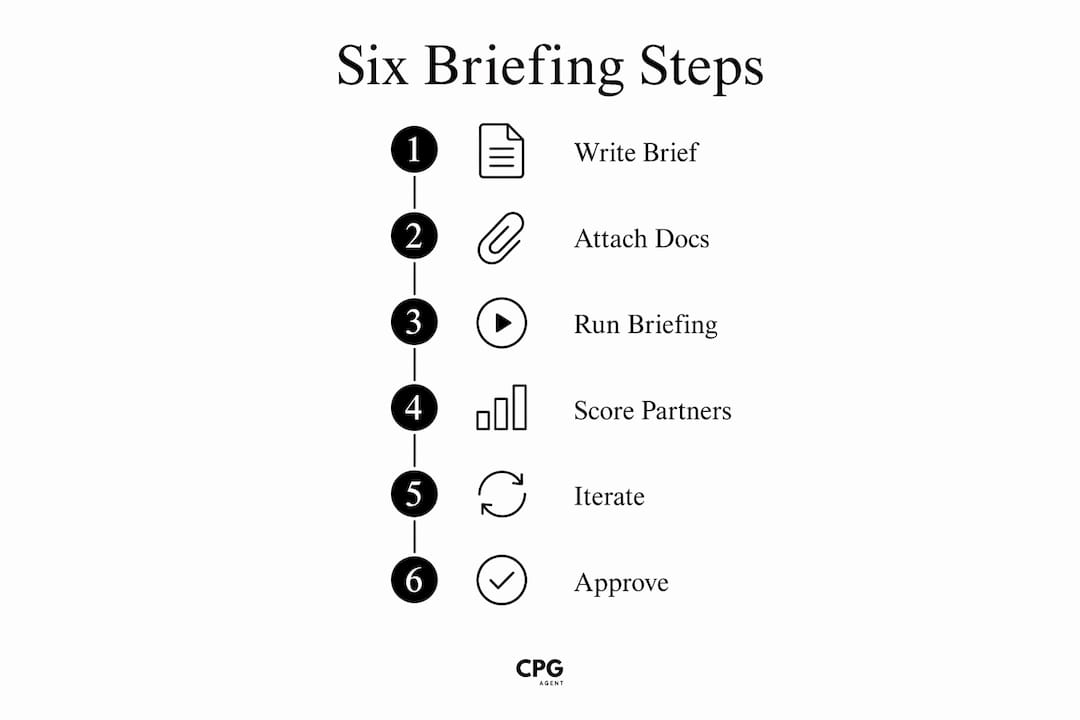
The six-step process works when you execute it in order: write the brief with technical and regulatory attachments, run the live briefing within seven days, score partners on the rubric, lock the timeline and budget, clear regulatory and retail guardrails, and hand off cleanly with a signed checklist.
For time-constrained founders, the fastest path pairs a fractional CMO with AI-enabled tooling. That combination compresses decision cycles, removes the discovery-phase drag of a traditional agency, and keeps the brief grounded in real retail and regulatory constraints from the start.
Two actions to take this week:
- Freeze your objectives and attach all required documents (dielines, brand guide, regulatory hotlist)
- Schedule the live briefing within seven days with named reviewers from marketing, legal, and supply chain
Cpgagent's platform tools cover persona research, launch validation, and growth roadmaps that feed directly into a brief's objectives and KPIs section.
Key Takeaways
A structured brief plus a live briefing session is the single most reliable way to reduce revision cycles and accelerate time-to-shelf in CPG.
| Point | Details |
|---|---|
| Write the brief, then run the live session | A written document alone rarely creates alignment; the live briefing is where understanding transfers. |
| Include technical dielines and regulatory copy | Attach dieline files, FDA-required label copy, and a named legal reviewer before the agency sees the brief. |
| Score partners on problem-solving, not price | Use a six-criterion rubric covering strategic thinking, retail experience, and regulatory familiarity. |
| Freeze scope before the clock starts | A cross-functional pre-brief checkpoint eliminates most schedule slippage before design begins. |
| Cpgagent accelerates the process | AI tools and fractional CMO advisory compress brief-to-shelf timelines without traditional agency overhead. |
Why the live briefing is the investment most brands skip
The conventional wisdom in CPG is that a thorough written brief is the hard work. It is not. Writing the brief is necessary but not sufficient. The live session is where the agency either catches the real problem or misses it entirely, and you will not know which until concepts come back three weeks later.
What most articles on briefing process miss is the interpersonal transfer. A brief document cannot answer a question. It cannot show enthusiasm for the brand's shelf ambition. It cannot catch the moment an agency lead misreads "premium" as "minimalist" when you meant "indulgent." The IPA's position on this is not a soft recommendation. It is the single most evidence-backed point in agency management.
AI tools and fractional leadership change the speed equation, not the fundamentals. Cpgagent's platform can generate persona research and launch validation data that sharpens the brief's objectives section before the agency ever enters the room. A fractional CMO brings the regulatory and retail fluency to run the live session without a lengthy onboarding period. The brief still needs to be written. The live session still needs to happen. The difference is that both get done faster, with fewer revision cycles, and with a clearer line to the shelf outcome.
Cpgagent cuts brief-to-shelf time for CPG brands
Brand leaders who have run through this process know the bottleneck is rarely the agency. It is the internal alignment that should have happened before the brief went out, and the absence of senior marketing judgment during the live session.
Cpgagent gives you both. The platform includes AI-powered tools for persona research, product launch validation, retail audit, and growth roadmaps, all of which feed directly into a brief's objectives, consumer profile, and KPI sections. Fractional CMO advisory means a senior marketing leader runs your live briefing, scores your agency shortlist, and owns the handoff, without a 12-month retainer. You get the brief written faster, the live session run by someone who has done it before, and a clear path from concept to shelf. Visit cpgagent.com to explore platform tools and fractional leadership options.
FAQ
What are the six steps to coordinate a CPG agency briefing?
Write the brief with technical and regulatory attachments, run a live briefing session, score partner candidates on a rubric, agree on timeline and budget, clear US regulatory and retail guardrails, then execute a signed handoff checklist.
How long does a typical CPG packaging brief process take?
From briefing through on-shelf delivery, expect a timeline of several months depending on structural complexity, regulatory review cycles, and co-packer lead times.
What must a CPG brief include for FDA compliance?
Every US CPG brief must reference a nutrition facts panel, ingredient declaration in descending weight order, allergen statement per FALCPA, net weight in both US customary and metric units, and substantiation notes for any health or structure/function claims.
When should a CPG brand hire a fractional CMO instead of an agency?
Choose a fractional CMO when you need embedded senior decision-making, faster approval loops, or direct retail remediation without a full agency retainer, particularly for time-sensitive launches or regulatory-heavy categories.
How does Cpgagent support the briefing process?
Cpgagent's platform provides AI tools for persona research, launch validation, and retail audits that sharpen brief objectives and KPIs, while fractional CMO advisory covers live briefing facilitation and partner scoring.
Authoritative sources and further reading
- IPA Briefing an Agency Best Practice Guide: the foundational reference for live briefing structure and written brief principles, cited throughout the briefing session and components sections
- FMCG Packaging Brief: How to Write One That Actually Works: detailed checklist for technical specs, regulatory mandatories, and timeline milestones; supports the components checklist, timeline, and handoff sections
- How to Write a Creative Brief That Ignites Growth (Theory House): single-source-of-truth brief structure with component-by-component rationale
- Design Brief for Agency and CPG Brand (The Gro Agency): shelf simulation and competitive audit guidance for the live briefing session
- A Guide to Creating Better Events with a Better RFP (CPG Agency): RFP framing as business-problem statements; informs the partner screening and scoring rubric sections