

TL;DR:
- Founder brands win retail shelf space by proving consistent repeat purchase velocity with data. Starting locally in independent stores provides valuable sell-through data and builds demand before pitching larger chains. Ongoing support at the store level ensures long-term placement and growth.
Winning retail placement as a founder brand means proving your product generates consistent repeat purchase velocity at the shelf level. Retail buyers treat shelf space as real estate: every facing must pay its rent through reliable sales turnover. Founders who understand this economics-first mindset, and back it with velocity data, margin math, and retail-ready execution, are the ones who secure and keep shelf space. The brands that fail treat placement as a milestone. The brands that win treat it as the starting line.
How founder brands win retail placement: start local, prove velocity
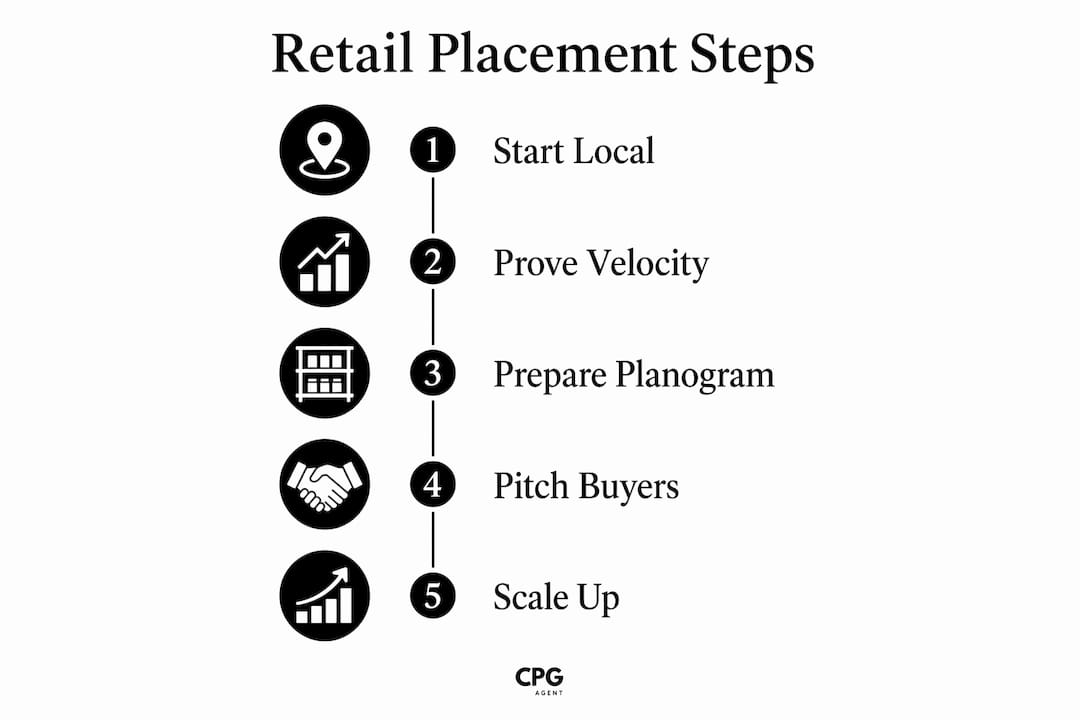
The most effective founder brand retail strategy begins with independent retailers, not national chains. Independent stores give you faster feedback loops, lower barriers to entry, and real sell-through data within 30–90 days. That data becomes your most powerful sales tool when you pitch larger buyers.

The goal at this stage is depth, not breadth. Building strength in 120 stores is more effective than a weak presence in 800. Concentrated distribution produces cleaner reorder data, stronger velocity per location, and a defensible proof of concept that national buyers can actually evaluate.
Here is how to execute an independent-store-first approach:
- Identify 5–15 local independent accounts that match your target shopper profile. Specialty grocery, natural food co-ops, and independent gift shops are common starting points for CPG founders.
- Negotiate a 30–90 day pilot window. Commit to in-store support during that period. Show up, merchandise the shelf, and track every unit sold.
- Collect sell-through data by location. Record units sold per week, reorder frequency, and any shopper feedback you can gather from store staff.
- Refine your product-market fit in real time. If one SKU underperforms, adjust pricing, packaging, or placement before you pitch a regional buyer.
- Build a reorder track record. A buyer at a regional chain wants to see that stores are reordering, not just stocking. Repeat orders are the proof that your product earns its shelf space.
Pro Tip: Ask independent store owners to write a short testimonial about your sell-through rate. A one-paragraph note from a real buyer carries more weight in a pitch deck than any marketing claim you can make about yourself.
This phase is not a detour. It is the foundation. Founders who skip it and pitch national retailers cold almost always lack the data to close the deal.
What metrics and materials do retail buyers actually want?
Retail buyers evaluate brands on a short list of measurable factors. Velocity metrics and repeat purchase behavior are the two most critical. Everything else, including your brand story and packaging design, supports those numbers rather than replacing them.
Velocity, margin, and category fit
Velocity is measured as units sold per store per week. A buyer at a regional grocery chain wants to see that your product moves at a rate that justifies the shelf space it occupies. Repeat purchase rate tells them whether shoppers are coming back, which signals genuine product demand rather than novelty purchases.
Margin math matters just as much. You need to understand your wholesale price, your suggested retail price, and the trade spend you are willing to commit. Your margins must be ready before you walk into any buyer meeting. A product priced too tightly for the retailer's standard markup will not make it past the first conversation.
Category fit is the third factor. Products aligned to emerging consumer trends or white space needs have higher chances of placement during reset windows. Tracking functional claim trends 6–18 months before they go mainstream helps you justify why your product deserves a new facing in the category.
Planogram readiness
Planogram readiness is where many founder brands fall short. A planogram is a visual diagram that shows exactly where your product sits on the shelf, how many facings it gets, and what it sits next to. Brands that provide planogram-ready assets reduce the work a buyer has to do to visualize your product in their store. Brands that show up without one force the buyer to do that work themselves, which often means a lost placement.
Planogram preparation should begin 6–12 months before your first buyer meeting to align with reset cycles and category management planning. Reset cycles are the scheduled periods when retailers reorganize shelf layouts. Missing a reset window can mean waiting another 6–12 months for your next shot.
Pro Tip: Use your independent store placements to photograph your product on a real shelf with real adjacencies. That photo, paired with a simple planogram diagram, gives buyers a concrete visual they can share with their category team.
| Retail readiness factor | What buyers look for |
|---|---|
| Velocity per location | Units sold per store per week over 30–90 days |
| Repeat purchase rate | Reorder frequency from the same shopper |
| Wholesale margin | Retailer's standard markup covered by your pricing |
| Trade spend budget | Promotional support you can commit to post-placement |
| Planogram assets | SKU placement diagram with facing counts and adjacency logic |
What founder brands miss after getting on the shelf
Getting the placement is not the hard part. Keeping it is. Most founders over-invest in landing the initial door count and under-invest in the store-level support that drives velocity after placement. That gap is where brands get delisted.
Post-placement activities that directly impact reorder rates include:
- In-store sampling. Sampling converts curious shoppers into first-time buyers. First-time buyers become the repeat purchasers that justify your velocity numbers. Strong post-placement support increases velocity and reorder rates in a measurable way.
- Shelf merchandising visits. Show up at your accounts regularly. Check that your product is faced correctly, stocked fully, and positioned where the planogram specifies. Retail staff are busy. Your product will drift if you are not watching it.
- Local awareness campaigns. Run geo-targeted social ads pointing shoppers to the specific stores that carry your product. A small budget directed at zip codes around your retail accounts drives foot traffic that shows up in the velocity data.
- Staff education. Retail employees who know your product will recommend it. A short one-page product brief left with the store manager, or a five-minute conversation with the floor team, can meaningfully increase word-of-mouth at the shelf.
Founder visibility on social media builds brand awareness, but retailers scrutinize whether brand traction can survive beyond the founder's personal platform. Your social following does not substitute for product demand. It supplements it. The shelf does not care how many followers you have.
The brands that build channel-ready retail hooks into their post-placement plans are the ones that generate the reorder data needed to pitch the next tier of retail.
How to scale from local wins to regional and national accounts
Scaling retail placement requires a deliberate transition from proof-of-concept to professional pitch. The data you collected from independent stores is now your primary asset. Here is how to use it effectively:
- Build a sell sheet grounded in velocity data. Your sell sheet should lead with units per store per week, reorder rate, and the number of accounts currently stocking your product. Buyers at regional chains want numbers, not narratives.
- Develop a promotional support plan. Retailers expect brands to fund introductory promotions, temporary price reductions, and sometimes slotting fees. Budget for this before you pitch. A buyer who asks about your promotional support and gets a blank stare will not move forward.
- Time your pitch to reset cycles. Research when your target retailer runs category resets. Pitching outside a reset window is almost always a waste of time. Pitching inside one, with a complete submission package, puts you in the right conversation at the right moment.
- Engage brokers and distributors strategically. Brokers have existing relationships with retail buyers and can open doors faster than cold outreach. However, direct outreach early builds real relationships and demonstrates measurable sell-through before you hand off to a broker. Do not outsource the relationship before you have proven the product.
- Expand your footprint with depth, not speed. When you land a regional account, apply the same focused support model you used with independents. Velocity in 50 regional stores beats thin presence across 200.
Founders who want to expand into new retailers successfully treat each new account as a pilot, not a trophy. The data from each pilot funds the next pitch.
Key Takeaways
Founder brands win retail placement by proving repeat purchase velocity with data, not by pitching brand story alone.
| Point | Details |
|---|---|
| Start with independent stores | Target 5–15 local accounts to build sell-through data within 30–90 days before pitching larger buyers. |
| Lead with velocity metrics | Units per store per week and repeat purchase rate are the two numbers retail buyers prioritize above all others. |
| Prepare planograms early | Begin planogram assets 6–12 months before your first buyer meeting to align with retailer reset cycles. |
| Support the shelf after placement | Sampling, merchandising visits, and local campaigns drive the velocity that earns reorders and prevents delisting. |
| Scale with depth, not speed | Build strong performance in fewer stores before expanding to regional or national accounts. |
What I have learned about winning and keeping retail shelf space
The founders I have seen succeed in retail share one habit: they treat every store like a laboratory. They show up, they count facings, they talk to staff, and they track every unit. The ones who fail treat placement as a finish line and move on to the next pitch before the first placement has proven anything.
The data-backed proof beats storytelling every time. A buyer does not care that your grandmother's recipe inspired the product. They care that it moved 4.2 units per store per week and that three independent accounts reordered within 60 days. That is the language retail speaks.
The other mistake I see constantly is spreading too thin too fast. Founders get excited about door counts and chase 200 accounts before they have figured out how to support 20. Depth beats breadth at every stage of retail growth. A concentrated, well-supported set of accounts generates the clean data that opens the next door.
Retail readiness is not a one-time checklist. It is an ongoing discipline. Your planogram needs to evolve as the category changes. Your velocity data needs to be refreshed every quarter. Your promotional support plan needs to match the retailer's current priorities. The brands that stay on the shelf are the ones that keep doing the work after the placement is won.
— Matthew
Cpgagent: built for founders who are serious about retail
Securing shelf space is one challenge. Managing the data, margins, and relationships that keep you there is another. Cpgagent is built specifically for CPG and FMCG founders who need to move fast without building a full agency team behind them.
The Cpgagent platform gives you AI-driven tools to track velocity metrics, model margin structures, and build sell sheets grounded in real data. Fractional leadership support means you get senior CPG expertise without the overhead. Whether you are preparing your first independent store pitch or scaling to a regional chain, Cpgagent helps you show up to every buyer meeting with the numbers that close deals. Visit Cpgagent to see how the platform fits your current stage.
FAQ
What is the most important metric for winning retail placement?
Velocity per location, measured as units sold per store per week, is the metric retail buyers prioritize most. Repeat purchase rate is the second critical number, as it proves genuine shopper demand beyond the initial stock.
How many stores should a founder brand target before pitching a national retailer?
Targeting 5–15 independent accounts first is the recommended approach. Generating clean sell-through data across that group within 30–90 days gives you the proof of concept that national buyers require.
What is a planogram and why does it matter for retail placement?
A planogram is a diagram showing exactly where your product sits on the shelf, including facing counts and adjacency logic. Providing planogram-ready assets reduces buyer friction and significantly increases your chances of placement.
When should a founder brand engage a broker or distributor?
Engage brokers after you have demonstrated measurable sell-through at the independent store level. Building direct relationships with buyers first gives you leverage and credibility before handing off to a third party.
How does local marketing support retail placement success?
Geo-targeted campaigns directed at shoppers near your retail accounts drive foot traffic that shows up in your velocity data. Higher in-store traffic converts to stronger reorder rates, which is the evidence buyers need to keep your product on the shelf.