

TL;DR:
- AI retail shelf audits use computer vision to detect stock issues and ensure planogram compliance in real time. They outperform manual audits by 50% to 200%, with accuracy levels reaching 98%, reducing out-of-stocks caused by phantom inventory. Implementing these systems with mobile apps in pilot stores before scaling and focusing on closure workflows maximizes ROI and improves sales.
An AI retail shelf audit is the process of using computer vision and machine learning to automatically analyze retail shelves, detect stock issues, and deliver real-time insights on product placement and planogram compliance. The industry term for this practice is automated shelf analysis, and it is replacing manual store walks at speed. Retailers lose 3%–4% of total revenue annually from poor out-of-stock management. Manual audits miss between 50% and 200% more gaps than AI-driven systems. For brand managers and retail professionals, that gap is not a data problem. It is a revenue problem with a solvable fix.
What is an AI retail shelf audit and how does it work?
An AI retail shelf audit uses computer vision models to capture shelf images and compare them against a planogram in real time. The system identifies missing products, misplaced SKUs, and compliance failures within seconds of image capture. Modern AI image recognition platforms achieve 96%–98% accuracy in SKU detection, processing each image in 2–10 seconds. That speed and accuracy level is impossible to replicate with a clipboard and a store associate.

The core technology stack includes an image capture layer (smartphone camera or fixed shelf camera), an AI inference engine, and a reporting dashboard. The inference engine compares captured shelf images against a digital planogram and flags deviations. Results feed directly into inventory and replenishment systems, closing the loop between shelf reality and supply chain response.
Phantom inventory is the hidden driver behind most out-of-stock events. Phantom inventory causes up to 80% of retail out-of-stocks because the system shows stock on hand while the shelf sits empty. AI computer vision detects this discrepancy by reading the physical shelf rather than trusting the inventory record. That single capability alone justifies the investment for most retailers.
What tools and technologies are required for effective shelf audits?
The right hardware and software combination determines whether your AI shelf audit program delivers results or stalls at pilot stage. The choice of capture method drives most of the upfront cost decision.
Hardware options for image capture
- Smartphone apps (BYOD): Store associates use their own or company-issued phones to photograph shelves. This is the lowest-cost entry point and requires no fixed infrastructure.
- Fixed shelf cameras: Mounted cameras capture continuous or scheduled images without requiring staff involvement. Higher upfront cost but delivers passive, always-on monitoring.
- Edge computing devices: On-device AI processing runs inference locally, reducing dependence on cloud connectivity. Edge computing models ensure real-time alerts even in stores with poor network coverage.
Software requirements
The AI platform must support planogram ingestion, SKU-level model training, and integration with your existing inventory management system. Generic AI models frequently fail in retail environments because product packaging is visually similar across competing SKUs. Fine-tuning AI models with store-specific planograms and private product catalogs is what separates accurate detection from expensive noise.
Connectivity is a real constraint in many store environments. Cloud-only platforms fail when Wi-Fi drops. Edge computing solves this by running the AI model on the capture device itself. Most bottlenecks in AI shelf audits come from bandwidth and processing latency, not camera resolution. Prioritize platforms that support offline working modes.
Pro Tip: Before evaluating any platform, confirm it supports planogram import in your existing format (PDF, JDA, or similar). Rebuilding planograms from scratch inside a new tool adds weeks to your deployment timeline.
| Capability | Entry-level field apps | Enterprise platforms |
|---|---|---|
| Planogram compliance detection | Basic (category level) | SKU-level with fine-tuning |
| Offline/edge processing | Limited | Full edge support |
| Inventory system integration | Manual export | API-based real-time sync |
| Audit speed per image | 5–10 seconds | 2–5 seconds |
| Model customization | Generic models | Store-specific fine-tuning |
How to implement AI retail shelf audits step by step
Deployment fails most often not because the technology is wrong, but because the rollout skips critical preparation steps. Follow this sequence to avoid the most common traps.
-
Assess your current audit process. Map how often audits happen, who conducts them, and where the most frequent gaps appear. Identify which categories carry the highest dollar risk per out-of-stock event.
-
Select the right AI tool for your store profile. A 5,000-square-foot convenience store has different needs than a 60,000-square-foot grocery chain. Match platform complexity to store size, SKU count, and budget. Starting with BYOD mobile apps is the most cost-effective way to prove ROI before committing to fixed camera infrastructure.
-
Prepare your data inputs. Gather current planograms for every category you plan to audit. Build a complete product catalog with SKU images, barcodes, and shelf positions. The quality of this input data directly determines AI detection accuracy.
-
Train and fine-tune your AI models. Upload planograms and product images to the platform. Run initial detection tests in a single store and review false positives and missed detections. Iterate on the model with store-specific corrections before scaling.
-
Deploy your image capture method. For BYOD rollouts, train store associates on capture angles, lighting conditions, and frequency. For fixed cameras, work with your facilities team on mounting positions that cover full shelf faces without blind spots.
-
Integrate AI insights with inventory and replenishment systems. The audit output is only valuable if it triggers action. Connect the platform to your warehouse management system or replenishment tool so detected gaps automatically generate restocking tasks.
-
Establish a continuous monitoring workflow. Set audit frequency by category risk level. High-velocity categories like beverages and snacks need daily or intraday audits. Slower categories can run weekly. Assign ownership for gap resolution and track closure rates as a KPI.
- Assign a single owner per store for audit compliance
- Set gap resolution SLAs by category (e.g., 2 hours for top-selling SKUs)
- Review weekly reports at the district manager level to catch systemic issues
What benefits can AI retail shelf audits deliver?
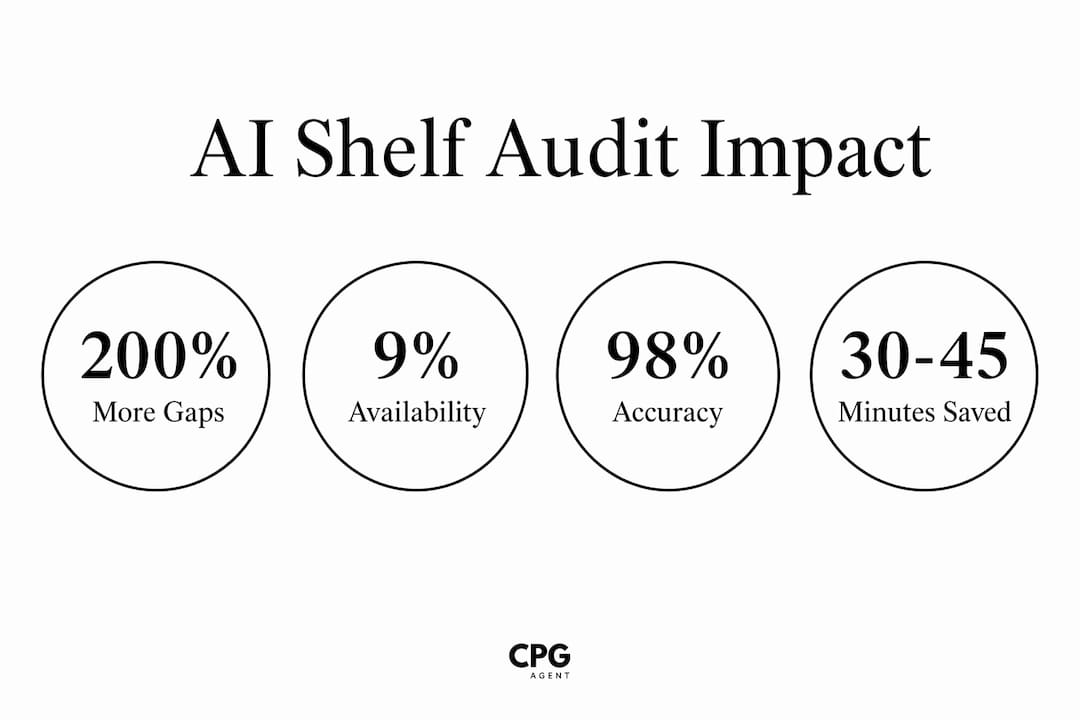
The financial case for automated shelf analysis is direct. AI-driven shelf monitoring identifies 50%–200% more gaps than manual sampling. More gaps found means more gaps fixed, which means more products sold.
On-shelf availability improves measurably. Vision-based monitoring has delivered a 9-percentage-point improvement in on-shelf availability without any changes to the supply chain. That improvement comes entirely from better detection and faster response at the store level.
Planogram compliance accuracy also rises sharply. AI audit systems deliver objective data with greater than 98% accuracy, compared to approximately 80% accuracy from manual self-reporting. The difference matters because compliance data drives category resets, promotional planning, and buyer negotiations.
The speed advantage compounds over time. A store associate conducting a manual audit of a full grocery aisle takes 30–45 minutes and produces subjective, inconsistent data. An AI system processes the same aisle in minutes and delivers standardized, comparable data across every store in your network.
AI scoring of shelf gaps by dollar value at risk lets store teams prioritize the highest-impact fixes first. A missing facing of a $12 product in a high-velocity location outranks a misplaced $2 item in a slow aisle. That prioritization logic is what converts audit data into revenue recovery.
What are common challenges in AI shelf audit deployment?
Most AI shelf audit programs hit the same four obstacles. Knowing them in advance cuts your troubleshooting time significantly.
Phantom inventory confusion. Your inventory system says a product is in stock, but the shelf is empty. AI computer vision resolves this by reading the physical shelf directly. Phantom inventory detection prevents false replenishment triggers and is one of the clearest ROI drivers in the first 90 days of deployment.
ROI paralysis from hardware costs. Fixed camera systems carry significant upfront investment. Teams get stuck waiting for budget approval while the out-of-stock problem continues. BYOD mobile programs allow proof of concept before committing to infrastructure. Start with 3–5 pilot stores, measure gap detection improvement, and use that data to justify the next investment phase.
AI model accuracy problems. Generic models trained on public datasets struggle with retail-specific packaging. Two products from the same brand in similar packaging will confuse an untuned model. Fine-tuning on proprietary store data is not optional. It is the step that determines whether your detection rate is 70% or 97%.
Connectivity failures in store environments. Cloud-dependent platforms fail when store Wi-Fi is unreliable. Edge computing solves this at the device level. Most processing bottlenecks come from bandwidth constraints, not hardware limitations. Confirm your platform supports local inference before signing a contract.
Store team adoption is the most underestimated challenge in AI shelf audit rollouts. The technology works. The gap is almost always in training associates to capture images correctly and act on alerts within the defined SLA.
Pro Tip: Run a 2-hour training session with store associates before go-live. Cover camera angle, lighting, and what to do when an alert fires. Teams that understand the "why" behind the audit process close gaps 40% faster than teams that treat it as another compliance checkbox.
Key takeaways
AI retail shelf audits deliver measurable revenue recovery by detecting gaps that manual methods consistently miss, with AI systems identifying 50%–200% more out-of-stocks and achieving greater than 98% detection accuracy.
| Point | Details |
|---|---|
| Start with BYOD mobile apps | Prove ROI in 3–5 pilot stores before investing in fixed camera infrastructure. |
| Fine-tune AI models on your data | Generic models fail with similar SKUs; store-specific training is required for accurate detection. |
| Prioritize gaps by dollar risk | Score shelf deviations by revenue impact so teams fix the highest-value gaps first. |
| Integrate with replenishment systems | Audit insights only drive results when they automatically trigger restocking workflows. |
| Address phantom inventory first | Phantom stock causes up to 80% of out-of-stocks and is the fastest ROI win in early deployment. |
The case for closing the loop, not just opening the data
Retail teams I have worked with often treat shelf audit data as a reporting exercise. The numbers go into a dashboard, a district manager reviews them on Friday, and by monday the gaps have already cost the brand two days of lost sales. That is not an AI problem. That is a workflow problem.
The brands that extract real value from automated shelf analysis build a closed-loop system. The AI detects a gap, scores it by dollar risk, fires an alert to the store associate, and logs the resolution time. Every step is tracked. The AI-powered consumer research that informs your product strategy is only as good as the execution at the shelf level. If the product is not on the shelf, none of the upstream strategy matters.
My strongest advice is to resist the temptation to audit everything at once. Start with your top 20% of SKUs by revenue contribution. Get the detection and response workflow tight on those products first. Once your team trusts the system and the closure rate is above 90%, expand to the full catalog. Brands that try to boil the ocean in week one almost always stall by week six.
The other thing I have seen consistently: the teams that treat AI as a replacement for human judgment get worse results than the teams that use it as a decision support tool. AI tells you where the gap is and what it costs. A trained associate decides whether to pull from the back room, flag a delivery issue, or escalate to the buyer. That human judgment layer is what turns a data point into a fixed shelf.
— Matthew
How Cpgagent supports your shelf execution strategy
Cpgagent is built for CPG and FMCG brands that need to move fast without building a full internal analytics team. The Cpgagent platform integrates AI-driven strategy tools with real-time data workflows, giving brand managers the infrastructure to act on shelf insights without the overhead of a traditional agency. Whether you are running your first pilot audit or scaling across a national retail network, Cpgagent connects shelf performance data to the broader brand growth strategy. Explore the platform to see how AI shelf analytics fits into your retail execution and channel-ready retail approach for 2026.
FAQ
What is an AI retail shelf audit?
An AI retail shelf audit uses computer vision to automatically photograph and analyze retail shelves, detecting out-of-stocks, misplaced products, and planogram compliance failures in real time. It replaces manual store walks with objective, high-speed data capture.
How accurate are AI shelf audit systems?
Modern AI image recognition platforms achieve 96%–98% accuracy in SKU detection, compared to approximately 80% accuracy from manual self-reporting methods.
What causes most retail out-of-stocks?
Phantom inventory causes up to 80% of retail out-of-stocks. The inventory system records stock as available while the physical shelf is empty, preventing replenishment from triggering correctly.
How do I start an AI shelf audit program with a limited budget?
Start with a BYOD mobile app program in 3–5 pilot stores. This approach avoids fixed camera infrastructure costs and lets you prove ROI before scaling investment.
How does AI shelf audit data connect to inventory management?
AI audit platforms integrate with warehouse management and replenishment systems via API, so detected shelf gaps automatically generate restocking tasks without manual data entry.