

TL;DR:
- Content marketing for FMCG brands involves embedding authentic, culturally relevant stories into consumer content, replacing intrusive ads. It emphasizes meeting consumers inside preferred channels like videos, social feeds, and e-commerce, supported by AI-driven personalization and creator partnerships. This operational system enhances brand reach, effectiveness, and measurement accuracy, ensuring continuous growth and agility.
Content marketing for FMCG brands is the practice of embedding authentic, solution-driven brand stories into the everyday content consumers already engage with, replacing intrusive advertising with culturally relevant communication across digital, social, and retail media. This discipline, formally called integrated content marketing, is now the primary brand-building mechanism for companies like Unilever, Marico, and DS Group. Rajeev Jain, Senior VP at DS Group, states content is overtaking advertising as the dominant force in FMCG brand building, with brand stories woven into the YouTube videos, creator content, and social feeds consumers watch daily. For brand managers seeking to understand how content marketing works for FMCG brands, the answer starts with one principle: meet consumers inside the content they choose, not the ads they skip.
How content marketing works for FMCG brands across touchpoints
Consumers no longer follow a linear path from awareness to purchase. They interact with brands across connected TV, mobile, social media, influencer content, and e-commerce product pages, often in the same hour. Marico CEO Saugata Gupta calls marketing the most disrupted FMCG function precisely because this fragmented, multi-touchpoint behavior demands versatile content approaches rather than a single broadcast strategy. The implication is direct: a TV commercial alone no longer builds a brand.

The shift from TV-led advertising to content-led storytelling is visible in how DS Group and Unilever now operate. DS Group embeds brand narratives inside content formats consumers actively seek out, from cooking tutorials to lifestyle vlogs, rather than interrupting them. Unilever applies the same logic at scale, using YouTube and creator partnerships to place brand messages inside trusted, culturally relevant content. This approach builds the kind of familiarity and trust that a 30-second pre-roll ad cannot replicate.
AI and first-party data now drive the personalization layer of this strategy. FMCG brands use behavioral data to understand consumer motivations, map content to specific life moments, and tailor creative assets by platform, region, and audience segment. A snack brand targeting Gen Z on TikTok needs entirely different content than the same brand targeting parents on YouTube. Data makes that distinction precise and scalable.
- Identify the 3 to 5 platforms where your core consumer spends the most time
- Map content formats to each platform's native behavior (short-form video, recipe content, comparison articles)
- Use first-party data and AI tools to personalize content by audience segment and purchase stage
- Synchronize content calendars with cultural moments, seasonal peaks, and product launches
Pro Tip: Build a platform-specific content brief for each major channel rather than repurposing one asset everywhere. A YouTube video reformatted for TikTok without native editing loses both reach and credibility.
What content formats and creator partnerships drive FMCG success
Creator and influencer marketing has evolved from transactional endorsement to what practitioners now call contextual coauthorship. Creators are no longer hired to read a script. They are brought in to contribute authentic narratives that carry the brand's meaning into communities the brand cannot reach organically. Unilever demonstrated this at scale when it secured 25% of ad inventory on Taylor Swift's official YouTube channel, reaching nearly 30 million women and driving measurable brand recall and consideration. That result came from cultural proximity, not just media spend.
The content formats that consistently perform for FMCG brands in 2026 include:
- Recipe and usage videos that show the product solving a real consumer problem
- Educational content addressing ingredient questions, sustainability claims, or health benefits
- Troubleshooting and how-to guides that support purchase decisions at the moment of consideration
- Comparison content that positions the brand against category alternatives with honest detail
- Always-on branded content that maintains category presence between major campaign flights
Micro and nano influencers in local or niche markets deliver high return on investment precisely because their audiences trust them as peers rather than celebrities. A nano influencer with 8,000 highly engaged followers in a specific regional market can outperform a macro influencer with 2 million passive ones. Unilever's K18 Hair YouTube Shorts campaign confirmed this dynamic: the creator-led approach produced a 25% lower cost-per-view alongside higher viewer retention and brand recognition compared to standard media buys.
"Creators add value by providing authentic context and cultural proximity, not just reach. This drives stronger brand affinities." — Think with Google, Unilever Creator Strategy
The practical balance for FMCG brand managers is to run iconic brand storytelling alongside performance-driven creator content. Neither replaces the other. Iconic storytelling builds long-term brand equity; creator content drives short-term consideration and conversion. Understanding brand personas for FMCG is the prerequisite for briefing creators effectively, because a creator who does not understand your brand's core consumer will produce content that feels generic regardless of their follower count.
Pro Tip: Brief creators with a consumer persona document, not a product feature list. Creators who understand who they are talking to produce content that converts; creators who memorize product specs produce content that bores.
How AI tools and content workflows help FMCG brands scale
Scaling content across multiple markets, product lines, and seasonal campaigns is the operational challenge that separates high-performing FMCG brands from those that fall behind. The solution is treating content production as a supply chain triggered by product calendar events, with automated generation, compliance checks, and human review gates built into every step. Amplience's Workforce tool generates compliant product descriptions and optimizes imagery within minutes, allowing FMCG brands to publish accurate, on-brand content across channels without the bottleneck of manual production.
| Manual content workflow | AI-enabled content workflow |
|---|---|
| 3 to 5 days per product description | Minutes per description with human review |
| Single-market copy requiring manual localization | Multi-market variants generated simultaneously |
| Reactive updates for compliance changes | Feed-triggered updates with automated compliance checks |
| Creative refresh every 4 to 6 weeks | Continuous refresh cadence aligned to fatigue signals |
Creative fatigue in FMCG campaigns occurs within 7 to 21 days, meaning a campaign that looks healthy at week two may already be losing efficiency by week three. This compressed cycle demands a continuous testing and refresh cadence rather than the traditional campaign-then-review model. GrowthJockey recommends structured testing sprints with early fatigue signals as the trigger for creative rotation, rather than waiting for end-of-campaign analysis when the damage is already done.
The content supply chain approach also addresses multi-market compliance, a persistent challenge for FMCG brands operating across regulatory environments. Automated workflows can generate market-specific variants of packaging copy, nutritional claims, and promotional language, with a human review gate before publication. This protects brand integrity while removing the production delays that cause brands to miss seasonal windows. For FMCG marketers exploring top content workflow tools, the priority should be platforms that integrate with existing product data feeds rather than standalone content tools that require manual input.
Pro Tip: Set a creative fatigue alert at day 10 of any paid campaign. If click-through rates drop more than 15% from the first three days, rotate creative immediately rather than waiting for the weekly review.
How FMCG brands measure content marketing performance
Traditional last-click attribution systematically undercounts the contribution of upper-funnel content, creator campaigns, and brand storytelling. A consumer who watches a recipe video on YouTube, sees a creator post on Instagram, and then purchases in-store three days later will show up in last-click models as an organic or direct conversion. The content that drove the decision receives no credit. This is why leading FMCG brands have shifted to holdout group testing and lift measurement studies as the primary evaluation method.
DoorDash's advertising platform reports 30% to 65% sales lift for CPG brands using Sponsored Product ads, with the Snacks category reaching the upper end of that range. That range reflects the difference between brands running isolated campaigns and those running integrated, always-on content programs. Ocado Retail's shift to always-on YouTube Demand Gen campaigns produced a 32% rise in new customer transactions and a 43% lift in brand searches, tied directly to iterative creative refreshes and data-driven attribution models. Both results demonstrate that measurement methodology determines whether you can see the impact of content marketing at all.
For creator-driven campaigns where direct purchase tracking is not possible, proxy signals become the measurement currency:
- UTM click data from creator posts to landing pages or product detail pages
- Shopping list adds and wishlist saves on retail platforms
- Brand search volume lift in the days following a creator activation
- Cost-per-view trends as an efficiency indicator across creator tiers
- Retail sell-through velocity in markets where creator content was activated versus control markets
Combining marketing mix modeling (MMM) with lift tests and proxy signals gives FMCG brand managers a triangulated view of content performance that no single method can provide alone. The customer decision journey research from Google confirms that credible, decision-support content, including comparisons, FAQs, and how-to formats, drives measurable lift at the consideration stage, which MMM models can capture when properly configured.
Practical steps to build an effective FMCG content strategy
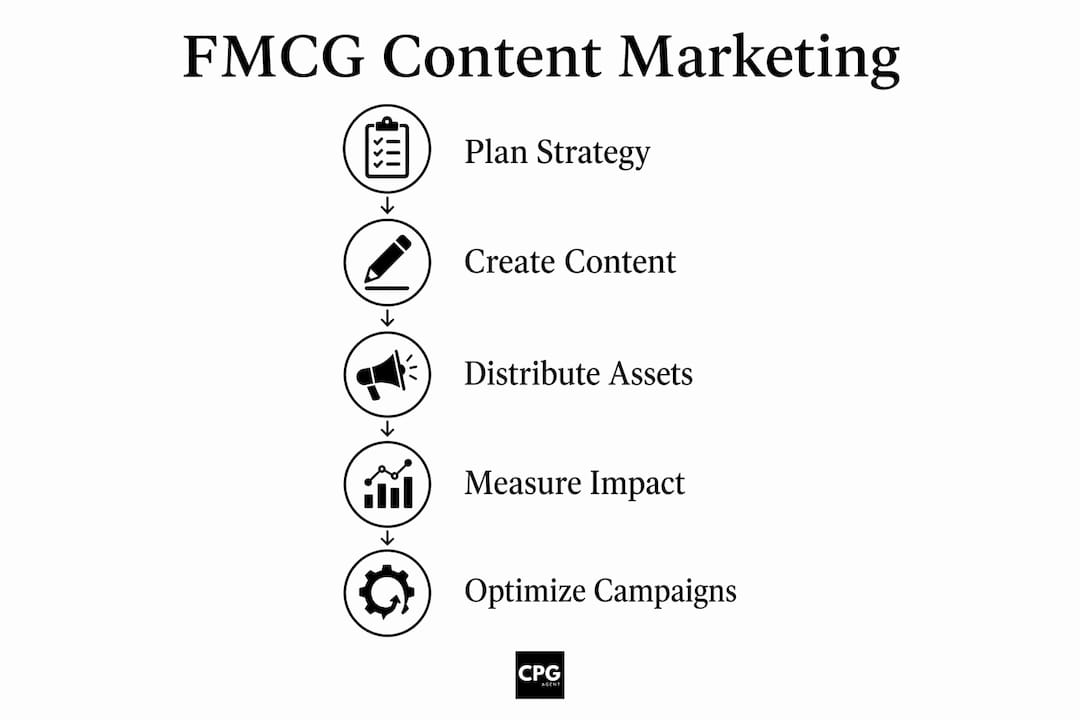
Building a content marketing program that performs requires discipline in both strategy and operations. The following steps reflect how high-performing FMCG brands structure their approach in 2026.
- Start with the consumer's job to be done. Identify the specific decision your consumer is trying to make and create content that supports it directly: comparisons, FAQs, ingredient explainers, and usage guides.
- Map content campaigns to cultural windows. Align high-impact formats and trusted creators to seasonal peaks, cultural moments, and product launch windows where consumer attention is highest.
- Adopt an always-on testing cadence. Run continuous creative testing sprints informed by early fatigue indicators rather than waiting for campaign end dates to evaluate performance.
- Use AI-enabled tools for operational scale. Automate product description generation, image resizing, and multi-channel publishing to maintain content velocity across markets without proportional headcount increases.
- Build a measurement stack that captures incrementality. Combine lift studies, MMM models, and proxy consumer intent signals to evaluate content performance beyond last-click attribution.
- Refresh creative proactively. Treat creative refresh as a scheduled operational task, not a reactive response to declining metrics.
FMCG brands that scale marketing without traditional agency overhead are finding that AI-enabled content operations give them the speed and personalization that large agency retainers historically promised but rarely delivered.
Key takeaways
Effective FMCG content marketing requires integrating authentic storytelling, creator partnerships, AI-enabled workflows, and incrementality measurement across every consumer touchpoint to outperform traditional advertising.
| Point | Details |
|---|---|
| Omnichannel embedding is the foundation | Place brand content inside the formats consumers actively choose, not between them. |
| Creators provide cultural proximity, not just reach | Brief creators with consumer personas to generate content that converts rather than content that merely appears. |
| Content supply chains enable scale | AI tools like Amplience Workforce automate compliant content generation, cutting production time from days to minutes. |
| Creative fatigue hits within 7 to 21 days | Build a continuous refresh cadence with early fatigue signals as the trigger, not end-of-campaign analysis. |
| Lift studies reveal true content impact | Combine MMM, holdout group tests, and proxy signals to measure incrementality that last-click attribution misses. |
Where most FMCG content strategies actually break down
The brands I see struggling with content marketing are not failing because of bad creative. They are failing because they treat content as a campaign deliverable rather than an operational system. A great video produced once every quarter cannot compete with a brand that publishes 40 relevant content pieces per month across YouTube, retail media, and social. The volume gap is also a quality gap, because brands producing more content iterate faster and learn what works sooner.
The second failure point is creator briefing. Most FMCG brands brief creators on product features and brand guidelines, then wonder why the content feels like a polished ad rather than an authentic recommendation. The brands getting the best results from creator partnerships are the ones who invest time in consumer persona development first, then share that persona with creators as the primary brief. The creator's job is to translate your brand's meaning into their community's language. You cannot do that without knowing who the consumer is.
The third issue is measurement avoidance. Lift studies and MMM models require investment and patience, so many brand managers default to vanity metrics: views, likes, and reach. Those numbers feel good and prove nothing about business impact. The Ocado and DoorDash results cited in this article came from teams willing to run holdout tests and wait for statistically significant results. That discipline is what separates content marketing that builds brands from content marketing that fills calendars.
The future of FMCG content marketing belongs to brands that treat it as a system: operationally disciplined, creator-informed, data-measured, and continuously refreshed. Technology makes that system faster. Human judgment makes it credible.
— Matthew
How Cpgagent helps FMCG brands operationalize content marketing
Cpgagent is built specifically for FMCG and CPG brands that need to move at the speed this article describes. The platform combines AI-driven content strategy tools, automated workflow capabilities, and fractional CMO advisory to replace the slow, expensive agency model with something that actually keeps pace with creative fatigue cycles and omnichannel demands.
From automated content brief generation to multi-channel asset distribution and performance measurement frameworks, Cpgagent gives brand managers the operational infrastructure to run always-on content programs without proportional headcount. If you are ready to build a content system rather than a content calendar, the Cpgagent platform is the practical next step for FMCG brands serious about scaling content marketing with precision and speed.
FAQ
What is content marketing for FMCG brands?
Content marketing for FMCG brands is the practice of creating and distributing useful, culturally relevant content across digital and retail media to build brand awareness and support consumer purchase decisions. It replaces interruptive advertising with content consumers actively seek out, such as recipe videos, how-to guides, and creator-led reviews.
How do FMCG brands measure content marketing ROI?
FMCG brands measure content marketing ROI through lift studies, holdout group tests, and marketing mix modeling rather than last-click attribution. DoorDash reports 30% to 65% sales lift for CPG brands using integrated content and sponsored product strategies, measured through controlled incrementality tests.
How often should FMCG brands refresh their content creative?
FMCG brands should refresh creative every 7 to 21 days in active paid campaigns, as creative fatigue can set in within that window. GrowthJockey recommends using early performance signals, such as declining click-through rates, as the trigger for rotation rather than waiting for scheduled campaign reviews.
Why do creator partnerships outperform traditional ads for FMCG?
Creator partnerships outperform traditional ads because creators provide cultural proximity and authentic context that brand-produced content cannot replicate. Unilever's K18 Hair YouTube Shorts campaign achieved 25% lower cost-per-view and higher brand recognition compared to standard media placements by using creators with genuine audience trust.
What tools support FMCG content marketing workflows?
AI-enabled commerce CMS and digital asset management platforms like Amplience Workforce automate product description generation, image resizing, and multi-channel publishing for FMCG brands. These tools reduce content production time from days to minutes while maintaining compliance and brand consistency across markets.