

TL;DR:
- CPG brands are replacing traditional account executive models with AI-driven decisioning and centralized workflows to scale marketing efficiently. This shift reduces manual coordination, automates measurement, and speeds campaign execution, enabling faster market responses and lower costs. Successful implementation requires establishing clear decision rules and governance, with gradual trust-building through proof of concept.
The account executive model is breaking under its own weight. Slow approvals, expensive retainers, and a human middleman standing between your data and your decisions: this is the reality for too many CPG brands still running marketing the traditional way. How CPG brands are scaling marketing without account executives is no longer a fringe experiment. It's the operational shift defining who wins shelf space in 2026. The brands pulling ahead have replaced coordination-heavy AE structures with AI-driven decisioning, centralized workflows, and measurement frameworks that make human gatekeepers redundant.
Table of Contents
- Key takeaways
- How CPG brands are rethinking marketing workflows
- AI platforms replacing manual campaign coordination
- Measurement innovations that replace AE oversight
- Technology that eliminates manual account-exec workflows
- Practical steps to transition away from AE-dependent marketing
- My honest take on where this is actually hard
- How Cpgagent helps you scale without the overhead
- FAQ
Key takeaways
| Point | Details |
|---|---|
| AI replaces AE coordination | Platforms like AIRA make 80% of marketing decisions automatically, cutting acquisition costs in half. |
| Centralize strategy, localize execution | Reducing middle-layer management while empowering local teams is the core of the new CPG operating model. |
| Incrementality beats ROAS | Brands like Chobani and Liquid Death use profit-gated decision rules instead of vanity metrics to auto-allocate spend. |
| Syndication removes manual ops | Tools like Syndigo eliminate per-retailer manual content workflows, directly increasing shopper engagement. |
| Decision rights matter as much as tools | Automation without governance creates new bottlenecks. AI must have authority to act, not just analyze. |
How CPG brands are rethinking marketing workflows
For decades, the account executive sat at the center of CPG marketing. They brokered information between brand teams, retail partners, and agency vendors. That model made sense when data lived in spreadsheets and campaigns moved quarterly. Neither of those things is true anymore.
The shift that is actually working involves two parallel moves: centralizing global brand standards through AI capability, and pushing execution closer to the consumer without requiring a regional layer to translate between them. BCG's 2026 analysis shows that 70% of CPG marketing leaders expect generative AI to improve productivity, yet only 13% have widespread integration. The gap is not a technology problem. It's an organizational design problem.
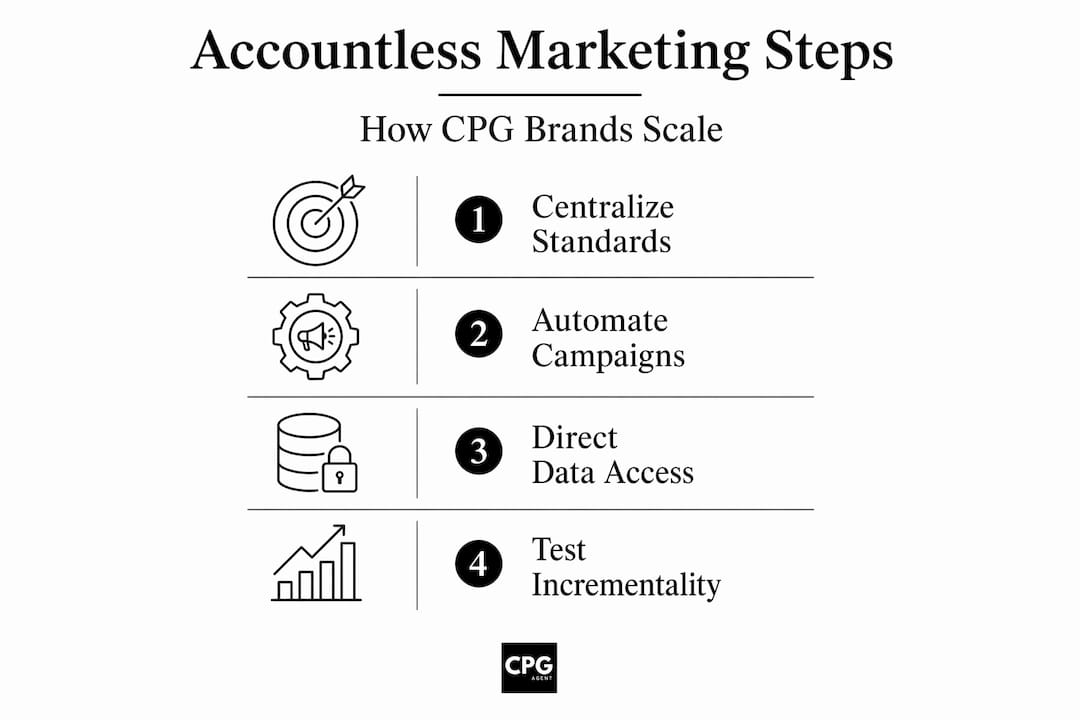
Brands that close that gap share a common structural move: they collapse the middle layer. Regional account teams that once existed to customize global templates for local markets are being replaced by AI tools that handle localization automatically. The result is faster execution, lower overhead, and campaigns that reach market in days rather than weeks.
Here's what this looks like in practice across marketing teams making this transition:
- A centralized AI layer sets guardrails: brand voice, spend floors, creative standards, and compliance rules.
- Local market managers operate within those guardrails without needing sign-off from a regional account lead.
- AI-supported workflows flag exceptions and escalate only true anomalies, not every routine decision.
- Content variants get generated programmatically, tested in market, and optimized without a creative review queue.
Pro Tip: Before cutting any AE role, map every decision that person makes in a month. You'll find 80% of those decisions are rules-based and can be handed to a configured AI workflow. The remaining 20% are where human judgment still earns its cost.
The CPG marketing strategies gaining traction are not about removing humans entirely. They're about removing humans from decisions that should never have required a human in the first place.
AI platforms replacing manual campaign coordination
The clearest evidence that accountless marketing approaches work at scale comes from brands that have already done it. Apex Brands built an AI system called AIRA directly into its marketing stack. AIRA makes 80% of marketing decisions autonomously, delivering a 37% efficiency improvement and cutting acquisition costs in half over 18 months. No meetings required. No account exec to relay the data and come back next Tuesday with a recommendation.
Newell Brands took a complementary path. Their iHub platform democratizes consumer insights and automates campaign asset generation across their portfolio. Integrated with Adobe and other production tools, iHub allows brand managers to spin up creative variants and execute media plans without routing requests through a central coordination team.
What makes these systems work is not just the technology. It's the specificity of how they're configured. The steps that actually separate successful AI marketing deployments from expensive pilots are:
- Define decision categories. Separate decisions into three buckets: fully automated, AI-recommended with human approval, and human-only. Most brands are surprised how much falls in the first bucket.
- Set explicit spend and performance thresholds. The AI needs rules, not just data. If a tactic hits a cost ceiling, it should auto-pause without anyone's permission.
- Integrate at the data layer, not just the surface. Tools plugged into dashboards but not into your actual data pipeline will still require someone to act on what they show.
- Run continuous A/B loops. Replace campaign-by-campaign testing with always-on experimentation. Scale what works within 48 hours, kill what doesn't.
Pro Tip: Self-serve insight platforms compress your marketing cycle the fastest when you grant brand managers direct access to results without routing through a central analytics team. The queue is where speed dies.
Marketing automation for CPG is not the end state. It's the infrastructure that makes everything else faster. The brands winning with this approach treat it as a permanent operating model, not a cost-cutting experiment.
Measurement innovations that replace AE oversight
One of the quieter reasons CPG brands historically needed account executives was measurement. Someone had to track results, compile reports, and decide what the numbers meant. That function is now being automated out of existence through a shift in what gets measured and how.
The move from ROAS to incrementality is the clearest signal of this. ROAS tells you correlation. Incrementality tells you causation. Brands like Chobani have built rigorous incrementality methodologies using first-party retailer data and clean rooms to understand which marketing dollars are actually driving new buyers versus recycling existing customers.
| Metric | Old model (ROAS) | New model (incrementality) |
|---|---|---|
| What it measures | Attributed revenue per ad dollar | New buyers driven by spend |
| Risk | Rewards efficiency in existing audiences | Penalizes spend that doesn't grow share |
| Decision speed | Requires human interpretation | Can trigger automated budget rules |
| Data source | Platform-reported attribution | Retailer first-party data, clean rooms |
| AE dependency | High: someone must compile and interpret | Low: rules-based, automated decisioning |
Liquid Death operationalized this thinking into a single rule that any junior marketer can execute: the 30-cent cliff. Any tactic that costs more than 30 cents per incremental dollar of revenue gets auto-killed. Budget reallocates within 48 hours. No account exec needed to debate it, defend it, or schedule a review.
The infrastructure supporting these decisions includes:
- Retailer clean rooms that allow brands to match campaign exposure to actual purchase behavior without sharing raw consumer data.
- Always-on experimentation platforms that continuously split audiences into exposed and control groups.
- Standardized metric definitions applied across all retail media networks, so the same decision rule works regardless of which retailer is running the media.
The implication for CPG digital marketing trends is direct: measurement precision, not media scale, is the new foundation for spending decisions. And precision at scale requires no account executive. It requires the right rules embedded in the right system.
Technology that eliminates manual account-exec workflows
Beyond decisioning and measurement, there's a category of operational work that account executives have historically owned: keeping product content accurate and synchronized across dozens of retail partners. SKU updates, image refreshes, compliance copy changes: all of it used to require manual coordination with each retailer's portal.

Syndication platforms have made that model obsolete. Colgate-Palmolive deployed Syndigo Syndication combined with Flywheel to centralize product content management. The result was a 13% increase in shopper engagement driven entirely by faster, more consistent content updates across retailer pages. The per-retailer manual workflows that account teams previously managed were replaced by a single centralized update process.
| Operational task | AE-driven model | Syndication platform model |
|---|---|---|
| Product content updates | Manual submission per retailer | Single update, distributed automatically |
| Image and copy compliance | Retailer-by-retailer review | Validated at source, auto-distributed |
| Time to update at scale | Days to weeks | Hours |
| Error rate | High, due to manual transcription | Low, due to structured data standards |
Colgate also demonstrated what happens when you bring machine learning into media targeting. Their Amazon model applied shopper scoring algorithms to improve ROAS by 65%, reduce cost-per-click by 43%, and cut total media spend by 58%. These are outcomes that no account executive team, however talented, can replicate at that speed or scale.
The technology infrastructure enabling this sits at the intersection of API integrations and centralized asset management. When your product data lives in one structured source and flows out through APIs to every retail destination, you eliminate the exception-handling workload that used to justify entire account teams.
Practical steps to transition away from AE-dependent marketing
Knowing what the future model looks like is easier than getting there. Most CPG marketing teams carry years of process debt: approvals built around human intermediaries, reporting structured for weekly meetings, and budgets allocated based on relationship history rather than performance data. Here's how to start dismantling that without breaking what's working.
- Audit every decision that touches an account exec. Categorize each as rules-based, judgment-based, or relationship-based. Start automating the first category immediately.
- Build incrementality measurement before cutting headcount. You need the measurement infrastructure in place first, or you'll automate spend decisions without knowing if they're the right ones.
- Deploy democratized dashboards to brand managers. When your team has direct insight access, they stop generating internal requests for analysis that slow everything down.
- Create explicit decision rights for your AI systems. Tools that can only recommend but never act are still creating bottlenecks. Define what the system can do autonomously, and document it.
- Invest in AI literacy across your marketing team. The brands scaling fastest are not those with the most sophisticated AI. They're the ones where every marketer understands how to interpret and act on what the AI surfaces.
Pro Tip: AI adoption in CPG fails most often not because the technology is wrong but because roles and governance were never redesigned around it. Before rolling out any new platform, rewrite the decision rights first.
For teams exploring how to build this kind of lean marketing engine from scratch, Cpgagent's lean CPG strategy guide covers the foundational moves without the agency overhead.
My honest take on where this is actually hard
I've watched enough of these transitions to know the part nobody puts in the case study: the automation without decision autonomy trap is real, and it's where most brands stall.
In my experience, a brand will invest six figures in an AI marketing platform, configure it beautifully, and then require a senior manager to approve every output before anything goes live. They've built a faster recommendation engine with the same human bottleneck at the end. The efficiency gains evaporate. The team gets frustrated. Leadership concludes AI doesn't work in their organization. None of that is true. The problem was governance, not technology.
What I've found actually works is starting with one repeatable decision, such as which creative variant gets more budget, and granting the system full authority over that decision for 90 days. No overrides unless the brand safety guardrails are triggered. You measure the outcome against the baseline, and in almost every case, the AI outperforms. That proof point is what creates organizational trust. And trust is what lets you hand over the next decision category, then the next.
The cultural shift is harder than the technical one. Marketing leaders need to stop thinking of AI as a tool that informs them and start thinking of it as a system that acts on their behalf within boundaries they set. That reframe changes everything, including how you structure teams, how you define success, and how you stop confusing cost-effective CPG marketing with simply spending less.
— Matthew
How Cpgagent helps you scale without the overhead
Cpgagent is built specifically for CPG and FMCG brands that want to grow without the cost and friction of traditional account executive models.
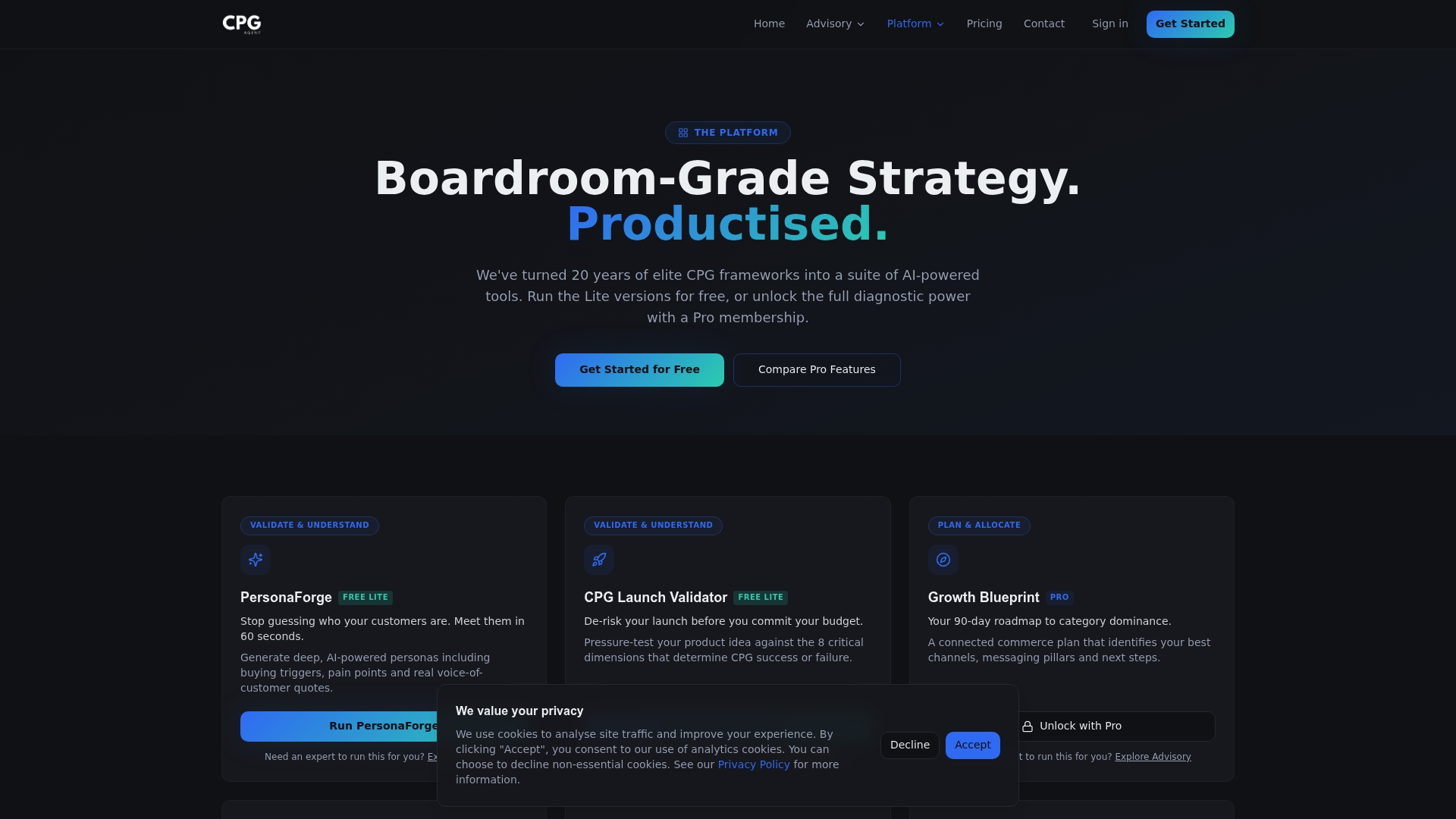
The platform combines AI-driven marketing automation, centralized data syndication, and real-time measurement tools into a single operating environment. Instead of routing decisions through account managers, your team gets direct access to the insights, decision frameworks, and content generation tools needed to move fast. Cpgagent replaces the coordination layer with infrastructure, so your budget goes toward growth experiments and asset creation, not internal meetings. Whether you're a founder building your first retail playbook or a brand manager modernizing a legacy portfolio, the Cpgagent platform gives your team the decision rights and data access to scale marketing on your terms.
FAQ
What is a productized agency model for CPG brands?
A productized agency model replaces open-ended retainers and account manager coordination with fixed-scope deliverables and automated workflows. In CPG, this means 100% of the flat-fee budget flows toward growth execution and data infrastructure rather than account management overhead.
How does scaling marketing in CPG work without account executives?
CPG brands replace AE functions with AI decisioning platforms, syndication tools, and incrementality measurement frameworks that allow marketing to run continuously without human intermediaries approving each step.
How do deliverables work in a productized agency model?
Deliverables are pre-defined and scoped before engagement begins, removing the ambiguity that typically requires account management to negotiate. Each output, whether a content update, campaign variant, or media plan, is tied to a measurable outcome and delivered through automated workflows.
What measurement replaces traditional AE reporting?
Incrementality testing replaces ROAS-based reporting by measuring whether spend actually drives new buyers. Brands like Chobani use retailer first-party data and clean rooms to make these assessments automatically.
How quickly can a CPG brand transition to an accountless marketing model?
Most brands can automate the first category of rules-based decisions within 60 to 90 days. Full transition typically takes six to twelve months and depends on how quickly governance frameworks and decision rights are established alongside the technology.