

TL;DR:
- AI retail hook generators produce short, impactful ad openers in seconds, vastly reducing manual creation time. They enable brands to generate multiple tested variants by applying proven frameworks, increasing campaign efficiency and effectiveness. Connecting these hooks to real-time automated sequences boosts revenue through more targeted customer engagement.
An AI retail hook generator is a tool that produces short, high-impact advertising openers for retail campaigns in seconds, replacing a process that once took 20–30 minutes of manual brainstorming. These tools apply proven frameworks, including curiosity, emotional, data-driven, and story-based structures, to generate copy optimized for fast-scroll platforms like TikTok and Instagram. For brand managers running multiple SKUs across multiple channels, that speed is not a convenience. It is a competitive requirement. The industry term for the broader practice is AI-driven ad creative generation, and the hook is its most critical output.
What is an AI retail hook generator and why does it matter?

An AI retail hook generator automates the creation of the first 30 words of an ad, the words that determine whether a viewer stops scrolling or keeps moving. Manual brainstorming takes 20–30 minutes per hook. AI generation takes seconds. That gap compounds fast when you are running 10 SKUs across Meta, TikTok, and Google Shopping simultaneously.
The tools work by applying structured frameworks to your product and audience inputs. The four most common frameworks are curiosity ("You've been buying the wrong protein bar"), emotional ("This is what your skin looks like after 30 days"), data-driven ("9 out of 10 shoppers miss this on the label"), and story-based ("I switched brands after one ingredient change"). Each framework targets a different audience temperature, from cold traffic to warm retargeting pools.
Retail marketers who treat hook generation as a one-time creative task miss the point. The real value is in volume and iteration. A 6-step AI pipeline can produce 30–50 scored hooks per session, each with a predicted hook-rate of 35–50%. That output gives your team enough variants to test across platforms without burning creative budgets on guesswork.
What tools and data do you need before you start?
Effective dynamic retail hook creation requires three inputs before you touch any AI tool: a product brief, an audience profile, and a competitor hook audit. Without these, the AI generates generic copy that sounds like every other brand in your category.
The product brief should include the product name, primary benefit, key differentiator, and the specific objection it overcomes. The audience profile needs demographic data, purchase history signals, and the exact language your customers use in reviews and social comments. Customer language mining from sources like Amazon reviews and Instagram comments is the single most underused input in retail hook generation. It gives the AI the words your buyers already trust.
The competitor hook audit is equally important. Pull active ads from the Meta Ad Library for your top three category competitors. Identify the frameworks they use most. Then brief your AI to fill the gaps they are missing. This is how you create hooks that feel fresh in a crowded feed rather than derivative.
Feature categories to evaluate in any AI hook tool
| Feature category | What to look for |
|---|---|
| Framework library | Curiosity, emotional, data, story, urgency, and social proof templates |
| Audience input fields | Persona, pain points, purchase stage, and platform targeting |
| Scoring and ranking | Predicted hook-rate, pattern interrupt strength, and readability score |
| Platform optimization | Separate output styles for TikTok, Meta, and Google |
| Integration capability | API or native connection to Shopify, WooCommerce, or your CRM |
Pro Tip: Feed the AI three to five real customer reviews as part of your brief. The tool will mirror the vocabulary your buyers use, which consistently outperforms copy written in brand voice alone.
How do you generate high-converting hooks step by step?
The most effective approach treats the AI as a junior copywriter, not a vending machine. Briefing AI like a creative director with full campaign context produces campaign-ready assets. Feeding it a single product name produces filler.
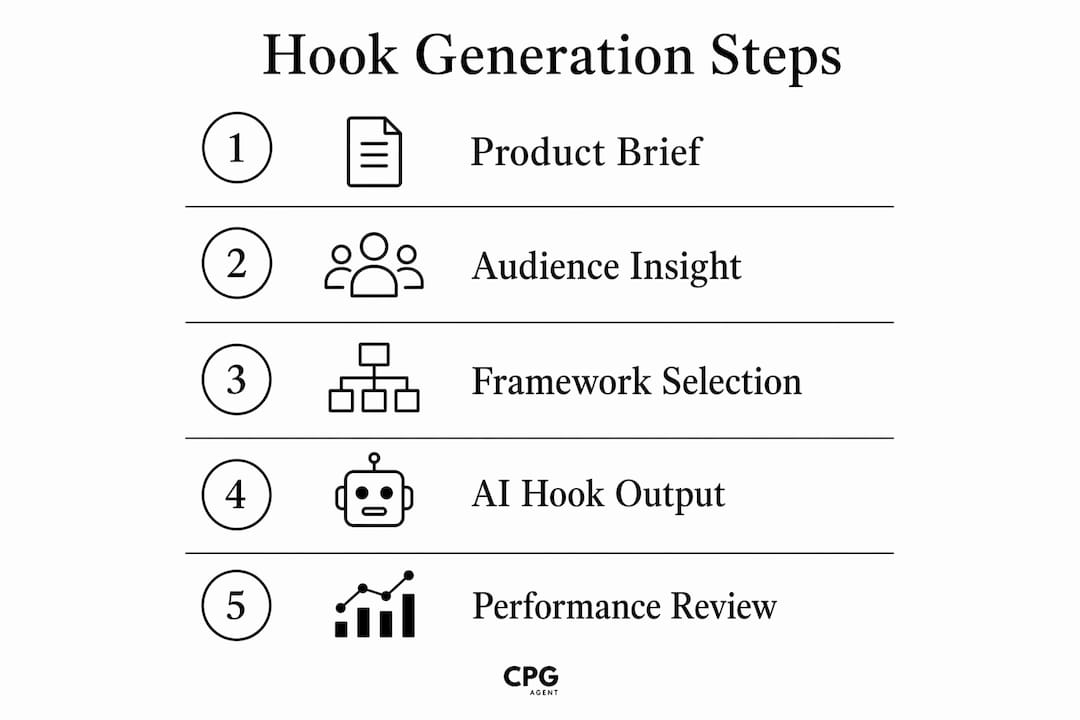
The 6-step pipeline that top retail marketers use runs in this sequence:
- Audience research. Define the audience segment by purchase stage: cold, warm, or retargeting. Cold audiences need pattern interrupts. Warm audiences respond to social proof and urgency.
- Competitor hook audit. Pull competitor ads from the Meta Ad Library. Identify which frameworks dominate your category and which are absent.
- Customer language mining. Extract exact phrases from reviews, comments, and support tickets. These phrases become seed language for your brief.
- Framework matching. Match the hook framework to the audience temperature. Pain-based hooks work for cold traffic. Curiosity and urgency hooks perform better for warm segments.
- Hook generation. Input your brief into the AI tool. Request 10–20 variants per framework. Platform-specific hook styles matter here: TikTok hooks should be conversational and under 15 words; Facebook hooks perform better as sharp, claim-led statements.
- Performance scoring. Score each hook against a rubric covering pattern interrupt strength, specificity, emotional resonance, and platform fit. Eliminate anything that scores below your threshold before testing.
Pro Tip: Write your brief in the second person, addressing the AI as if you are a creative director giving a morning briefing. Include the campaign objective, the audience's biggest fear, and the one thing your product does that no competitor does. Output quality improves measurably with this level of context.
The channel-ready retail hooks guide from Cpgagent covers platform-specific formatting in detail, including character limits and visual hook pairing for paid social.
How does integrating AI hooks with automation increase ROI?
Hook generation in isolation produces content. Hook generation connected to customer behavior data produces revenue. AI marketing agents increase abandoned cart revenue per recipient from $3.65 to over $28.89 by continuously testing hooks, copy, and offers across paid and retention channels. That is not a marginal improvement. It is a structural change in how retail marketing performs.
The integration works by connecting your hook generator output to behavior-triggered sequences. When a customer abandons a cart, the system pulls the most relevant hook variant for that product category and fires it across Meta DPA, email, and SMS within minutes. The hook is not chosen by a scheduler. It is chosen by the customer's actual behavior.
Connecting AI hooks to real-time purchase signals and loyalty data reduces ad waste by targeting customers at the exact moment their intent is highest. Fixed-schedule campaigns send the same message to everyone at the same time. Behavior-triggered campaigns send the right message to the right person when they are most likely to act.
Common mistakes retail teams make when integrating AI hooks with automation include:
- Generating hooks in a separate workflow from campaign deployment, creating a manual handoff that slows execution
- Using the same hook variant across all audience segments instead of matching framework to purchase stage
- Failing to feed post-purchase data back into the hook generation brief, so the AI never learns what actually converted
- Treating the hook as a standalone asset rather than the entry point to a multi-step sequence
Pro Tip: Connect your AI hook tool directly to your CRM or ecommerce platform via API. When the tool can read purchase history and segment data, it generates hooks that reference the customer's actual category behavior rather than generic product claims. Personalization at this level consistently reduces cost per acquisition.
For a deeper look at how AI-powered consumer research feeds into hook generation, Cpgagent's 2026 guide covers the full data pipeline from audience insight to campaign asset.
What are the most common pitfalls in AI hook creation?
Over-reliance on templates is the most common failure mode in AI retail hook creation. Templates produce hooks that are structurally correct but category-generic. A hook that could apply to any protein bar, skincare product, or snack brand will not stop a scroll. High-converting hooks require strong pattern interrupts and must be validated beyond initial AI generation.
The workflow-first approach solves this. Instead of starting with a template and filling in product details, you start with a product brief and let the AI select the framework. Workflow-first AI creative processes reduce production cycles and allow brands to launch comprehensive campaigns including video and copy variants at scale. The difference in output quality is significant.
Best practices for consistent performance in AI hook creation:
- Test a minimum of three hook variants per audience segment before scaling spend
- Use predicted hook-rate scores as a filter, not a guarantee. A high score means higher probability, not certainty
- Rotate frameworks every four to six weeks to prevent audience fatigue in retargeting pools
- Audit your hook library quarterly against current competitor activity in the Meta Ad Library
- Document which customer language phrases drove the highest engagement and feed them back into future briefs
Interpreting performance metrics correctly is also critical. Click-through rate measures attention capture. Conversion rate measures message-to-offer alignment. If your CTR is high but conversion is low, the hook is working but the landing page or offer is misaligned. Fix the offer before rewriting the hook.
The CPG hook library from Cpgagent documents five high-converting frameworks with retail-specific examples, including curiosity and competitor-gap approaches.
Key takeaways
AI retail hook generators produce the highest ROI when they combine structured creative frameworks, customer language data, and behavior-triggered automation into a single connected workflow.
| Point | Details |
|---|---|
| Speed and volume | AI reduces hook creation from 20–30 minutes to seconds, enabling 30–50 scored variants per session. |
| Brief quality determines output | Briefing AI with product context, audience pain points, and competitor gaps produces campaign-ready hooks. |
| Platform style matters | TikTok hooks need conversational, short copy; Facebook hooks perform better as sharp, claim-led statements. |
| Automation multiplies impact | Connecting hooks to behavior-triggered sequences increases abandoned cart revenue per recipient significantly. |
| Test before scaling | Validate hooks against predicted hook-rate scores and multi-variant experiments before committing ad spend. |
What I've learned from treating AI as a creative director
Most retail marketing teams adopt AI hook tools and immediately ask them to do the creative thinking. That is the wrong order of operations. The AI does not know your brand, your customer's specific objection, or the gap your competitor left open last quarter. You do. The AI's job is to execute at speed once you have given it that context.
The mindset shift that changed my results was treating every AI brief like a creative director's morning briefing. I stopped typing "write a hook for a protein bar" and started writing three-paragraph briefs that included the audience's biggest fear, the product's single most defensible claim, and two competitor hooks I wanted to differentiate from. Output quality improved immediately and consistently.
The second shift was connecting hook generation to the customer journey rather than treating it as a standalone content task. When I started feeding post-purchase data and loyalty signals back into the brief, the hooks stopped sounding like ads and started sounding like conversations. That is when engagement metrics moved in a meaningful direction.
The uncomfortable truth is that AI hook generation is not a creative shortcut. It is a creative amplifier. The teams that get the best results are the ones who invest more time in the brief, not less. The AI handles the volume and the variation. You handle the strategy and the context. That division of labor is what makes the whole system work.
— Matthew
How Cpgagent helps retail teams build and deploy AI hooks at scale
Retail brand managers who want to move from manual hook creation to a fully integrated AI-driven workflow have a direct path through Cpgagent. The platform combines AI product promotion tools, automated campaign workflows, and customer data integration in one place, so your hooks are generated, scored, and deployed without manual handoffs slowing the process.
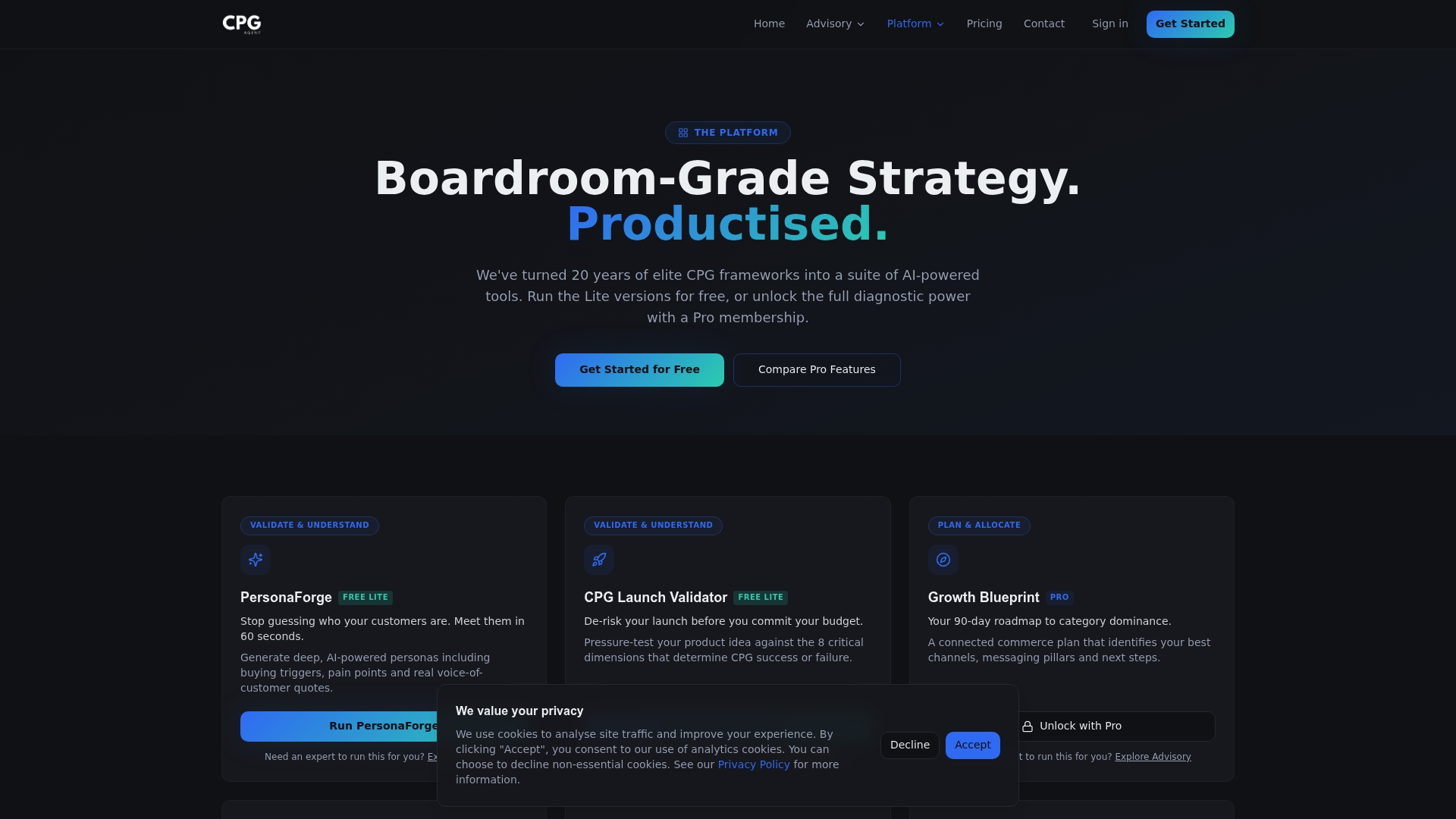
Cpgagent connects product briefs and audience data directly to hook generation, then routes output into behavior-triggered sequences across paid and retention channels. The result is retail marketing automation that runs on customer behavior, not fixed schedules. Brand managers at both startup and established CPG brands use the Cpgagent platform to cut creative production time and increase campaign performance without adding headcount.
FAQ
What is an AI retail hook generator?
An AI retail hook generator is a tool that creates short, attention-capturing advertising openers for retail campaigns using frameworks like curiosity, emotional, data-driven, and story-based structures. It replaces manual brainstorming, reducing hook creation time from 20–30 minutes to seconds.
How many hook variants should I generate per campaign?
Advanced AI pipelines produce 30–50 scored hook variants per session, with predicted hook-rates of 35–50%. Testing a minimum of three variants per audience segment before scaling spend is the standard practice.
Do AI-generated hooks work differently on TikTok vs. Facebook?
Yes. TikTok hooks perform best when they are conversational and under 15 words. Facebook hooks perform better as sharp, claim-led statements. Platform-specific formatting is a required step in any effective hook generation workflow.
What data inputs improve AI hook quality the most?
Customer language mining from reviews and social comments, combined with a competitor hook audit from the Meta Ad Library, produces the most relevant and differentiated hooks. Generic prompts without these inputs generate category-generic copy.
How does connecting AI hooks to automation increase revenue?
Integrating AI-generated hooks with behavior-triggered sequences, such as cart abandonment flows connected to real-time purchase signals, increases revenue per recipient significantly compared to fixed-schedule campaigns.