

Generative engine optimization (GEO) is the practice of shaping content so AI systems like ChatGPT, Google's AI Overviews, and Perplexity select and cite it when synthesizing answers. The single highest-leverage move right now: make your content extractable and back every key claim with a citation, quote, or statistic. Do that first. Measurement and outreach tactics matter, but they build on that foundation.
TL;DR:
- Including explicit citations, quotes, and sourced statistics in content increases the likelihood of being selected and cited in AI-generated answers by roughly 30 to 40 percent.
- Creating short, extractable passages that directly answer common questions improves the chance of your content being featured in generative engine responses.
- Ensuring your website's pages are server-rendered or prerendered with structured data enhances content accessibility for AI crawlers and improves extractability.
- Measuring success through metrics like AI mentions, citations, share of voice, and referral traffic helps track the impact of GEO tactics over time.
- Consistent outreach to third-party review sites, forums, and trade publications holds significant weight in influencing AI retrieval and citation decisions for your brand.
Table of Contents
- What Makes GEO Different From Traditional SEO
- Why GEO Now Shapes Discovery, Consideration, and Conversion
- High-Impact GEO Strategies Marketers Should Adopt
- How to Implement GEO: A Step-by-Step Checklist
- Measuring GEO: Metrics, Tools, and Proving ROI
- Tools and Proof Points for Operationalizing GEO
- A 90-Day Plan for Winning GEO Coverage
- Where Cpgagent Fits Into Your GEO Rollout
- Sources
- FAQ
What Makes GEO Different From Traditional SEO
SEO earned its name by chasing rankings, a blue link in position one. GEO grew out of that discipline, sometimes called answer engine optimization (AEO) in its earlier form, but it chases something else entirely: inclusion inside a generated answer where there is no ranked list at all. Semrush's practitioner guide frames GEO as overlapping heavily with SEO fundamentals while shifting the target from "rank higher" to "get selected."
Three distinctions matter most for how you plan work:
- Selection, not ranking. A generative model picks a handful of sources to synthesize, not ten blue links. There's no position ten to settle for.
- Extractability over keyword density. Models pull short, self-contained passages. A page stuffed with keywords but light on clear, quotable statements loses to a competitor with one tight paragraph that answers the question directly.
- Dependence on external mentions. Your own site's authority isn't the only input. What Reddit threads, review sites, and trade press say about your brand feeds the model's training and retrieval too.
The outcomes worth tracking shift accordingly: AI mentions, AI citations, share of voice inside generated answers, and referral traffic from AI platforms, not just organic rank.
Why GEO Now Shapes Discovery, Consideration, and Conversion
AI answers are compressing the traditional discovery funnel. Instead of clicking through five results to compare products, a shopper asks an AI assistant which laundry detergent is best for sensitive skin and gets one synthesized answer, often with two or three brands named. If your brand isn't one of them, you don't just lose a click. You lose the consideration set entirely.
The data backs this up. Academic testing of GEO methods found that adding citations, direct quotations, and statistics to content increased visibility in generative engine responses by roughly 30 to 40 percent across benchmark evaluations. That's not a marginal edit. That's the difference between being cited and being invisible.
A second research pass reached a similar conclusion: content carrying quotes and statistics correlates with higher selection probability when models draw from multiple competing sources. The caveat worth holding onto: these platforms change their retrieval logic often, and content built purely to please a model, stripped of voice, nuance, or genuine usefulness, tends to perform worse over time even inside AI answers. Write for the person first. Structure for the machine second.
High-Impact GEO Strategies Marketers Should Adopt
Not every GEO tactic delivers equal return. These are the ones with the clearest evidence behind them, in rough priority order.
- Add explicit citations and short quotations. Every data point in your content should trace back to a named source. A generated answer favors content that already looks fact-checked, because it lowers the model's own risk of hallucinating.
- Include specific, sourced statistics as standalone callouts. A number sitting inside a dense paragraph gets buried. The same number pulled into its own line, with the source named, becomes an extractable unit a model can lift cleanly.
- Write extractable passage candidates. Open each major section with a two-to-three sentence answer to the implicit question a reader (or a model) is asking. Save the elaboration for after.
- Fix technical crawlability. If your key pages render content client-side with JavaScript, some AI crawlers never see it. Platform guidance from Microsoft's advertising team recommends server-side rendering or prerendering plus structured data markup so generative crawlers can parse content the same way a human browser would.
- Earn mentions on UGC and authoritative third-party sites. Reddit threads, review platforms, and trade publications feed model training and retrieval independent of your own domain authority. Unlinked brand mentions still carry weight in how a model decides what to surface.
- Edit with the specific platform's behavior in mind. ChatGPT, Perplexity, and Google's AI Overviews don't extract content identically. Perplexity leans heavily on recent, citation-dense sources. Google's AI Overviews often pulls directly from structured, list-formatted sections. Test your key pages against each.
Pro Tip: Run a quick audit before you write anything new. Ask three or four AI platforms the exact questions your customers ask, and note which domains get cited. If competitors show up and you don't, that gap tells you exactly which pages need extractable rewrites first.
Outreach deserves a specific callout here: PR and targeted outreach remain essential even when your technical SEO is airtight, because generative engines weigh what other credible sites say about you, not just what you say about yourself.
How to Implement GEO: A Step-by-Step Checklist
Turn strategy into assigned work by splitting the checklist across the teams who actually own each piece.
Editorial team:
- Lead every section with a direct, two-sentence answer before adding context.
- Break paragraphs down to three or four sentences maximum; dense blocks resist extraction.
- Phrase key subheadings as the literal questions customers ask.
- Attach a citation, quote, or statistic to every claim that could otherwise read as opinion.
Engineering team:
- Confirm server-side rendering or prerendering on pages that matter for AI visibility, not just on the homepage.
- Expose structured data (schema markup) for products, FAQs, and articles so machine-readable context sits alongside the visible copy.
- Lock down stable canonical URLs; a page that moves or duplicates breaks a crawler's ability to attribute it consistently.
Operations team:
- Build a simple experiment matrix: page, hypothesis, edit made, AI visibility before and after.
- Set an approval gate so edits made purely for model preference don't degrade the reader experience.
- Version your content changes so you can trace which edit produced which visibility shift.
Outreach team:
- Target mentions on sites your buyers already trust, review platforms, forums, trade press.
- Make every external fact about your brand checkable, consistent naming, consistent claims, no exaggerated stats that a model might flag as unreliable.
Pro Tip: Treat this like an ongoing editorial A/B test, not a one-time project. Iterate on the exact phrasing of your extractable passages, watch which version gets cited in the wild, and roll the winning phrasing across similar pages sitewide. This mirrors how content-testing engines like Dejan's optimizer approach the problem, simulating which phrasing an AI ranker prefers before you commit to it at scale.
For CPG and food brands specifically, the infrastructure question often comes first. A practical playbook for building AI marketing infrastructure walks through what needs to be in place before any of this editorial work compounds.
Measuring GEO: Metrics, Tools, and Proving ROI
Four metrics carry most of the weight in a GEO measurement program:
- AI mentions, how often your brand name appears in generated answers for target queries.
- AI citations, how often your specific URLs get linked or referenced as a source.
- AI share of voice, your mention rate relative to named competitors across the same query set.
- Referral traffic and conversion lift from sessions that originate from an AI platform link.
Search platforms have started building reporting specifically for this. Google Search Console and Bing Webmaster Tools now surface AI-driven visibility signals, giving marketers a first-party view of which queries trigger AI Overviews and whether their pages get cited. Third-party AI visibility monitors fill the gaps these platforms don't cover, tracking Perplexity and ChatGPT citations specifically.
| Metric | What it measures | Recommended tooling |
|---|---|---|
| AI mentions | Frequency your brand appears in generated answers | Third-party AI visibility monitors |
| AI citations | How often your URLs are directly linked as sources | Google Search Console AI reports, Bing Webmaster Tools |
| AI share of voice | Your mention rate vs. named competitors | Third-party AI visibility monitors, manual query sampling |
| Referral traffic from AI | Sessions originating from AI platform links | Analytics platform referral segmentation |
| Conversion lift | Revenue or lead impact from AI-referred sessions | Analytics platform, attribution modeling |
Run this as a longitudinal test, not a one-time snapshot. Sample the same fifteen to twenty customer queries weekly across two or three AI platforms, log which sources get cited, and pair that with A/B tests on your own extractable passages to isolate what's actually moving the needle.
Tools and Proof Points for Operationalizing GEO
Three tool categories cover most of what a GEO program needs: AI visibility monitors that track mentions and citations across platforms, content-optimizer harnesses that simulate how a model selects passages, and AI agents that automate the repetitive parts of the workflow.
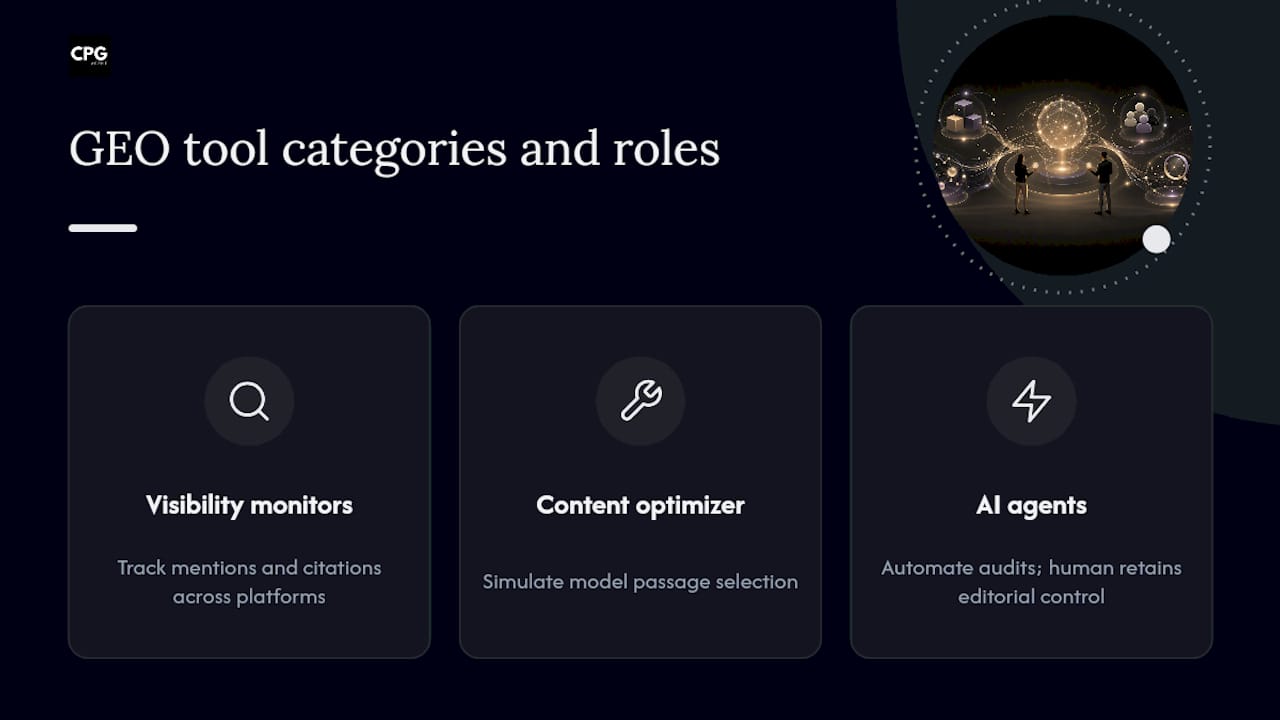
That third category deserves a specific note. AI agents can automate audits, monitoring, and brief generation, but the return is highest when a human strategist keeps control of the actual editorial and positioning decisions. Agents are good at flagging what changed. They're not good at deciding what your brand should say about it.
Across the research, the content attribute with the most consistent evidence behind it is simple: citations, quotations, and statistics, stated plainly and sourced clearly, outperform vague or unsupported claims in generative selection.
This is close to how CPG Agent's platform approaches GEO for consumer brand teams: continuous AI visibility monitoring paired with rapid experiment cycles, so a brand can test an extractable passage this week and see whether it moved citation rates by next week, rather than waiting a full quarter for an agency report. Fractional leadership support sits on top of that, keeping the experiments tied to a coherent brand strategy instead of a pile of disconnected tests. A related breakdown on getting CPG brands recommended by AI search engines covers category-specific tactics in more depth.
A 90-Day Plan for Winning GEO Coverage
The first thirty days should go entirely to an audit: run your top twenty customer queries through three AI platforms, log who gets cited, and rewrite the five pages with the biggest visibility gap into extractable, citation-backed passages. Days thirty to sixty add the technical layer, server-side rendering checks, structured data, and a baseline measurement dashboard tracking AI mentions and citations weekly. Days sixty to ninety shift to experimentation: run three to five phrasing tests on your highest-traffic pages and start outreach to two or three third-party sites your buyers already trust.
Success at day thirty looks like a documented gap list. At day sixty, it's a working measurement baseline. At day ninety, it's a measurable lift in citation rate on at least two of your test pages. Brands that treat this as a quarterly discipline, not a one-time sprint, tend to compound the advantage; the ones that treat it as a single project usually watch their early gains erode as competitors catch up. If you want a structured version of this exact sequence, the 90-day AI pilot playbook lays out a similar week-by-week cadence built specifically for CPG marketing teams.
— Matthew
Where Cpgagent Fits Into Your GEO Rollout
Cpgagent gives CPG and FMCG teams a faster path to GEO results than hiring a traditional agency and waiting through a months-long discovery phase. The platform pairs AI-driven monitoring with the rapid experiment cycles this guide walks through, so instead of a quarterly report telling you what happened, you get a live view of which extractable passages and citations are actually moving your AI mentions this week.
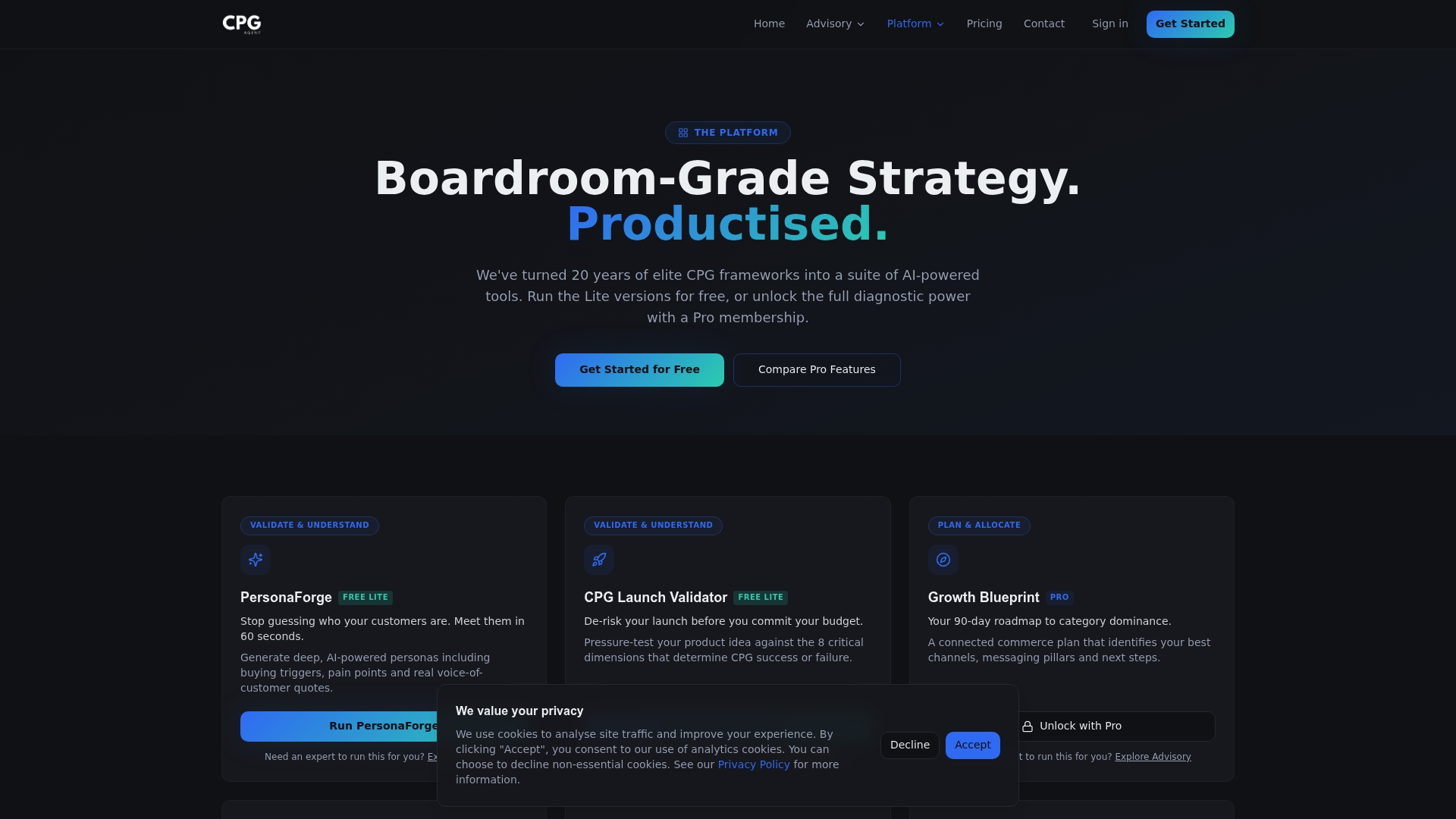
Beyond the monitoring layer, some platforms offer tools for persona research, launch validation, and creative generation, helping build content optimized for AI visibility on a data-backed foundation. Teams needing expert oversight without adding full-time headcount can also consider fractional CMO support options. If your GEO audit just surfaced a list of pages that need work, explore the platform and see which tools match the gaps you found.
Sources
- GEO: Generative Engine Optimization (arXiv paper)
- Generative Engine Optimization: A Practical Guide - Semrush
- From discovery to influence: a guide to AEO and GEO (Microsoft/advertising doc PDF)
FAQ
What Is Generative Engine Optimization?
Generative engine optimization is the practice of structuring and evidencing content so AI systems like ChatGPT, Perplexity, and Google's AI Overviews select and cite it when generating answers.
How Is GEO Different From SEO?
SEO optimizes for ranking position in a list of links; GEO optimizes for being one of the few sources a model actually selects and synthesizes into a single generated answer.
Which Metrics Matter Most for GEO?
AI mentions, AI citations, AI share of voice against named competitors, and referral traffic or conversion lift from AI-originated sessions are the core metrics to track.
Do Citations and Statistics Really Improve AI Visibility?
Yes. Benchmark testing found that adding citations, quotes, and statistics increased visibility in generative responses by roughly 30 to 40 percent.
Can Cpgagent Help CPG Brands With GEO?
Cpgagent's platform combines AI visibility monitoring with rapid experiment cycles and fractional leadership support, giving CPG and FMCG teams a faster way to test and scale GEO tactics than a traditional agency engagement.