

An effective AI marketing stack is a composable, function-first architecture that pairs one measurable pilot with a governance layer and a brand context hub. It connects research, content, creative, personalization, analytics, and orchestration tools through a unified data layer rather than bolting AI onto disconnected point solutions. The right move is not buying more tools. It's picking one function, wiring it correctly, and proving lift before you scale.
TL;DR:
- Focusing on one core function and proving measurable lift before scaling reduces waste and prevents overlapping tool subscriptions.
- A composable architecture allows easy swapping of tools and requires access to five data classes: customer, company, content, code, and control data.
- Starting with a small pilot on a single high-impact function and following a phased rollout maximizes learning and minimizes integration issues.
- Small teams benefit from lightweight tools for content and analytics, while larger organizations require integrated platforms with governance and provenance tracking.
- Prioritizing data hygiene, governance, and clear ownership helps avoid pitfalls like shadow tools and misaligned integrations during AI stack development.
Table of Contents
- What Are the Core Functions of an AI Marketing Stack?
- How Do You Design an AI-Ready Marketing Stack?
- How Do You Choose the Right AI Marketing Tools?
- What Does a Phased AI Marketing Rollout Look Like?
- What Do Lean, Growth, and Enterprise AI Marketing Stacks Look Like?
- How CPG Agent Builds AI Marketing Stacks for CPG Brands
- A Few Rules of Thumb Worth Repeating
- How CPG Agent Can Help You Execute Faster
- Sources
- FAQ
What Are the Core Functions of an AI Marketing Stack?
Every AI marketing stack, regardless of company size, needs to cover a set of jobs that map to how marketing actually works. Practitioner roundups consistently group AI marketing tools into functional categories rather than treating them as interchangeable software, and that grouping matters more than which specific product you pick.
Here's the functional map most mature stacks converge on:
- Research and insights: Tools that mine customer reviews, social listening data, and search trends to surface unmet needs. The job is turning raw signal into a testable hypothesis, like identifying a flavor gap before a competitor fills it.
- Content generation and optimization: Drafting, rewriting, and scoring copy against SEO and brand guidelines. The practical use case is producing a first draft of product page copy in minutes, then having a human editor refine tone and accuracy.
- Creative and asset generation: Producing images, video variants, and ad creative at a volume no design team could hit manually. A common use case is generating a dozen packaging mockups for shelf testing before a single physical sample gets printed.
- Personalization and experimentation: Segmenting audiences and running automated A/B or multivariate tests on messaging. This is what lets a mid-market brand run five landing page variants simultaneously instead of one at a time.
- Analytics and attribution: Connecting spend to outcomes across channels, including media mix modeling that accounts for retail and e-commerce overlap. The job is answering "what actually drove the lift" instead of guessing from last-click data.
- Orchestration and workflow automation: The connective tissue that moves outputs from one tool into execution, like pushing an AI-drafted email into a CRM send queue automatically. This layer is often the single highest-leverage investment for a lean team, since it lets a handful of people amplify output across channels without adding headcount.
- CRM and engagement: Managing lifecycle messaging, loyalty triggers, and retailer or distributor communication, increasingly with AI-suggested next actions baked into the workflow.
- Answer engine optimization: A newer category focused on getting a brand recommended inside AI-generated search answers rather than just ranked in a results page, which is a distinct discipline from traditional SEO.
New categories like answer engine optimization have emerged specifically because AI-native tooling has displaced legacy workflows in search and content, not replaced them wholesale. That's worth noting because a stack built two years ago probably has gaps a 2026 stack should not.
Keep the examples category-level when you're evaluating vendors. The function matters more than the brand name, and locking into one tool before you understand the job it needs to do is how teams end up with six overlapping subscriptions and no clear owner for any of them.
How Do You Design an AI-Ready Marketing Stack?
The architecture question comes down to one word: composability. Rather than buying a single monolithic platform that tries to do everything, the strongest approach treats the stack as a canvas of interoperable pieces, and that's the framing Databricks uses to describe the shift happening across martech right now. Composability means you can swap a personalization tool for a better one next year without a six-month migration.
Underneath that canvas sit five classes of data that every AI tool in your stack needs some access to:
- Customer data — purchase history, loyalty signals, support interactions, and behavioral data from your website or app.
- Company data — internal knowledge like sales targets, retail distribution maps, and category performance.
- Content data — every asset you've published: product copy, images, video, past campaigns.
- Code data — the technical layer, APIs, and scripts that connect systems and let automations run.
- Control data — brand guidelines, compliance rules, and the governance logic that keeps AI outputs on brand and legally sound.
Treating these as five distinct classes, rather than one undifferentiated data blob, is what lets a personalization engine and a content generator both draw from the same customer profile without duplicating effort or contradicting each other.
Integration patterns matter as much as the data model. A warehouse-first approach centralizes data in one place and lets tools query it directly, which works well for larger teams with data engineering resources. Reverse ETL pushes that warehouse data back out into operational tools like a CRM or ad platform, closing the loop between analysis and action. Newer MCP-style connectors, the kind Zapier has built out, let AI models talk directly to thousands of apps without custom integration code, which is often the fastest path for a team without dedicated engineering support. API orchestration sits underneath all of it, stitching individual calls into multi-step automations.
Governance is not optional at this layer. A brand context hub, essentially a single source of truth for tone, claims, and visual identity, keeps every AI tool grounded in the same rules. Provenance tracking, which records what source data an output drew from, is what prevents a generative tool from inventing a claim your legal team never approved.
Pro Tip: Before you connect a single new AI tool to your stack, write down which of the five data classes it needs to read and which it's allowed to write to. That one exercise catches most integration and governance problems before they become expensive.
How Do You Choose the Right AI Marketing Tools?
Selection criteria matter more than brand reputation, and the checklist is fairly consistent across categories. Before you sign a contract, run every candidate tool through the same set of questions.
- Data access: Can it read from your existing warehouse or CRM, or does it require a separate data export that creates a sync lag?
- Lineage and provenance: Does the tool show you what source data informed a given output, or is it a black box?
- Integration surfaces: Does it offer a real API, native connectors, or only a clunky CSV upload?
- Governance controls: Can you set brand guardrails, approval workflows, and permission tiers, or does everyone get the same access?
- Scale and latency: Does performance hold up at your actual volume, not just in a sales demo?
- Pricing model: Is it seat-based, usage-based, or a flat platform fee, and does that model actually match how your team will use it?
- Security: Does it meet your compliance requirements for customer and company data, especially if you operate in regulated categories?
Fit also depends heavily on where your team sits on the size and motion spectrum. A five-person marketing team at an early-stage brand needs entry-level tools: a content generator with solid templates, a scheduling automation, and a lightweight analytics dashboard. That's usually enough to prove out one function without a procurement headache.
A platform-level need looks different. Think a media mix modeling tool that ingests years of retail scan data alongside digital spend, or a personalization engine that runs concurrent experiments across a dozen SKUs and three retail channels simultaneously. Entry-level tools in these categories tend to hit a ceiling around data volume or the number of concurrent campaigns they can manage; platform-level tools are built to handle that ceiling from day one, usually at a materially higher price point.
The practical move is matching your current motion, not your ambitions, to the tier you buy. A brand running its first AI pilot doesn't need enterprise-grade attribution modeling. It needs one tool that does one job well and connects cleanly to what's already in place, since wiring and data flow determine outcomes far more than how many tools sit in the stack.
What Does a Phased AI Marketing Rollout Look Like?
Rolling out an AI marketing stack works best as three deliberate phases rather than one big-bang deployment, and the timeline matters as much as the sequence.
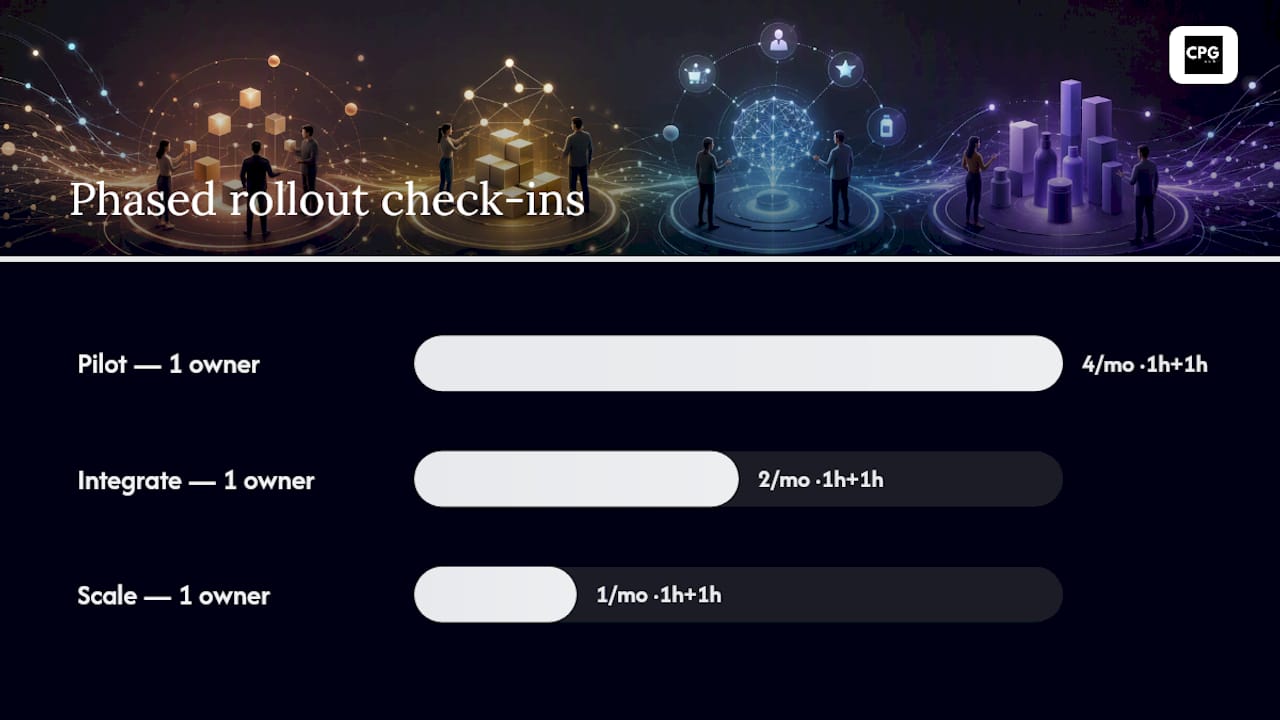
- Pilot (days 1 to 30): Pick one function with clear, measurable output, like content generation for product descriptions or a single personalization test on your highest-traffic landing page. Assign one owner, set a baseline metric, and give the team a hard 30-day window to show a result. A realistic KPI here is time-to-publish or conversion rate on the specific page or asset you tested, not a company-wide revenue number.
- Integrate (days 30 to 60): Once the pilot shows lift, connect that tool to at least one adjacent system, usually your CRM or your content management system, so outputs stop requiring manual copy-paste. This is where orchestration tools earn their place, and automated workflows typically cut the manual handoff time between drafting and publishing by a meaningful margin.
- Scale (days 60 to 90 and beyond): Expand the proven function across additional channels, SKUs, or campaigns, and start layering in the second function from your priority list. This phase also includes a formal review: what worked, what the actual cost per output looked like, and whether the governance rules held up under higher volume.
Practitioner guidance backs this cadence directly: phased rollouts starting with a high-impact pilot consistently outperform attempts to deploy five tools simultaneously, mostly because teams learn what "good governance" actually means for their brand only after they've seen a real output go slightly wrong.
Operationally, each phase needs a named owner, not a committee. Training should be scoped tightly: one hour on how the tool works, one hour on the guardrails, and a written escalation path for when an output needs human review before it ships. Review cadence should match the phase: weekly check-ins during the pilot, biweekly during integration, and monthly once you're in scale mode. Skipping the review cadence is the single most common reason pilots quietly die instead of graduating to phase two.
What Do Lean, Growth, and Enterprise AI Marketing Stacks Look Like?
The right stack configuration depends heavily on team size and how fast the brand needs to move, and the differences show up function by function rather than as one uniform upgrade.
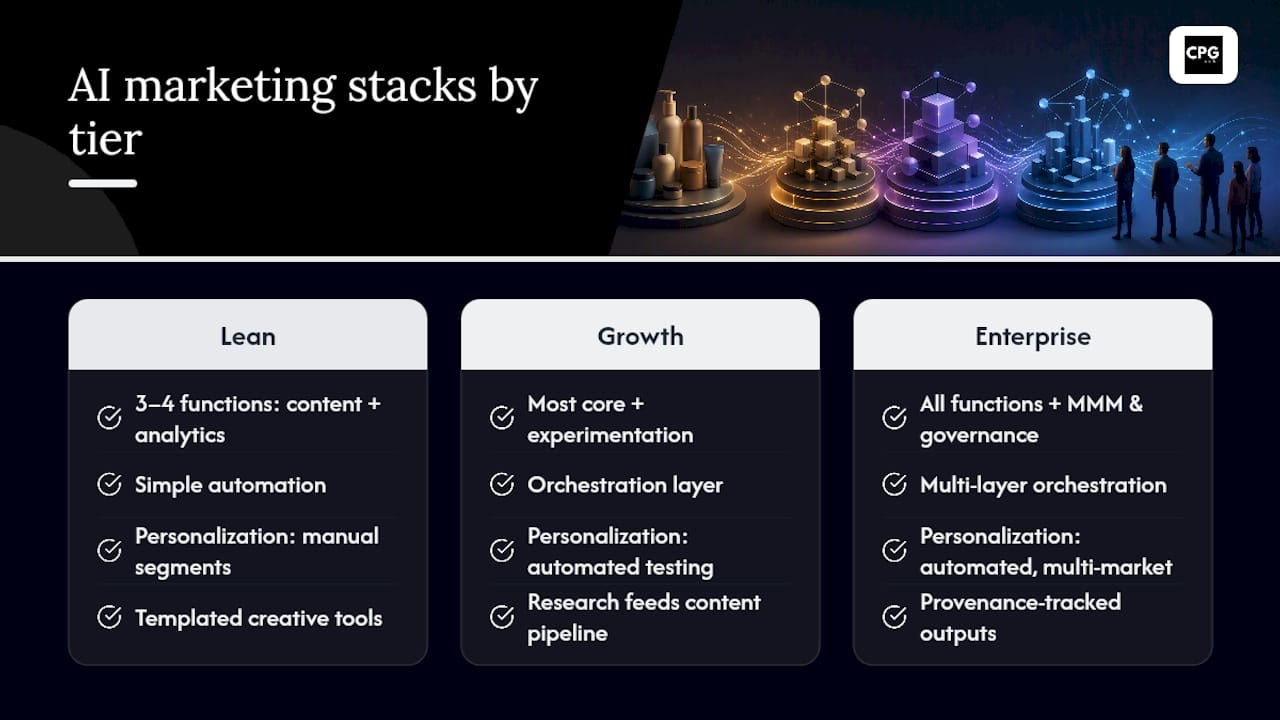
A lean or SMB stack typically covers three to four functions well instead of trying to cover all eight. Content generation and basic analytics come first, paired with a lightweight orchestration tool that automates the handoff between drafting and publishing. Personalization is usually manual at this stage, run as simple audience segments rather than automated experimentation, and creative generation leans on templated tools rather than custom pipelines. The wiring pattern here is intentionally simple: one automation platform connecting two or three tools, with a human checking outputs before anything ships.
A mid-market growth stack adds real orchestration and starts layering in experimentation. Research and insights tools get added to feed the content pipeline directly, personalization moves from manual segments to automated testing, and analytics starts incorporating attribution across paid and organic channels. The chokepoint that shows up most often at this stage is data fragmentation, where the CRM, the e-commerce platform, and the analytics tool each hold a slightly different version of the customer record. The mitigation is a reverse ETL layer or a shared customer data class, the kind Databricks describes in its composable data model, that forces every tool to read from the same source of truth.
An enterprise stack covers all core functions and adds media mix modeling, multi-market governance, and dedicated provenance tracking across every generative output. Orchestration becomes multi-layered: one automation layer handles tool-to-tool connections, while a separate governance layer audits outputs before they reach a regulated claim or a retail partner feed. The most common chokepoint at this scale is governance drift, where regional teams quietly adopt their own tools outside the sanctioned stack. The fix is a centralized brand context hub that every regional team is required to route generative outputs through, with provenance tracking flagging anything that didn't pass through it.
Across all three tiers, the wiring pattern that fails most often is the same: teams buy the tool before they've mapped which data class it needs, then spend months untangling an integration that should have taken a week.
How CPG Agent Builds AI Marketing Stacks for CPG Brands
CPG Agent was built specifically for the gaps that show up in the stack patterns above, particularly the research and validation functions that CPG and FMCG brands struggle to staff internally. The platform pairs AI tools with fractional leadership so a brand doesn't have to choose between speed and senior judgment.
Two tools illustrate how this works in practice:
- PersonaForge handles the research and insights function, building out detailed buyer personas from category and behavioral data so campaign targeting starts from evidence instead of internal guesswork.
- Launch Validator covers the validation step most brands skip under launch pressure, stress-testing a new product concept against market signals before it hits a shelf or a retail buyer meeting.
A typical workflow looks like this: a brand runs PersonaForge to sharpen its target segment, feeds that persona into Launch Validator to pressure-test a new SKU concept, then hands the validated positioning to a fractional CMO engagement to build the go-to-market plan. The expected outcome is a shorter path from concept to shelf-ready campaign, without the multi-month discovery phase a traditional agency engagement usually requires.
Pro Tip: If your internal stack already covers content and analytics but nobody owns persona research or launch validation, that's the gap to fill first. It's usually the missing piece that makes every downstream campaign guess instead of know.
The platform is designed to sit alongside tools a brand already has, not replace the whole stack. For a brand with content and orchestration already wired up, adding CPG Agent's research and validation layer closes the gap that causes the most expensive mistake in CPG marketing: launching something nobody asked for.
A Few Rules of Thumb Worth Repeating
Start smaller than feels comfortable. Every team that skips the pilot phase and deploys three tools at once ends up debugging integrations instead of measuring lift, and that debugging time never shows up in the original project plan.
Govern outputs before you scale them, not after. A brand context hub sounds like bureaucracy until the first AI-generated claim almost ships without legal review, and then it looks like the cheapest insurance you've ever bought.
Invest in data hygiene before you invest in a new tool. Every function in the stack, from personalization to attribution, degrades quietly when the underlying customer or product data is inconsistent, and no AI model fixes a bad data pipeline.
Three pitfalls show up constantly: buying tools before mapping the job they need to do, skipping the review cadence between pilot and scale, and letting regional teams adopt shadow tools outside the sanctioned stack. Fix all three by naming one owner per function and one governance checkpoint per phase.
If you do nothing else after reading this, pick the one function in your stack causing the most manual work right now and run a 30-day pilot on it.
— Matthew
How CPG Agent Can Help You Execute Faster
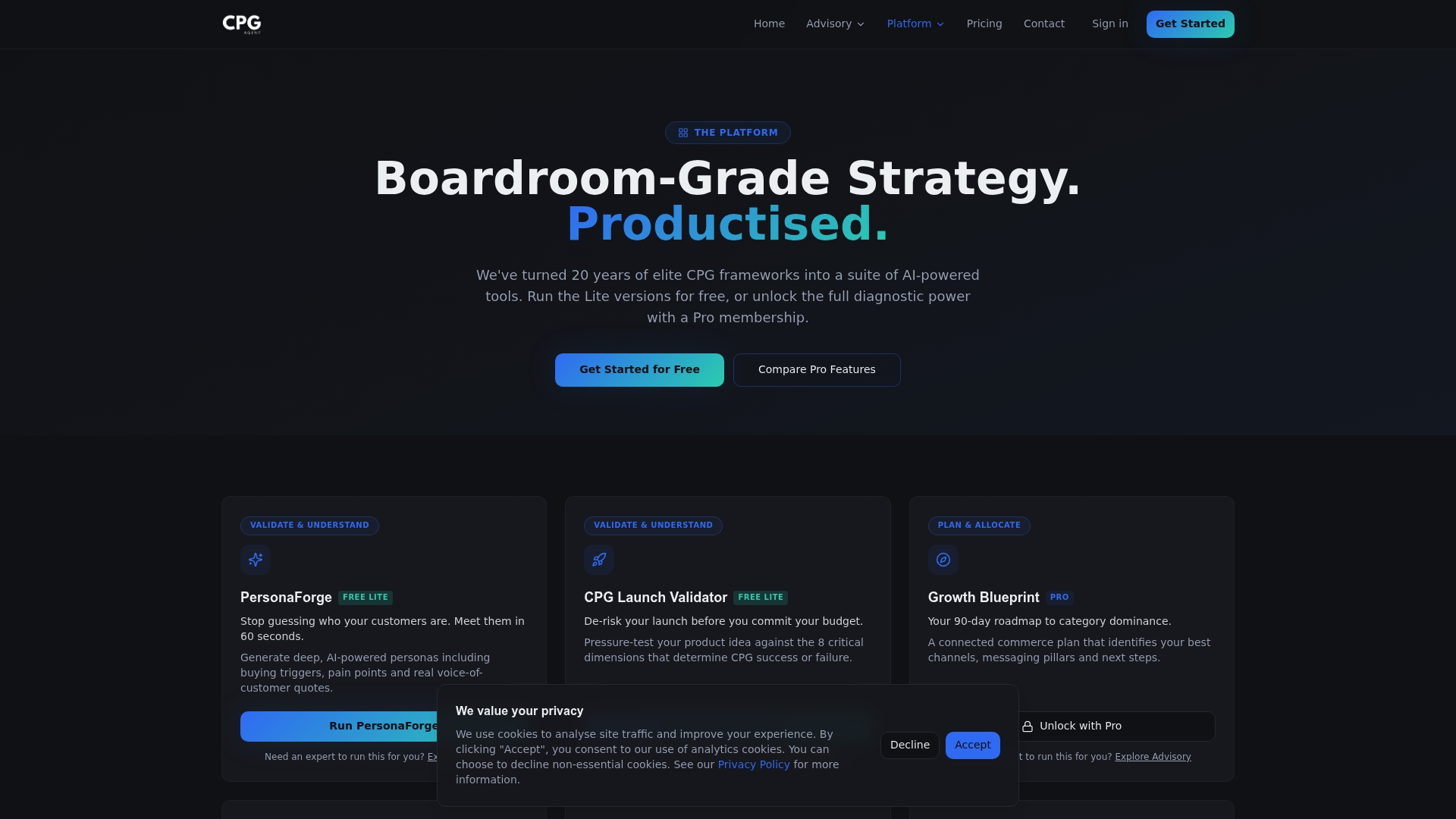
CPG Agent is the alternative to a traditional agency for building an AI marketing stack. Instead of a lengthy discovery phase and a retainer that locks you in for months, you get AI tools built for CPG and FMCG brands paired with fractional senior leadership that plugs directly into the phases outlined above.
This fits brands at two ends of the spectrum: early-stage teams that need market validation before a launch decision, and established brands trying to modernize a legacy portfolio without ripping out what already works. Both groups benefit most from the research and validation layer, since that's the function most internal teams are least equipped to staff.
Set realistic expectations going in. The platform accelerates key parts of the stack such as persona research, launch validation, and campaign planning, but it works best alongside strong data hygiene practices. If you're ready to see how the pieces fit together for your specific category, visit the CPG Agent platform and book a walkthrough to map your first pilot.
Sources
- The New Martech “Stack” for the AI Age | Databricks
- The best AI marketing tools (Zapier)
- The ultimate AI marketing tech stack for 2026 (Knock)
FAQ
What Is the 30% Rule in AI Marketing?
There's no single, universally recognized "30% rule" specific to AI marketing stacks. If you've seen the term used, it typically refers informally to capping how much of a workflow runs fully automated versus human-reviewed, but definitions vary by team and it isn't a standardized industry benchmark.
What Is the Best AI Marketing Stack?
There's no single best stack. The strongest approach is a composable, function-first architecture where you pick tools per job (research, content, personalization, analytics, orchestration) and wire them to a shared data layer, since wiring and integration determine results more than any individual tool choice.
Is There an AI Tool for Marketing?
Yes, and there are AI tools for nearly every marketing function now, including research, content drafting, creative generation, personalization, analytics, and orchestration. CPG and FMCG brands specifically can use tools like PersonaForge and Launch Validator to cover the research and validation functions many internal teams lack.
What Are the Core Layers of an AI Marketing Tech Stack?
A practical AI marketing stack breaks into core functional layers: research and insights, content and creative generation, personalization and experimentation, analytics and attribution, and orchestration or workflow automation, all sitting on top of a unified data layer covering customer, company, content, code, and control data, per Databricks' composable martech model.
How Long Does It Take to Build an AI Marketing Stack?
A single pilot function can show measurable results within 30 days, with integration into adjacent systems by day 60 and scaled rollout by day 90, though a full enterprise-wide stack with governance across every function usually takes longer depending on team size and existing data maturity.