

The best marketing mix modeling approach for most CMOs is a hybrid model calibrated with real experiments, not a pure regression tool or a black-box managed service. Hybrid MMM balances the speed of software with the credibility finance teams demand, because it ties statistical outputs to actual geo-tests and holdouts. For CPG and FMCG brands without an in-house data science bench, CPG Agent offers a practical way to get a finance-ready model running without hiring a modeling team first.
TL;DR:
- Hybrid marketing mix models calibrated with real experiments provide credible, finance-ready insights by linking statistical outputs to geo-tests and holdouts.
- MMM remains valuable because it relies on aggregated, privacy-safe data, capturing offline channels and marginal returns that digital attribution often misses.
- Small-scale pilots using the actual data and operational constraints help detect model stability issues and operational infeasibility before full deployment.
- Data quality, experiment capability, and industry-specific buying behaviors determine whether a brand should choose self-serve, hybrid, or managed MMM solutions.
- The typical rollout takes 8 to 12 weeks for hybrid models, with ongoing calibration, scenario planning, and operational integration being key to success.
Table of Contents
- Why Marketing Mix Modeling Still Matters for ROI Planning
- Self-Serve, Hybrid, or Managed: Which MMM Model Fits?
- How to Choose the Best MMM Approach for Your Brand
- Implementation Checklist: Data, Timelines, and Team Roles
- Why CPG Agent Is a Practical Option for CPG and FMCG Brands
- What Marketing Mix Modeling Actually Costs
- How Marketing Mix Modeling Evolved Into Its Current Form
- The Real Limitations of Marketing Mix Modeling
- How MMM Plays Out Across Different Industries
- Best Practices for Reading and Acting on MMM Results
- Author's Perspective: What Actually Breaks MMM Projects
- Getting Started With CPG Agent
- Sources
- FAQ
Why Marketing Mix Modeling Still Matters for ROI Planning
Marketing mix modeling survived the death of third-party cookies for a reason: it never depended on them. MMM works from aggregated, privacy-safe data, pulling in weekly or monthly spend and sales figures across every channel, including the offline ones that click-based attribution never touched, like TV, out-of-home, and retail promotions.
That aggregation is also what makes MMM useful for a question multi-touch attribution can't answer well: what happens at the margin. A channel can show strong average ROI while its next incremental dollar returns almost nothing, and MMM's response curves are built specifically to expose that gap. Spending more on a channel that's already saturated is one of the most common budget mistakes MMM catches before the money goes out the door.
The strongest measurement stacks pair MMM with incrementality testing rather than picking one. Continuous calibration against real experiments is what separates platforms producing genuinely defensible outputs from those that just look confident. MMM sets the strategic frame; geo-tests and holdouts confirm or correct it.
That combination is what makes MMM defensible in a CFO's office. The outputs support decisions finance actually has to sign off on:
- Reallocating budget between channels based on marginal, not average, returns
- Forecasting scenarios before committing spend, not after
- Holding channel owners accountable to a shared, agreed-upon measurement standard
- Justifying investment in offline channels that digital-only attribution tools ignore entirely
None of this works if the underlying data is thin. Get the data pipeline connected to media planning early, because the model is only as trustworthy as the feed behind it.
Self-Serve, Hybrid, or Managed: Which MMM Model Fits?
Every MMM solution on the market falls into one of three service models, and the right one depends less on budget than on what your team can actually operate day to day.
- Self-serve, open-source frameworks. Tools like Google's Meridian and Meta's Robyn give you full transparency and control over every assumption in the model, but they demand real data science skill and longer implementation timelines to stand up and maintain. This fits organizations with an existing analytics team that wants to own the model end to end.
- Hybrid platforms. These pair modeling software with analyst support, usually a dashboard for scenario planning backed by a human who can adjust priors and explain drift. In practice, open-source frameworks often end up living inside hybrid stacks anyway, wrapped in a data engineering layer and a planning interface finance can actually read. This is the sweet spot for most mid-market CMOs.
- Managed services. A vendor runs the entire model, from data ingestion to quarterly readouts, which suits brands with complex media mixes across multiple markets or teams that would rather buy outcomes than build capability.
Before picking a lane, run through a short internal checklist: Do you have 18 to 24 months of clean channel-level data? Does anyone on staff know what a response curve is? Can you run a geo-holdout test without disrupting a launch calendar? If the answer to any of those is no, lean hybrid or managed rather than self-serve, at least for the first year.
How to Choose the Best MMM Approach for Your Brand
Picking the right marketing mix modeling technique starts with an honest audit of what you have, not a feature comparison of what vendors sell.
Data maturity comes first. Industry guidance consistently points to a substantial period of consistent, channel-level historical data as the baseline before an enterprise MMM platform will produce stable results. Deploy on shorter or messier data and you'll get a model that looks precise and is actually noise. Data quality and governance matter more to your eventual ROI than which platform logo is on the contract.
Media complexity is the second filter. A brand running five channels in one market needs a much simpler model than one running national TV, retail media, sampling programs, and digital across a dozen DMAs. More channels and more offline spend both push you toward a platform built to handle that granularity rather than a spreadsheet-based tool stretched past its limits.
Experiment readiness decides whether your model gets trusted or argued over in every budget meeting. Hybrid approaches that pair geo-tests and holdouts with the econometric model produce more reliable coefficients and more CFO trust than correlation-only regression ever will, because the experiments supply causal priors the statistics alone can't. If you can't run at least one holdout test a quarter, budget for that capability before you budget for a bigger model.
Finance-readiness is where most MMM projects quietly fail. A model that spits out a single point estimate with no uncertainty range is a model finance will eventually stop believing. Look for:
- Exposed priors and confidence intervals, not just a final number
- Scenario outputs that show a range of likely outcomes under different spend levels
- Documentation of every assumption baked into the adstock and decay curves
- A refresh cadence frequent enough to catch drift before it corrupts a quarterly plan
Transparent Bayesian modeling that exposes its priors is a genuine differentiator here. Platforms built to hand over auditable, inspectable outputs rather than a locked dashboard make the CFO conversation dramatically easier.
Last, feed your scenario planner the operational constraints that actually govern your business. Committed spend floors, contractual minimums, inventory limits, and pacing rules need to be hard inputs to the optimization, not filters applied after the fact. A model that recommends a perfect allocation you're contractually unable to execute isn't useful, no matter how elegant the math.
Pro Tip: Before signing anything annual, ask a shortlisted vendor to run a small pilot on your actual data. A two to four week pilot will tell you more about model stability than any sales deck, and most experienced buyers now build a pilot phase into procurement for exactly this reason.
Implementation Checklist: Data, Timelines, and Team Roles
Rolling out MMM has a predictable shape, and skipping steps is the fastest way to end up with a model nobody trusts.
- Data intake (weeks 1 to 4). Connect your media, sales, and pricing feeds, map the schema, and clean out the gaps and duplicates that will otherwise poison the regression. This phase usually takes longer than teams expect, especially with legacy retail data.
- Model setup (weeks 3 to 6, overlapping intake). Choose priors, adstock decay assumptions, and response curve shapes for each channel. This is where analyst judgment matters most, and where a hybrid platform's human support earns its keep.
- Calibration (weeks 5 to 10). Run or schedule incrementality tests, geo-holdouts where feasible, and validate against known historical results. This step is what turns a statistical guess into a defensible number.
- Delivery (ongoing from week 8 onward). Set a reporting cadence, build governance around who can adjust the model, and integrate scenario outputs directly into the budget planning cycle, not as a side report nobody opens.
A realistic first full cycle runs 8 to 12 weeks for a hybrid deployment, longer for fully managed builds across multiple markets, and considerably longer for self-serve teams standing up open-source frameworks from scratch. Vendor or advisory involvement should be heaviest in the setup and calibration phases and lighter once the reporting cadence stabilizes. Feed the outputs straight into media budget allocation workflows so the model influences actual spend decisions instead of sitting in a slide deck.
Why CPG Agent Is a Practical Option for CPG and FMCG Brands
Most CPG and FMCG brands don't fail at MMM because the math is too hard. They fail because the surrounding infrastructure, clean data pipelines, aligned stakeholders, and executive buy-in, was never built. CPG Agent's platform is designed to close that gap before the modeling even starts.
CPG Agent combines AI-driven strategy tools with automated workflows built specifically for CPG and FMCG operating realities:
- AI-powered brand and retail audits that surface data gaps before they derail a model
- PersonaForge, which sharpens the customer segmentation that MMM channel groupings depend on
- Launch Validator, which connects product launch data directly to the spend and response history a model needs
- Automated workflows that reduce the manual data wrangling that eats the first month of most MMM projects
The other half of the readiness problem is political, not technical. Getting a CFO to trust a new measurement framework takes someone who can speak both languages, marketing strategy and finance governance, and that's exactly the gap fractional CMO advisory is built to close. A fractional CMO engagement through CPG Agent brings senior leadership into the room during model rollout, translating uncertainty ranges and scenario outputs into language a finance committee will actually approve.
For brands earlier in the funnel, AI tools that support marketing teams can also shorten the runway between "we want MMM" and "we have a model finance trusts."
What Marketing Mix Modeling Actually Costs
Pricing varies enormously by service model, and vendors rarely publish clean numbers, but the general bands hold across most guides in the category.
Self-serve, open-source deployments carry the lowest software cost, often close to zero for the tooling itself, but the hidden cost is data science headcount, which can run higher over a year than a hybrid subscription would. Hybrid platforms typically land in a mid-range monthly or annual subscription band that includes both software and a defined amount of analyst support. Fully managed services sit at the top of the range, reflecting the fact that a vendor team is running the entire pipeline, calibration, and reporting cycle for you.
Beyond the sticker price, three recurring cost drivers show up regardless of which model you pick:
- Data engineering. Someone has to keep the connectors, schema, and cleaning pipeline healthy every month, not just at launch.
- Experiment budgets. Geo-tests and holdouts cost real media dollars set aside specifically for calibration, separate from your working media budget.
- Analyst or advisory time. Even the most automated hybrid platform needs a human reviewing outputs before they hit a planning deck.
On refresh cadence, most mature programs run three tiers at once: a weekly pulse for monitoring anomalies, a monthly refresh for operational budget shifts, and a full quarterly rebuild for strategic planning. Skipping the quarterly rebuild is the most common corner-cutting mistake, and it's the one that lets model drift go unnoticed the longest.
How Marketing Mix Modeling Evolved Into Its Current Form
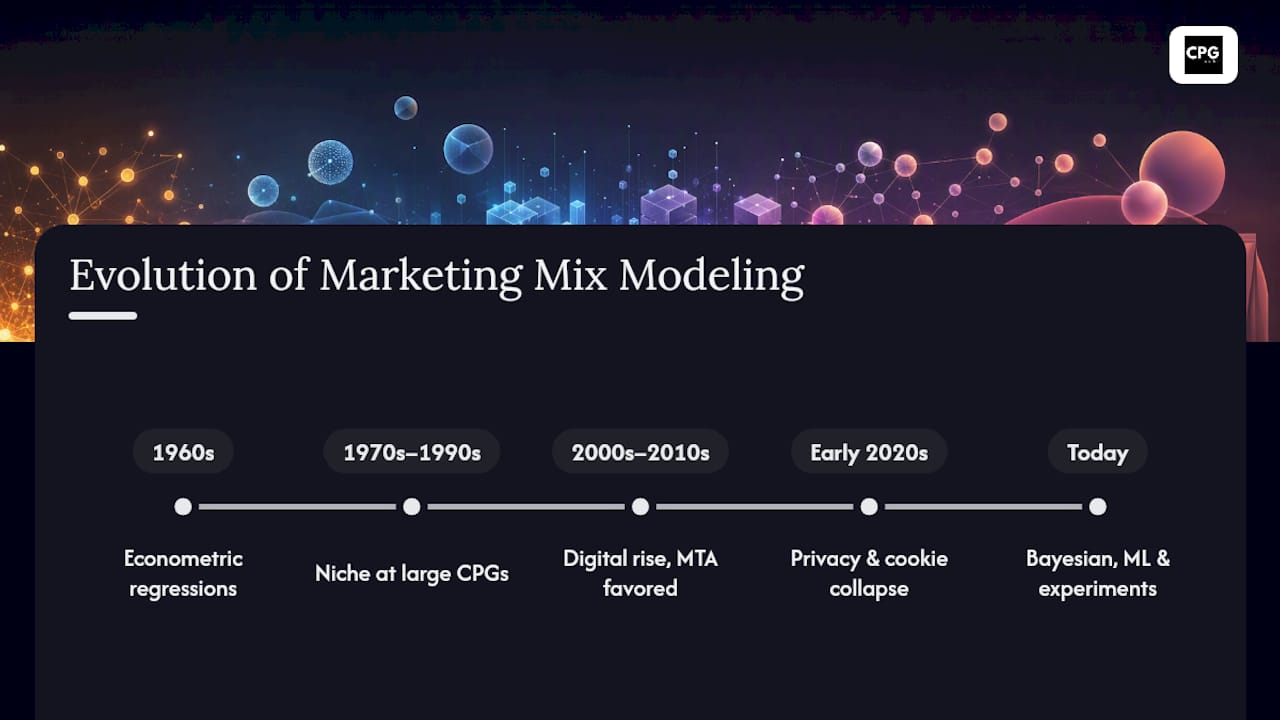
Marketing mix modeling traces back to econometric regression techniques marketers borrowed from economics in the 1960s, when companies first tried to quantify how advertising spend translated into sales using aggregate market data. For decades it stayed a niche discipline, run by a handful of statisticians at the largest consumer goods companies with the budget to afford custom modeling teams.
The shift happened in two waves. First, the rise of digital advertising in the 2000s and 2010s pulled attention toward multi-touch attribution, which promised granular, click-level insight that MMM's aggregate approach couldn't match, and MMM temporarily fell out of fashion among digital-first marketers. Second, privacy regulation and the collapse of third-party cookie tracking in the early 2020s reversed that trend almost completely, because MMM never depended on individual-level tracking in the first place.
Today's MMM looks nothing like the regression models of the 1960s. Bayesian statistical frameworks, machine learning based response curves, and direct integration with experimental calibration have turned it from a backward-looking academic exercise into a forward-looking planning tool. The core question, how much did this channel actually contribute, has stayed the same. Everything about how you answer it has changed.
The Real Limitations of Marketing Mix Modeling
MMM is not a universal measurement solution, and pretending otherwise is how projects lose credibility. The most persistent limitation is data hunger: a model trained on a market that hasn't run 18 to 24 months of clean history will produce coefficients that look precise and are statistically unstable.
Granularity is the second limitation. MMM works at the aggregate level, typically weekly or monthly, at a market or regional level, which means it can't tell you which specific ad creative or audience segment drove a result the way a granular digital attribution tool can. It answers "which channel" and "how much," not "which exact touchpoint."
New or rapidly changing channels are a third weak spot. A channel that's only been live for three months doesn't have enough history to model reliably, and a channel where spend patterns shifted dramatically midyear can confuse a model trained on the old pattern. Finally, MMM is retrospective by design; it explains what happened, and scenario forecasts built from that history carry real uncertainty the further out you project. None of these are reasons to skip MMM. They're reasons to pair it with experiments and treat every output as a range, not a fact.
How MMM Plays Out Across Different Industries
The mechanics of marketing mix modeling stay consistent across categories, but what the model has to account for shifts a lot depending on the industry.
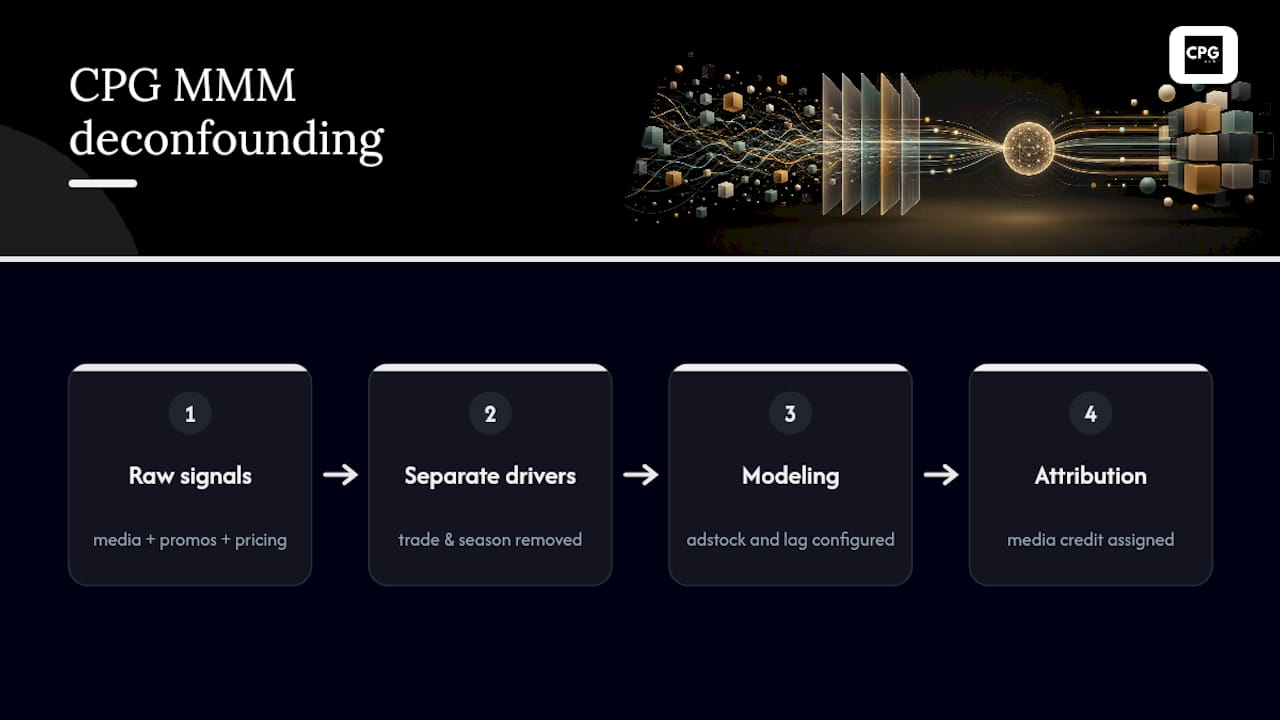
In grocery and CPG, MMM has to handle heavy promotional cadence, retailer-specific pricing, and seasonal spikes that can swamp the signal from media spend if the model isn't built to separate them out. Retail promotions and trade spend often move sales more than any single media channel, which means a CPG model that ignores promotional calendars will misattribute credit to advertising that actually came from a discount event.
In beverage and alcohol categories, regulatory restrictions on certain channels create gaps in the media mix that the model has to work around, often relying more heavily on out-of-home and sponsorship data than a typical CPG brand would.
In durable goods and appliances, purchase cycles stretch out much longer, so the model has to account for a lag between exposure and purchase that can run months rather than weeks, which changes how adstock decay gets configured entirely.
Across all three, the through line is the same: MMM works when the model architecture reflects the actual buying behavior of the category, not a generic template borrowed from a different industry's case study.
Best Practices for Reading and Acting on MMM Results
The most common mistake with MMM output isn't a modeling error. It's treating a point estimate as a certainty rather than a range with a confidence interval attached.
Read every channel result alongside its uncertainty band before making a budget call. A channel showing strong average ROI with a wide confidence interval deserves more scrutiny, and probably a calibration test, than a channel with a tighter, more stable range. Prioritize marginal ROI over average ROI when deciding where the next dollar goes, since average returns tell you how a channel performed historically, not what happens if you spend more or less on it right now.
Cross-check model outputs against at least one incrementality test per major channel per year rather than trusting the regression in isolation indefinitely. And feed operational constraints, contractual minimums, inventory limits, seasonal windows, into the scenario planner before you act on a recommendation, because the mathematically optimal allocation is worthless if it's operationally impossible to execute. Treat every quarterly MMM readout as a working hypothesis for the next quarter's plan, not a verdict on the last one.
Author's Perspective: What Actually Breaks MMM Projects
The biggest pitfall I see isn't a modeling choice at all. It's launching an MMM project before the data is ready and expecting the platform to compensate for gaps that no amount of statistical sophistication can fix. Teams get excited about a vendor's dashboard and skip the unglamorous work of getting 18 to 24 months of clean history in place first.
The second pitfall is treating constraints as an afterthought. Constraint-aware scenario planning should be built in from day one, not bolted on after the first board presentation goes sideways.
What actually moves the needle is narrower than most teams expect: get marginal ROI right, calibrate against real experiments even if it's just one geo-test a quarter, and put MMM outputs on the same table as the media plan, not in a separate report that gets read once and archived. Do those three things consistently and the platform choice matters far less than the discipline behind it.
— Matthew
Getting Started With CPG Agent
If you've read this far, you already know the honest tradeoffs: open-source frameworks give you control but demand a data science team you may not have, and fully managed services buy you speed but cost the most and leave you dependent on someone else's roadmap. CPG Agent sits in the practical middle for CPG and FMCG brands specifically, pairing AI-driven tools built for consumer goods data with fractional leadership that knows how to get a CFO to sign off on a new measurement framework.
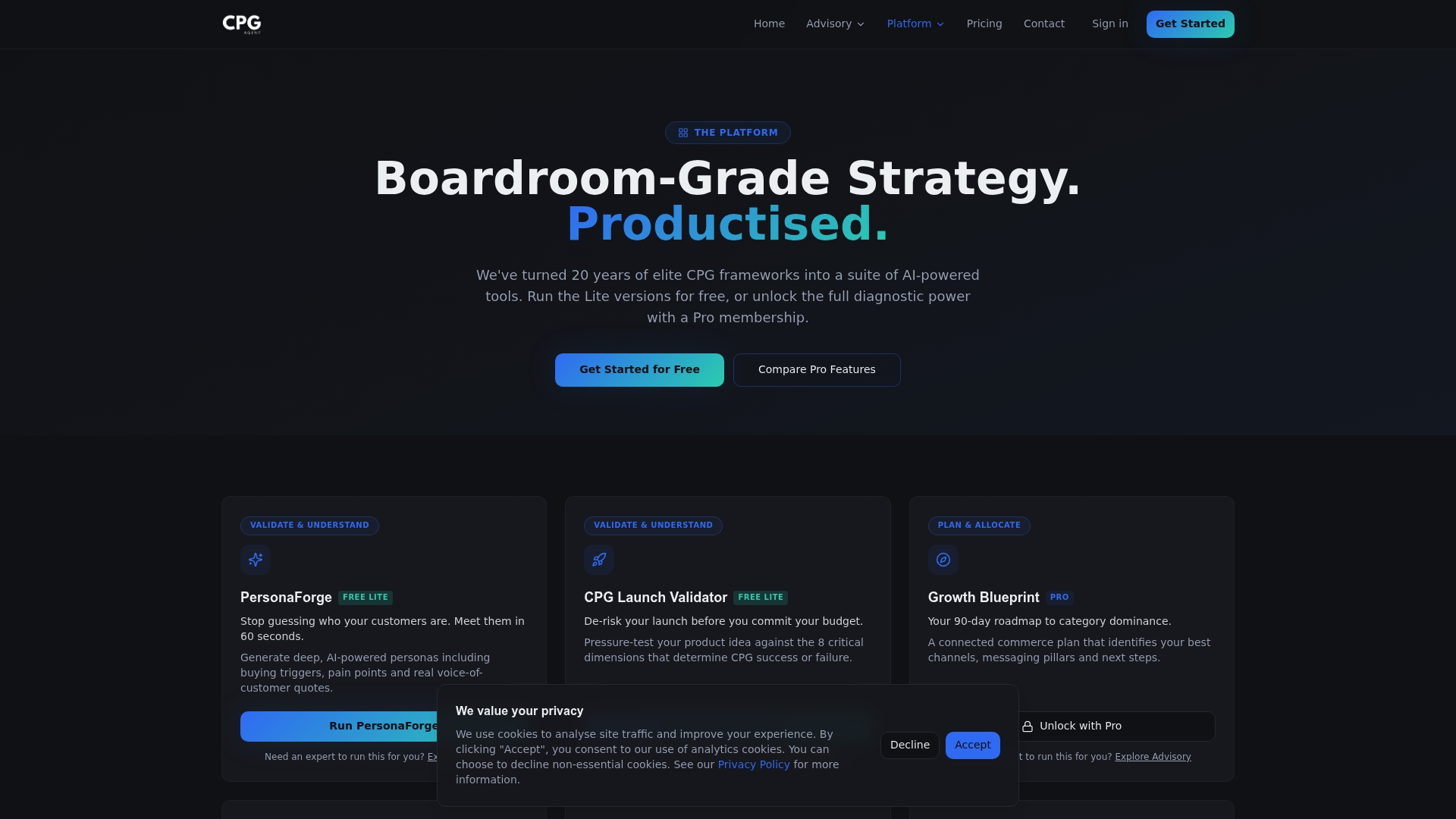
The platform's AI audits, PersonaForge, and Launch Validator handle the readiness work that usually delays MMM projects by months, while fractional CMO advisory handles the governance conversation that stalls even well-built models. Instead of hiring a full analytics team or signing a year-long managed contract sight unseen, you can start with a diagnostic on your current data maturity, move into a pilot on a single market or channel group, and scale from there once the outputs prove out.
Check out the CPG Agent platform to request a diagnostic and see what a pilot would look like against your own data.
Sources
- Marketing mix modeling vs multi-touch attribution — privacy-first measurement framework for 2026
- Top Marketing Mix Modeling Platforms in 2026: A Buyer's Guide for CMOs and CFOs
- Marketing Mix Modeling Software | SIMBA
FAQ
Which companies lead in marketing mix modeling?
There's no single winner across every use case. Enterprise measurement platforms like Measured combine MMM with always-on incrementality testing for large spenders, open-source frameworks like Google's Meridian and Meta's Robyn serve teams with in-house data science, and hybrid platforms backed by advisory support, including CPG Agent for CPG and FMCG brands, fit teams that want speed without building a modeling team from scratch.
Are the 4 Ps still relevant to marketing strategy?
Yes. Product, price, place, and promotion still describe the levers a brand actually controls, and marketing mix modeling exists specifically to measure how changes in those levers, especially promotion and price, move sales. The framework hasn't aged out; it's the measurement tools around it that have gotten more sophisticated.
What does Coca-Cola's marketing mix look like?
Coca-Cola's marketing mix spans a broad product portfolio across carbonated and non-carbonated beverages, premium pricing supported by heavy brand investment, global distribution through retail and foodservice, and promotion concentrated in mass media, sponsorships, and experiential campaigns. That scale and channel diversity is exactly the kind of complexity marketing mix modeling was built to untangle.
What is marketing mix modeling, in practical terms?
Marketing mix modeling is a statistical technique that measures how different marketing and business variables, media spend, pricing, promotions, and external factors like seasonality, drive sales, using aggregated historical data rather than individual-level tracking. It's the primary tool marketers use to answer "how much did each channel actually contribute" at a strategic, budget-setting level.
How long does it take to see reliable MMM results?
Most hybrid deployments take 8 to 12 weeks to reach a first stable model, assuming you already have 18 to 24 months of clean historical data on hand. Without that data history in place, expect the timeline to stretch while the data pipeline gets built out first.